This manual focuses on the selection, design, and specification of pavement systems for rooftop applications. In particular, this section will focus on “segmental concrete paving slabs,” for rooftop applications.
The objective of this section is to provide the contractor or designer of record (DOR) with a procedural checklist for selecting, designing, and specifying a segmental concrete paving slab system for a rooftop application. It is imperative to note that many of the following checklist items simply do not apply for paving systems at grade.
This design manual provides guidelines and procedures for the design and installation of articulating concrete block revetment systems. Articulating concrete block (ACB) systems are used to provide erosion protection to underlying soil from the hydraulic forces of moving water. An ACB system is comprised of a matrix of individual concrete blocks placed together to form an erosion-resistant revetment with a geotextile underlay for subsoil retention.
The term “articulating” implies the ability of the matrix to conform to minor changes in the subgrade while remaining interlocked with or without the use of cables, geotextiles or geogrids. Several varieties of ACB systems are available: interlocking, cable-tied and noncable-tied matrices, and open cell and closed cell varieties. Open cell units contain open voids within individual units that facilitate the placement of aggregate and/or vegetated soil. Closed cell units are solid, concrete elements that are capable of allowing vegetation growth between adjacent units.
This 3rd edition includes the new Shear and Velocity design methodology for design velocities higher than 8 ft/s (2.43 m/s) on channelizing and overtopping projects. Use this design manual to ensure proper design and construction of ACB systems.
In addition to the Manual, CMHA has developed a design spreadsheet for ACB systems using the same methodology. Access the design spreadsheet here.
On all construction projects, including those involving segmental retaining walls (SRWs), it is the owner’s responsibility to achieve coordination between construction and design professionals that ensures all required design, engineering analysis, and inspection is provided. In many cases, a design professional such as a site civil engineer or an architect acts as the owner’s representative. In either case, the owner or owner’s representative should ensure that the engineering design professionals’ scope of work, roles and responsibilities are clearly defined so that there is no ambiguity regarding responsibility for investigation, analysis and design, and that all required testing is performed.
The roles outlined in this TEK are typical industry roles for various engineering disciplines. SRW design and construction should generally follow these traditional roles. However, these roles may vary from project to project, depending on the contractual obligations of each consultant. For example, for simpler projects, such as residential landscapes, one design professional may take on the responsibility of several roles, if acceptable to local building code requirements.
For tall or complex walls and for commercial projects, each of these roles is likely to be provided by separate firms, each with expertise in a particular discipline. The discussion in this Tech Note is generally oriented towards projects where several design professionals are contracted.
Reinforced SRWs, because of their nature as composite soil structures, may have unique design and inspection considerations for the site civil engineer, the geotechnical engineer, and the independent testing agency. These considerations are discussed in further detail in the following sections.
Detailed guidance on SRW design, construction and inspection can be found in references 1 through 3.
Figure 1—Reinforced Segmental Retaining Wall System Components
OVERVIEW OF ROLES
The owner/developer, or a designated representative, is ultimately responsible for ensuring that all applicable requirements of governing authorities for the permitting, design, construction and safety on the project are addressed. The owner or owners’ representative should ensure that the types of retaining walls specified are appropriate for the site conditions and ensure the wall alignment fits within the site’s space limitations. It is the owner’s or owner’s representative’s responsibility to contract an engineer to provide site civil engineering including site layout, drainage and grading. The owner must also ensure that a geotechnical engineer and testing agency are contracted to provide all necessary and required soils exploration, analysis and earthwork inspection for the entire project, including in the vicinity of the SRWs, just as they do in the vicinity of building structures. The owner or owner’s representative must also ensure that a qualified wall design engineer provides an SRW structural design.
The most straightforward means for the owner or owner’s representative to ensure all engineering roles are well-defined is for the SRW design engineer’s assigned roles to be the same as those traditionally given to a structural engineer designing a cast-in-place concrete retaining wall, and for the other design professionals, such as site civil and geotechnical engineers, to also provide the same roles and services as they would for a cast-in-place retaining wall.
Table 1 contains an itemized list of the suggested roles for each professional discipline for larger walls and commercial projects involving SRWs. A more thorough explanation of the site civil engineer’s, geotechnical engineer’s and SRW engineer’s roles, and construction observation and testing roles is provided in the following sections. The actual responsibilities for each discipline should be contractually based.
Table 1—Suggested Roles for a Segmental Retaining Wall Project
SITE CIVIL ENGINEER SUGGESTED ROLES OVERVIEW
It is suggested that the site civil engineer be contracted for all traditional site civil duties, including the design of surface drainage, storm drainage collection structures, utility layout, erosion control and scour protection. The site civil engineer is also typically responsible for site layout and grading plans, including slopes and retaining wall locations. The site civil engineer should, in consultation with the geotechnical engineer, ensure that all planned grades, including those at the top and bottom of SRWs, do not exceed the stable slope angles and do not cause surface drainage or erosion problems.
The site civil engineer should also plan the wall alignment so that the SRW structure does not encroach on any easements. In addition, the site civil engineer should be responsible for any other issues related to the wall location, such as proximity to property lines, utilities, watersheds, wetlands, or any other easements. In some cases, the site civil engineer may also act as the SRW Design Engineer and take on suggested roles for the SRW Engineer discussed below.
The site civil engineer should evaluate and design for any hydrologic issues and structures such as: culverts, open channels, detention/retention ponds, scour and erosion control details, as well as defining high water levels, flow volumes, flood areas and scour depths. The site civil engineer should provide any pertinent hydrologic data that may affect the SRW to the SRW engineer.
Often, when not designing the SRW in-house, the site civil engineer specifies the engineering design of SRWs to be part of the SRW construction contract (a design/build bid). While a common practice, this type of bid can place the SRW engineer in a different position than other project engineers. Unlike other engineers working directly for the owner, the SRW engineer in this design/build case is often working directly for a contractor, who is often a subcontractor to other contractors. This can cause design coordination issues because the SRW engineer may not be included in project discussions with other engineers, such as pre-construction meetings. Therefore, it is suggested that the site civil first determine if it is appropriate to have the SRW engineering specified as part of the wall construction contract. For some more complicated projects, it may be preferable to have the SRW design engineer perform the design prior to bidding the construction rather than as part of a design/build bid. If the site civil engineer chooses to specify the SRW design as part of the construction bid, it is recommended that the site civil engineer ensure that the SRW design engineer is involved in any required design and construction observation services before and during construction, similar to the way geotechnical engineers are often contracted for their services during construction.
GEOTECHNICAL ENGINEER SUGGESTED ROLES OVERVIEW
The geotechnical engineer should typically be contracted to provide the same engineering roles in the vicinity of the SRW as they do for all other structures on site. The geotechnical engineer’s typical roles are the investigation, analysis and testing of the site soil materials and groundwater conditions. Just as geotechnical engineers traditionally provide bearing capacity, settlement estimates and slope stability analysis for building structures, it is suggested they do the same for SRWs. The geotechnical engineer’s role should include providing soil properties such as soil shear strength parameters, ground water elevation, seismic conditions, and bearing capacities to the SRW engineer.
Responsibility for slope stability evaluation around an SRW can be a source of confusion, because the SRW engineer can often address slope stability issues near a geosynthetic-reinforced SRW by modifying the geosynthetic reinforcement layout. Thus, the SRW engineer is sometimes requested to evaluate and design for slope stability by the civil engineer’s specifications. However, involving the SRW engineer in addressing slope stability should not remove ultimate global/slope stability responsibility from the geotechnical engineer.
It is therefore suggested that, regardless of the SRW engineer’s involvement, the geotechnical engineer be contracted to have the ultimate responsibility for the site’s slope stability, including: determining when and where global stability analyses are required, determining the appropriate soils and groundwater properties to be used for the analyses, and ensuring that all required failure planes are analyzed. While the geotechnical engineer may need to coordinate with the SRW engineer for evaluating potential failure planes that pass through the reinforced soil (compound failures), the geotechnical engineer has the primary responsibility for these analyses.
When the geotechnical consultant is retained to provide construction observation and soils testing for a project, the contract should include inspection and testing of SRW earthwork along with all other earthwork on site. See TEC-008-12, Inspection Guide for Segmental Retaining Walls (ref. 3) for further discussion of inspection roles.
While geotechnical engineers should be contracted for the same traditional roles regarding SRWs as for other structures, the soils engineering for SRWs may require some slightly different methods of analysis compared to evaluating soils below rigid structures on spread footings. Design guidelines for SRWs are provided in Reference 1.
SRW DESIGN ENGINEER SUGGESTED ROLES OVERVIEW
As noted previously, the SRW design engineer should serve the same roles for SRWs as a structural engineer would for the design of a cast-in-place concrete retaining wall. In some cases, the site civil engineering firm may also act as the SRW engineer, while in others, the SRW design engineer will be a separate firm. The SRW design engineer should design a stable SRW, given the specified wall geometry and site conditions provided by the site civil and geotechnical engineers. The SRW engineer’s duties typically include determining the SRW’s maximum stable unreinforced height and providing a geosynthetic reinforcement layout design when required.
The SRW design engineer is typically responsible for preparing the SRW construction drawings, and for determining the internal stability, facial stability of the SRW units, internal drainage of the SRW (both at the face of the wall and at the rear of the reinforced soil mass, if required), external stability (sliding and overturning), and internal compound stability.
The SRW designer engineer’s output generally consists of specifications of wall components, a wall elevation detail, typical cross sections, details for any required drainage materials within or just behind the wall system, and details for how to incorporate any other structures (utilities, pipe penetrations, posts, etc.), if feasible, within the reinforced zone and wall face.
The SRW design engineer should typically not assume any duties typically relegated to the geotechnical engineer elsewhere on site. While an SRW engineer may be asked to participate in addressing the slope stability immediately around the SRW or foundation improvements in the soil below an SRW, it is recommended that the geotechnical engineer be clearly contracted to have ultimate responsibility for all slope stability and bearing capacity/settlement concerns on site, including those below and around SRWs.
It is appropriate that the SRW engineer be contracted to provide services during construction, especially on larger projects, but it is recommended that these not be included in a design/build contract for the wall construction. Time lag between design and construction can make it impractical to expect the designer to be available for services during construction and, given the often unpredictable extent and timing of construction, it is inappropriate to have services during construction be in a lump-sum design/build contract. Rather, it is suggested that the SRW engineer be hired under a separate contract directly with the owner or owner’s representative to provide services during construction. These services may include preconstruction correspondences and meetings, review of materials submittals, review of earthwork testing performed by the geotechnical engineer, and review of the wall contractor’s building practices.
CONSTRUCTION OBSERVATION AND TESTING SUGGESTED ROLES OVERVIEW
The soil in the reinforced zone should be checked to ensure it meets specifications; just as concrete and steel are inspected in a cast-in-place concrete retaining wall.
The wall contractor is responsible for quality control of the wall installation: performing necessary observation and testing to verify that the work performed meets minimum standards.
It is the owner’s or owner’s representative’s responsibility to perform quality assurance: auditing and verifying that the quality control program is being performed properly.
Just as is done for building structures and cast-in-place concrete retaining walls, foundation and retained soils should be evaluated for consistency with the soil properties used in the design. Generally, the geotechnical engineer evaluates the onsite soil conditions and performs earthwork testing. It is suggested that the geotechnical engineer perform any field and laboratory testing they deem required to verify soil conditions. The geotechnical engineer should confer with the SRW engineer regarding the reinforced soil specifications and provide the SRW engineer with the fill soil test results. The geotechnical engineer should also determine the frequency of tests required to ensure that compaction of the SRW reinforced fill meets the project specifications.
OWNER SUGGESTED ROLES OVERVIEW
Segmental retaining walls are designed to provide a long life with little to no maintenance required. After the SRW installation is complete, some very basic maintenance will help maximize the SRW project’s beauty and durability.
The most basic maintenance task is a periodic visual assessment of the SRW units and overall wall. If coatings have been applied to the wall, the need for re-coating should be assessed based on the coating manufacturer’s recommendations and the exposure conditions of the wall. Table 2 lists regular inspection tasks that can be performed on SRWs and their suggested frequency.
Periodic cleaning of SRWs may be desired to maintain the wall’s aesthetics. Cleaning recommendations for SRWs are essentially the same as those for other concrete masonry walls. The reader is referred to: TEK 8-04A, Cleaning Concrete Masonry; TEK 08-02A, Removal of Stains from Concrete Masonry; and TEK 08-03A, Control and Removal of Efflorescence (refs. 5, 6, 7), for more detailed guidance.
In addition to maintenance and cleaning, the owner is also responsible for ensuring that subsequent digging or trenching, such as for landscaping, does not impact the SRW installation. During any excavation, care should be taken to leave a zone of undisturbed soil behind the segmental retaining wall. Particular care should be taken to ensure that excavation does not damage, cut or remove the geosynthetic soil reinforcement, if present. For this reason, the owner should maintain a record of the installation, including the locations of geosynthetic reinforcement.
Once established, tree roots do not typically damage an SRW. The roots will typically not damage the wall face from behind because the drainage aggregate behind the SRW face does not support root growth. In fact, the root system can act as additional soil reinforcement, helping to further stabilize the soil. When newly planted, trees and other large vegetation should be adequately supported to prevent them from toppling and potentially damaging the SRW.
Table 2—Example SRW Maintenance Schedule (ref. 4)
REFERENCES
Design Manual for Segmental Retaining Walls, Third Edition, SRW-MAN-001-10, Concrete Masonry & Hardscapes Association, 2010.
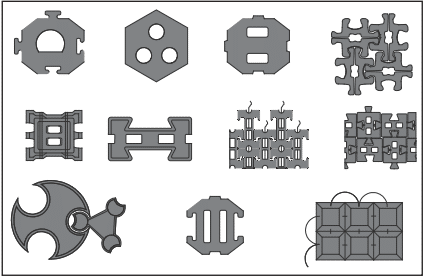
This Tech Note is intended to help designers understand the ACB design methodology and the different variables influencing the design and safety factor selection. Articulating concrete block (ACB) systems provide erosion protection to soil exposed to the hydraulic forces of moving water. ACB systems are a matrix of individual concrete blocks placed closely together to form an erosion-resistant overlay with specific hydraulic performance characteristics. Because it is composed of individual units, the ACB system can conform to minor changes in the subgrade without loss of intimate contact. Systems may be connected through geometric interlock and/or other components such as cables. Systems with openings in the blocks can typically be vegetated to provide a “green” channel and facilitate infiltration/exfiltration of channel moisture. Figure 1 illustrates a variety of ACB systems, but is not all-inclusive of available systems.
ACB units are concrete block produced in accordance with Standard Specification for Materials and Manufacture of Articulating Concrete Block (ACB) Revetment Systems, ASTM D6684 (ref. 1). Units must conform to minimum compressive strength, absorption and geometric specifications tested in accordance with Standard Test Methods for Sampling and Testing Concrete Masonry Units and Related Units, ASTM C140 (ref. 2).
This Tech Note addresses the structural stability of ACB revetment systems as a function of site-specific hydraulic conditions and unit characteristics. This Tech Note does not address geotextile filter and/or subgrade filter design, minimum installation guidelines critical to the proper performance of ACB revetments, or minimum upstream or downstream toe treatments. These topics are covered in design manuals such as references 5 and 6.
Figure 1—Examples of Proprietary ACB Systems (plan view). These are not inclusive of all available configurations. No endorsement or recommendation is intended.
FACTOR OF SAFETY METHOD
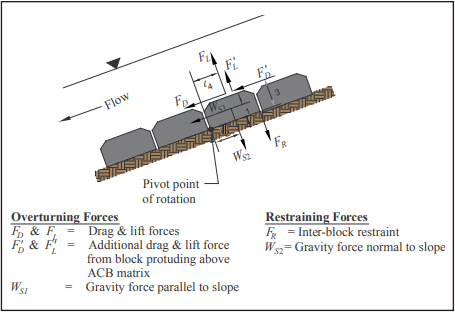
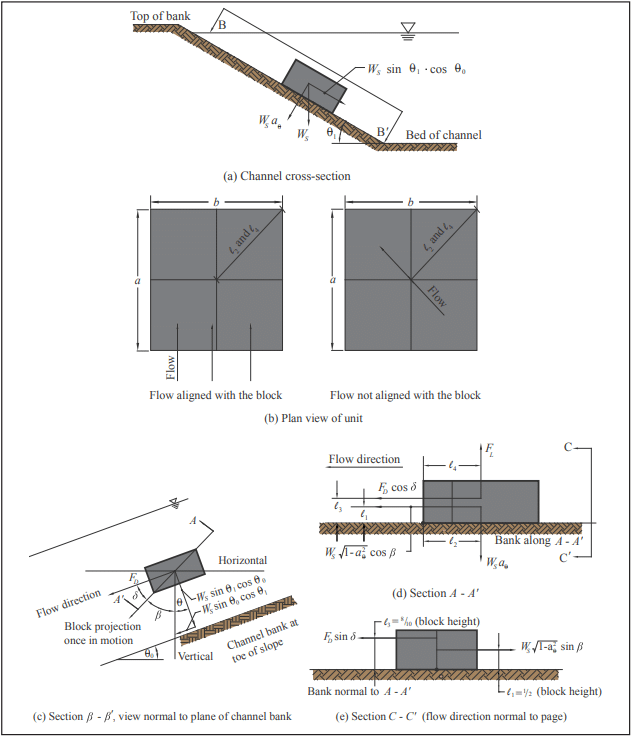
Similar to many rip rap sizing methods, the Factor of Safety method quantifies hydraulic stability of ACB systems using a “discrete particle” approach (see ref. 7). The design method involves balancing the driving and resisting forces, including gravity, drag and lift as illustrated in Figure 2. In typical channel and spillway applications, failure due to sliding (slipping) of the ACB revetment along the bed is remote. The revetment system is more apt to fail as a result of overturning about the downstream edge of the ACB unit, or downstream corner point when the ACB unit is located on the side slope of a steep channel. For cases where the revetment is placed on steep side slopes (2H:1V or steeper), the design should evaluate the potential for slip shear failures along geosynthetic-ACB unit interfaces induced by hydraulic and gravitational forces (i.e., potential slope instability).
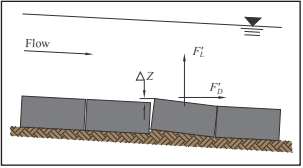
Fundamental principles of open channel flow and rigid body mechanics are used along with hydraulic test results supplied by manufacturers. The size and weight of the ACB units, as well as performance data from full-scale laboratory testing, are considered in evaluating the ratio of resisting to overturning moments (the “force balance” approach). This ratio defines the factor of safety against uplift. The design procedure accounts for additional forces applied to the unit when protrusions above the matrix occur, such as subgrade irregularities or due to improper placement (see Figure 3). Failure is defined as loss of intimate contact between the ACB unit and subgrade. The effects of cables or rods, vegetative root anchorage or mechanical anchorage devices are conservatively ignored.
Figure 2—Moment Balance on an ACB at Incipient Failure (ref. 6)
Figure 3—Schematic of Protruding Block (ref. 6)
Target Factor of Safety
There are several factors that need to be understood and considered when evaluating the appropriate target safety factor for design purposes. These can be categorized into two groups; external and internal factors. The external group consists of factors such as the complexity of the hydraulic system, the uncertainty of the input hydraulics, and the overall consequence of failure. These uncertainties are accounted for in the design by incorporating them into the target safety factor.
As discussed below, there are multiple facets of the safety factor methodology that are considered as they relate to external and internal design factors.
External Factors
Complexity of the hydraulic system and uncertainty of the input hydraulics. All hydraulic systems are not of the same complexity. Modeling the flow characteristics of a stream bank or channel is much different than the design of scour protection around bridge piers. If the flow is relatively uniform and predictable, then the designer may select a lower value for the target safety factor. As the complexity of the system increases, so too should the sophistication of the model used to determine the hydraulic parameters. Utilizing a simplistic model in a complex environment may warrant an increase in the target safety factor (i.e., greater than 1.5). Conversely, if a complex model is used to analyze a simplistic design scenario, then a lower target safety factor may be adequate (i.e., less than 1.5).
Consequence of failure. As with the complexity of the hydraulic system, the overall consequence of failure needs to be understood. Failure that results in loss of life is much different from a failure resulting in soil erosion along a stream bank in which no loss of life or property is imminent. Increasing the target safety factor is one way of potentially offsetting environmental conditions that are considered high risk.
Internal Factors
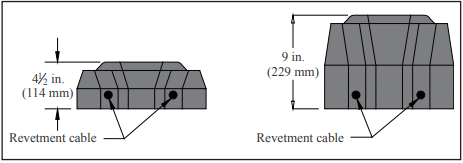
Extrapolation of Test Data. In order to use the safety factor methodology, the critical shear stress of the unit along a horizontal surface must be understood and quantified. An equation is used for the extrapolation of test results from a steeper bed slope to a horizontal slope. A second extrapolation takes place from the tested units to thicker, untested units. In both processes, it is assumed that the intra-block restraint is the same for all thicknesses of the units. Under this assumption, the extrapolation equations only consider the weight and thickness of the units. This moment balance approach (obtained from the geometry of the unit) neglects any intra-block restraint. This assumption can be very conservative given the fact that thicker units have much more intra-block friction than thinner units given the shape of the blocks. As illustrated in Figure 4, the bottom half of an ACB unit is essentially a rectangle of concrete with adjacent units resting against six surrounding units (because the units are placed in a running bond pattern, there are six adjacent units, rather than four). As the unit increases in thickness, so too does the intra-block friction. Currently, the safety factor methodology does not account for this variable, which only increases the conservatism of this design approach for such conditions.
Performance Values. Hydraulic testing on different “footprint” or classes of blocks and tapers for a variety of dam overtopping and spillway applications has been performed by system manufacturers. In many of these tests, the testing facility was unable to fail the system under a 4 ft (1.2 m) and 5 ft (1.5 m) overtopping scenario. Nevertheless, the resulting shear stresses obtained from the tests are used within the safety factor methodology as a threshold, or failure, shear stress. This issue is compounded when extrapolating to thicker units. Without being able to reach a threshold condition in the testing flume, licensors and manufacturers extrapolate shear stress value from a stable value. A large degree of conservatism in the performance values of the units is the result of not being able to fail these systems under laboratory conditions.
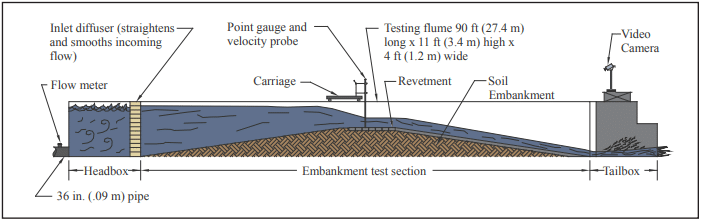
Interaction between Velocity and Shear Stress. In flume testing of the units (see Fig. 5), two of the most important results obtained are: a stable shear stress; and, velocity at a downstream point under the highest flow conditions.Consider for example testing results whereby the highest boundary shear stress and velocity obtained was 22.2 lb/ft² (1,063 Pa) and 26.1 ft/s (7.96 m/s), respectively. In the safety factor methodology one utilizes a shear stress of 22.2 lb/ft² (1,063 Pa) regardless of the expected design velocity for every design utilizing this particular unit (provided that the design velocity is less than or equal to the tested velocity). Common “hydraulic” sense would state that if the velocity was only 12 ft/s (3.66 m/s) for a given application, then the system could withstand a much larger shear stress than 22.2 lb/ft² (1,063 Pa). Therefore, an additional degree of conservatism is present when the design velocity is less than the tested velocity and the design utilizes the maximum shear stress generated during the higher velocity event.
Allowable shear stress in a vegetated state. All of the testing on existing ACB systems has taken place in a non-vegetated state. In contrast, many ACB applications for overtopping and spillway applications seek a final system that is fully vegetated. A series of hydraulic tests conducted by the U.S. Army Corp of Engineers investigated the performance of identical ACB systems in both vegetated and non-vegetated conditions (ref. 14). The end result was an increase in the allowable shear stress of 41% when vegetated.
Taking into consideration all of the points addressed above, what is the proper target safety factor required for a dam overtopping or spillway application? It is safe to state that the methodology used for ACB design is full of conservative assumptions. From the fact that tapered ACB systems have not reached their threshold condition in the testing flume to the fact that vegetation increases the allowable shear stress, it is apparent that the resulting safety factor can be conservative by 20 – 50%. Therefore, a target safety factor of 1.3 – 1.5 is adequate for applications in which the design hydraulics and site geometry are clearly understood, such as dam overtopping or spillway applications. Ultimately, the “external” factors and overall design of the project will need to be evaluated and decided on by the engineer of record. It may also be appropriate for an individual experienced in ACB design to offer an opinion on how these factors should be incorporated into an overall target safety factor.
Figure 4—Comparison of the Potential Intra-Block Friction Between 4.5 in. (114 mm) and 9.0 in. (229 mm) ACB Units. (ref. 6)
Figure 5—Laboratory Flume Schematic
Hydraulic Considerations
The main hydraulic variable in ACB stability design is the total hydraulic load (or bed shear stress) created by a varying discharge within a fixed geometric cross-section. The ratio of designed average cross-sectional bed shear to the ACB’s critical shear value (obtained from testing) is used, in part, for practical analysis and evaluation of ACB stability. The cross-section averaged bed shear stress, τo, can be calculated for design using a simple equation (ref. 13):
τo = γR Sf
τo is applied over the channel boundary, regardless of o channel lining. Shear stress is a function of the hydraulic radius and the slope of the energy line (for the simplest case—the bed slope), both defined by channel geometry and flow conditions.
The cross-section averaged bed shear stress is suitable for uniform flow conditions such as those found in long straight reaches of open channels with uniform cross section. It may be determined using simplified model approaches, such as the Manning equation or the HEC-RAS model (ref. 11). For cases involving bends, confluences, constrictions and flow obstructions, more sophisticated hydraulic modeling is generally appropriate, such as a two-dimensional model which can evaluate time-dependent flow conditions or complex geometry (ref. 10).
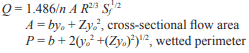
Design velocity is often determined using the Manning Equation for steady uniform flow as follows (ref. 13):
An iterative process is used to determine the flow depth, yo, because both the area and hydraulic radius are functions of yo. Cross-sectional averaged velocity of flow is then defined as V = Q/A. As noted previously, complex hydraulic systems require sophisticated modeling to determine averaged velocity.
The cross-sectional averaged bed shear stress and cross sectional averaged velocity should be determined by a design professional familiar with hydraulic design practices.
ACB Revetment Considerations
Historically, manufacturers of ACB systems published performance data from full-scale tests performed in accordance with Federal Highway Administration guidelines (ref. 8). Two relatively new ASTM standards have been developed based on the FHWA method: Standard Guide for Analysis and Interpretation of Test Data for Articulating Concrete Block (ACB) Revetment Systems in Open Channel Flow, ASTM D7276 (ref. 3) and Standard Test Method for Performance Testing of Articulating Concrete Block (ACB) Revetment Systems for Hydraulic Stability in Open Channel Flow, ASTM D7277 (ref. 4), that eventually will replace the FHWA test method. This data provides the critical shear stress, τc, and is based on specific flow conditions and ACB system characteristics. The manufacturer should specify whether the critical shear stress is for a unit on a horizontal surface or on an inclined surface. Values for a unit on a horizontal surface are commonly specified. It is important that the designer consider the full-scale test configuration and hydraulic conditions used to derive the critical shear stress on a horizontal surface.
Testing involves the construction of a full-scale test embankment that is subsequently exposed to hydraulic load until failure—defined as the local loss of intimate contact between the ACB unit and the subgrade it protects. A schematic of a typical flume is illustrated in Figure 5. ACB system stability is evaluated by summing the driving and resisting moments about the toe of an individual ACB unit. The inter-block restraint, FR, is ignored, as is any contribution from cables, anchorages and vegetation (see Figure 2).
ACB placement or subgrade irregularities can result in one unit protruding above the ACB matrix, as shown in Figure 3. The protrusion height, ΔZ, is a function of installation practice and block-to-block interface, and is often assumed to be ¼ to ½ in. (6 to 13 mm). However, the designer must consider site-specific conditions and adjust ΔZ as required. The lift force, F’L, resulting from the protrusion is conservatively assumed equal to the drag force, F’D.
The established design methodology assumed that the flow was parallel to the block and calculated the drag forces using the block width perpendicular to the flow, b (see equation for F’D in Table 1 and Figure 6b). However, in the field not all ACB applications have the flow aligned with the sides of the block. To account for that uncertainty, it is recommended that the diagonal distance of the block, 2l2, be used instead of b in the drag force calculations (see Figure 6b). It is recommended that the designer analyze the project conditions and determine the appropriate dimension for determining the drag forces, F’D, and safety factors on each project. Examples of non-parallel flow conditions are open channels and levees where the flow alignment is uncertain during the life of the project.
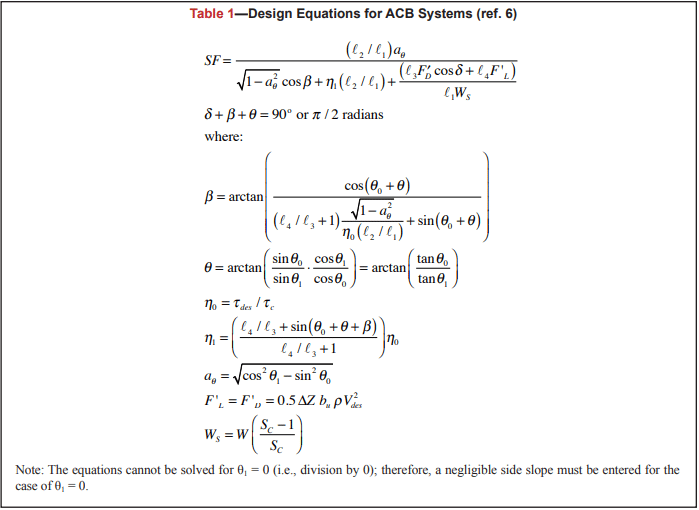
The factor of safety against loss of intimate contact is considered to be a function of design bed shear stress, critical shear stress, channel geometry and ACB unit geometry and weight. Figure 2 illustrates unit moment arms based on unit geometry. The safety factor for a single ACB unit is determined from the ratio of restraining moments to overturning moments. Considering the submerged unit weight, WS, unit moment arms and drag and lift forces, the safety factor, SF is defined as (ref. 6):
Dividing by l1WS and substituting terms, the equation for SF resolves to that presented in Table 1. Table 1 also outlines the calculations necessary for determining factor of safety.
Figure 6—ACB Unit Design Variables
Table 1—Design Equations for ACB Systems (ref. 6)
DESIGN EXAMPLE
A trapezoidal channel section with 3H:1V side slopes (Z = 3, θ1 = 18.4°) and a base width b of 15 ft (4.6 m) requires stabilization. The 100-year design discharge is 450 ft³/s (12.7 m³/s), and the channel slope So is 0.03 ft/ft (0.03 m/m) (θ0 = 1.72°). The channel has a uniform bed and no flow obstructions (i.e. confluences, bends or changes in geometry). Manning’s n is specified as 0.035. Based on design conditions, the energy grade line Sf is assumed equal to the channel slope So.
Step 1 Determine flow depth and cross-sectional averaged velocity:
R = A/P, hydraulic radius
By iteration, the flow depth yo is determined to be 2.1 ft (0.6 m).
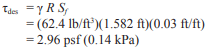
Step 2 Calculate design shear stress:
Step 3 Select target factor of safety: Based on the analysis of the project conditions, such as type of application, low consequence of failure and the empirical hydraulic model, the designer has recommended a target factor of safety, SFT, for the project of 2.34.
Step 4 Select potential ACB product and obtain geomorphic and critical shear stress data: The proposed ACB manufacturer specifies a critical shear stress, τc, for the unit on a horizontal surface of 30 psf (1.4 kPa) for a maximum velocity of 20 ft/s (6.1 m/s), submerged unit weight of 38 lb (17.2 kg) and dimensions of 15 (w) x 18 (l) x 5 (h) in. (381 x 457 x 127 mm).
Step 5 Calculate factor of safety against incipient unit movement: Given; Ws = 35 lb (16 kg) bu = 1.5 ft (460 mm) τc = 30 psf (1.4 kPa) ηo = 2.96/30 = 0.0987
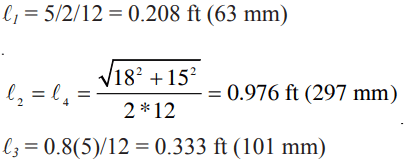
and determining the following geometrically (see Figure 6);
and assuming (see discussion); ΔZ = 0.0417 ft (13 mm)
the following are calculated using the equations in Table 1:
For this open channel application the flow is not considered to align with the block, so b = 2l2 aθ = 0.948 θ = 5.16° β = 19.4° η1 = 0.08 δ = 65.4° SF = 2.43
Because the calculated factor of safety exceeds the target, the proposed ACB system is stable against loss of intimate contact.
An ACB Design Spreadsheet (ref. 15) that makes these calculations much easier is available free on request via the CMHA web site.
NOTATIONS:
A = cross-sectional flow area, ft² (m²) aq = projection of Ws into subgrade beneath block (Table 1) b = width of channel base, ft (mm) bu = width of ACB unit in the direction of flow, ft (mm) FD = drag force, lb (kN) F’D = additional drag forces, lb (kN) FL = lift force, lb (kN) F’L = additional lift forces, lb (kN) (Table 1) FR = inter-block restraint, lb (kN) lx = block moment arms, ft (mm) n = Manning’s roughness coefficient Q = design discharge, ft³/s (m³/s) R = hydraulic radius (A/wetted perimeter), ft (m) SC = specific gravity of concrete (assume 2.1) Sf = energy grade line, ft/ft (m/m) So = bed slope, ft/ft (m/m) SF = calculated factor of safety (Table 1) SFT = target factor of safety V = cross-sectional averaged flow velocity, ft/s (m/s) W = weight of block, lb (kg) Ws = submerged weight of block, lb (kg) (Table 1) Ws1 = gravity force parallel to slope, lb (kN) Ws2 = gravity force normal to slope, lb (kN) yo = flow depth, ft (m) Z = horizontal to vertical ratio of channel side slope β = angle of block projection from downward direction, once in motion, degrees or radians γ = unit weight of water, 62.4 pcf (1,000 kg/m³) ΔZ = height of block protrusion above ACB matrix, ft (mm) δ = angle between drag force and block motion, degrees or radians ηo = stability number for a horizontal surface (Table 1) η1 = stability number for a sloped surface (Table 1) θ = angle between side slope projection of WS and the vertical, degrees or radians (Table 1) θ0 = channel bed slope, degrees or radians θ1 = channel side slope, degrees or radians ρ = mass density of water, 1.94 slugs/ft³ (1,000 kg/m³) τc = critical shear stress for block on a horizontal surface, lb/ft² (kPa) τdes = design shear stress, lb/ft² (kPa) τo = cross-section averaged bed shear stress, lb/ft² (kPa)
REFERENCES
Standard Specification for Materials and Manufacture of Articulating Concrete Block (ACB) Revetment Systems, ASTM D6684-04(2010). ASTM International, 2010.
Standard Test Methods for Sampling and Testing Concrete Masonry Units and Related Units, ASTM C140-09. ASTM International, 2010.
Standard Guide for Analysis and Interpretation of Test Data for Articulating Concrete Block (ACB) Revetment Systems in Open Channel Flow, ASTM D7276-08. ASTM International, 2010.
Standard Test Method for Performance Testing of Articulating Concrete Block (ACB) Revetment Systems for Hydraulic Stability in Open Channel Flow, ASTM D7277-08. ASTM International, 2010
Design Manual for Articulating Concrete Block Systems. Harris County Flood Control District, Houston, Texas, 2001.
Bridge Scour and Stream Instability Countermeasures: Experience, Selection, and Design Guidance – 3rd Edition. Federal Highway Administration Hydraulic Engineering Circular No. 23.
Clopper, P. E. and Y. Chen. Minimizing Embankment Damage During Overtopping Flow, Technical Report FHWA RD-88-181. Federal Highway Administration, 1988.
Clopper, P. E. Hydraulic Stability of Articulated Concrete Block Revetment Systems During Overtopping Flow, Technical Report FHWA RD-89-199. Federal Highway Administration, 1989.
RMA2 Version 4.5. United States Army Corps of Engineers. USACE Waterways Experiment Station, 2008.
HEC-RAS Version 4.1. United States Army Corps of Engineers. USACE Hydrologic Engineering Center, 2010.
Morris, H. M. and J. Wiggert. Applied Hydraulics in Engineering, Second Edition, James Wiley & Sons, 1972.
Lipscomb, C.M, C.I. Thornton, S.R. Abt, and J. R. Leech. Performance of Articulated Concrete Blocks in Vegetated and Un-Vegetated Conditions. Proceedings of the International Erosion Control Association 32nd Annual Conference and Exposition, Las Vegas, NV, February 5-8, 2001.