Resources

Concrete Masonry Gravity Retaining Walls

INTRODUCTION

Retaining walls support soil and other materials laterally. That is, retaining walls “retain” earth, keeping it from sliding. Retaining walls must resist overturning and sliding, and the pressure under the toe (front bottom edge of footing) should not exceed the bearing capacity of the soil. Finally, the wall must be strong enough to prevent failure at any point in its height due to the pressure of the retained material. Concrete masonry retaining walls meet these requirements admirably.

Three different types of concrete masonry retaining walls are illustrated in Figure 1. They are the simple unreinforced vertical face gravity retaining wall, the steel reinforced cantilever retaining wall, and the segmental retaining wall. This TEK addresses unreinforced gravity retaining walls only. Each of these retaining wall systems has its advantages, and the choice may depend on a number of factors including aesthetics, constructibility, cost, and suitability for a particular project. The gravity wall is much simpler in design and construction, and can be an effective choice for smaller projects. It is thicker at the base than cantilever and segmental walls, and hence could cost more to construct on larger projects. Gravity retaining walls resist sliding by means of their large mass, whereas cantilever retaining walls are designed to resist sliding by using reinforcement. Because of their large mass, gravity retaining walls may not be appropriate for use on soils with low bearing capacities.

An engineer who is familiar with local conditions can assist in the choice of retain ing wall type. Where especially unfavorable soil conditions occur or where piling is required under a retaining wall, the assistance of an engineer is essential for design and construction.

DESIGN

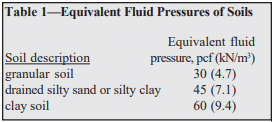
The primary force acting on a retaining wall is the pressure exerted by the retained material at the back of the wall and on the heel of the footing. The magnitude and direction of this pressure depends on the height and shape of the surface and on the nature and properties of the backfill. One common method of estimating backfill pressure is the equivalent fluid pressure method. In this method, it is assumed that the retained earth will act as a fluid in exerting pressure on the wall. Assumed equivalent fluid pressures vary with the type of soil. Representative soil types with their equivalent fluid pressures are shown in Table 1.

Since the stability of the gravity type retaining wall depends mainly on its weight, the thickness required at its base will increase with height of backfill, or wall height. Uplift pressure at the back of the wall (the heel) is avoided by designing the gravity retaining wall thick enough at the base so that the resultant of all forces (overturning force and vertical loads) falls within a zone called the kern, which is the middle one third of the base. The eccentricity of the resultant force is equal to or less than one-sixth of the base width. When the eccentricity, e, is equal to one-sixth the base width exactly, the maximum footing pressure on the soil at the front edge of the base (toe) will be twice the average pressure on the soil.

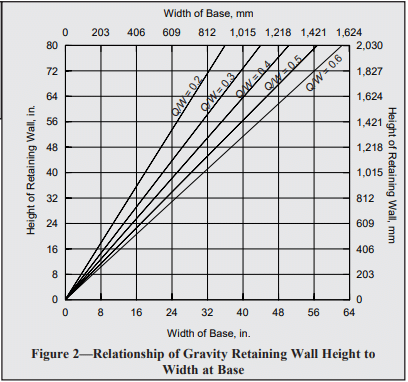
The horizontal force of the retained material causes the overturning moment on the gravity retaining wall. For a given wall height, the required thickness at the base will depend not only on height, but also on the magnitude of the equivalent fluid pressure of the retained soil. The two forces act in opposition; the horizontal force tends to overturn the wall, while the vertical forces tend to stabilize it via gravity. The ratio of wall height to base width will vary with the ratio of vertical pressure to horizontal pressure. More properly, the relationship between thickness of base and wall height can be expressed:

where:
H = height of gravity retaining wall, in. (mm)
L = width of gravity retaining wall at base, in. (mm)
Q = equivalent fluid pressure of retained material acting horizontally as overturning moment, pcf (kg/m³)
W = average weight of masonry, soil and other material acting vertically to retain soil, pcf (kg/m³)
This relationship between wall height and base width for gravity retaining walls is shown in Figure 2 for different ratios of horizontal to vertical unit loads. The relationship shown in Figure 2 is employed in the selection of dimensions for gravity retaining walls up to eight ft (1.8 to 2.4 m) high.

Having selected the height-base proportions from Figure 2, the trial design is analyzed for safety against overturning and sliding, bearing pressure on the soil, and flexural and shear stress in the wall.
CONSTRUCTION AND MATERIALS

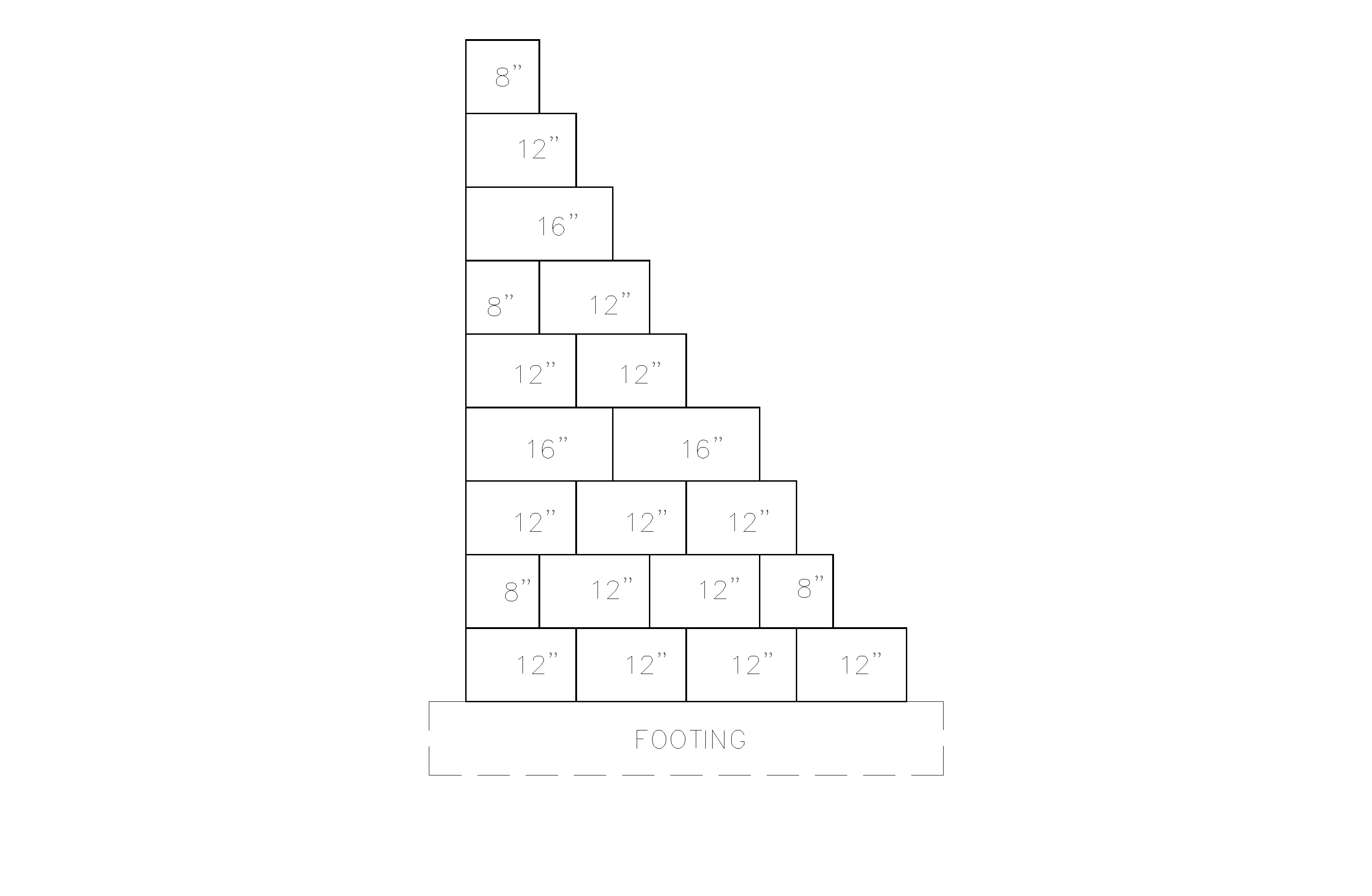
Each course of the retaining wall should be constructed with full-size concrete masonry units, with an overlapping bond pattern between courses, as shown in Figure 3.

Hollow or solid concrete masonry units used in gravity retaining walls should meet the requirements of ASTM C 90 (ref. 2) and preferably have an oven-dry density of 125 lb/ft³ (2002 kg/m³) or more. Cores of hollow units are typically filled to increase the weight of the wall. The fill should be granular in areas subject to freezing. Bond is important to ensure sufficient shear resistance to withstand the pressure exerted by the retained earth. Type M or S mortars complying to ASTM C 270 (ref. 3) are recommended.

Concrete footings should be placed on firm undisturbed soil. In areas where freezing is expected, the base of the footing should be placed below the frost line. If the soil under the footing consists of soft or silty clay, it is usually advisable to place 4 to 6 in. (102 to 152 mm) of well compacted sand or gravel under the footing before pouring the concrete. It is usually not necessary to reinforce the footing.

If heavy equipment is employed for backfilling, it should not be allowed to approach closer to the top of the wall than a distance equal to the wall height. Care should also be taken to avoid large impact forces on the wall as could occur by a large mass of moving earth.

Provision should be made to pre vent water accumulation behind the retaining wall. Accumulated water causes increased pressure, seep age, and in areas subject to frost action, an expansive force of considerable magnitude near the top of the wall. In most instances, weep holes located at 5 to 10 foot (1.5 to 3 m) spacing along the base of the wall are sufficient.
DESIGN EXAMPLES

  1. 4-foot (1.2 m) high gravity retaining wall
    equivalent fluid pressure of soil = 30 pcf (4.7 kN/m³)
    soil weight = 100 pcf (15.7 kN/m³)
    soil friction coefficient = 0.55
    soil bearing capacity = 2000 lb/ft² (0.096 MPa)
    100% solid concrete masonry units, 120 pcf (18.9 kN/m³)
    concrete footing, 150 pcf (23.6 kN/m³)
First, determine the width of the wall base:
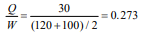
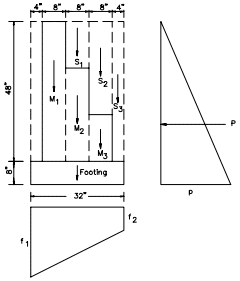
From Figure 2, the base of the wall is 24 in. (610 mm), which can be accomplished using three 8-inch (203 mm) block. Note that the footing weight was not included in the calculation of average unit weight of the materials acting vertically, so that the width determined from Figure 2 would be the width of the masonry wall at its base.

Determine overturning moment:
pressure at the base of the wall, p = total soil height x equivalent fluid pressure of soil
p = (4.67 ft)(30 pcf) = 140 lb/ft² (6703 Pa)
resultant pressure, P = ½ (p)(total soil height)
P = ½ (140 lb/ft²)(4.67 ft) = 327 lb/ft (4.8 kN/m)

Determine resisting moment (about the toe):
First, determine the weight of each element, then determine the resisting moment of each weight, then sum the resisting moments to determine the total resisting moment.


Element:Weight 
S1(0.67 ft)(1.33 ft)(100 pcf)= 89 lb (396 N)
S2(0.67 ft)(2.67 ft)(100 pcf)= 179 lb (796 N)
S3(0.33 ft)(4.0 ft)(100 pcf)= 132 lb (587 N)
M1(0.67 ft)(4.0 ft)(120 pcf)= 322 lb (1432 N)
M2(0.67 ft)(2.67 ft)(120 pcf)= 214 lb (952 N)
M3(0.67 ft)(1.33 ft)(120 pcf)= 107 lb (476 N)
F(2.67 ft)(0.67 ft)(150 pcf)= 268 lb (1192 N)


Element:Weight, lb (N) xArm, ft (m) =Moment, ft-lb (N-m)
S189 (396)1.33 (0.41)118.5 (161)
S2179 (796)2.00 (0.61)357.8 (485)
S3132 (587)2.50 (0.76)330.0 (447)
M1322 (1432)0.67 (0.20)215.5 (292)
M2214 (952)1.33 (0.41)285.5 (387)
M3107 (476)2.00 (0.61)213.9 (290)
F268 (1192)1.33 (0.41)356.4 (483)
Total1311 (5832) 1878 (2546)


Determine the overturning moment about the base, M:
M = (P)( x total height of soil)
M = (327 lb/ft)(⅓ x 4.67 ft) = 509 ft-lb/ft (2.28 kN-m/m)

Check safety factors:
overturning moment safety factor = 1878/509 = 3.7
3.7 > 2 OK
sliding safety factor = (1311 lb)(0.55)/(327 lb/ft) = 2.2
2.2 > 1.5 OK

Check pressure on soil:
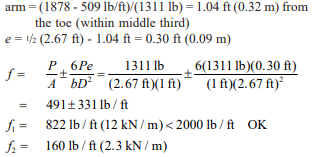
Since the concrete masonry used in this example is assumed solid or fully grouted, the calculations do not include a check of shear stresses and flexural stresses in the wall. Flexural and shear stresses are checked in the second design example, and it is seen that the magnitudes are very low. Flexural and shear stresses in gravity retaining walls will almost always be of minor importance.

  1. 6-foot (1.8 m) high gravity retaining wall
    equivalent fluid pressure of soil = 40 pcf (7.1 kN/m³)
    soil weight = 100 pcf (15.7 kN/m³)
    soil friction coefficient = 0.55
    soil bearing capacity = 2000 lb/ft² (0.096 MPa)
    hollow concrete masonry units, 130 pcf (20.4 kN/m³), units will be filled with sand, resulting in a combined weight of 115 pcf (18.1 kN/m³)
    f’m = 1500 psi (10.3 MPa)
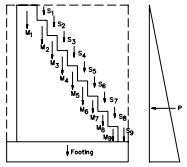
Type S portland cement-lime mortar concrete footing, 150 pcf (23.6 kN/m³)

First, determine the width of the wall base:
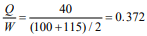
From Figure 2, try a base width of 42 in. (1067 mm), with a footing width of 50 in. (1270 mm)

Determine overturning moment:
p = (6.67 ft)(40 pcf) = 267 lb/ft² (0.013 MPa)
P = ½ (267 lb/ft²)(6.67 ft) = 890 lb/ft (13 kN/m)
M = (890 lb/ft)(⅓ x 6.67 ft) = 1978 ft-lb/ft (8.81 kN-m/m)

Element:Weight, lb (N) xArm, ft (m) =Moment, ft-lb (N-m)
S122 (98)1.50 (0.46)33 (45)
S244 (196)1.83 (0.56)80 (108)
S366 (294)2.17 (0.66)143 (194)
S488 (391)2.50 (0.76)220 (298)
S5110 (489)2.83 (0.86)311 (422)
S6132 (587)3.17 (0.97)418 (566)
S7154 (685)3.50 (1.07)539 (731)
S8176 (783)3.83 (1.17)674 (914)
S9198 (881)4.17 (1.27)826 (1120)
M1690 (3070)0.83 (0.25)575 (780)
M2202 (899)1.50 (0.46)303 (411)
M3177 (787)1.83 (0.56)325 (441)
M4152 (676)2.17 (0.66)329 (446)
M5126 (560)2.50 (0.76)316 (428)
M6101 (449)2.83 (0.86)287 (389)
M776 (338)3.17 (0.97)241 (327)
M850 (222)3.50 (1.07)177 (240)
M925 (111)3.83 (1.17)97 (132)
F419 (1864)2.08 (0.63)872 (1182)
Total3008 (13,380)6766 (9173)


Check safety factors:
overturning moment safety factor = 6766/1978 = 3.4
3.4 > 2 OK
sliding safety factor = (3008 lb)(0.55)/(890 lb/ft) = 1.9
1.9 > 1.5 OK

Check pressure on soil:
location of P and eccentricity, e:
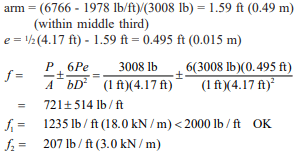
Check flexural stresses:
At 6 ft (1.8 m) depth:
P = ½ (6 ft)(40 pcf)(6 ft) = 720 lb (3203 N)
M = (720 lb)(⅓ x 6 ft) = 1440 ft-lb (1952 N-m)

Assume mortar bed is 50% of gross area:
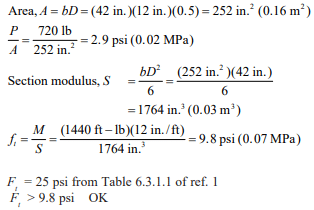
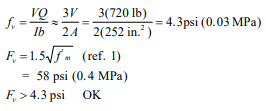
Check shear stresses:
REFERENCES

  1. Building Code Requirements for Masonry Structures, ACI 530-95/ASCE 5-95/TMS 402-95. Reported by the Masonry Standards Joint Committee, 1995.
  2. Standard Specification for Load-Bearing Concrete Masonry Units, ASTM C 90-94. American Society for Testing and Materials, 1994.
  3. Standard Specification for Mortar for Unit Masonry, ASTM C 270-92a. American Society for Testing and Materials, 1992.

Segmental Retaining Wall Design

INTRODUCTION

Segmental retaining walls (SRWs) function as gravity structures by relying on self-weight to resist the destabilizing forces due to retained soil (backfill) and surcharge loads. The self-weight of the SRW system is either the weight of the SRW units themselves including aggregate core fill if used (in the case of conventional SRWs) or the combined weight of the units, aggregate core fill if used and the reinforced soil mass (in the case of soil-reinforced SRWs).

Stability is provided by a coherent mass with sufficient width to prevent both sliding at the base and overturning about the toe of the structure under the action of lateral earth forces.

SRWs are durable and long lasting retaining wall systems. The typical size of SRW units, placed without mortar (dry- stacked), permits the construction of walls in locations with difficult access and allows the construction of tight curves or other complex architectural layouts. Segmental retaining walls are used in many applications, including landscaping walls, structural walls for changes in grade, bridge abutments, stream channelization, waterfront structures, tunnel access walls, wing walls and parking area support. This Tech Note provides a general overview of design considerations and the influences that height, soil, loads and geometry have on structural stability, based on Design Manual for Segmental Retaining Walls (ref. 1).

It is recommended that users of this Tech Note consult local building codes to determine additional SRW requirements and the engineering needs of their project. Where such specific requirements do not exist, CMHA recommends an engineered design performed by a registered professional on walls with a total (design) height, H, exceeding 4 ft (1.21 m) (for further detail, refer to SRW-TEC-008-12, Inspection Guide for Segmental Retaining Walls (ref. 3).

TYPES OF SEGMENTAL RETAINING WALLS

Conventional (Gravity) Segmental Retaining Walls

Conventional (gravity) SRWs retain soils solely through the self-weight of the SRW units. They can be constructed with either a single depth of unit or with multiple depths. The maximum wall height achievable using a conventional SRW is directly proportional to the unit’s weight, width, site geometry, surcharge load and retained soil type. Table 1 illustrates the effect of increasing the wall batter, unit width, unit’s in-place density (using either a solid unit or unit with aggregate core fill), and better quality backfill on the maximum height of a gravity wall.


Soil-Reinforced Segmental Retaining Walls

Soil-reinforced SRWs are composite systems consisting of SRW units in combination with a mass of reinforced soil. The soil is stabilized by horizontal layers of reinforcement, typically a geosynthetic material. The reinforcement increases the effective width and weight of the gravity system.

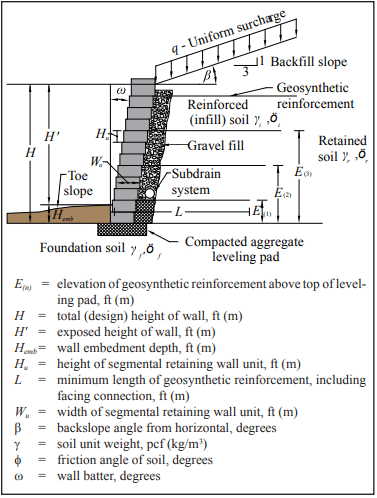
Geosynthetic reinforcement materials are high-tensile-strength polymeric materials. They may be geogrids or geotextiles, although current SRW construction typically uses geogrids. Figure 2 illustrates a typical soil-reinforced segmen- tal retaining wall and current design terminology.

The geosynthetic reinforcement is placed between the units and extended into the soil to create a composite gravity mass structure. This mechanically stabilized wall system, comprised of the SRW units and a reinforced soil mass, is designed to offer the required resistance to external forces associated with taller walls, surcharged structures, or more difficult soil conditions. Soil-reinforced SRWs may also be referred to as mechanically stabilized earth (MSE) walls, the generic term used to describe all forms of reinforced soil structures.

DESIGN CONSIDERATIONS

Geosynthetic Length and Spacing

For soil-reinforced segmental retaining walls, geosynthetic reinforcement increases the mass of the composite SRW structure, and therefore increases its resistance to destabilizing forces. Geosynthetic length (L) is typically controlled by external stability or internal pullout capacity calculations. Increasing the length of the geosynthetic layers increases the SRW’s resistance to overturning, base sliding, bearing failure and geosynthetic pullout. In some cases, the length of the uppermost layer(s) is locally extended to provide adequate anchorage (pullout capacity) for the geosynthetic layers. The strength of the geosynthetic and the frictional interaction with the surrounding soil may also affect the geosynthetic length necessary to provide adequate pullout capacity. In addition, the required length to achieve minimum pullout capacity is affected by soil shear strength, backslope geometry and surcharge load (dead or live).

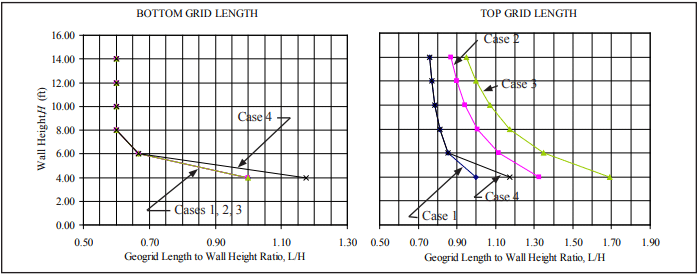
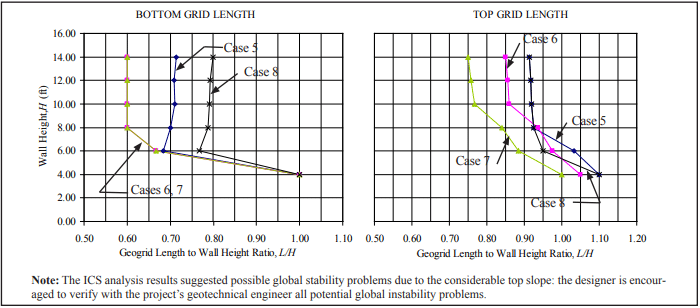
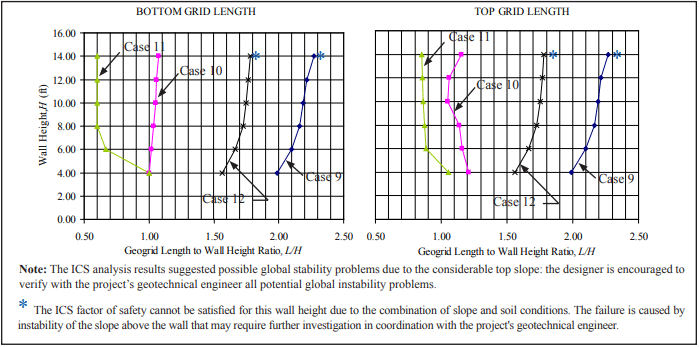
The minimum geosynthetic length required to satisfy external stability criteria is also a function of the soil shear strength and structure geometry (including wall batter, backslope, toe slope and surcharge). As the external driving force increases (as occurs with an increase in backslope angle, reduction in soil shear strength, or increase in external surcharge load (dead or live)), the length of the geosynthetic increases to satisfy minimum external stability requirements. Figures 3 through 5 illustrate the effect of backslope geometry, surcharge, soil unit weight and soil shear strength on the minimum required geosynthetic length to satisfy base sliding (FS = 1.5), overturning (FS = 1.5) and pullout (FS = 1.5). Regardless of the results of external stability analyses for sliding and overturning, the geogrid length (L) should not be less than 0.6H. The purpose of this empirical constraint is to prevent the construction of unusually narrow reinforced retaining walls. In addition, it is recommended that the absolute minimum value for L be 4 ft (1.2 m).

A sufficient number and strength of geosynthetic layers must be used to satisfy horizontal equilibrium with soil forces behind the wall and to maintain internal stability. In addition, the tension forces in the geosynthetic layers must be less than the design strength of the geosynthetic and within the allowable connection strength between the geosynthetic and the SRW unit. The optimum spacing of these layers is typically determined iteratively, usually with the aid of a computer program. Typically, the vertical spacing decreases with depth below the top of the wall because earth pressures increase linearly with depth.

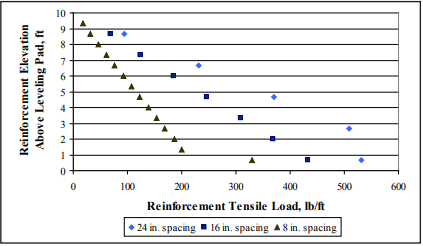
Vertical spacing between geosynthetic layers should be limited to prevent bulging of the wall face between geosynthetic connection points, to prevent exceeding the shear capacity between SRW units, to decrease the load in the soil reinforcement and at the geosynthetic-SRW unit connection interface. Figure 6 shows that smaller vertical reinforcement spacings reduce the geosynthetic reinforcement tensile load. Even when all internal and facial stability failure modes can be satisfied with larger spacings, however, a maximum vertical spacing between reinforcement layers of 24 in. (609 mm) is suggested to reduce construction stability issues. Note that some proprietary systems may be capable of supporting larger spacings: a 32 in. (813 mm) maximum spacing is suggested for these systems. This maximum spacing limits construction issues and also ensures that the reinforced soil mass behaves as a composite material, as intended by this design methodology. For SRW units less than or equal to 10 in. (254 mm) in depth, it is recommended that the maximum vertical spacing of the reinforcement layers be no more than twice the depth of the unit. For example, the maximum vertical spacing for a 9 in. (229 mm) deep modular block would be 18 in. (457 mm). Within these limits, the wall designer should choose an appropriate maximum reinforcement spacing for the proprietary system used.

Regardless of the reinforcement spacing, compaction of the reinforced fill zone is generally limited to 6 to 8 in. (152 to 203 mm) (compacted height) in order to achieve the necessary density and construction quality control. Compaction lift thickness in the retained zone is typically limited to the same height; however, thicker lifts can be accomplished if the specified density can be achieved throughout the entire lift thickness and it can be demonstrated that there are no adverse affects to the wall system performance or aesthetics. Regardless of the compaction method or equipment, the specified densities should be met and any variation from the approved specifications must be authorized by the SRW design engineer of the project.

Gravel Fill and Drainage Materials

Whenever possible, water should be directed away from SRWs. However, when water does reach an SRW, proper drainage components should be provided to avoid erosion, migration of fines, and hydrostatic pressure on the wall. Drainage features of the SRW will depend on site-specific groundwater conditions. The wall designer should provide adequate drainage features to collect and evacuate water that may potentially seep at the wall. The civil site engineer is typically responsible for the design of surface drainage structures above, below and behind the wall and the geotechnical engineer is typically responsible for foundation preparation and subsurface drainage beneath a wall. Reference 1 addresses in detail the drainage features and materials required for various ground water conditions on SRWs.

The gravel fill (formerly known as the drainage aggregate) and drain pipe shown on Figure 2 should only be relied on to remove incidental water—they are not meant to be the primary drainage path of the system. The gravel fill acts mainly as a compaction aid to reduce horizontal compaction stresses on the back of the SRW units during construction. It also prevents retained soils from washing through the face of the wall when designed as a soil filter, and facilitates drainage of incidental water, thereby relieving hydrostatic pressure or seepage forces.

The drain pipe collects and evacuates any water in the system through weep holes (maximum 50 ft (15.2 m) o.c. spacing) or directly to a drainage collection system. The elevation and diameter of the drain pipe should be determined by the wall designer depending on the specific site conditions.

The gravel fill should consist of at least 12 in. (305 mm) of a free-draining aggregate installed behind of the SRW units, and the drain pipe have a minimum diameter of 3 in. (75 mm).

Wall Batter

Segmental retaining walls are generally installed with a small horizontal setback between units, creating a wall batter into the retained soil (ω in Figure 2). The wall batter compensates for any slight lateral movement of the SRW face due to earth pressure and complements the aesthetic attributes of the SRW system. For conventional (gravity) SRWs, increasing the wall batter increases the wall system stability.

Unit Size and Shear Capacity

All SRW units provide a means of transferring lateral forces from one course to the next. Shear capacity provides lateral stability for the mortarless SRW system. SRW units can develop shear capacity by shear keys, leading lips, trailing lips, clips, pins or compacted columns of aggregate in open cores. In conventional (gravity) SRWs, the stability of the system depends primarily on the mass and shear capacity of the SRW units: increasing the SRW unit width or weight provides greater stability, larger frictional resistance, and larger resisting moments. In soil-reinforced SRWs, heavier and wider units may permit a greater vertical spacing between layers of geosynthetic, minimize the potential for bulging of the wall face. For design purposes, the unit weight of the SRW units includes the gravel fill in the cores if it is used.

Wall Embedment

Wall embedment is the depth of the wall face below grade (Hemb in Figure 2). The primary benefit of wall embedment is to ensure the SRW is not undermined by soil erosion in front of the wall. Increasing the depth of embedment also provides greater stability when site conditions include weak bearing capacity of underlying soils, steep slopes near the toe of the wall, potential scour at the toe (particularly in waterfront or submerged applications), seasonal soil volume changes or seismic loads.

The embedment depth is determined based on the wall height and toe slope conditions (see Table 2), although the absolute minimum suggested Hemb is 6 in. (152 mm).

Surcharge Loadings

Often, vertical surcharge loadings (q in Figure 2) are imposed behind the top of the wall in addition to load due to the retained earth. These surcharges add to the lateral pressure on the SRW structure and are classified as dead or live load surcharges.

Live load surcharges are considered to be transient loadings that may change in magnitude and may not be continuously present over the service life of the structure. In this design methodology, live load surcharges are considered to contribute to destabilizing forces only, with no contribution to stabilizing the structure against external or internal failure modes. Examples of live load surcharges are vehicular traffic and bulk material storage facilities.

Dead load surcharges, on the other hand, are considered to contribute to both destabilizing and stabilizing forces since they are usually of constant magnitude and are present for the life of the structure. The weight of a building or another retaining wall (above and set back from the top of the wall) are examples of dead load surcharges.

DESIGN RELATIONSHIPS

Table 1 summarizes the influence of increasing the wall batter, increasing the unit width, increasing the unit’s in-place density, and using better quality backfill on the maximum constructible height of a gravity SRW to satisfy sliding and overturning.

Figures 3 through 5 summarize the influences wall geometry, backslope and soil shear strength have on the minimum required reinforcement length to satisfy base sliding, overturning and pullout for a reinforced SRW.

These design relationships were generated using conservative, generic properties of SRW units. They are not a substitute for project-specific design, since differences between properties assumed in the tables and project-specific parameters can result in large differences in final design dimensions or factors of safety. Although wall heights up to 8 ft (2.44 m) for conventional (gravity) walls and 14 ft (4.28 m) for soil-reinforced walls are presented, properly engineered walls can exceed these heights.

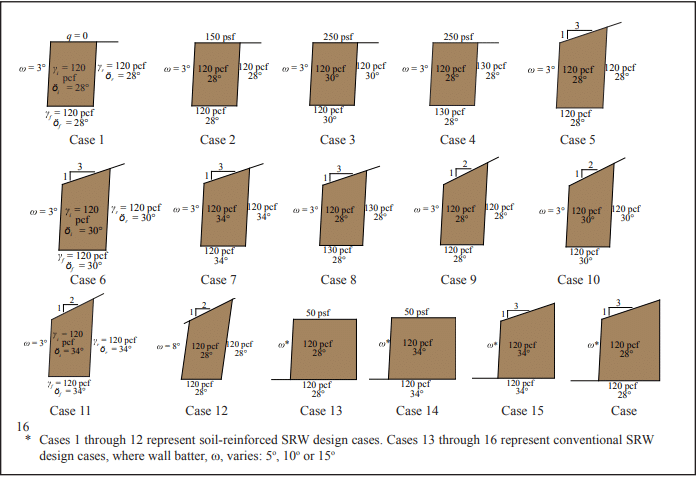
For a detailed discussion of design and analysis parameters, the Design Manual for Segmental Retaining Walls (ref. 1) should be consulted. Design cases 1 through 16 are illustrated in Figure 1. All results shown were calculated using the software SRWall 4.0 (ref. 2) providing the appropriate geosynthetic lengths to satisfy sliding, overturning, and pullout (reinforced walls only) safety factors; or the maximum gravity wall height to satisfy sliding, overturning and internal shear. The final number, distribution and strength of the geogrids can only be determined by a designer for each specific SRW unit-geogrid combination to guarantee the appropriate safety factors for internal, facial stability and Internal Compound Stability (ICS) are met (for more detailed information, see Reference 1). The ICS can be met by reducing the geogrid spacing or increasing the grid length or strength: the examples presented here were calculated by reducing the geogrid spacing and maintaining the maximum and minimum geogrid lengths for convenience. See SRW-TEC-003-10, Segmental Retaining Wall Global Stability, (ref. 4) for more detailed information.

Large or commercial SRWs might also require foundation soil competency, settlement, and global stability analyses for a final design in coordination with other professionals in the project that are not addressed here (for more details on roles and responsibilities see SRW-TEC-002-10, Roles and Responsibilities on Segmental Retaining Wall Projects (ref. 5)). If the foundation and global analyses ultimately require a modification to the wall design, this must be done in coordination with the SRW designer.

EXAMPLE

A reinforced SRW is specified for a project that has the following characteristics:

H= 10 ft (3.0 m)
Backslope 3:1
Live surcharge= 0 psf
All soils Φ= 28° and γ = 120 pcf (1,922 kg/m³)

Determine the approximate geogrid lengths (L) at the bottom and top of the retaining wall.

Solution

Determine the case that applies to this problem using Figure 1: Case 5 for this example. Using Figure 4 (3:1 backslope), find L/H for the given soil conditions and for the design height of 10 ft (3.0 m).

Bottom geogrid:
L/H= 0.71; Lbottom = 0.71 x 10 ft = 7.1 ft (2.2 m)
Top geogrid:
L/H= 0.92; Ltop = 0.92 x 10 ft = 9.2 ft (2.8 m)

For estimating purposes, the volume of excavation and reinforced fill could be determined from the obtained data. The number, strength and distribution of the geogrids can only be determined by a designer for the specific SRW unit-geogrid combination to comply with the appropriate safety factors for internal, facial stability and ICS. The ICS is dependent on the spacing, length and strength of the geogrids: the designer is encouraged to perform the appropriate calculations to verify the distribution of the geosynthetics.

NOTATIONS:

REFERENCES

  1. Design Manual for Segmental Retaining Walls, 3rd edition. Concrete Masonry & Hardscapes Association, 2009.
  2. Design Software for Segmental Retaining Walls, SRWall 4.0. Concrete Masonry & Hardscapes Association, 2009. 
  3. Inspection Guide for Segmental Retaining Walls, SRW-TEC-008-12, Concrete Masonry & Hardscapes Association, 2010.
  4. Segmental Retaining Wall Global Stability, SRWTEC-003-10, Concrete Masonry & Hardscapes Association, 2010.
  5. Roles and Responsibilities on Segmental Retaining Wall Projects, SRW-TEC-002-10, Concrete Masonry & Hardscapes Association, 2010.

Segmental Retaining Wall Units

INTRODUCTION

Mortarless segmental retaining walls are a natural enhancement to a variety of landscape projects. Applications range from 8 in. (204 mm) high terraces for erosion control to retaining walls 20 ft (6.1 m) or more in height. The individual concrete units can be installed to virtually any straight or curved plan imaginable.

Segmental retaining walls are used to stabilize cuts and fills adjacent to highways, driveways, buildings, patios and parking lots, and numerous other applications. Segmental retaining walls replace treated wood, cast-in-place concrete, steel, and other retaining wall systems because they are durable, easier and quicker to install, and blend naturally with the surrounding environment. Concrete units resist deterioration when exposed to the elements without the addition of toxic additives which can threaten the environment.

A variety of surface textures and features are available, including split faced, stone faced, and molded face units, any one of which may be scored, ribbed, or colored to fit any project application. Construction of segmental retaining walls does not require heavy equipment access, nor does the system require special construction skills to erect. Manufactured concrete retaining wall units generally weigh 30 to 100 lb (14 to 45 kg) each and are placed by hand on a level or sloped gravel bed.

Successive courses are stacked dry on the course below in the architectural pattern desired. Mechanical interlocking and/or frictional shear strength between courses resists lateral soil pressure. In low-height walls, overturning forces due to soil pressure are resisted by the weight of the units, sometimes aided by an incline toward the retained soil. Higher walls resist lateral soil pressures by inclining the wall toward the retained earth, or by other methods such as anchoring to geosynthetic reinforcement embedded in the soil. Further information on the design of segmental retaining walls can be found in Design Manual for Segmental Retaining Walls (ref. 1).

Segmental retaining wall units are factory-manufactured to quality standards in accordance with ASTM C1372, Standard Specification for Segmental Retaining Wall Units (ref. 2). These requirements are intended to assure lasting performance, little or no maintenance, structural integrity, and continued aesthetic value.

Segmental retaining wall units complying with the requirements of ASTM C1372 have been successfully used and have demonstrated good field performance. Segmental retaining wall units currently being supplied to the market should be produced in accordance with this standard so that both the purchaser and the supplier have the assurance and understanding of the expected level of performance of the product.

ASTM C1372 covers both solid and hollow units which are to be installed without mortar (dry-stacked). Units are designed to interlock between courses or to use mechanical devices to resist sliding due to lateral soil pressure. If particular features are desired, such as a specific weight classification, higher compressive strength, surface texture, finish, color, or other special features, they should be specified separately by the purchaser. However, local suppliers should be consulted as to the availability of units with such features before specifying them.

Materials

ASTM C1372 includes requirements that define acceptable cementitious materials, aggregates, and other constituents used in the manufacture of concrete segmental retaining wall units. These requirements are similar to those included in ASTM C90, Standard Specification for Loadbearing Concrete Masonry Units (ref. 3).

Compressive Strength

Minimum compressive strength requirements for segmental retaining wall units are included in Table 1. Units meeting or exceeding these strengths have demonstrated the integrity needed to resist the structural demands placed on them in normal usage. These demands include impact and vibration during transportation, the weight of the units above them in the wall, nonuniform distribution of loads between units, and the tensile stresses imposed as a result of typical wall settlement.

Segmental retaining wall units will not fail in service due to compressive forces since axial loads are only a result of self-weight. Due to the direct relationship between compressive strength and tensile strength, this minimum requirement is used to ensure overall performance.

Compressive strength testing of full size units is impractical due to the large size and/or unusual shape of some segmental retaining wall units. Therefore, compressive strength of these units is determined from testing coupons cut from the units. The results of tests on these smaller coupons will typically yield lower strengths than if the larger, full-size specimen were tested. The reason for the difference is size and aspect ratio. However, it is important to keep in mind that the compression test is not intended to determine the load-carrying capacity of the unit, since segmental retaining walls are not designed to carry vertical structural loads. Compressive strength is used solely to assess the quality of the concrete.


Because tested strengths are affected by size and shape of the specimen tested, it is important that all retaining wall units be tested using a similar size and shape. ASTM C140/ C140M, Standard Method for Sampling and Testing Concrete Masonry Units and Related Units (ref. 4) requires that specimens cut from full-size units for compression testing must be a coupon with a height to thickness ratio of 2 to 1 before capping and a length to thickness ratio of 4 to 1. The coupon width is to be as close to 2 in. (51 mm) as possible based on the configuration of the unit and the capacity of the testing machine, but not less than 1.5 in. (38 mm). The preferred size is 2 x 4 x 8 in. (51 x 102 x 203 mm) (width x height x length). The coupon height is to be in the same direction as the unit height dimension. If these procedures are followed, the compressive strength of the coupon is considered the strength of the whole unit.

Alignment of the specimen in the compression machine is critical. Care should be taken in capping the test specimen to assure that capping surfaces are perpendicular to the vertical axis of the specimen. Capping needs to be performed in accordance with ASTM C1552, Standard Practice for Capping Concrete Masonry Units, Related Units and Masonry Prisms for Compression Testing (ref. 5).

Saw-cutting is the required method of extracting a test specimen from a full-size unit. Proper equipment and procedures are essential to prevent damaging the test specimen as a result of saw-cutting. Water-cooled, diamond-tipped blades on a masonry table saw are recommended. The blade should ideally have a diameter sufficient enough to make all cuts in a single pass. Manufacturers of the unit (or licensors of proprietary shapes) should be consulted about recommended locations for obtaining the compression specimen.

Weight Classification

Weight classifications for segmental retaining wall units are defined in Table 1. The three classifications, lightweight, medium weight, and normal weight, are a function of the oven dry density of the concrete. Most segmental retaining wall units fall into the normal weight category.

Absorption

Absorption requirements are also included in Table 1. This value is used to represent the volume of voids in a concrete masonry unit, including voids inside the aggregate itself. The void space is measured by determining the volume of water that can be forced into the unit under the nominal head pressure that results from immersion in a tank of water.

Lightweight aggregates used in the production of lightweight and medium weight units contain voids within the aggregate itself that also fill with water during the immersion test. While reduced voids indicate a desired tightly compacted unit, tightly compacted lightweight and medium weight units will still have higher absorption due to the voids in the aggregates. For this reason the maximum allowable absorption requirements vary according to weight classification.

Similar to compression testing, it generally is not practical to test full-size retaining wall units in absorption tests due to their size and weight. Therefore, ASTM C140/C140M permits the testing of segments saw-cut from full-size units to determine absorption and density. When reduced-size units are used for absorption testing, the reduced-size specimen must have an initial weight of at least 20% of the full-size unit weight. This is intended to ensure that a sufficiently sized specimen is tested in order for the results to be representative of the entire unit.

Absorption limits are typically expressed as mass (weight) of water absorbed per concrete unit volume. This is preferred to expressing by percentage which permits a denser unit to absorb more water than a lighter weight unit.

Testing larger specimens requires particular attention to drying times, because it takes a greater length of time to remove all moisture from larger masses. ASTM C140/C140M requires that specimens be dried for a period of not less than 24 hours at a temperature of at least 221°F (105°C). The 24-hour time period does not start until the oven reaches the specified temperature. When placing larger specimens in an oven, it may take several hours for the oven to reach the prescribed temperature. ASTM C140/C140M then requires that specimen weights be determined every two hours to make sure that the unit is not still losing water weight (maximum weight loss in two hours must be less than 0.2% of the previous specimen weight). This will require 48 hours or more for some specimens. If not adequately dried, reported absorptions will be lower than the actual value.

Permissible Variations in Dimensions

Mortarless systems require consistent unit heights to maintain vertical alignment and level of the wall. For this reason, permissible variation in dimensions is limited to ±⅛ in. (3.2 mm) from the specified standard dimensions. Regarding dimensions, “width” refers to the horizontal dimension of the unit measured perpendicular to the face of the wall. “Height” refers to the vertical dimension of the unit as placed in the wall. “Length” refers to the horizontal dimension of the unit measured parallel to the running length of the wall.

Dimensional tolerance requirements for width are waived for split faced and other architectural surfaces. The surface is intended to be rough to satisfy the architectural features desired and cannot be held to a specific tolerance.

Finish and Appearance

Minor cracks incidental to the usual method of manufacture or minor chipping resulting from customary methods of handling in shipment and delivery are not grounds for rejection. Units used in exposed wall construction are not to show chips or cracks or other imperfections in the exposed face when viewed from a distance of not less that 20 ft (6.1 m) under diffused lighting. In addition, up to five percent of a shipment are permitted to: contain chips on the finished face not larger than 1 in. (25.4 mm) in any dimension; contain cracks on the finished face wider than 0.02 in. (0.5 mm) and longer than 25% of the nominal height of the unit; have dimensions outside the permissible dimensional variations; or be broken.

Freeze-Thaw Durability

Segmental retaining wall units may be used in aggressive freezing and thawing environments. Freeze-thaw damage can occur when units are saturated with water and then undergo temperature cycles that range from above to below the freezing point of water. Freezing and thawing cycles and a constant source of moisture must both be present for potential damage to occur.

Many variations can exist in exposure conditions, any of which may affect the freeze-thaw durability performance of the units. Such variations include: maximum and minimum temperatures, rate of temperature change, duration of temperatures, sunlight exposure, directional facing, source and amount of moisture, chemical exposure, deicing material exposure, and others.

When units are used in applications where freezing and thawing under saturated conditions can occur, ASTM C1372 includes three different methods of satisfying freeze-thaw durability requirements:

  1. Proven field performance,
  2. Five specimens shall have less than 1% weight loss after 100 cycles in water using ASTM C1262 (ref. 6), or
  3. Four of five specimens shall have less than 1.5% weight loss after 150 cycles in water using ASTM C1262.

Segmental retaining wall units in many areas of the country are not exposed to severe exposures. Therefore, the requirements above apply only to “areas where repeated freezing and thawing under saturated conditions occur.”


Freeze-thaw durability tests are conducted in accordance with ASTM C1262, Standard Test Method for Evaluating the Freeze-Thaw Durability of Dry-Cast Segmental Retaining Wall Units and Related Concrete Units, (ref. 6) using water or saline as the test solution. For most applications, tests in water are considered sufficient. If the units will be exposed to deicing salts on a regular basis, consideration should be given to performing the tests in saline. However, no pass/fail criteria has been adopted by ASTM for saline testing.

Compliance

ASTM C1372 also provides guidance regarding compliance. If a sample fails, the manufacturer can remove or cull units from the shipment. Then a new sample is selected by the purchaser from the remaining units of the shipment and tested, which is typically paid for by the manufacturer. If the second sample passes, then the remaining units of the lot being sampled are accepted for use in the project. If the second sample fails; however, the entire lot represented by the sample is rejected.

The specification also provides guidance on responsibility for paying for the tests. Unless otherwise provided for in the contract, the purchaser typically pays for the testing if the units pass the test. However, if the units fail the test, the seller bears the cost of the testing. See SRW-TEC-007-15 Sampling and Testing Segmental Retaining Wall Units (ref. 7) for more detailed information on SRW unit sampling, testing, and acceptance.

REFERENCES

  1. Design Manual for Segmental Retaining Walls, 3rd edition, SRW-MAN-001-10, Concrete Masonry & Hardscapes Association, 2010.
  2. Standard Specification for Dry Cast Segmental Retaining Wall Units, ASTM C1372-14. ASTM International, 2014.
  3. Standard Specification for Loadbearing Concrete Masonry Units, ASTM C90-14. ASTM International, 2014.
  4. Standard Methods for Sampling and Testing Concrete Masonry Units and Related Units, ASTM C140/C140M-14a. ASTM International, 2014.
  5. Standard Practice for Capping Concrete Masonry Units, Related Units and Masonry Prisms for Compression Testing, ASTM C1552-14. ASTM International, 2014.
  6. Standard Test Method for Evaluating the Freeze-Thaw Durability of Dry-Cast Segmental Retaining Wall Units and Related Concrete Units, ASTM C1262-10. ASTM International, 2010.
  7. Sampling and Testing Segmental Retaining Wall Units, SRW-TEC-007-15, Concrete Masonry & Hardscapes Association, 2015.