Resources

Inspection Guide for Segmental Retaining Walls

INTRODUCTION

Segmental retaining walls (SRWs) are gravity retaining walls which can be classified as either: conventional (structures that resist external destabilizing forces due to retained soils solely through the self-weight and batter of the SRW units); or geosynthetic reinforced soil SRWs (composite systems consisting of SRW units in combination with a mass of reinforced soil stabilized by horizontal layers of geosynthetic reinforcement materials). Both types of SRWs use dry-stacked segmental units that are typically constructed in a running bond configuration. The majority of available SRW units are dry-cast machine-produced concrete.

Conventional SRWs are classified as either single depth or multiple depth. The maximum wall height that can be constructed using a single depth unit is directly proportional to its weight, width, unit-to-unit shear strength and batter for any given soil and site geometry conditions. The maximum height can be increased by implementing a conventional crib wall approach, using multiple depths of units to increase the weight and width of the wall.

Reinforced soil SRWs utilize geosynthetic reinforcement to enlarge the effective width and weight of the gravity mass. Geosynthetic reinforcement materials are high tensile strength polymeric sheet materials. Geosynthetic reinforcement products may be geogrids or geotextiles, although most SRW construction has used geogrids. The geosynthetic reinforcement extends through the interface between the SRW units and into the soil to create a composite gravity mass structure. This enlarged composite gravity wall system, comprised of the SRW units and the reinforced soil mass, can provide the required resistance to external forces associated with taller walls, surcharged structures or more difficult soil conditions.

Segmental retaining walls afford many advantages, including design flexibility, aesthetics, economics, ease of installation, structural performance and durability. To function as planned, SRWs must be properly designed and installed. Inspection is one means of verifying that the project is constructed as designed using the specified materials.

This Tech Note is intended to provide minimum levels of design and construction inspection for segmental retaining walls. The inspection parameters follow the Design Manual for Segmental Retaining Walls (ref. 1) design methodology. This information does not replace proper design practice, but rather is intended to provide a basic outline for field use by installers, designers and inspectors.

INSPECTION

Many masonry projects of substantial size require a quality assurance program, which includes the owner’s or designer’s efforts to require a specified level of quality and to determine the acceptability of the final construction. As part of a quality assurance program, inspection includes the actions taken to ensure that the established quality assurance program is met. As a counterpart to inspection, quality control includes the contractor’s or manufacturer’s efforts to ensure that a product’s properties achieve a specified requirement. Together, inspection and quality control comprise the bulk of the procedural requirements of a typical quality assurance program.

SRW UNIT PROPERTIES

SRW units comply with the requirements of ASTM C1372, Standard Specification for Dry-Cast Segmental Retaining Wall Units (ref. 2), which governs dimensional tolerances, finish and appearance, compressive strength, absorption, and, where applicable, freeze-thaw durability. These requirements are briefly summarized below. A more thorough discussion is included in SRW-TEC-001-15, Segmental Retaining Wall Units (ref. 3). The user should refer to the most recent edition of ASTM C1372 to ensure full compliance with the standard.

  • Dimensional tolerances: ±1/8 in. (3.2 mm) from the specified standard overall dimensions for width, height and length (waived for architectural surfaces).
  • Finish and appearance:
    • free of cracks or other defects that interfere with proper placement or significantly impair the strength or permanence of the construction (minor chipping excepted),
    • when used in exposed construction, the exposed face or faces are required to not show chips, cracks or other imperfections when viewed from at least 20 ft (6.1 m) under diffused lighting,
    • 5% of a shipment may contain chips 1 in. (25.4 mm) or smaller, or cracks less than 0.02 in. (0.5 mm) wide and not longer than 25% of the nominal unit height,
    • the finished exposed surface is required to conform to an approved sample of at least four units, representing the range of texture and color permitted
  • Minimum net area compressive strength: 3,000 psi (20.7 MPa) for an average of three units with a minimum of 2,500 psi (17.2 MPa) for an individual unit. When higher compressive strengths are specified, the tested average net area compressive strength of three units is required to equal or exceed the specified compressive strength, and the minimum required single unit strength is:
    • the specified compressive strength minus 500 psi (3.4 MPa) for specified compressive strengths less than 5,000 psi (34.4 MPa), or
    • 90% of the specified compressive strength when the specified compressive strength is 5,000 psi (34.4 MPa) or greater.
  • Maximum water absorption:
    • 18 lb/ft3 (288 kg/m3) for lightweight units (< 105 pcf (1,680 kg/m3))
    • 15 lb/ft3 (240 kg/m3) for medium weight units (105 to less than 125 pcf (1,680 to 2,000 kg/m3))
    • 13 lb/ft3 (208 kg/m3) for normal weight units ( > 125 pcf (2,000 kg/m3 or more))
    • Freeze-thaw durability—In areas where repeated freezing and thawing under saturated conditions occur, freeze- thaw durability is required to be demonstrated by test or by proven field performance. When testing is required, the units are required to meet the following when tested in accordance with ASTM C 1262, Standard Test Method for Evaluating the Freeze-Thaw Durability of Manufactured Concrete Masonry Units and Related Concrete Units (ref. 4):
  • weight loss of each of five test specimens at the conclusion of 100 cycles < 1% of its initial weight; or
  • weight loss of each of four of the five test specimens at the end of 150 cycles < 1.5 % of its initial weight.

REFERENCES

  1. Design Manual for Segmental Retaining Walls (Third Edition), TR 127B. Concrete Masonry & Hardscapes Association, 2009.
  2. Standard Specification for Dry-Cast Segmental Retaining Wall Units, ASTM C1372. ASTM International, Inc., 2017.
  3. Segmental Retaining Wall Units, SRW-TEC-001-15, Concrete Masonry & Hardscapes Association, 2008.
  4. Standard Test Method for Evaluating the Freeze-Thaw Durability of Dry Cast Segmental Retaining Wall Units and Related Concrete Units, ASTM C1262. ASTM International, Inc., 2017.
  5. International Building Code. International Code Council, 2012.
  6. Segmental Retaining Wall Installation Guide, SRW- MAN-003-10, Concrete Masonry & Hardscapes Association, 2010.

Design Checklist

Construction Checklist

Concrete Masonry Cantilever Retaining Walls

INTRODUCTION

Using concrete masonry in retaining walls, abutments and other structural components designed primarily to resist lateral pressure permits the designer and builder to capitalize on masonry’s unique combination of structural and aesthetic features—excellent compressive strength; proven durability; and a wide selection of colors, textures and patterns. The addition of reinforcement to concrete masonry greatly increases the tensile strength and ductility of a wall, providing higher load resistance.

In cantilever retaining walls, the concrete base or footing holds the vertical masonry wall in position and resists overturning and sliding caused by lateral soil loading. The reinforcement is placed vertically in the cores of the masonry units to resist the tensile stresses developed by the lateral earth pressure.

DESIGN

Retaining walls should be designed to safely resist overturning and sliding due to the forces imposed by the retained backfill. The factors of safety against overturning and sliding should be no less than 1.5 (ref. 7). In addition, the bearing pressure under the footing or bottom of the retaining wall should not exceed the allowable soil bearing pressure.

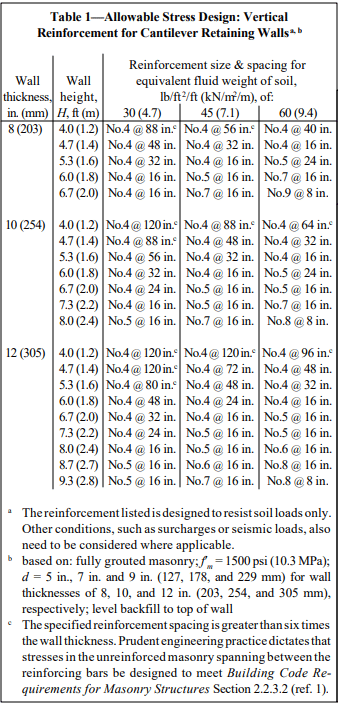
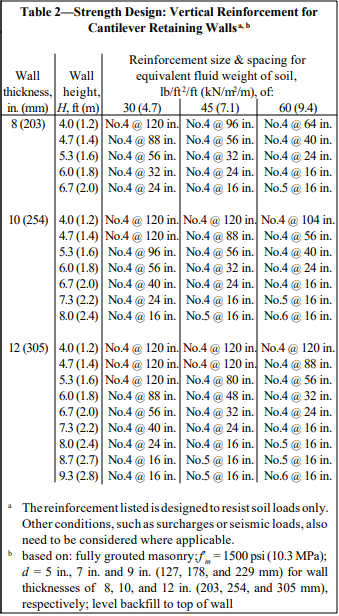
Recommended stem designs for reinforced cantilever retaining walls with no surcharge are contained in Tables 1 and 2 for allowable stress design and strength design, respectively. These design methods are discussed in detail in ASD of Concrete Masonry (2012 IBC & 2011 MSJC), TEK 14-07C, and Strength Design Provisions for Concrete Masonry, TEK 14-04B (refs. 5, 6).

Figure 1 illustrates typical cantilever retaining wall detailing requirements.

DESIGN EXAMPLE

The following design example briefly illustrates some of the basic steps used in the allowable stress design of a reinforced concrete masonry cantilever retaining wall.

Example: Design the reinforced concrete masonry cantilever retaining wall shown in Figure 2. Assume level backfill, no surcharge or seismic loading, active earth pressure and masonry laid in running bond. The coefficient of friction between the footing and foundation soil, k1, is 0.25, and the allowable soil bearing pressure is 2,000 psf (95.8 kPa) (ref. 7).

a. Design criteria:

Wall thickness = 12 in. (305 mm)
f’m = 1,500 psi (10.3 MPa)

Assumed weights:
Reinforced masonry: 130 pcf (2,082 kg/m³) (solid grout to increase overturning and sliding resistance)
Reinforced concrete: 150 pcf (2,402 kg/m³)

Required factors of safety (ref. 7)
F.S. (overturning) = 1.5
F.S. (sliding) = 1.5

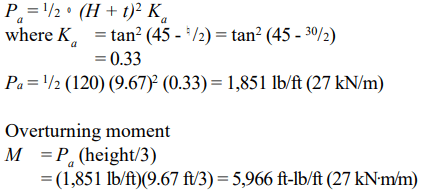
b. Rankine active earth pressure

c. Resisting moment (about toe of footing)

Component weights:
masonry: (0.97)(8.67 ft)(130 pcf) = 1,093 lb/ft (16 kN/m)
earth: (2.69)(8.67 ft)(120 pcf) = 2,799 lb/ft (41 kN/m)
footing: (1.0)(5.33 ft)(150 pcf) = 800 lb/ft (12 kN/m)

Weight (lb/ft)XArm (ft)=Moment (ft-lb/ft)
masonry:1,093X2.67=2,918
earth:2,799X3.98=11,140
footing:800X2.67=2,136
4,69216,194
Total resisting moment16,194 ft-lb/ft
Overturning moment– 5,966 ft-lb/ft
10,228 ft-lb/ft (45.5 kN m/m)

d. Check factors of safety (F.S.)

F.S. (overturning)
= total resisting moment about toe/overturning moment
= 14,670/5,966
= 2.4 > 1.5 O.K.

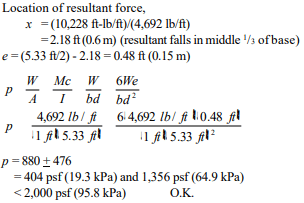
e. Pressure on footing

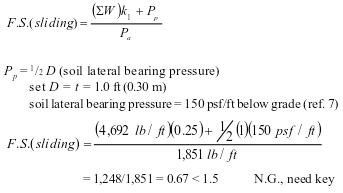
f. Determine size of key

Passive lateral soil resistance = 150 psf/ft of depth and may be increased 150 psf for each additional foot of depth to a maximum of 15 times the designated value (ref. 7). The average soil pressure under the footing is: ½ (1,356 + 404) = 880 psf (42.1 kPa).

Equivalent soil depth: 880 psf/120 pcf = 7.33 ft (2.23 m)

Pp = (150 psf/ft)(7.33 ft) = 1,100 psf (52.7 kPa)

For F.S. (sliding) = 1.5, the required total passive soil resistance is: 1.5(1,851 lb/ft) = 2,776 lb/ft (41 kN/m)

The shear key must provide for this value minus the frictional resistance: 2,776 – 1,248 = 1,528 lb/ft (22 kN/m).

Depth of shear key = (1,528 lb/ft)/(1,100 psf) = 1.39 ft (0.42 m), try 1.33 ft (0.41 m).

At 1.33 ft, lateral resistance = (1,100 psf) + (150 psf/ft)(1.33 ft) = 1,300 lb/ft (19 kN/m)
Depth = (1,528 lb/ft)/[½ (1,100 + 1,300)] = 1.27 ft (0.39 m) < 1.33 ft (0.41 m) O.K.

g. Design of masonry

Tables 1 and 2 can be used to estimate the required reinforcing steel based on the equivalent fluid weight of soil, wall thickness, and wall height. For this example, the equivalent fluid weight = (Ka)(º) = 0.33 x 120 = 40 pcf (6.2 kN/m³).

Using allowable stress design (Table 1) and the conservative equivalent fluid weight of soil of 45 pcf (7.1 kN/m³), this wall requires No. 6 bars at 16 in. o.c. (M #19 at 406 mm o.c.). Using strength design (Table 2), this wall requires No. 5 bars at 16 in. o.c. (M #16 at 406 mm o.c.).

h. Design of footing

The design of the reinforced concrete footing and key should conform to American Concrete Institute requirements. For guidance, see ACI Standard 318 (ref. 2) or reinforced concrete design handbooks.

CONSTRUCTION

Materials and construction practices should comply with applicable requirements of Specification for Masonry Structures (ref. 4), or applicable local codes.

Footings should be placed on firm undisturbed soil, or on adequately compacted fill material. In areas exposed to freezing temperatures, the base of the footing should be placed below the frost line. Backfilling against retaining walls should not be permitted until the masonry has achieved sufficient strength or the wall has been adequately braced. During backfilling, heavy equipment should not approach closer to the top of the wall than a distance equal to the height of the wall. Ideally, backfill should be placed in 12 to 24 in. (305 to 610 mm) lifts, with each lift being compacted by a hand tamper. During construction, the soil and drainage layer, if provided, also needs to be protected from saturation and erosion.

Provisions must be made to prevent the accumulation of water behind the face of the wall and to reduce the possible effects of frost action. Where heavy prolonged rains are anticipated, a continuous longitudinal drain along the back of the wall may be used in addition to through-wall drains.

Climate, soil conditions, exposure and type of construction determine the need for waterproofing the back face of retaining walls. Waterproofing should be considered: in areas subject to severe frost action; in areas of heavy rainfall; and when the backfill material is relatively impermeable. The use of integral and post-applied water repellents is also recommended. The top of masonry retaining walls should be capped or otherwise protected to prevent water entry.

REFERENCES

  1. Building Code Requirements for Masonry Structures, ACI 530-05/ASCE 5-05/TMS 402-05. Reported by the Masonry Standards Joint Committee, 2005.
  2. Building Code Requirements for Structural Concrete and Commentary, ACI 318-02. Detroit, MI: American Concrete Institute, 2002.
  3. Das, B. M. Principles of Foundation Engineering. Boston, MA: PWS Publishers, 1984.
  4. Specification for Masonry Structures, ACI 530.1-05/ASCE 6-05/TMS 602-05. Reported by the Masonry Standards Joint Committee, 2005.
  5. ASD of Concrete Masonry (2012 IBC & 2011 MSJC), TEK 14-07C, Concrete Masonry & Hardscapes Association, 2004.
  6. Strength Design Provisions for Concrete Masonry, TEK 14-04B, Concrete Masonry & Hardscapes Association, 2008.
  7. 2003 International Building Code. International Code Council, 2003.

NOTATIONS

a     length of footing toe, in. (mm)
B     width of footing, ft (m)
d     distance from extreme compression fiber to centroid of tension reinforcement, in. (mm)
e       eccentricity, in. (mm)
F.S.  factor of safety
f’m     specified compressive strength of masonry, psi (MPa)
H       total height of backfill, ft (m)
I         moment of inertia, ft4 (m4)
Ka      active earth pressure coefficient
k1       coefficient of friction between footing and foundation soil
M       maximum moment in section under consideration, ft-lb/ft (kN⋅m/m)
Pa       resultant lateral load due to soil, lb/ft (kN/m)
Pp       passive earth pressure, lb/ft (N/m)
p         pressure on footing, psf (MPa)
T         thickness of wall, in. (mm)
t          thickness of footing, in. (mm)
W       vertical load, lb/ft (N/m)
x         location of resultant force, ft (m)
º         density of soil, pcf (kg/m³)
¤         angle of internal friction of soil, degreesDisclaimer: Although care has been taken to ensure the enclosed information is as accurate and complete as possible, NCMA does not assume responsibility for errors or omissions resulting from the use of this TEK.

Guide to Segmental Retaining Walls

INTRODUCTION

Segmental retaining walls (SRWs) are gravity retaining walls that rely primarily on their mass (weight) for stability. The system consists of concrete masonry units which are placed without the use of mortar (dry stacked), and which rely on a combination of mechanical interlock, unit to unit interface friction or shear capacity and mass to prevent overturning and sliding. The units may also be used in combination with horizontal layers of soil reinforcement which extend into the backfill to increase the effective width and weight of the gravity mass.

Segmental retaining walls are considered flexible structures, so the footing does not need to be placed below the frost line provided there is sufficient foundation bearing capacity. SRW units are manufactured in conformance with industry standards and specifications to assure that units delivered to a project are uniform in weight, dimensional tolerances, strength, and durability—features not necessarily provided in site cast materials.

SYSTEM ADVANTAGES

Segmental retaining walls afford many advantages; among which are design flexibility, aesthetics, economics, ease of installation, performance and durability.

Design flexibility: The SRW system is composed of units whose size and weight makes it possible to construct walls in the most difficult of locations. Curves and other unique layouts can be easily accommodated. Segmental retaining walls have the ability to function equally well in large-scale applications (highway walls, bridge abutments, erosion control, parking area supports, etc.) as well as smaller residential landscape projects.

Aesthetics: Since SRW units are available in a variety of sizes, shapes, textures and colors, segmental retaining walls provide designers and owners with both an attractive and a structurally sound wall system.

Economics: SRWs provide an attractive, cost effective alternative to conventional cast-in-place concrete retaining walls. Savings are gained because on-site soil can usually be used eliminating costs associated with importing fill and/or

removing excavated materials, and because there is no need for extensive formwork or heavy construction equipment.

Ease of installation: Most SRW units can be placed by a single construction worker. The dry stack method of laying units without mortar allows erection of the wall to proceed rapidly.

Performance: Unlike rigid retaining wall structures, which may display cracks when subjected to movement, the flexible nature of segmental retaining walls allows the units to move and adjust relative to one another without visible signs of distress.

Durability: Segmental units are manufactured of high compressive strength, low absorption concrete which helps make them resistant to spalling, scour, abrasion, the effects of freeze-thaw cycles, rot, and insect damage.

WALL TYPES

Segmental retaining walls can be designed as either conventional or as reinforced soil, as illustrated in Figure 1. The structural capacity of the SRW system will vary with the SRW unit size, shape, batter, etc. Manufacturers recommendations should be followed regarding the capacity of their particular system for the soil loads under consideration.

Conventional

Conventional SRWs are constructed with either single or multiple depths of units. For stability, the conventional SRW structure must have sufficient mass to prevent both sliding at the base and overturning about the toe of the structure. Since the system consists of individual units dry stacked one atop another, shear capacity is an important component to assure that the units act together as a coherent mass.

Shear capacity provides a means of transferring lateral forces from each course to the succeeding course. This is provided by the frictional resistance between SRW units; and in the form of “keys” or leading/trailing lips which are an integral part of the units; or by the use of clips, pins, or compacted columns of aggregate placed in the open cores (Figure 2).

Structural stability of the SRW can be increased by increasing the wall batter. Batter is achieved through the setback between SRW units from one course to the next. In most cases, the batter is controlled by the location of shear pins or leading/trailing lips (Figure 2), however, some systems allow some adjustment to the batter.

Taller walls can also be achieved by using multiple depths of units, shown in Figure 1a. The multiple depths of units increase the weight of the wall system and provide a more stable base and greater resistance to soil pressures.

Reinforced Soil

Reinforced soil walls should be specified when the maximum height for conventional gravity walls is exceeded or when lower structures are surcharged by sloping backfills, live loads, and/or have poor foundations. A reinforced soil SRW is designed and constructed with multiple layers of soil reinforcement placed between the SRW courses and extending back into the soil behind the wall at designated heights and lengths as shown in Figure 1b. The geosynthetic reinforcement and the soil in the reinforced zone acts as a composite material, effectively increasing the size and weight of the gravity wall system.

SYSTEM COMPONENTS

The basic elements of each segmental retaining wall system are the foundation soil, leveling pad, segmental retaining wall units, retained soil, drainage fill, and, for reinforced soil SRWs, the soil reinforcement.

Foundation soil: The foundation soil supports the leveling pad and the reinforced soil zone of a soil-reinforced SRW system.

Leveling pad: The leveling pad is a level surface, consisting of crushed stone or unreinforced concrete, which distributes the weight of the SRW units over a wider area and provides a working surface during construction. The leveling pad typically extends typically 6 in. (152 mm) from the toe and heel of the lowermost SRW unit and is at least 6 in. (152 mm) thick.

Segmental retaining wall units: Segmental retaining wall units are concrete masonry units that are used to create the mass necessary for structural stability, and to provide stability, durability, and visual enhancement at the face of the wall.

Retained soil: Retained soil is the undisturbed soil for cut walls or the common backfill soil compacted behind infill soils.

Gravel fill: Gravel fill is free-draining granular material placed behind the facing units to facilitate the removal of incidental groundwater and minimize buildup of hydrostatic pressure, and to allow compaction to occur without large forces acting on the SRW units. In units with open cores, gravel can be used to increase the weight and shear capacity. In some cases, a geotextile filter is installed between the gravel fill and the infill to protect the gravel from clogging. The gravel fill should extend a minimum of 12 in. (305 mm) behind the SRW units regardless of the type.

Reinforced soil: Reinforced soil is compacted structural fill used behind soil-reinforced SRW units which contains horizontal soil reinforcement. A variety of geosynthetic soil reinforcement systems are available.

DESIGN CONSIDERATIONS

Typical designs and specifications for segmental retaining walls should be prepared by a designer who has technical knowledge of soil and structural mechanics. Each SRW unit manufacturer can provide design information tailored to that product, which will indicate the wall heights and design conditions when an SRW should be designed by a qualified engineer. In addition, SRW systems should be designed by a qualified engineer when:

  • structures will be subject to surcharge loads;
  • walls will be subjected to live loads;
  • walls will be founded on poor foundations; or
  • the nature of the design conditions requires special consideration.

The following general site information should be provided:

  • a wall profile, including the grade at the top and bottom of the wall, the physical elevation of the top and bottom of the structure to be retained, and the variation of the design section along the height of the wall,
  • a description of the infill, foundation, and retained soils,
  • a wall plan, which should include geometry for curved wall lengths and the proximity to any existing or proposed surcharges, structures, or utilities that may affect wall construction or performance. Ends of the wall should be designed with consideration of how surface water flow is directed around the wall ends to prevent erosion.

This data should be sufficiently accurate to develop an efficient, safe, and cost-effective structural design.

GUIDE SPECIFICATIONS

Guide specifications for a materials specification (product/ method) for segmental retaining walls is available in standard Construction Specifications Institute (CSI) format in the Design Manual for Segmental Retaining Walls, (ref. 1). Gravel fill is free-draining granular material placed behind the facing units to facilitate the removal of incidental groundwater and minimize buildup of hydrostatic pressure, and to allow compaction to occur without large forces acting on the SRW units. In units with open cores, gravel can be used to increase the weight and shear capacity. In some cases, a geotextile filter is installed between the gravel fill and the infill to protect the gravel from clogging. The gravel fill should extend a minimum of 12 in. (305 mm) behind the SRW units regardless of the type.

The traditional product/method specification, designating materials and installation requirements, stipulates that a site- specific design be performed by the engineer. Designs should be such that specified SRW and soil reinforcement properties can be met by a number of manufacturers, and should include properties of the on-site soil. SRW and soil reinforcement properties are then specified as the minimum properties that must be met.

In addition, the specification for SRW units may be found in ASTM C1372, Standard Specification for Segmental Retaining Wall Units (ref. 3).

CONSTRUCTION

The success of any segmental retaining wall installation depends on complete and accurate field information, careful planning and scheduling, the use of specified materials, proper construction procedures, and inspection.

It is good practice to have the retaining wall location verified by the owner’s representative. Existing and proposed finish grades shown on the drawings should be verified to ensure the planned design heights are in agreement with the topographic information from the project grading plan. The contractor should coordinate the delivery and storage of materials at the site to ensure unobstructed access to the work area and availability of materials. Materials delivered to the site should be accompanied by the manufacturer’s certification that the materials meet or exceed the specified minimum requirements.

Construction occurs in the following sequence:

  1. excavation and leveling pad construction
  2. setting, leveling, and backfilling base course
  3. filling unit openings with gravel (if applicable) and placing gravel fill behind the units,
  4. backfilling from the back of the gravel fill to the end of the reinforcement (if applicable),
  5. compaction of backfill to the specified density in lifts of 8 in. or less from the front of the wall to the back of the reinforcement (if applicable),
  6. placement of units, backfilling and compacting in succeeding courses,
  7. placement of soil reinforcement, securing with the next course of blocks and the gravel fill before tensioning, and backfilling (when required),
  8. capping and finish grading.

As with any structure used to retain soil, careful attention should be paid to the compaction equipment and procedures used during construction. When compacting soil within 3 ft (0.91 m) of the front face of a wall, compaction tools should be limited to hand operated or walk-behind equipment, preferably a vibrating plate compactor with a minimum weight of 250 lb (113 kg). Reinforced soil behind the 3 ft (0.91 m) area can be compacted with self-propelled riding compaction equipment.

REFERENCES

  1. Design Manual for Segmental Retaining Walls, Third Edition, Concrete Masonry & Hardscapes Association, 2009.
  2. Simac, M. R. and J. M. Simac, “Specifying Segmental Retaining Walls”, Landscape Architecture, March 1994.
  3. Standard Specification for Segmental Retaining Wall Units, ASTM C1372. ASTM International, 2017.