Resources

Fire Resistance Ratings of Concrete Masonry Assemblies

INTRODUCTION

Concrete masonry is widely specified for fire walls and fire barriers because concrete masonry is noncombustible, provides durable fire resistance, and is economical to construct. Chapter 7 of the International Building Code (IBC) (ref. 2) governs materials and assemblies used for structural fire resistance and fire-rated separation of adjacent spaces. This TEK is based on the provisions of Code Requirements for Determining Fire Resistance of Concrete and Masonry Construction Assemblies, ACI 216.1/TMS 216 (ref. 1) , which outlines a procedure to calculate the fire resistance ratings of concrete masonry assemblies. The 2014 edition of the ACI 216.1/TMS 216 is referenced in the 2015 IBC for concrete and masonry materials. This TEK is based on both prescriptive details and tables as well as the calculated fire resistance procedure, which is practical, versatile and economical. The calculation procedure allows the designer virtually unlimited flexibility to incorporate the excellent fire-resistive properties of concrete masonry into a design. Included are methods for determining the fire resistance rating of concrete masonry walls, columns, lintels, beams, and concrete masonry fire protection for steel columns. Also included are assemblies composed of concrete masonry and other components, including plaster and gypsum wallboard finishes, and multi-wythe masonry components including clay or shale masonry units.

METHODS OF DETERMINING FIRE RESISTANCE RATINGS

Because full-scale fire testing of representative test specimens is not practical in daily practice due to time and financial constraints, the IBC outlines multiple options for fire rating determination:

  • standardized calculation procedures, such as those in the ACI 216.1/TMS 216 and in Section 722 of the IBC;
  • prescriptive designs such as those in Section 721 of the IBC;
  • engineering analysis based on a comparison with tested assemblies;
  • third party listing services, such as Underwriters Laboratory; and
  • alternative means approved by the building official per Section 104.11 of the IBC.

Of these, the calculation method is an economical and commonly used method of determining concrete masonry fire resistance ratings. The calculations are based on extensive research, which established relationships between the physical properties of materials and the fire resistance rating. The calculation method is fully described in ACI 216.1/TMS 216 and IBC Section 722, and determines fire resistance ratings based on the equivalent thickness of concrete masonry units and the aggregate types used to manufacture the units. Private commercial listing services allow the designer to select a fire rated assembly that has been previously tested, classified and listed in a published directory of fire rated assemblies. The listing service also monitors materials and production to verify that the concrete masonry units are and remain in compliance with appropriate standards, which usually necessitates a premium for units of this type. The system also is somewhat inflexible in that little variation from the original tested wall assembly is allowed, including unit size, shape, mix design, constituent materials, and even the plant of manufacture. More information on listing services for fire ratings is provided in CMU-FAQ 015-23 (ref. 16).

For prescriptive designs, the IBC provides a series of tables that describes requirements of various assemblies to meet the fire resistance ratings specified. The last two options listed above require justification to the building official that the proposed design is at least the equivalent of what is prescribed in the code.

CALCULATED FIRE RESISTANCE RATINGS

Background

The calculated fire resistance method is based on extensive research and testing of concrete masonry walls. Fire testing of wall assemblies is conducted in accordance with Standard Test Methods for Fire Tests of Building Construction and Materials, ASTM E119 (ref. 3), which measures four performance criteria, as follows:

  • resistance to the transmission of heat through the wall assembly;
  • resistance to the passage of hot gases through the wall, sufficient to ignite cotton waste;
  • load-carrying capacity of loadbearing walls; and
  • resistance to the impact, erosion and cooling effects of a hose stream on the assembly after exposure to the standard fire.

The fire resistance rating of concrete masonry is typically governed by the heat transmission criteria. From the standpoint of life safety (particularly for fire fighters) and reuse, this failure mode is certainly preferable to a structural collapse endpoint, characteristic of many other building materials.

The calculated fire resistance rating information presented here is based on the IBC and ACI 216.1/TMS 216 (refs. 1, 2).

Equivalent Thickness

Extensive testing has established a relationship between fire resistance and the equivalent solid thickness of concrete masonry walls, as shown in Table 1. Equivalent thickness is essentially the solid thickness that would be obtained if the volume of concrete contained in a hollow unit were recast without core holes (see Figure 1). The equivalent thickness is determined in accordance with Standard Methods of Sampling and Testing Concrete Masonry Units, ASTM C140 (ref. 4), and is reported on the C140 test report. If the equivalent thickness is unknown, but the percent solid of the unit is, the equivalent thickness of a hollow unit can be determined by multiplying the percent solid by the unit’s actual thickness.

The equivalent thickness of a 100% solid unit or a solid grouted unit is equal to the actual thickness. For partially grouted walls where the unfilled cells are left empty, the equivalent thickness for fire resistance rating purposes is equal to that of an ungrouted unit. For partially grouted walls with filled cells, see the following section. Loadbearing units conforming to ASTM C90 (ref. 5) that are commonly available include 100% solid units, 75% solid units, and hollow units meeting minimum required face shell and web dimensions. Typical equivalent thickness values for these units are listed in Table 2.

Filling Cells with Loose Fill Material

If all cells of hollow unit masonry are filled with an approved material, the equivalent thickness of the assembly is the actual thickness. This also applies to partially grouted concrete masonry walls where all ungrouted cells are filled with an approved material.

Applicable fill materials are: grout, sand, pea gravel, crushed stone, or slag that comply with ASTM C33 (ref. 6); pumice, scoria, expanded shale, expanded clay, expanded slate, expanded slag, expanded fly ash, or cinders that comply with ASTM C331 (ref. 7); perlite meeting the requirements of ASTM C549 (ref. 8); or vermiculite complying with C516 (ref. 9).

Wall Assembly Fire Ratings

The fire resistance rating is determined in accordance with Table 1 utilizing the appropriate aggregate type used in the masonry unit and the equivalent thickness.

Units manufactured with a combination of aggregate types are addressed by footnote C, which may be expressed by the following equation (see also the blended aggregate example, below):

Blended aggregate example:

The required equivalent thickness of an assembly constructed of units made with expanded shale (80% by volume), and calcareous sand (20% by volume), to meet a 3-hour fire resistance rating is determined as follows. From Table 1:

Multi-Wythe Wall Assemblies

The fire resistance rating of multi-wythe walls (Figure 2) is based on the fire resistance of each wythe and the air space between each wythe using the following equation:

For multi-wythe walls of clay and concrete masonry, use the values in Table 3 for the brick wythe in the above equation.

Reinforced Concrete Masonry Columns

Concrete masonry column fire testing evaluates the ability of the column to carry design loads under standard fire test conditions. Based on a compendium of fire tests, the fire resistance rating of reinforced concrete masonry columns is based on the least plan dimension of the column as indicated in Table 4. The minimum required cover over the vertical reinforcement is 2 in. (51 mm).

Concrete Masonry Lintels

Fire testing of concrete masonry beams and lintels evaluates the ability of the member to sustain design loads under standard fire test conditions. This is accomplished by ensuring that the temperature of the tensile reinforcement does not exceed 1,100°F (593°C) during the rating period. The calculated fire resistance rating of concrete masonry lintels is based on the nominal thickness of the lintel and the minimum cover of longitudinal reinforcement (see Table 5). The cover requirements protect the reinforcement from strength degradation due to excessive temperature during the fire exposure period. Cover requirements may be provided by masonry units, grout, or mortar. Note that for 3 and 4 hour requirements, not enough cover is available for 6-in. (152 mm) masonry; however, if a special analysis indicates that the reinforcement is not necessary or not needed, such as when conditions for arching action are present, the cover requirements may be waived. See TEK 17-01D (ref. 11) for lintel design and conditions for arching action.

Control Joints

Figure 3 shows control joint details in fire-rated wall assemblies in which openings are not permitted or where openings are required to be protected. Maximum joint width is 1/2 in. (13 mm). Although these details are not directly in the IBC, they are included by reference in ACI 216.1/TMS 216.

In addition to these prescriptive fire resistance rated control joints, other control joints may be permitted in fire rated masonry walls. For example, the IBC and ACI 216.1/1/TMS 216 include provisions for ceramic fiber joint protection for precast panels, which are similar to concrete masonry walls in that both rely on concrete for fire protection, and both are governed by the ASTM E119 heat transmission criteria (see Figure 4). The first two categories of aggregate types in Table 1 would correspond to the carbonate or siliceous aggregate concrete curve and the last two aggregate categories of Table 1 would correspond to the semi-lightweight or lightweight concrete curve. For example, for an 8-in. (203-mm) limestone aggregate concrete masonry wall with a maximum control joint width of 1/2 in. (13 mm), a 1 in. (25 mm) thickness (measured perpendicular to the face of the wall) of ceramic fiber in the joint can be used in walls with fire resistance ratings up to 3 hours, while a 2 in. (51 mm) thickness can be used in the joints of a 4-hour wall.

Steel Columns Protected by Concrete Masonry

Fire testing of a steel column protected by concrete masonry evaluates the structural integrity of the steel column under fire test conditions, by measuring the temperature rise of the steel. The calculated fire resistance rating of steel columns protected by concrete masonry, as illustrated in Figure 5, is determined by:

Effects of Finish Materials on Fire Resistance Ratings

In many cases, drywall, plaster or stucco finishes are used on concrete masonry walls. While finishes are normally applied for architectural reasons, they can also provide additional fire resistance. The IBC and ACI 216.1/TMS 216 include provisions for calculating the additional fire resistance provided by these finishes.

Note that when finishes are used to achieve the required fire rating, the masonry alone must provide at least one- half of the total required rating and the contribution of the finish on the non-fire-exposed side cannot be more than one-half of the contribution of the masonry alone. This is to assure structural integrity during a fire. The finish material must also be continuous over the entire wall.

Certain finishes deteriorate more rapidly when exposed to fire than when they are on the non-fire side of the wall. Therefore, two separate tables are required. Table 7 applies to finishes on the non fire-exposed side of the wall, and Table 8 applies to finishes on the fire-exposed side. For finishes on the non-fire exposed side of the wall, the finish is converted to an equivalent thickness of concrete masonry by multiplying the finish thickness by the factor given in Table 7. The result, Tef, is then added to the concrete masonry wall equivalent thickness, Te, and used in Table 1 to determine the wall’s fire resistance rating (i.e., the equivalent thickness of concrete masonry assemblies, Tea = Te Tef).

For finishes on the fire-exposed side of the wall, a time (from Table 8) is assigned to the finish. This time is added to the fire resistance rating determined for the base wall and nonfire-exposed side finish, if any. The times listed in Table 8 are essentially the length of time the various finishes will remain intact when exposed to fire (i.e., on the fire-exposed side of the wall).

When calculating the fire resistance rating of a wall with finishes, two calculations are performed, assuming each side of the wall is the fire exposed side. The fire rating of the wall assembly is the lower of the two. Typically, for an exterior wall with a fire separation distance greater than 5 ft (1,524 mm), fire needs be considered on the interior side only

Installation of Finishes

Finishes that contribute to the total fire resistance rating of a wall must meet certain minimum installation requirements. Plaster and stucco are applied in accordance with the provisions of the building code without further modification. Gypsum wallboard and gypsum lath are to be attached to wood or metal furring strips spaced a maximum of 16 in. (406 mm) o.c., and must be installed with the long dimension parallel to the furring members. All horizontal and vertical joints must be supported and finished.

UNCONVENTIONAL AGGREGATES

In recent years, manufacturers of concrete masonry products have been exploring the use of alternative materials in the production of concrete masonry units. Some of these materials have not been evaluated using standardized fire resistance test methods or have been evaluated only to a limited degree. Such unconventional materials, which are typically used as a replacement for conventional aggregates, may not be covered within existing codes and standards due to their novelty or proprietary nature.

While test methods such as ASTM E119 define procedures for evaluating the fire resistance properties of concrete masonry assemblies, including those constructed using unconventional constituent materials, there has historically been no defined procedure for applying the results of ASTM E119 testing to standardized calculation procedures available through ACI 216.1/TMS 216. To provide consistency in applying the results of full scale ASTM E119 testing to established calculation procedures, CMHA has developed CMU-FAQ-013-23 (Ref. 15).

This guideline stipulates that when applying the fire resistance calculation procedure of ACI 216.1/TMS 216 to products manufactured using aggregate types that are not listed in ACI 216.1/TMS 216, at least two full scale ASTM E119 tests must be conducted on assemblies containing the unconventional material. Based on the results of this testing, an expression can be developed in accordance with this industry practice that permits the fire resistance of units produced with such aggregates to be calculated for interpolated values of equivalent thickness and proportion of non listed aggregate.

REFERENCES

  1. Code Requirements for Determining Fire Resistance of Concrete and Masonry Construction Assemblies, ACI 216.1- 14/TMS216-14. American Concrete Institute and The Masonry Society, 2014.
  2. International Building Code 2015. International Code Council, 2015.
  3. Standard Test Methods for Fire Tests of Building Construction and Materials, ASTM E119-16a. ASTM International, Inc., 2016.
  4. Standard Methods for Sampling and Testing Concrete Masonry Units, ASTM C140-16. ASTM International, Inc., 2016.
  5. Standard Specification for Loadbearing Concrete Masonry Units, ASTM C90-16. ASTM International, Inc., 2016.
  6. Standard Specification for Concrete Aggregates, ASTM C33-16e1. ASTM International, Inc., 2016.
  7. Standard Specification for Lightweight Aggregates for Concrete Masonry Units, ASTM C331-14. ASTM International, Inc., 2014.
  8. Standard Specification for Perlite Loose Fill Insulation, ASTM C549-06(2012). ASTM International, Inc., 2012.
  9. Standard Specification for Vermiculite Loose Fill Thermal Insulation, ASTM C516-08(2013)e1. ASTM International, Inc., 2013.
  10. Steel Column Fire Protection, TEK 07-06A. Concrete Masonry & Hardscapes Association, 2009.
  11. ASD of Concrete Masonry Lintels Based on the 2012 IBC/2011 MSJC, TEK 17-01D. Concrete Masonry & Hardscapes Association, 2011.
  12. Standard Specification for Concrete Building Brick, ASTM C55 14a. ASTM International, Inc., 2014.
  13. Standard Specification for Calcium Silicate Brick (SandLime Brick), ASTM C73-14. ASTM International, Inc., 2014.
  14. Standard Specification for Prefaced Concrete and Calcium Silicate Masonry Units, ASTM C744-16. ASTM International, Inc., 2016.
  15. How is the fire resistance of a concrete masonry assembly calculated when using unconventional aggregates?, CMU-FAQ-013-23. Concrete Masonry & Hardscapes Association, 2023.
  16. What is the difference between fire resistance ratings for masonry assemblies obtained through IBC versus a listing service such as UL or FM?, CMU-FAQ-015-23. Concrete Masonry & Hardscapes Association, 2023.
Evaluating Existing Concrete Masonry Construction

INTRODUCTION

The majority of quality control testing of concrete masonry materials is conducted on samples representative of those used in actual construction (ref. 1, 2, 3, and 4). In some cases, however, it may be necessary or desirable to evaluate the properties of existing masonry construction using the actual construction materials instead of representative samples. Examples where the in-place (in situ) masonry properties might need to be considered include old construction, damaged construction or during the construction process when:

  • a testing variable or construction practice fails to meet specifications;
  • a test specimen is damaged prior to testing;
  • test records are lost; or
  • representative samples are not otherwise available.

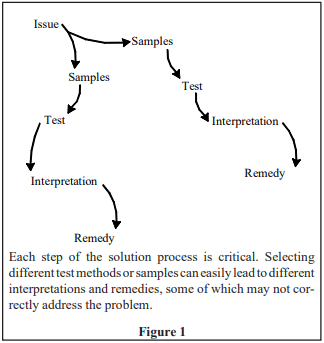
This TEK outlines guides and practices for the physical evaluation of masonry units, grout, mortar, and assemblies that form a part of an existing structure. Because no single procedure can be considered universally applicable for the evaluation and assessment of all conditions, proper tests or inspections must be selected with care as they form only a part of a broader evaluation, which may also include structural considerations, performance attributes, acceptance criteria, and goals (see Figure 1).

In some cases the physical characteristics of the materials or construction may not be in question, but instead concerns are focused on one or more performance attributes. While possibly stemming from any one of a number of sources, including poor construction, detailing, or materials; common performance related assessments include sources and causes of cracking, mitigating water penetration, and strength evaluation. Options for the evaluation and remediation of masonry structures are virtually endless. A thorough review of this subject can be found in reference 17.

MASONRY UNITS

When it is deemed necessary to remove units from a wall to evaluate their physical properties, the selection and removal of specimens should follow ASTM C 1420 Standard Guide for Selection, Removal, and Shipment of Manufactured Masonry Units Placed in Usage (ref. 5) to minimize potential damage to the units during their removal and transport and to obtain a representative sampling of specimens from which generalized conclusions can be drawn. Once removed, units can be sent to a laboratory for further assessment using visual techniques, petrographic techniques, or more common tests such those used in determining the compressive strength or equivalent thickness for fire resistant construction. Although comprehensive in its scope, ASTM C 1420 does not contain acceptance criteria or guidance for the interpretation of the results, as the application of such information is nearly always project specific.

While often definitive in their results when properly implemented and interpreted, the option of removing units from existing construction can have its limitations, especially when the existing construction is grouted or contains reinforcement. While it is still physically possible to remove a hollow unit that has been grouted and reinforced from a masonry wall, it becomes difficult (if not impossible) to determine the compressive strength of such units due to the presence of the grout and reinforcement. Hence, for construction that contains grout and/or reinforcement, it may be more appropriate to remove prisms or cores from the assembly, particularly when structural stability is the primary reason for the evaluation.

MORTAR

In many cases, the importance placed on the compressive strength of masonry mortars is overemphasized. Because the compressive strength of masonry mortars is not of principal concern in the overall performance of masonry structures there are no test methods that directly measure the compressive strength of mortar taken from an assembly. Yet, there may be circumstances when the removal and evaluation of mortar from existing masonry construction may be deemed necessary. ASTM C 1324 Standard Test Method for Examination and Analysis of Hardened Masonry Mortar (ref. 6) reviews procedures primarily related to the petrographic examination and chemical analysis of samples of masonry mortar removed from masonry construction. Based upon such examination and analysis, proportions of components in masonry mortars can be determined, which can then easily be compared to the volume proportions of ASTM C 270 (ref. 7) to classify a particular mortar or to document the actual proportions of materials used in the mortar.

While ASTM C 1324 can be an invaluable tool for measuring the relative amounts of constituent materials used in a mortar or in mapping the chemical makeup of a mortar, it does have its limitations. For example, even if a mortar is shown to have proportions that do not comply with the requirements of ASTM C 270, the mortar may still comply with the property requirements of C 270, which cannot be reasonably measured through examination of field mortars. Further, the information provided by C 1324 is anecdotal and highly subject to user error. Like all emerging technologies, results stemming from petrographic analyses should be subjected to critical review and careful interpretation.

GROUT

Unlike mortar and units, grout is often hidden from view once placed. Hence, evaluation methods that are focused on grout include both physical tests, such as measuring the compressive strength or grout/unit bond strength, as well as documenting proper placement and consolidation, to ensure as few voids as possible in the resulting construction.

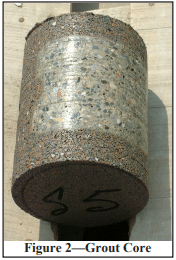
While following the grout lift height and pour height of Specification for Masonry Structures (ref. 8) is a prescriptive means of ensuring high quality grout placement, alternative grouting procedures, such as those permitted by Specification for Masonry Structures through the construction of a grout demonstration panel (refs. 8 and 9), may require supplementary means of documenting proper grout placement and consolidation. Obtaining physical specimens, such as grout cores (see Figure 2) or saw-cut samples (ref. 10), is one means of documenting proper grout placement when non-standardized grouting procedures are used, less destructive (and often less expensive) tests such as ultrasound, impact-echo and infrared photography can be highly efficient tools for measuring the subsurface characteristics of a masonry wall.

ASSEMBLIES

As with individual units, ASTM has published a guide for the selection and removal of masonry assemblies from existing construction, ASTM C 1532 (ref. 11). The procedures outlined in ASTM C 1532 are useful when physical examination of an assembly’s compressive strength, stiffness, flexural strength, or bond strength is needed on a representative sample of the actual construction (ref. 12). When conditions permit, or when less destructive means of evaluation are warranted, several testing alternatives are available.

Modulus of Elasticity

ASTM C 1197, Standard Test Method for In Situ Measurement of Masonry Deformability Properties Using the Flatjack Method, (ref. 13) can be used to evaluate the modulus of elasticity (stiffness) of a single wythe of unreinforced masonry constructed with solid units. To perform the test, two slots are cut into the mortar joints at the top and bottom of the section of masonry to be evaluated. Thin, bladder-like flatjack devices are inserted into these open mortar joints and then pressurized, inducing a controlled compressive stress on the masonry between them. Pressure in the flatjacks is gradually increased and the resulting masonry deformations are measured. The modulus of elasticity is calculated based on the resulting stress-strain relationship. Note that experimental and analytical investigations have indicated that this test typically overestimates the compressive modulus of masonry by up to 15 percent.

Mortar Joint Shear Strength

Guidelines for the Rehabilitation of Existing Buildings (ref. 14) contains a relationship between masonry bed joint shear strength measured in situ to the overall strength of a masonry shear wall. This relationship assumes the wall shear strength is limited by shear through the mortar joints rather than shear through the units. To measure the in situ mortar joint shear strength, ASTM C 1531, Standard Test Method for In Situ Measurement of Masonry Mortar Joint Shear Strength Index (ref. 15), is used. Included in ASTM C 1531 are three test methods for determining an index of the horizontal shear resistance of mortar bed joints in existing unreinforced solid-unit or ungrouted hollow-unit masonry.

In accordance with ASTM C 1531, the mortar bed joint shear strength index is determined by horizontally displacing a test unit relative to the surrounding masonry using a hydraulic jack or specialized flatjacks. The horizontal force required to displace the test unit provides a measured index of the mortar joint shear strength. Some studies have indicated that the in situ mortar joint shear strength may overestimate the actual shear strength index of a masonry wall. While a relationship has been established between the mortar joint shear strength and the shear strength of a masonry wall, there is currently insufficient data to define a similar correlation between the in situ measurement of bed joint shear strength and the actual bed joint shear strength.

Compressive Stress and Strength

For some engineering evaluations of existing masonry it may be necessary to estimate the compressive stress present in the wall. ASTM C 1196, Standard Test Method for In Situ Compressive Stress Within Solid Unit Masonry Estimated Using Flatjack Measurements (ref. 16), provides one such method to determine the average compressive stress in an unreinforced solid unit masonry wythe. The method uses flatjacks above and below the test region similar to ASTM C 1197 previously discussed. When the mortar joints above and below the test area are removed from the masonry to accommodate the flatjacks, the masonry deforms. The flatjack pressure required to move the masonry back to its original position is approximately equal to the compressive stress in the masonry.

The compressive strength of masonry can be evaluated by testing masonry prisms removed from the wall or by using cores cut from a grouted portion of the wall. If vertical reinforcement is present in the wall, testing a prism can be difficult because the vertical reinforcing steel carries load, hence the test is not a true evaluation of the masonry properties. In this case, cored samples may provide a better estimate, because the cores are tested in an orientation 90 degrees from the in situ position, so the reinforcing steel does not interfere with the test.

Limited research (ref. 10) on 6 inch (152-mm) diameter cores cut from grouted masonry compared the compressive strength of the core sample to that of masonry prisms constructed using the same materials. In these investigations, the average ratio of core to prism compressive strength was 1.04 for cores with an aspect ratio (height to diameter) of 1.27. Research on in situ masonry prism removal and testing (ref. 12) found a similar correlation factor when comparing both masonry prisms removed from existing construction to laboratory prepared prisms using similar materials.

NONDESTRUCTIVE EVALUATION

Obviously, the removal of units, prisms, cores, or other materials from a masonry structure is aesthetically detrimental and potentially structurally damaging. When possible, the physical evaluation of existing concrete masonry structures should provide the necessary information that results in the least cost and damage to the structure. A number of nondestructive evaluation procedures are applicable to masonry construction, which are often used in concert with the previously described test methods. The benefit of these techniques is the ability to evaluate portions of a structure with little or no damage.

Ultrasound and Impact-Echo

Ultrasound evaluations (pulse-velocity and pulse-echo) use a transmitter and receiver to pass ultrasonic energy through a wall. The density of the wall is estimated based on the velocity of the waves passing through the wall. Unlike the other methods discussed here, ultrasound requires access to both sides of the wall being evaluated.

Impact-echo differs in two ways from ultrasound: lower frequencies are used, which helps overcome the high signal attenuation and noise often encountered with ultrasound; and access to both sides of the wall is not required. Impact-echo uses elastic stress waves generated by a surface impact. These stress waves are reflected back to the receiver as they encounter internal anomalies or an exterior surface of the wall. Analysis of the reflected signal strength and shape allows evaluation of wall thickness and location of voids and grout areas.

Infrared

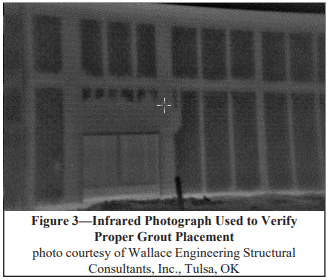
Infrared, or heat imaging, technologies measure thermal radiation from a wall surface, and record these emissions as different colors, corresponding to different surface temperatures (see Figure 3). Variations in temperature can be associated with factors such as wall solidity, moisture content, or a change in construction materials or insulation. Infrared cameras allow the user to survey an entire wall relatively quickly.

In order to provide a representative image of the wall, infrared measuring devices require heat to be transmitting through the wall (i.e., a warm interior and a relatively cool exterior ambient temperature). Generally, the larger the temperature flux, the better the resolution of subsurface anomalies.

Fiber Optics (Borescope and Fiberscope)

Borescopes (rigid optical scope) and fiberscopes (flexible optical scope) are useful for viewing interior void areas in a masonry wall. The scope is inserted into a small hole drilled into the wall, and can be attached to a camera or video recorder to document the observations. Borescopes and fiberscopes are often used to visually confirm anomalies detected using ultrasound, impact-echo or infrared methods, or to assess the condition of interior objects or cavities such as wall ties and collar joints.

Electromagnetic Devices (Rebar Locators)

Electromagnetic devices are commonly used to locate metal in masonry walls. Rebar locators generate a magnetic field, which is disturbed when a metallic object is encountered. The magnitude of the disturbance is related to the size of the object and its distance from the probe. Rebar locators can be used to: detect the location and orientation of reinforcing bars, prestress cables and other embedded metal items; measure the depth of embedded metal; and estimate the size of the metal items.

REFERENCES

  1. Evaluating the Compressive Strength of CM based on 2012IBC/2011 MSJC, TEK 18-01B. Concrete Masonry & Hardscapes Association, 2011.
  2. Sampling and Testing Concrete Masonry Units, TEK 1802C. Concrete Masonry & Hardscapes Association, 2014.
  3. Concrete Masonry Inspection, TEK 18-03B, Concrete Masonry & Hardscapes Association, 2014.
  4. Masonry Mortar Testing, TEK 18-05B, Concrete Masonry & Hardscapes Association, 2014.
  5. Standard Guide for Selection, Removal, and Shipment of Manufactured Masonry Units Placed in Usage, ASTM C 1420-99, ASTM International, 1999.
  6. Standard Test Method for Examination and Analysis of Hardened Masonry Mortar, ASTM C 1324-02a, ASTM International, 2002.
  7. Standard Specification for Mortar for Unit Masonry, C 270-02. ASTM International, 2002.
  8. Specification for Masonry Structures, ACI 530.1-02/ASCE 6-02/TMS 602-02. Reported by the Masonry Standards Joint Committee, 2002.
  9. Grouting Concrete Masonry Walls, TEK 03-02A, Concrete Masonry & Hardscapes Association, 2005.
  10. Research Evaluation of Various Grout Consolidation Techniques in Concrete Masonry, MR-13, Concrete Masonry & Hardscapes Association, 1999.
  11. Standard Guide for Selection, Removal, and Shipment of Masonry Assemblage Specimens from Existing Construction, ASTM C 1532-02, ASTM International, 2002.
  12. Research Evaluation of the Compressive Strength of In Situ Masonry, MR-8, Concrete Masonry & Hardscapes Association, 1993.
  13. Standard Test Method for In Situ Measurement of Masonry Deformability Properties Using the Flatjack Method, ASTM C 1197-03, ASTM International, 2003.
  14. Guidelines for the Rehabilitation of Existing Buildings, International Code Council, 2000.
  15. Standard Test Method for In Situ Measurement of Masonry Mortar Joint Shear Strength Index, ASTM C 1531-03, ASTM International, 2002.
  16. Standard Test Method for In Situ Compressive Stress Within Solid Unit Masonry Estimated Using Flatjack Measurements, ASTM C 1196-03, ASTM International, 2003.
  17. Nondestructive Evaluation and Testing of Masonry Structures, Suprenant, B.A., Schuller, M.P., Hanley-Wood, 1994.


Segmental Retaining Wall Units

INTRODUCTION

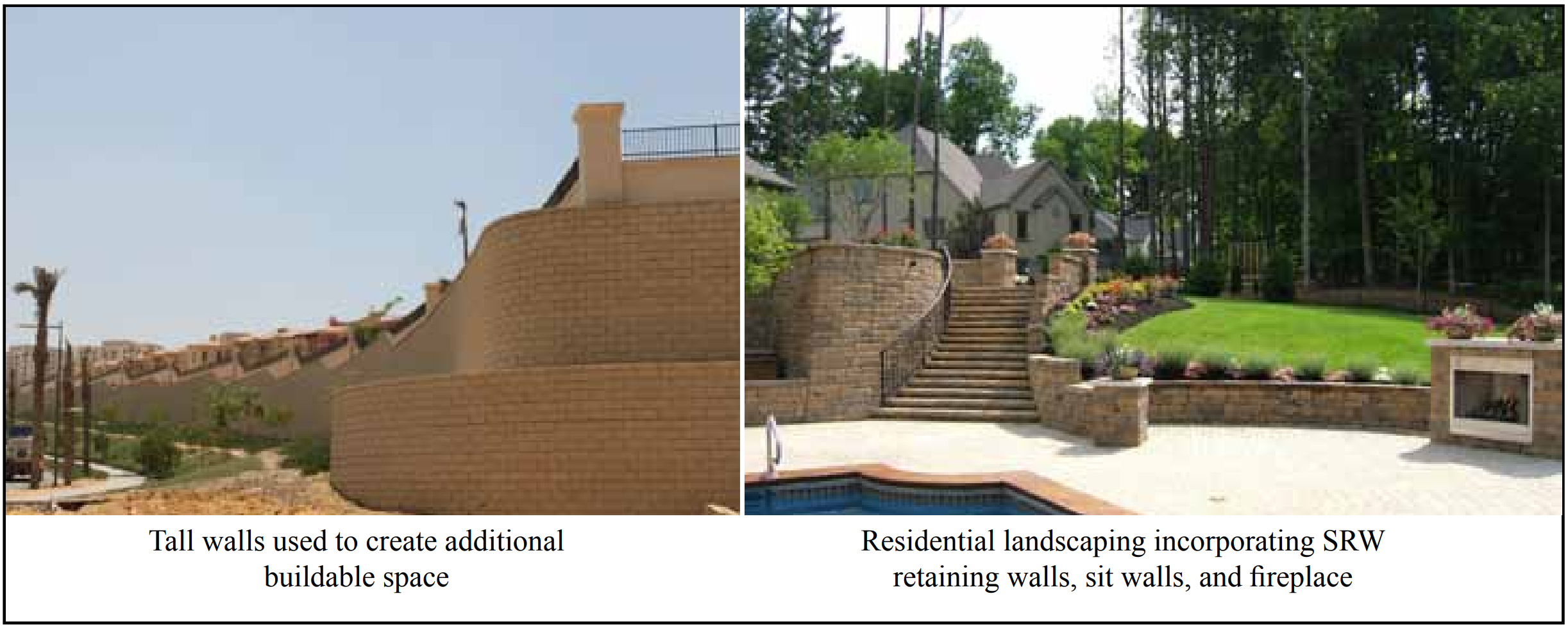
Mortarless segmental retaining walls are a natural enhancement to a variety of landscape projects. Applications range from 8 in. (204 mm) high terraces for erosion control to retaining walls 20 ft (6.1 m) or more in height. The individual concrete units can be installed to virtually any straight or curved plan imaginable.

Segmental retaining walls are used to stabilize cuts and fills adjacent to highways, driveways, buildings, patios and parking lots, and numerous other applications. Segmental retaining walls replace treated wood, cast-in-place concrete, steel, and other retaining wall systems because they are durable, easier and quicker to install, and blend naturally with the surrounding environment. Concrete units resist deterioration when exposed to the elements without the addition of toxic additives which can threaten the environment.

A variety of surface textures and features are available, including split faced, stone faced, and molded face units, any one of which may be scored, ribbed, or colored to fit any project application. Construction of segmental retaining walls does not require heavy equipment access, nor does the system require special construction skills to erect. Manufactured concrete retaining wall units generally weigh 30 to 100 lb (14 to 45 kg) each and are placed by hand on a level or sloped gravel bed.

Successive courses are stacked dry on the course below in the architectural pattern desired. Mechanical interlocking and/or frictional shear strength between courses resists lateral soil pressure. In low-height walls, overturning forces due to soil pressure are resisted by the weight of the units, sometimes aided by an incline toward the retained soil. Higher walls resist lateral soil pressures by inclining the wall toward the retained earth, or by other methods such as anchoring to geosynthetic reinforcement embedded in the soil. Further information on the design of segmental retaining walls can be found in Design Manual for Segmental Retaining Walls (ref. 1).

Segmental retaining wall units are factory-manufactured to quality standards in accordance with ASTM C1372, Standard Specification for Segmental Retaining Wall Units (ref. 2). These requirements are intended to assure lasting performance, little or no maintenance, structural integrity, and continued aesthetic value.

Segmental retaining wall units complying with the requirements of ASTM C1372 have been successfully used and have demonstrated good field performance. Segmental retaining wall units currently being supplied to the market should be produced in accordance with this standard so that both the purchaser and the supplier have the assurance and understanding of the expected level of performance of the product.

ASTM C1372 covers both solid and hollow units which are to be installed without mortar (dry-stacked). Units are designed to interlock between courses or to use mechanical devices to resist sliding due to lateral soil pressure. If particular features are desired, such as a specific weight classification, higher compressive strength, surface texture, finish, color, or other special features, they should be specified separately by the purchaser. However, local suppliers should be consulted as to the availability of units with such features before specifying them.

Materials

ASTM C1372 includes requirements that define acceptable cementitious materials, aggregates, and other constituents used in the manufacture of concrete segmental retaining wall units. These requirements are similar to those included in ASTM C90, Standard Specification for Loadbearing Concrete Masonry Units (ref. 3).

Compressive Strength

Minimum compressive strength requirements for segmental retaining wall units are included in Table 1. Units meeting or exceeding these strengths have demonstrated the integrity needed to resist the structural demands placed on them in normal usage. These demands include impact and vibration during transportation, the weight of the units above them in the wall, nonuniform distribution of loads between units, and the tensile stresses imposed as a result of typical wall settlement.

Segmental retaining wall units will not fail in service due to compressive forces since axial loads are only a result of self-weight. Due to the direct relationship between compressive strength and tensile strength, this minimum requirement is used to ensure overall performance.

Compressive strength testing of full size units is impractical due to the large size and/or unusual shape of some segmental retaining wall units. Therefore, compressive strength of these units is determined from testing coupons cut from the units. The results of tests on these smaller coupons will typically yield lower strengths than if the larger, full-size specimen were tested. The reason for the difference is size and aspect ratio. However, it is important to keep in mind that the compression test is not intended to determine the load-carrying capacity of the unit, since segmental retaining walls are not designed to carry vertical structural loads. Compressive strength is used solely to assess the quality of the concrete.


Because tested strengths are affected by size and shape of the specimen tested, it is important that all retaining wall units be tested using a similar size and shape. ASTM C140/ C140M, Standard Method for Sampling and Testing Concrete Masonry Units and Related Units (ref. 4) requires that specimens cut from full-size units for compression testing must be a coupon with a height to thickness ratio of 2 to 1 before capping and a length to thickness ratio of 4 to 1. The coupon width is to be as close to 2 in. (51 mm) as possible based on the configuration of the unit and the capacity of the testing machine, but not less than 1.5 in. (38 mm). The preferred size is 2 x 4 x 8 in. (51 x 102 x 203 mm) (width x height x length). The coupon height is to be in the same direction as the unit height dimension. If these procedures are followed, the compressive strength of the coupon is considered the strength of the whole unit.

Alignment of the specimen in the compression machine is critical. Care should be taken in capping the test specimen to assure that capping surfaces are perpendicular to the vertical axis of the specimen. Capping needs to be performed in accordance with ASTM C1552, Standard Practice for Capping Concrete Masonry Units, Related Units and Masonry Prisms for Compression Testing (ref. 5).

Saw-cutting is the required method of extracting a test specimen from a full-size unit. Proper equipment and procedures are essential to prevent damaging the test specimen as a result of saw-cutting. Water-cooled, diamond-tipped blades on a masonry table saw are recommended. The blade should ideally have a diameter sufficient enough to make all cuts in a single pass. Manufacturers of the unit (or licensors of proprietary shapes) should be consulted about recommended locations for obtaining the compression specimen.

Weight Classification

Weight classifications for segmental retaining wall units are defined in Table 1. The three classifications, lightweight, medium weight, and normal weight, are a function of the oven dry density of the concrete. Most segmental retaining wall units fall into the normal weight category.

Absorption

Absorption requirements are also included in Table 1. This value is used to represent the volume of voids in a concrete masonry unit, including voids inside the aggregate itself. The void space is measured by determining the volume of water that can be forced into the unit under the nominal head pressure that results from immersion in a tank of water.

Lightweight aggregates used in the production of lightweight and medium weight units contain voids within the aggregate itself that also fill with water during the immersion test. While reduced voids indicate a desired tightly compacted unit, tightly compacted lightweight and medium weight units will still have higher absorption due to the voids in the aggregates. For this reason the maximum allowable absorption requirements vary according to weight classification.

Similar to compression testing, it generally is not practical to test full-size retaining wall units in absorption tests due to their size and weight. Therefore, ASTM C140/C140M permits the testing of segments saw-cut from full-size units to determine absorption and density. When reduced-size units are used for absorption testing, the reduced-size specimen must have an initial weight of at least 20% of the full-size unit weight. This is intended to ensure that a sufficiently sized specimen is tested in order for the results to be representative of the entire unit.

Absorption limits are typically expressed as mass (weight) of water absorbed per concrete unit volume. This is preferred to expressing by percentage which permits a denser unit to absorb more water than a lighter weight unit.

Testing larger specimens requires particular attention to drying times, because it takes a greater length of time to remove all moisture from larger masses. ASTM C140/C140M requires that specimens be dried for a period of not less than 24 hours at a temperature of at least 221°F (105°C). The 24-hour time period does not start until the oven reaches the specified temperature. When placing larger specimens in an oven, it may take several hours for the oven to reach the prescribed temperature. ASTM C140/C140M then requires that specimen weights be determined every two hours to make sure that the unit is not still losing water weight (maximum weight loss in two hours must be less than 0.2% of the previous specimen weight). This will require 48 hours or more for some specimens. If not adequately dried, reported absorptions will be lower than the actual value.

Permissible Variations in Dimensions

Mortarless systems require consistent unit heights to maintain vertical alignment and level of the wall. For this reason, permissible variation in dimensions is limited to ±⅛ in. (3.2 mm) from the specified standard dimensions. Regarding dimensions, “width” refers to the horizontal dimension of the unit measured perpendicular to the face of the wall. “Height” refers to the vertical dimension of the unit as placed in the wall. “Length” refers to the horizontal dimension of the unit measured parallel to the running length of the wall.

Dimensional tolerance requirements for width are waived for split faced and other architectural surfaces. The surface is intended to be rough to satisfy the architectural features desired and cannot be held to a specific tolerance.

Finish and Appearance

Minor cracks incidental to the usual method of manufacture or minor chipping resulting from customary methods of handling in shipment and delivery are not grounds for rejection. Units used in exposed wall construction are not to show chips or cracks or other imperfections in the exposed face when viewed from a distance of not less that 20 ft (6.1 m) under diffused lighting. In addition, up to five percent of a shipment are permitted to: contain chips on the finished face not larger than 1 in. (25.4 mm) in any dimension; contain cracks on the finished face wider than 0.02 in. (0.5 mm) and longer than 25% of the nominal height of the unit; have dimensions outside the permissible dimensional variations; or be broken.

Freeze-Thaw Durability

Segmental retaining wall units may be used in aggressive freezing and thawing environments. Freeze-thaw damage can occur when units are saturated with water and then undergo temperature cycles that range from above to below the freezing point of water. Freezing and thawing cycles and a constant source of moisture must both be present for potential damage to occur.

Many variations can exist in exposure conditions, any of which may affect the freeze-thaw durability performance of the units. Such variations include: maximum and minimum temperatures, rate of temperature change, duration of temperatures, sunlight exposure, directional facing, source and amount of moisture, chemical exposure, deicing material exposure, and others.

When units are used in applications where freezing and thawing under saturated conditions can occur, ASTM C1372 includes three different methods of satisfying freeze-thaw durability requirements:

  1. Proven field performance,
  2. Five specimens shall have less than 1% weight loss after 100 cycles in water using ASTM C1262 (ref. 6), or
  3. Four of five specimens shall have less than 1.5% weight loss after 150 cycles in water using ASTM C1262.

Segmental retaining wall units in many areas of the country are not exposed to severe exposures. Therefore, the requirements above apply only to “areas where repeated freezing and thawing under saturated conditions occur.”


Freeze-thaw durability tests are conducted in accordance with ASTM C1262, Standard Test Method for Evaluating the Freeze-Thaw Durability of Dry-Cast Segmental Retaining Wall Units and Related Concrete Units, (ref. 6) using water or saline as the test solution. For most applications, tests in water are considered sufficient. If the units will be exposed to deicing salts on a regular basis, consideration should be given to performing the tests in saline. However, no pass/fail criteria has been adopted by ASTM for saline testing.

Compliance

ASTM C1372 also provides guidance regarding compliance. If a sample fails, the manufacturer can remove or cull units from the shipment. Then a new sample is selected by the purchaser from the remaining units of the shipment and tested, which is typically paid for by the manufacturer. If the second sample passes, then the remaining units of the lot being sampled are accepted for use in the project. If the second sample fails; however, the entire lot represented by the sample is rejected.

The specification also provides guidance on responsibility for paying for the tests. Unless otherwise provided for in the contract, the purchaser typically pays for the testing if the units pass the test. However, if the units fail the test, the seller bears the cost of the testing. See SRW-TEC-007-15 Sampling and Testing Segmental Retaining Wall Units (ref. 7) for more detailed information on SRW unit sampling, testing, and acceptance.

REFERENCES

  1. Design Manual for Segmental Retaining Walls, 3rd edition, SRW-MAN-001-10, Concrete Masonry & Hardscapes Association, 2010.
  2. Standard Specification for Dry Cast Segmental Retaining Wall Units, ASTM C1372-14. ASTM International, 2014.
  3. Standard Specification for Loadbearing Concrete Masonry Units, ASTM C90-14. ASTM International, 2014.
  4. Standard Methods for Sampling and Testing Concrete Masonry Units and Related Units, ASTM C140/C140M-14a. ASTM International, 2014.
  5. Standard Practice for Capping Concrete Masonry Units, Related Units and Masonry Prisms for Compression Testing, ASTM C1552-14. ASTM International, 2014.
  6. Standard Test Method for Evaluating the Freeze-Thaw Durability of Dry-Cast Segmental Retaining Wall Units and Related Concrete Units, ASTM C1262-10. ASTM International, 2010.
  7. Sampling and Testing Segmental Retaining Wall Units, SRW-TEC-007-15, Concrete Masonry & Hardscapes Association, 2015.