Resources

Evaluating Existing Concrete Masonry Construction

INTRODUCTION

The majority of quality control testing of concrete masonry materials is conducted on samples representative of those used in actual construction (ref. 1, 2, 3, and 4). In some cases, however, it may be necessary or desirable to evaluate the properties of existing masonry construction using the actual construction materials instead of representative samples. Examples where the in-place (in situ) masonry properties might need to be considered include old construction, damaged construction or during the construction process when:

  • a testing variable or construction practice fails to meet specifications;
  • a test specimen is damaged prior to testing;
  • test records are lost; or
  • representative samples are not otherwise available.

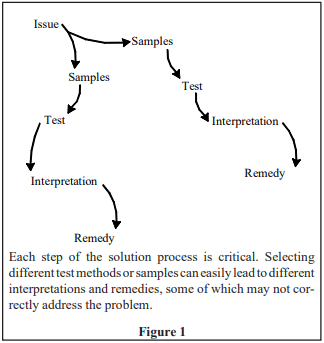
This TEK outlines guides and practices for the physical evaluation of masonry units, grout, mortar, and assemblies that form a part of an existing structure. Because no single procedure can be considered universally applicable for the evaluation and assessment of all conditions, proper tests or inspections must be selected with care as they form only a part of a broader evaluation, which may also include structural considerations, performance attributes, acceptance criteria, and goals (see Figure 1).

In some cases the physical characteristics of the materials or construction may not be in question, but instead concerns are focused on one or more performance attributes. While possibly stemming from any one of a number of sources, including poor construction, detailing, or materials; common performance related assessments include sources and causes of cracking, mitigating water penetration, and strength evaluation. Options for the evaluation and remediation of masonry structures are virtually endless. A thorough review of this subject can be found in reference 17.
MASONRY UNITS

When it is deemed necessary to remove units from a wall to evaluate their physical properties, the selection and removal of specimens should follow ASTM C 1420 Standard Guide for Selection, Removal, and Shipment of Manufactured Masonry Units Placed in Usage (ref. 5) to minimize potential damage to the units during their removal and transport and to obtain a representative sampling of specimens from which generalized conclusions can be drawn. Once removed, units can be sent to a laboratory for further assessment using visual techniques, petrographic techniques, or more common tests such those used in determining the compressive strength or equivalent thickness for fire resistant construction. Although comprehensive in its scope, ASTM C 1420 does not contain acceptance criteria or guidance for the interpretation of the results, as the application of such information is nearly always project specific.

While often definitive in their results when properly implemented and interpreted, the option of removing units from existing construction can have its limitations, especially when the existing construction is grouted or contains reinforcement. While it is still physically possible to remove a hollow unit that has been grouted and reinforced from a masonry wall, it becomes difficult (if not impossible) to determine the compressive strength of such units due to the presence of the grout and reinforcement. Hence, for construction that contains grout and/or reinforcement, it may be more appropriate to remove prisms or cores from the assembly, particularly when structural stability is the primary reason for the evaluation.

MORTAR

In many cases, the importance placed on the compressive strength of masonry mortars is overemphasized. Because the compressive strength of masonry mortars is not of principal concern in the overall performance of masonry structures there are no test methods that directly measure the compressive strength of mortar taken from an assembly. Yet, there may be circumstances when the removal and evaluation of mortar from existing masonry construction may be deemed necessary. ASTM C 1324 Standard Test Method for Examination and Analysis of Hardened Masonry Mortar (ref. 6) reviews procedures primarily related to the petrographic examination and chemical analysis of samples of masonry mortar removed from masonry construction. Based upon such examination and analysis, proportions of components in masonry mortars can be determined, which can then easily be compared to the volume proportions of ASTM C 270 (ref. 7) to classify a particular mortar or to document the actual proportions of materials used in the mortar.

While ASTM C 1324 can be an invaluable tool for measuring the relative amounts of constituent materials used in a mortar or in mapping the chemical makeup of a mortar, it does have its limitations. For example, even if a mortar is shown to have proportions that do not comply with the requirements of ASTM C 270, the mortar may still comply with the property requirements of C 270, which cannot be reasonably measured through examination of field mortars. Further, the information provided by C 1324 is anecdotal and highly subject to user error. Like all emerging technologies, results stemming from petrographic analyses should be subjected to critical review and careful interpretation.

GROUT

Unlike mortar and units, grout is often hidden from view once placed. Hence, evaluation methods that are focused on grout include both physical tests, such as measuring the compressive strength or grout/unit bond strength, as well as documenting proper placement and consolidation, to ensure as few voids as possible in the resulting construction.

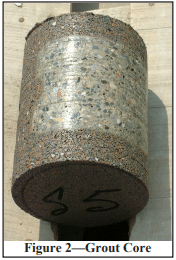
While following the grout lift height and pour height of Specification for Masonry Structures (ref. 8) is a prescriptive means of ensuring high quality grout placement, alternative grouting procedures, such as those permitted by Specification for Masonry Structures through the construction of a grout demonstration panel (refs. 8 and 9), may require supplementary means of documenting proper grout placement and consolidation. Obtaining physical specimens, such as grout cores (see Figure 2) or saw-cut samples (ref. 10), is one means of documenting proper grout placement when non-standardized grouting procedures are used, less destructive (and often less expensive) tests such as ultrasound, impact-echo and infrared photography can be highly efficient tools for measuring the subsurface characteristics of a masonry wall.
ASSEMBLIES

As with individual units, ASTM has published a guide for the selection and removal of masonry assemblies from existing construction, ASTM C 1532 (ref. 11). The procedures outlined in ASTM C 1532 are useful when physical examination of an assembly’s compressive strength, stiffness, flexural strength, or bond strength is needed on a representative sample of the actual construction (ref. 12). When conditions permit, or when less destructive means of evaluation are warranted, several testing alternatives are available.

Modulus of Elasticity

ASTM C 1197, Standard Test Method for In Situ Measurement of Masonry Deformability Properties Using the Flatjack Method, (ref. 13) can be used to evaluate the modulus of elasticity (stiffness) of a single wythe of unreinforced masonry constructed with solid units. To perform the test, two slots are cut into the mortar joints at the top and bottom of the section of masonry to be evaluated. Thin, bladder-like flatjack devices are inserted into these open mortar joints and then pressurized, inducing a controlled compressive stress on the masonry between them. Pressure in the flatjacks is gradually increased and the resulting masonry deformations are measured. The modulus of elasticity is calculated based on the resulting stress-strain relationship. Note that experimental and analytical investigations have indicated that this test typically overestimates the compressive modulus of masonry by up to 15 percent.

Mortar Joint Shear Strength

Guidelines for the Rehabilitation of Existing Buildings (ref. 14) contains a relationship between masonry bed joint shear strength measured in situ to the overall strength of a masonry shear wall. This relationship assumes the wall shear strength is limited by shear through the mortar joints rather than shear through the units. To measure the in situ mortar joint shear strength, ASTM C 1531, Standard Test Method for In Situ Measurement of Masonry Mortar Joint Shear Strength Index (ref. 15), is used. Included in ASTM C 1531 are three test methods for determining an index of the horizontal shear resistance of mortar bed joints in existing unreinforced solid-unit or ungrouted hollow-unit masonry.

In accordance with ASTM C 1531, the mortar bed joint shear strength index is determined by horizontally displacing a test unit relative to the surrounding masonry using a hydraulic jack or specialized flatjacks. The horizontal force required to displace the test unit provides a measured index of the mortar joint shear strength. Some studies have indicated that the in situ mortar joint shear strength may overestimate the actual shear strength index of a masonry wall. While a relationship has been established between the mortar joint shear strength and the shear strength of a masonry wall, there is currently insufficient data to define a similar correlation between the in situ measurement of bed joint shear strength and the actual bed joint shear strength.

Compressive Stress and Strength

For some engineering evaluations of existing masonry it may be necessary to estimate the compressive stress present in the wall. ASTM C 1196, Standard Test Method for In Situ Compressive Stress Within Solid Unit Masonry Estimated Using Flatjack Measurements (ref. 16), provides one such method to determine the average compressive stress in an unreinforced solid unit masonry wythe. The method uses flatjacks above and below the test region similar to ASTM C 1197 previously discussed. When the mortar joints above and below the test area are removed from the masonry to accommodate the flatjacks, the masonry deforms. The flatjack pressure required to move the masonry back to its original position is approximately equal to the compressive stress in the masonry.

The compressive strength of masonry can be evaluated by testing masonry prisms removed from the wall or by using cores cut from a grouted portion of the wall. If vertical reinforcement is present in the wall, testing a prism can be difficult because the vertical reinforcing steel carries load, hence the test is not a true evaluation of the masonry properties. In this case, cored samples may provide a better estimate, because the cores are tested in an orientation 90 degrees from the in situ position, so the reinforcing steel does not interfere with the test.

Limited research (ref. 10) on 6 inch (152-mm) diameter cores cut from grouted masonry compared the compressive strength of the core sample to that of masonry prisms constructed using the same materials. In these investigations, the average ratio of core to prism compressive strength was 1.04 for cores with an aspect ratio (height to diameter) of 1.27. Research on in situ masonry prism removal and testing (ref. 12) found a similar correlation factor when comparing both masonry prisms removed from existing construction to laboratory prepared prisms using similar materials.

NONDESTRUCTIVE EVALUATION

Obviously, the removal of units, prisms, cores, or other materials from a masonry structure is aesthetically detrimental and potentially structurally damaging. When possible, the physical evaluation of existing concrete masonry structures should provide the necessary information that results in the least cost and damage to the structure. A number of nondestructive evaluation procedures are applicable to masonry construction, which are often used in concert with the previously described test methods. The benefit of these techniques is the ability to evaluate portions of a structure with little or no damage.

Ultrasound and Impact-Echo

Ultrasound evaluations (pulse-velocity and pulse-echo) use a transmitter and receiver to pass ultrasonic energy through a wall. The density of the wall is estimated based on the velocity of the waves passing through the wall. Unlike the other methods discussed here, ultrasound requires access to both sides of the wall being evaluated.

Impact-echo differs in two ways from ultrasound: lower frequencies are used, which helps overcome the high signal attenuation and noise often encountered with ultrasound; and access to both sides of the wall is not required. Impact-echo uses elastic stress waves generated by a surface impact. These stress waves are reflected back to the receiver as they encounter internal anomalies or an exterior surface of the wall. Analysis of the reflected signal strength and shape allows evaluation of wall thickness and location of voids and grout areas.

Infrared

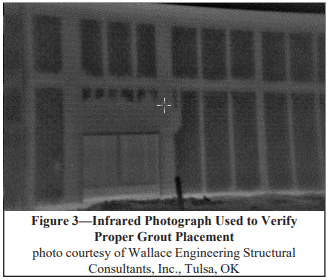
Infrared, or heat imaging, technologies measure thermal radiation from a wall surface, and record these emissions as different colors, corresponding to different surface temperatures (see Figure 3). Variations in temperature can be associated with factors such as wall solidity, moisture content, or a change in construction materials or insulation. Infrared cameras allow the user to survey an entire wall relatively quickly.

In order to provide a representative image of the wall, infrared measuring devices require heat to be transmitting through the wall (i.e., a warm interior and a relatively cool exterior ambient temperature). Generally, the larger the temperature flux, the better the resolution of subsurface anomalies.

Fiber Optics (Borescope and Fiberscope)

Borescopes (rigid optical scope) and fiberscopes (flexible optical scope) are useful for viewing interior void areas in a masonry wall. The scope is inserted into a small hole drilled into the wall, and can be attached to a camera or video recorder to document the observations. Borescopes and fiberscopes are often used to visually confirm anomalies detected using ultrasound, impact-echo or infrared methods, or to assess the condition of interior objects or cavities such as wall ties and collar joints.

Electromagnetic Devices (Rebar Locators)

Electromagnetic devices are commonly used to locate metal in masonry walls. Rebar locators generate a magnetic field, which is disturbed when a metallic object is encountered. The magnitude of the disturbance is related to the size of the object and its distance from the probe. Rebar locators can be used to: detect the location and orientation of reinforcing bars, prestress cables and other embedded metal items; measure the depth of embedded metal; and estimate the size of the metal items.
REFERENCES

  1. Evaluating the Compressive Strength of CM based on 2012IBC/2011 MSJC, TEK 18-01B. Concrete Masonry & Hardscapes Association, 2011.
  2. Sampling and Testing Concrete Masonry Units, TEK 1802C. Concrete Masonry & Hardscapes Association, 2014.
  3. Concrete Masonry Inspection, TEK 18-03B, Concrete Masonry & Hardscapes Association, 2014.
  4. Masonry Mortar Testing, TEK 18-05B, Concrete Masonry & Hardscapes Association, 2014.
  5. Standard Guide for Selection, Removal, and Shipment of Manufactured Masonry Units Placed in Usage, ASTM C 1420-99, ASTM International, 1999.
  6. Standard Test Method for Examination and Analysis of Hardened Masonry Mortar, ASTM C 1324-02a, ASTM International, 2002.
  7. Standard Specification for Mortar for Unit Masonry, C 270-02. ASTM International, 2002.
  8. Specification for Masonry Structures, ACI 530.1-02/ASCE 6-02/TMS 602-02. Reported by the Masonry Standards Joint Committee, 2002.
  9. Grouting Concrete Masonry Walls, TEK 03-02A, Concrete Masonry & Hardscapes Association, 2005.
  10. Research Evaluation of Various Grout Consolidation Techniques in Concrete Masonry, MR-13, Concrete Masonry & Hardscapes Association, 1999.
  11. Standard Guide for Selection, Removal, and Shipment of Masonry Assemblage Specimens from Existing Construction, ASTM C 1532-02, ASTM International, 2002.
  12. Research Evaluation of the Compressive Strength of In Situ Masonry, MR-8, Concrete Masonry & Hardscapes Association, 1993.
  13. Standard Test Method for In Situ Measurement of Masonry Deformability Properties Using the Flatjack Method, ASTM C 1197-03, ASTM International, 2003.
  14. Guidelines for the Rehabilitation of Existing Buildings, International Code Council, 2000.
  15. Standard Test Method for In Situ Measurement of Masonry Mortar Joint Shear Strength Index, ASTM C 1531-03, ASTM International, 2002.
  16. Standard Test Method for In Situ Compressive Stress Within Solid Unit Masonry Estimated Using Flatjack Measurements, ASTM C 1196-03, ASTM International, 2003.
  17. Nondestructive Evaluation and Testing of Masonry Structures, Suprenant, B.A., Schuller, M.P., Hanley-Wood, 1994.
 

Grout Quality Assurance

INTRODUCTION

Two field tests are commonly performed for conventional grout—the slump test and the compressive strength test. Information about types of grout, grout properties and grout admixtures can be found in Grout for Concrete Masonry, TEK 09-04A (ref. 1). Information on grout mixing and placement is contained in Grouting Concrete Masonry Walls, TEK 03-02A (ref. 2).

SAMPLING GROUT

Grout should be sampled by a qualified technician. A minimum bulk sample size of ½ ft³ (0.014 m3) is required for slump and compressive strength tests (ref. 3). Two or more grout portions are taken at regularly spaced intervals during grout discharge, and are then combined to form a bulk sample. No more than 15 minutes should elapse between obtaining the first and last portion. To help ensure the sample is representative, the portions should be taken from the middle of the batch; no samples should be taken from the first nor last 10% of the discharge.

If sampled in the field, the incremental samples are transported to the testing location, with care to protect them from sun, wind and other potential sources of evaporation and contamination. The portions are then combined and remixed to form the bulk sample. The slump test must be started within 5 minutes of obtaining the final portion. Preparation of compressive strength specimens must begin within 15 minutes of obtaining the final portion.

GROUT CONSISTENCY

The slump test gives an indication of the consistency, water to cement ratio and/or fluidity of the field grout batch. Standard Test Method for Slump of Hydraulic-Cement Concrete, ASTM C 143 (ref. 4), provides test procedures to test grout slump in either the laboratory or the field. The measured grout slump should be between 8 and 11 in. (203 and 279 mm) to facilitate complete filling of the grout space and proper performance (ref. 5). When a 12 ft-8-in. (3.9 m) grout lift height is used as permitted in the 2005 edition of Specification for Masonry Structures (ref. 5), grout slump must be maintained between 10 and 11 in. (254 and 279 mm). When the rate of water loss may be high, such as when temperatures are elevated and/or the concrete masonry units are highly absorptive, slumps in the upper part of the range (i.e., more fluid) may be desirable, although care should be taken that the grout does not segregate because the slump is too high. High-slump grouts are advantageous when grout spaces are small or highly congested. When water will be absorbed at a slower rate, such as with lower absorptive concrete masonry units, grouts in the lower slump range are good selections. If grout spaces are large, or the lifts are short, slumps in the lower part of the range also can work well.

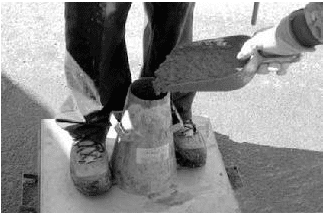
To perform the slump test, the cone, shown in Figures 1 and 2, is dampened and placed on a flat, rigid, nonabsorbent surface. The technician stands on the mold’s foot pieces to hold the mold firmly in place while filling the mold in three layers of equal volume (see Figure 1). The first layer should fill the mold to a depth of about 2 in. (67 mm), the second to 6 in. (156 mm) and the top layer should slightly overfill the mold. Each layer is rodded 25 times with a round steel tamping rod to consolidate the grout before the next layer is placed.

The middle and top layers are rodded through the depth of the layer, penetrating into the layer below. If the grout level falls below the top of the cone while rodding the top layer, grout is added to keep excess grout heaped above the top of the mold at all times. After the top layer is rodded, any excess grout is struck off flush with the top of the cone. Any grout which accumulates around the base of the mold is removed so that it does not interfere with the movement of the slumping grout.

Immediately after striking off and clearing grout from the base of the mold, the mold is lifted in 3 to 7 seconds by raising it vertically using a steady upward lift. The mold should not be twisted or moved sideways during lifting.

The slump is the vertical distance between the top of the cone and the displaced original center of the top surface of the specimen, as shown in Figure 2.

The entire test must be completed within 2 ½ minutes, from start of mold filling to measurement. If there is a decided falling away or shearing off of grout from one side or portion of the grout mass, the test should be disregarded and repeated with a fresh grout sample.

COMPRESSIVE STRENGTH TESTING

When grout compressive strength testing is required, the procedures of ASTM C 1019, Standard Test Method for Sampling and Testing Grout (ref. 3) are used. The Standard contains procedures for both field and laboratory grout compression testing and can be used either to help select grout proportions during preconstruction or as a quality control test for grout preparation uniformity during construction.

When used as part of a quality assurance program, the number of grout samples to be tested should be specified before the start of construction. One grout sample, as previously described, is used to make three compressive strength specimens. Grout specimens are formed in molds made from concrete masonry units with the same absorption and moisture content characteristics as those being used on the job (see Figures 3, 4).

Because the absorption characteristics of the grout mold must be similar to those experienced by the grout in the wall, when walls are constructed using both concrete and clay masonry units, the grout mold is constructed using both types of units, as shown in Figure 4.

The molds should be located where they can remain undisturbed for 24 to 48 hours, in a level area free from perceptible vibration.

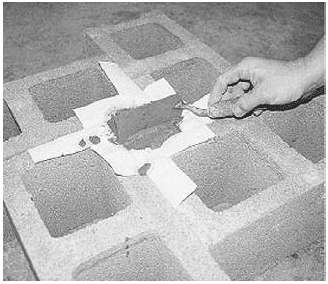
Units for the mold are laid out to form a space with a square cross section, 3 in. (76 mm) or larger on each side, with a height twice its width. Nonabsorbent spacers are placed at the bottom of the square space if needed to achieve the required specimen height. Permeable liners, such as paper towels, are taped to the surrounding masonry units to break the bond between the grout specimen and the masonry units, but still allow water to be absorbed into the units.

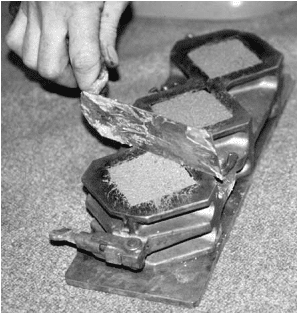
Grout is poured into the mold in two lifts of approximately equal depth, with each layer rodded 15 times to eliminate any air bubbles, distributing the strokes uniformly over the cross section of the mold. When rodding the upper layer, the rod should penetrate about ½ in. (13 mm) into the bottom layer. After the upper layer is rodded, the top of the specimen is leveled with a straight edge as shown in Figure 5, such that there are no projections or depressions exceeding in. (3.2 mm). The specimen is then immediately covered with damp fabric or similar material to promote curing.

Within 30 minutes of filling the mold, grout is added to completely fill any depression which may have formed due to initial water absorption. The top of the specimen is leveled again and re-covered to keep it damp until testing.

The specimens should remain undisturbed until the molds are removed, and should be protected from temperature extremes. After 24 to 48 hours, the molds are removed and the specimens are carefully packed for transport, keeping them damp, and shipped to the laboratory for testing.

Within 8 hours of removing the molds, laboratory personnel should store the specimens in a moist room, moist cabinet or water storage tank prior to testing.

Specimen width, height and out-of-plumb are measured and recorded. Average widths are used to calculate the average cross-sectional area, which is used to determine compressive strength based on the maximum compressive load.

Prior to testing, the specimens should be capped in accordance with the applicable provisions of ASTM C 617, Standard Method of Capping Cylindrical Concrete Specimens, (ref. 6), and tested according to ASTM C 39, Standard Method of Test for Compressive Strength of Molded Concrete Cylinders (ref. 7) (see Figure 6). More detail on the test method and procedures are included in ASTM C 1019.

When approved, other methods of obtaining grout samples, such as drilling cores, may be used to test grout compressive strength. Because test results vary with the method of forming the specimen and with specimen geometry, these test results cannot be directly compared unless previous testing has established a relationship between the two methods of forming and specimen geometries.

Concrete test methods should not be used for grout as they do not simulate water absorption into masonry units. Grout cubes or cylinders formed in nonabsorptive molds will give unreliable results.

SELF-CONSOLIDATING GROUTS

Self-consolidating grout (SCG) is a highly fluid and stable grout mix that is easy to place and does not require consolidation or reconsolidation. SCG is similar in nature to conventional grout, although the mix design is significantly different: proportions of constituent materials are highly controlled and admixtures (typically in the form of superplasticizers with or without viscosity modifiers) are used to produce a plastic grout with desired properties. Controlled aggregate gradation is also important to maintain fluidity without segregation, to produce a mix that results in consistent properties throughout the grout lift.

Because of the fluid nature of the material, traditional measures of consistency and flow such as the slump cone test (ASTM C 143) are not applicable to SCG.

SCG is a relatively new material, which is not yet incorporated into building codes and standards. To date, compliance has been achieved in several cases by using the grout demonstration panel option in Specification for Masonry Structures (ref. 5). Quality assurance provisions are being developed. It is anticipated that SCG testing procedures will be similar to those for self-consolidating concrete, as the two materials are very similar.

REFERENCES

  1. Grout for Concrete Masonry, TEK 09-04A. Concrete Masonry & Hardscapes Association, 2005.
  2. Grouting Concrete Masonry Walls, TEK 03-02A. Concrete Masonry & Hardscapes Association, 2005.
  3. Standard Test Method for Sampling and Testing Grout, ASTM C 1019-03. ASTM International, 2003.
  4. Standard Test Method for Slump of Hydraulic-Cement Concrete, ASTM C 143/143M-03. ASTM International, 2003.
  5. Specification for Masonry Structures, ACI 530.1-05/ASCE 6-05/TMS 602-05. Reported by the Masonry Standards Joint Committee, 2005.
  6. Standard Practice for Capping Cylindrical Concrete Specimens, ASTM C 617-98(2003). ASTM International, 2003.
  7. Standard Test Method for Compressive Strength of Cylindrical Concrete Specimens, ASTM C 39/C 39M-04a. ASTM International, 2004.
  8. Standard Practice for Sampling Freshly Mixed Concrete, ASTM C 172-04. ASTM International, 2004.


Compressive Strength Testing Variables for Concrete Masonry Units

INTRODUCTION

Anyone engaged in testing concrete masonry units or prisms, or interpreting test results, should be familiar with testing variables and their significance. Variables both prior to and during testing may significantly influence test results. Tests conducted to establish design criteria will affect the wall sections selected, and often will have a direct effect on the economics of the building.

Except for certain architectural facing units such as split block and slump block, concrete masonry units are manufactured to relatively precise dimensional tolerances. Because of this, it might be assumed that the units are not sensitive to variations during testing, although this is not necessarily true. Changes in concrete masonry unit moisture content can cause changes in the physical characteristics. Increases in moisture content of concrete masonry units at the time of testing reduces compressive strength. Volume change can also be influenced by the presence of moisture. Upon drying, concrete masonry units undergo shrinkage.

These conditions, i.e., strength gain and volume change, may occur simultaneously during the test period. Consequently, the effect of variables on the strength properties of the unit should be known. Testing, per se, thus becomes a conscientious effort to exclude known variables, adhere to prescribed testing methods, and present true test results.

This TEK discusses variables which may be encountered during testing of concrete masonry units. The person performing tests, and the person interpreting results, should assure themselves that all necessary precautions have been taken to render variables insignificant, or preferably nonexistent.

APPLICABLE STANDARDS

Compressive strength testing procedures for concrete masonry units and other related products are covered by ASTM C 140, Standard Methods of Sampling and Testing Concrete Masonry Units. By reference to other standards, items such as the requirements for the testing machine are covered. The completeness of these test methods disallows much variation. Strict adherence to the laboratory procedures outlined in this standard test method is critical to obtaining accurate results.

Both the tester and the interpreter should have a working knowledge of the procedures in ASTM C 140, the effects of test variables on results, and the requirements of the product specification which establishes minimum criteria for the unit being tested.

VARIABLES

Variables which may influence the reported test value include the test specimen and its preparation, the physical testing machine, the tester’s use of the machine, the placement of the specimen within the machine, plate thickness for compression testing, and the testing procedure used.

Variables in the concrete masonry unit that can influence the test results include the moisture content of the concrete masonry unit at the time of test and the geometry (shape) of the concrete masonry unit.

Moisture Content of the Concrete Masonry Unit at Testing

The moisture content of the concrete masonry unit at the time of test may have a significant effect on the reported test value. Testing of concrete masonry at various moisture contents, Figure 1, has demonstrated that moisture content may be responsible for a higher or lower reported test value. Oven-dry units possess higher tested compressive strengths than their normal (air-dry) moisture content counterpart. Conversely, concrete masonry units tested wetter than their normal counterpart yield lower compressive strengths. The approximate twenty percent increase or decrease is significant. This finding strongly suggests that sampled units destined for compressive strength testing should be maintained in their “as-received” or “as-desired” moisture condition. To help ensure this, ASTM C 140 requires that units be stored until tested in air at a temperature of 75 + 15 °F (24 + 8 °C) and a relative humidity of less than 80%, and not be subject to oven drying.

The cause for this strength increase-decrease is attributed to secondary hydraulic pressure which develops as the unit and water within the unit are subjected to external pressure. The loads are additive, so higher moisture contents yield larger strength reductions. Conversely, an oven-dry specimen possesses internal tensile strains, which must be overcome by compressive forces before the strains become compressive.

Reducing the moisture content of a specimen is even more significant when testing involves tensile strength properties, bond strength, or flexural strength. The strength reduction is greatest at the early period after specimen relocation to a drier environment. Again, maintaining the test specimen in the steady or equilibrated state is the proper way to conduct testing.

The moisture condition of concrete masonry at the time of testing may alter the true load carrying capacity of the unit.

Geometry (Shape) of the Test Specimen

Any material being tested, using test sections with various heights while maintaining a constant cross section, will yield higher compressive strengths as the ratio of the height to thickness of the specimen decreases. A tall specimen possesses a lower load carrying capacity than a short or shorter specimen. Test specimens subjected to compressive loads fail through a combination of compression and tension. Tall specimens are more sensitive to the influence of tensile stress, while short specimens fail in bearing.

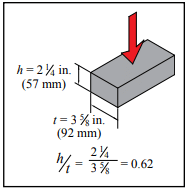
Although the general trend toward strength reduction is known, the height to thickness ratio (h/t) influence normally used to identify specimen shape effects varies with aggregate type, concrete masonry strength, moisture content, etc. A concrete brick from the same mixture used to produce a concrete block may have a higher apparent compressive strength than its block counterpart. The shape effect contributes as does the degree of consolidation during manufacturing and the effectiveness of unit curing.

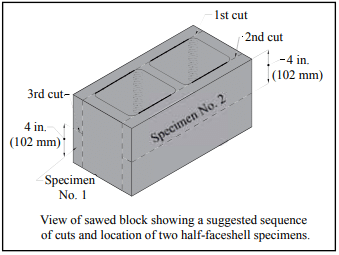
ASTM C 140 includes h/t correction factors for segmental retaining wall unit specimens with aspect ratios less than two. When coupons are used as compression specimens, they are cut at an h/t of 2, so correction factors are not needed. Figure 2 illustrates the effect of aspect ratio on apparent compressive strength of solid specimens. Hollow concrete masonry units are less affected by variations in h/t. For example, research has shown little change in apparent compressive strength when the unit height is reduced by one-third or less.

Tester Influenced Variables

A laboratory technician may significantly alter the failure compression test load, either consciously or unconsciously. Technician procedural influences include: (1) selection and maintenance of the physical testing machine and its accessories, such as bearing blocks and testing plates; (2) selection of capping material and application of a proper cap; (3) the positioning of the specimen for test; and (4) the rate of loading. Singly or collectively, these factors will influence the failure load. It is of interest to note that these variables, with the exception of a rapid rate of loading, will cause a lower reported failure load.

Testing machines should conform to the requirements of ASTM E 4, Practices for Force Verification of Testing Machines. The verification of the testing machine occurs under different loading conditions than those that prevail during actual test. The accessories such as bearing block or plates, and thin plates which deflect during loading, cause the same strength reduction discussed below for imperfect caps. Oil on the plates of the machine will also reduce the failure load result.

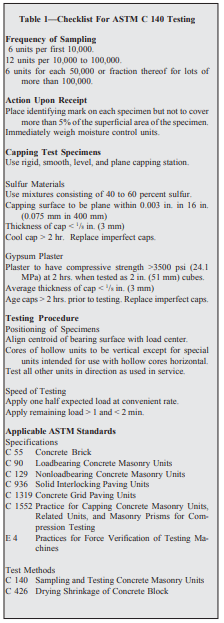
Capping materials vary in composition and, consequently, so does their modulus of elasticity. Approved (ASTM C 1552 Practice for Capping Concrete Masonry Units and Masonry Prisms for Compression Testing) capping compounds include mixtures of 40 to 60% sulfur and ground fire clay and other suitable material passing a No. 100 (150 µm) sieve or high strength gypsum cement. The use of alternate materials should not be permitted. Fiber board or other similar materials will compress more readily than their approved counterpart. Compressing the fiber board causes it to spread laterally, inducing tensile stresses into the test specimen and resulting in a lower apparent compressive strength. The resulting strength may still allow product certification if the strength value surpasses the minimum specified value. Results can vary from twenty to forty percent below the properly capped counterpart value. Because the compression results are conservative, many block producers use this less-labor intensive method as a means of assuring their compliance with specified minimum compressive strengths.

Capping materials that are not properly applied to the unit may be responsible for nonuniform stressing of the specimen during loading. A fifteen percent loss in strength has been measured for units improperly capped.

ASTM C 1552 requires the capping plate to be plane and rigid enough not to deflect during capping. Deflection of the capping plate results in a crown on the testing surface of the units, leading to nonuniform load distribution and lower apparent compressive strengths. One-half inch (13 mm) thick glass plates placed on top of 1 in. (25 mm) thick steel plates are recommended. The glass plates provide a smooth scratch-resistant replaceable wear surface while the steel plates provide needed stiffness to the capping station.

Similarly, the steel bearing plates on the compression testing machine must be rigid enough not to deflect during testing. Small deflections, unnoticeable to the naked eye, will negatively impact test results. ASTM C 140 requires that the steel bearing plates have a thickness at least equal to the distance from the edge of the spherical bearing block to the most distant corner of the specimen. This thickness must be achieved by using a single plate having a width and length at least ¼ in. (6.4 mm) greater than the length and width of the specimen being tested. Stacking several plates to reach the required plate thickness will be less rigid than a single plate of the required thickness. It is also required that the bearing faces of the plates have a Rockwell hardness of at least HRC 60 (BHN 620).

Oil on the testing plates or platens of the testing machine, or the capped surfaces of the test specimen, will also reduce the failure load. The oil lubricates the interface between specimen and machine. The result is that the test specimen expands at the interface; tensile failure occurs sooner and at a lower load.

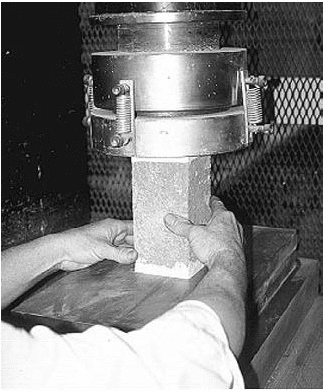
Positioning of the test specimen within the machine can have a significant effect on the failure load. For units that are essentially symmetrical the positioning is important, but to a lesser degree than when unsymmetrical units are being tested. The applied load of the testing machine should pass through the centroid of the test specimen. Units tested with applied load other than at the centroid can provide an array of reported values, Figure 3. Loads not applied through the center of mass of the unit results in lower tested strengths and increased variability in results.

For masonry units that are symmetrical about an axis, the location of that axis can be determined geometrically by dividing the dimension perpendicular to that axis (but in the same plane) by two. For masonry units that are nonsymmetrical about an axis, the location of that axis can be determined by balancing the masonry unit on a knife edge or a metal rod placed parallel to that axis. If a metal rod is used, the rod must be straight, cylindrical (able to roll freely on a flat surface), have a diameter of not less than ¼ in. (6.4 mm) and not more than ¾ in. (19.1 mm), and it must be longer than the specimen. Once determined, the centroidal axis is to be marked on the end of the unit.

Speed of Testing

The compression machine operator can also influence the test value by altering the rate of loading. Generally, rapid loading of a specimen will yield a higher apparent failure load than the less rapid or normal rate of loading. Loading should occur at some convenient rate to approximately one-half of the expected ultimate load. Thereafter the rate of loading should be adjusted such that failure occurs within the period from 1 to 2 minutes.

SUMMARY

The primary objective of testing concrete masonry units is to establish product quality for acceptance and to aid the design engineer toward selection of materials and their combination in the most economical wall section or structure. Unchecked variables during product testing invariably increase the cost of the wall. The effects of these variables will be lessened by conforming with the requirements high-lighted in the checklist, Table 1.

Unless controlled, testing variables will influence tested strength properties of concrete masonry. Variables which will result in higher compressive strength include the geometry (shape) of the specimen, rapid rate of load application, and low moisture content at the time of testing. Other testing variables such as improper application of the capping material, high moisture content at time of test, use of “thin” bearing plates, and improper positioning in the compression machine, will reduce the failure load value. Both extremes should be avoided.

Accurate and correct tested values are critical to masonry construction and design. Conservative results increase the factors of safety for design, but may result in uneconomical construction. The cost required to resolve compounding errors in judgement resulting from inaccurate testing is much greater than the cost required to use and maintain the right equipment and to properly train testing technicians to understand the effects of those variables discussed here.

Structural Testing of Concrete Masonry Assemblages

STRUCTURAL TESTING OF CONCRETE MASONRY ASSEMBLAGES

INTRODUCTION

A considerable amount of research has been conducted on concrete masonry units and assemblages in order to develop design stresses for building codes and to evaluate existing building systems. The properties of concrete masonry which are considered most important and which have been the subject of research on assemblages of concrete masonry units include: structural, fi re resistance, thermal insulation, noise insulation, and resistance to moisture penetration. This TEK is concerned with testing structural properties and reviews the kinds of loads and stresses which concrete masonry walls may be subjected to in service and the principal details of ASTM Test Methods used to investigate the structural behavior of masonry walls.

TYPES OF LOADS

Loads acting on masonry walls may be classified as vertical dead and live loads, sometimes called gravity loads, and lateral loads, these being due to wind, earthquake, earth or water pressure, etc. Vertical loads may be more or less uniformly distributed along the length of the wall or may include one or several concentrated loads which are transmitted to small areas of the wall section. Vertical loads may be centered in the same plane as the centroidal axis of the wall (concentric or axial loading) or at some distance away from this axis (eccentric loading). Eccentric loads produce bending as well as direct compressive stresses and consequently are more severe than concentric loading. Lateral loads may be uniformly distributed on the vertical surface as in the case of wind, or nonuniform according to some function of other factors, as in the case of earthquake or fluid pressure loads. Lateral loads may be concentrated and their direction may be normal or parallel to or at any intermediate angle with the wall surface. Loads may be gradually or quickly applied (impact), permanent (dead loads) or transient (wind load). Vertical and lateral loads may act simultaneously to produce a combination of axial compression and flexural stress in the masonry.

TYPES OF LOADING USED IN TESTS

Despite the variety of load types and stress conditions, masonry walls can be safety designed provided their ultimate strength in direct compression, flexure and shear is known. In developing this information the test procedures employed in the past often have varied as to specimen size, loading method and other details, but when properly presented and interpreted the results have proved to be applicable and useful. Beginning in the 1930’s, the National Bureau of Standards adopted standard methods for use in their own investigations of building constructions, these methods later forming the basis for ASTM Standard E 72, Standard Test Method for Conducting Strength Tests of Panels for Building Construction (ref. 2).

Figures 1 through 6 show schematically the general procedures used in conducting compression, flexural, and racking.

COMPRESSION

Test Methods

According to ASTM E 72, compressive strength tests are made on specimens having a height equal to the height of the wall in actual use and having a nominal width of 4 ft (1.2 m). Generally, story height walls (nominal height = 8 ft) are typical of those tested but compressive strength tests have been conducted on masonry walls over 20 ft high.

Referring to Figure 1, note that compression tests are made with the load line located a distance one-third the wall thickness from the inside face of the wall (eccentric loading) or at the central plane of the wall (axial loading). Eccentric loading is prescribed in ASTM E 72 and for many years has been preferred over axial loading by many investigators since it approximates more closely the loading condition of walls in buildings.

Loading at the central plane or centerline of the wall is true axial loading only when the wall section is geometrically and elastically symmetrical with respect to the center line.

With the advent of engineered loadbearing masonry design, simpler and less expensive test methods for determining compressive strength properties of masonry have come into wide usage: ASTM E 447, Standard Test Method for Compressive Strength of Masonry Prisms (ref. 1), and ASTM C 1314, Standard Test Method for Constructing and Testing Masonry Prisms Used to Determine Compliance with Specified Compressive Strength of Masonry (ref. 3). These tests prescribe methods for testing short compression prisms made of the same masonry units, mortar, and workmanship to be used in the construction. Although the test methods are similar, ASTM E 447 is intended for research purposes only (not for construction quality assurance purposes as is C 1314), and requires collection of additional detailed information associated with research tests.

Stresses Due to Applied Loads

The type of loading largely determines the general shape of the stress distribution diagram for the wall section. For solid walls, Figure 2, axial loading results in rectangular stress diagram, the fiber stresses being uniform over the entire cross section and equal to P/A. If the vertical load is applied eccentrically or off-center by a distance of one-sixth the wall thickness (t/6), the unit stress varies from a maximum of 2P/A at the wall face nearest the load line, to zero stress at the opposite face, Figure 2b. Eccentricity greater than t/6 would produce tensile stresses at the opposite face and a stress diagram which would show zero stress at some point between the wall faces. Eccentricity less than t/6 would result in some compression at the opposite face and a stress diagram of trapezoid shape.

In Figures 2a and 2b, the average compressive stress is the same in each case, assuming the same vertical load, but as noted, the maximum fiber stress for the eccentrically loaded wall is twice that for the axially loaded wall. A logical deduction is that a given wall will support a greater axial than eccentric load. This is borne out by tests which indicate that bending stress due to eccentric location of vertical load or other causes, reduces the ultimate vertical load capacity of masonry below its axial load strength.

FLEXURAL

The different types of loading used in testing masonry walls for flexural or transverse strength are shown in Figure 3, together with the moment and shear diagrams and formulas for calculating maximum shear, moment and deflection assuming simply supported spans. ASTM E 72 specifies a specimen width of 4 ft and either line loading applied at the outer 1/4 points of the span as shown in sketch (b) of the figure, or uniformly distributed loading shown in sketch (c). Uniform transverse loading of upright specimens such as masonry walls has become practical and more commonly used with the development of the “bag method” in which a plastic or rubberized fabric bag, interposed between the wall face and a backboard, is inflated with air to give increments of pressure against the wall until failure. Comparing the deflection formulas for the three loading methods, it will be noted that 1/4-point loading causes the greatest deflection, assuming a given moment and wall section, and from this standpoint is more severe than the other two methods. Also, any line load method produces combinations of maximum shear and moment in the same region which generally results in a lower indicated strength than would be obtained with uniform loading where the regions of maximum moment and of maximum shear are widely separated. It also appears that a test loading which does not include concentrated loads more nearly simulates the more common loads considered in design, such as wind and fluid or earth pressure.

Flexural strength of unreinforced masonry assemblages can also be measured by other ASTM methods. Method E 518, Standard Test Method for Flexural Bond Strength of Masonry (ref. 5), is intended to provide simplified and economical means for gathering comparative research data on the flexural bond strength developed with different types of masonry units and mortar or for the purpose of checking job quality control as regards materials and workmanship. Unlike ASTM E 72, Method E 518 is typically not intended for use in establishing design stresses. Specimens are small prisms laid up in stack bond and tested in a horizontal position by applying load at the third-points or by applying a uniform load by means of an inflated air bag.

Method C 1072, Standard Test Method for Measurement of Masonry Flexural Bond Strength (ref. 6) covers physical testing of each joint of masonry prisms using a bond wrench test apparatus. This method permits the measurement of multiple joints in a prism rather than the single joint tests of E 82 and E 518, making statistical evaluations easier and more cost effective. The results are used to: determine compatibility of mortars and masonry units; determine the effect on flexural bond strength of factors such as mortar properties and workmanship; and predict the flexural strength of a wall. The flexural bond strength determined using C 1072 is not typically used to predict the flexural bond strength of a wall constructed of the same material unless testing is performed to document the difference between the two; nor to determine extent of bond for a water permeance evaluation.

RACKING

Racking strength tests are performed according to the general schemes shown in Figure 4 and give an indication of the resistance of the construction to the horizontal component of shearing forces acting parallel to the wall. In the method prescribed in ASTM E 72, shown in the upper sketch, the horizontal component is equal to the load P, and the principal stress, compression acting in a diagonal line between the load point and lower right reaction, is the resultant of load P and vertical reaction Rv.

In the scheme shown in the lower sketch, the load is applied diagonally downward and the horizontal component or longitudinal shear is equal to P cosφ , approximately 0.7P since φ is usually about 45o. This alternative method is not addressed in ASTM E 72, but has often been used because it eliminates the need for tie-down rods.

Results of racking tests of masonry walls generally are given in terms of the maximum horizontal component, pounds per linear foot of wall, although the total load P may also be reported. While failure is considered to be in shear, it actually is caused by a combination of shear and secondary tensile stresses, the latter acting normal to the compressive stress. Although exceeding both the shearing and secondary tensile stresses in intensity, compressive stress is not sufficient to cause a compression-type failure.

As with compression and flexural testing, an ASTM method exists for testing shear on specimens smaller than required in ASTM E 72. In ASTM E 519, Standard Test Method for Diagonal Tension (Shear in Masonry Assemblages) (ref. 4), 4 ft by 4 ft masonry assemblages are positioned in a compression testing machine so that a compressive load is applied along one diagonal, causing a diagonal tension failure with the specimen splitting apart normal to the direction of load (see Figure 5). This method also avoids the need for a hold down force to prevent rotation of the specimen as used in the E 72 method, simplifying the analysis of the state of stress in the specimen.

IMPACT

The impact test of ASTM E 695 (ref. 7) affords a qualitative measure of the capacity of wall, floor and roof panels to resist impact loading. The impact force is obtained from the free-fall of a bag of lead shot through a path which causes it to strike the center of the panel at an angle normal to the surface. The essential details of the method as adapted to the testing of upright masonry wall panels are shown in Figure 6. Panels are typically 4 ft long and are simply supported on a span six inches less than the height of the specimen. The height of drop is increased in increments until failure occurs, but not exceeding 10 ft, and the maximum drop is the value reported.

The structural testing of masonry walls and assemblages encompasses much more than merely determining the ultimate load at failure. At each load increment, strains and deflections are carefully measured with precision instruments. at various locations on the specimen. In some procedures a load increment is applied and measurements are taken after which the load is released and measurements again taken to determine the residual strain or deflection. The specimen is examined and notes made of any cracking, crushing or other visible distress. This process is repeated at each increase in load so that when the test has been concluded the research engineer has accumulated the data needed to give a clear picture of the structural behavior of the specimen through all stages of loading.

REFERENCES

  1. Standard Test Method for Compressive Strength for Laboratory Constructed Masonry Prisms, ASTM E 447-97. American Society for Testing and Materials, 1997.
  2. Standard Test Method for Conducting Strength Tests of Panels for Building Construction, ASTM E 72-95. American Society for Testing and Materials, 1995.
  3. Standard Test Method for Constructing and Testing Masonry Prisms Used to Determine Compliance with Specified Compressive Strength of Masonry, ASTM C 1314-97. American Society for Testing and Materials, 1997.
  4. Standard Test Method for Diagonal Tension (Shear) in Masonry Assemblages, ASTM E 519-81(1993)e1. American Society for Testing and Materials, 1993.
  5. Standard Test Method for Flexural Bond Strength of Masonry, ASTM E 518 -80(1993)e1. American Society for Testing and Materials, 1993.
  6. Standard Test Method for Measurement of Masonry Flexural Bond Strength, ASTM C 1072-94. American Society for Testing and Materials, 1994.
  7. Standard Test Method for Measuring Relative Resistance of Wall, Floor, and Roof Construction to Impact Loading, ASTM E 695-79(1997)e1. American Society for Testing and Materials, 1997.

Masonry Mortar Testing

INTRODUCTION

Masonry mortars are composed of cementitious materials, aggregates, water, and admixtures when specified. Cementitious materials include portland cement, masonry cement, mortar cement, slag cement, blended hydraulic cement, hydraulic cement, quicklime, hydrated lime and lime putty. Aggregates consist of natural sand or manufactured sand. Admixtures may include such materials as coloring pigments, water repellent agents, accelerators, retarders and air-entraining agents. These materials are described in Mortars for Concrete Masonry, TEK 09-01A (ref. 1).

Quality assurance testing of site-prepared mortar is fairly uncommon, except on large jobs or for essential facilities. When mortar testing is required, it is essential that all parties involved possess a thorough knowledge of the mortar specifications, test methods and standard industry practices. Misinterpretations of these standards can result in improper testing and confusion regarding compliance with specifications.

Typically, project specifications require mortar to comply with Standard Specification for Mortar for Unit Masonry, ASTM C270 (ref. 2). Two methods of demonstrating compliance with ASTM C270 are permitted: the proportion specification or the property specification. Note that these compliance options are completely independent of each other; the requirements from one should not be used in conjunction with the other. Of the two options, the proportion specification is much more commonly used. TEK 09-01A covers the proportion specification in detail.

Although physical testing of the mortar is not required to demonstrate compliance with the proportion specification, the mortar is often tested to verify consistency throughout the job, most often by cone penetration or compressive strength testing. The property specification requires testing to be performed on laboratory-prepared mortar to demonstrate compliance with a specified minimum compressive strength, minimum water retention and maximum air content. This information is required for submittals, so is performed prior to construction. Where special inspection is required in accordance with the International Building Code (ref. 3), the special inspector, as part of his duties, is required to verify compliance with the approved mix proportions for field-prepared mortar. Both consistency testing and testing to verify compliance with the property specification are covered in this TEK.

Field-prepared and preconstruction mortar should be evaluated using Standard Test Method for Preconstruction and Construction Evaluation of Mortars for Plain and Reinforced Unit Masonry, ASTM C780 (ref. 4), which includes the following test methods: consistency by cone penetration; consistency retention by cone penetration; consistency by modified concrete penetrometer; mortar-aggregate ratio and water content; air content; and compressive strength. Note that mortar compressive strength is not an accurate indication of mortar strength in the wall, nor of the masonry wall compressive strength. This is discussed in detail in the section Compressive Strength Testing of Field-Prepared Mortar, below.

Note that the physical properties of these field mortar evaluations cannot be compared to the values required by the ASTM C270 property specification. In fact, ASTM does not publish minimum compressive strength requirements for field-prepared mortar.

When fresh mortar is placed on concrete masonry units during construction, its characteristics immediately begin to change due to water absorption by the masonry units. Nearly all of the available mortar test methods, however, are performed on mortar before it comes into contact with masonry units. Therefore, the properties of the sampled and tested mortar can be expected to differ significantly from mortar in contact with masonry units. Because conditions of the units and environment can vary greatly from job to job, the properties of the plastic mortar may need to vary as well to ensure quality construction. For this reason, no pass/fail criteria exist for field tests of mortar.

Standard Guide for Quality Assurance of Mortars, ASTM C1586 (ref. 5) provides guidance on the proper use of ASTM C270 and C780 for evaluating masonry mortar produced in the laboratory and at the construction site.

MORTAR CONSISTENCY

The most important aspect of mortar quality control is consistency throughout the construction project. The test methods outlined in ASTM C780 are intended to evaluate that consistency. Test results acquired throughout construction are compared to a baseline preconstruction evaluation.

The cone penetration test offers a quantitative measure of mortar consistency. Test values indicate the mortar workability, which may be affected by water content, aggregate properties, batch properties and other factors. Tested values are likely to change throughout a project’s duration due to variable site conditions as well as variations in masonry unit moisture content and absorption characteristics.

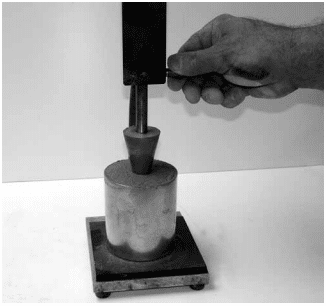
Cone penetration tests are performed by dropping a conical plunger from a specified height into a measured mortar sample and measuring the resulting depth of penetration, as shown in Figure 1.

MORTAR AGGREGATE RATIO

Mortar quality assurance often includes verification that mortar materials are proportioned as specified. ASTM C780 Annex A4 provides a method for sampling mortar from the field and determining the ratio of aggregate to cementitious material in the sample by weight. The mortar sample is passed through a No. 100 (150-µm) sieve to determine the percentage of material coarser than 150-µm. These results are compared to a sieve analysis of the aggregate used in the mortar to determine what fraction of the material passing the sieve is aggregate, and what fraction is cementitious material.

To complete the calculations in the test method, the mortar water content must also be determined, as detailed in Annex A4.

MORTAR COMPRESSIVE STRENGTH TESTING

One of the most universally recognized properties of masonry is compressive strength. While this property may not be the most important for masonry mortar, it is often perceived as such because compressive strength values are generally understood and are relatively easy to determine. Confusion and misinterpretation sometimes exist, however, when interpreting project specification requirements for mortar strength because there are several different compressive strength test methods included in ASTM Standards and model building codes. These methods were established to address specific needs, and they differ from each other in test requirements for obtaining, conditioning and testing mortar samples and specimens. Note that the mortar compressive strength determined in a laboratory is not indicative of either the strength of the mortar in the wall, nor of the masonry (i.e., wall) compressive strength. Specification for Masonry Structures (ref. 6) includes two alternatives for documenting masonry compressive strength; one based on the type of mortar and the compressive strength of the masonry units; the other based on compression testing of masonry prisms.

Compressive Strength Testing of Laboratory-Prepared mortar

Verifying compliance to the ASTM C270 property specification requires mortar compressive strength to be tested in accordance with Standard Test Method for Compressive Strength of Hydraulic Cement Mortars (Using 2-in. or 50-mm Cube Specimens), ASTM C 109 (ref. 7), with modifications regarding specimen storage and conditioning.

Compressive strength testing in accordance with ASTM C270 is conducted on specimens that are proportioned, mixed and conditioned in the testing laboratory. Water content of the mortar sample is such that the mortar flow must be 110 ± 5%. Compressive strength test specimens are 2 in. (51 mm) mortar cubes cast in nonabsorbent molds (see Figure 2) and cured in a moist room or moist cabinet meeting the requirements of ASTM C511, Standard Specification for Mixing Rooms, Moist Cabinets, Moist Rooms and Water Storage Tanks Used in the Testing of Hydraulic Cements and Concretes (ref. 9), until tested.

ASTM test methods emphasize the importance of extreme care in observing the testing procedures used to verify C270 requirements. According to Note 8 of ASTM C109: “Reliable strength results depend upon careful observance of all the specified requirements and procedures. Erratic results at a given test period indicate that some of the requirements and procedures have not been carefully observed, for example, those covering the testing of the specimens as prescribed in 10.6.2 and 10.6.3. Improper centering of specimens resulting in oblique fractures or lateral movement of one of the heads of the testing machine during loading will cause lower strength results.”

To facilitate centering the test specimens, the compression testing machine is required to have a spherically-seated upper bearing block attached at the center of the upper head. The bearing surface diagonal or diameter is required to be only slightly greater than the diagonal or diameter of the specimen.

Compressive Strength Testing of Field-Prepared Mortar

Compressive strength is one of the most commonly tested properties of field mortar. The test, described in ASTM C780, provides an indication of mortar consistency during construction, not as an indication of the compressive strength of the masonry, or even of the mortar in the wall. Compressive strength test results should be compared on a periodic basis to evaluate uniformity. These test results can be compared to preconstruction test results of similarly prepared mortar to provide a reference to a preapproved laboratory-prepared mortar strength.

Knowledgeable interpretations of results are necessary. As an example, consider the mortar’s water to cement ratio, which can have a significant effect on the tested strength. Mortar on site is adjusted to accommodate field conditions: on a hot sunny day, the mason may desire a more plastic mortar with a higher water content. Mortar sampled on this day will have a lower tested compressive strength than a similar mortar sampled on a cooler, damper day, which would likely be mixed using less water. However, the end result—the condition of the mortar in the wall—may be very comparable. These factors must be accounted for when interpreting compressive strength test results of field-prepared mortar.

Note that the results of these evaluations are not representative of the strength of the mortar in the wall, rather, they represent approximate mortar strengths only. The tested compressive strength of field-mixed mortar may be significantly less than that of hardened mortar joints for several reasons.

  • Mortar specimens are cast in nonabsorbent forms, whereas mortar in the wall is exposed to the suction from absorbent masonry units, reducing the water to cement ratio, which in turn increases the compressive strength.
  • The aspect ratio of the test specimens is greater than that of mortar joints. The typical mortar joint, at in. (9.5 mm) high with a depth of at least 1 in. (25 mm), results in a broad, stable configuration that is naturally able to carry more load than the comparatively taller and more slender mortar specimens used for material evaluation. When tested at an aspect ratio of :1, tested mortar compressive strength values are routinely 8,000 to 10,000 psi (55.16 to 68.95 MPa).

For these reasons as well as others, field mortar compressive strength test results should never be compared to the requirements in ASTM C270 Table 2, which apply to laboratory-prepared mortar only.

ASTM C780 permits the use of cube or cylinder molds. Cylinder molds of 2 or 3 in. (51 or 76 mm) diameter have heights twice their diameter. Due to the higher aspect ratio of cylinder specimens, tests on cylindrical specimens result in tested compressive strength values approximately 15% less than those of cube specimens of the same mortar. If cylinder test results are to be directly compared to those for cubes, correction factors should be applied to the cylinder specimen results.

Immediately after sampling the mortar, it is placed in the molds, consolidated and covered to prevent evaporation per the procedures dictated by C780. The filled molds are stored for 24 hours in conditions as close to laboratory conditions as possible, at which point they are transported to the laboratory and stored in a moist room for another 24 hours. The specimens are then stripped of their molds and stored in the moist room or closet until 2 hours prior to compressive strength testing.

Prior to testing, mortar cylinders are capped with a gypsum or sulfur capping compound to provide uniform parallel bearing surfaces. Mortar cubes, however, are tested without caps, as the molded cube surfaces provide a smooth and uniform bearing surface. The specimens are tested in a moist condition. The axis of the specimen is aligned with the center of thrust of the spherically-seated (upper) bearing block of the compression machine. Load is applied to the specimen continuously and without shock until failure, and the compressive strength, type of failure, and appearance of the mortar is reported.

Uniform Building Code Standard 21-16, Field Test Specimens For Mortar (ref. 10), contained another method to obtain mortar compressive strength test specimens. This method prescribes ½ to in. (13 to 16 mm) thickness of mortar to be spread on a masonry unit and allowed to stand for one minute. The mortar is then removed from the unit and placed in a cube or cylinder for compressive strength testing. The test method, however, is no longer used or referenced in current codes and standards and would not provide results that can be compared to C270 properties.

WATER RETENTION

The property specification of ASTM C270 requires a minimum water retention of 75% when tested in accordance with Standard Test Method for Water Retention of Hydraulic Cement-Based Mortars and Plasters, ASTM C1506 (ref. 15). This test was developed to measure the ability of a mortar to retain its mix water under the suction of the adjacent masonry unit. A certain amount of water absorption by the unit is beneficial, but too much may be detrimental.

Water retention is determined in the laboratory by measuring the mortar’s “initial flow,” and “flow after suction.” Initial flow is the percent increase in diameter of a mortar sample when it is placed on a flow table and dropped 25 times in 15 seconds. The same procedure is used to determine flow after some of the mortar’s mix water has been removed by an applied vacuum, which is meant to simulate the suction of masonry units on mortar. Water retention is the ratio of flow after suction to initial flow, expressed as a percentage.

AIR CONTENT

The ASTM C270 property specification includes a limit on the mortar air content. In general, greater air contents result in greater mortar durability and workability, but reduced mortar bond strength.

Air content is determined in accordance with ASTM C91, with the exception that the laboratory-prepared mortar is required to be of the materials and proportions used in the construction. The air content of the mortar is determined by calculation using the weight of a sample of mortar and accounting for all of the materials used. The calculation requires precise measurements of all materials and a knowledge of the specific gravity of those materials.

ASTM C780 also includes procedures for determining mortar air content using a pressure or volumetric method, either of which can be used in repetitive tests to evaluate the effects of changes in mixing time, mixing procedures, or other variables.

FLEXURAL BOND STRENGTH

ASTM C1329 Standard Specification for Mortar Cement (ref. 11) covers additional requirements for masonry mortars using mortar cement as a cementitious material. Although mortar cement is similar to masonry cement, it must achieve a minimum bond strength and must meet a lower air content than masonry cement. Mortar cement is permitted to be used in buildings assigned to Seismic Design Categories D, E or F, whereas masonry cement and Type N mortar cannot be used as part of the lateral force-resisting system for these buildings (ref. 12). Compliance testing for flexural bond strength is conducted in accordance with ASTM C1072 Standard Test Method for Measurement of Masonry Flexural Bond Strength (ref. 13). This method relies in turn on Standard Test Methods for Evaluating Masonry Bond Strength, ASTM C1357 (ref. 14). C1357 uses a prism constructed of “standard masonry units,” defined for this use as solid 3 x 2¼ x 7 in. (92 x 57 x 194 mm) units. Mortar bond is determined by calculating the modulus of rupture based on wrenching units from the prism using a bond wrench testing apparatus. C1072 includes detailed requirements for aggregates, mix design, manufacturing, size, curing and moisture content of the “standard” concrete masonry units used to determine compliance.

REFERENCES

  1. Mortars for Concrete Masonry, TEK 09-01A. Concrete Masonry & Hardscapes Association, 2004.
  2. Standard Specification for Mortar for Unit Masonry, ASTM C270-14. ASTM International, Inc., 2014.
  3. International Building Code. International Code Council, 2012.
  4. Standard Test Method for Preconstruction and Construction Evaluation of Mortars for Plain and Reinforced Unit Masonry, ASTM C780-14. ASTM International, Inc., 2014.
  5. Standard Guide for Quality Assurance of Mortars, ASTM C1586-05(2011). ASTM International, Inc., 2011.
  6. Specification for Masonry Structures, TMS 602-13/ACI 530.1-13/ASCE 6-13. Reported by the Masonry Standards Joint Committee, 2013.
  7. Standard Test Method for Compressive Strength of Hydraulic Cement Mortars (Using 2-in. or 50-mm Cube Specimens), ASTM C109/C109M-13. ASTM International, Inc., 2013.
  8. Standard Specification for Masonry Cement, ASTM C91/C91M-12. ASTM International, Inc., 2012.
  9. Standard Specification for Mixing Rooms, Moist Cabinets, Moist Rooms and Water Storage Tanks Used in the Testing of Hydraulic Cements and Concretes, ASTM C511-13. ASTM International, Inc., 2013.
  10. Field Test Specimens for Mortar, UBC Standard 21-16, International Conference of Building Officials, 1994.
  11. Standard Specification for Mortar Cement, ASTM C1329/C1329M-12. ASTM International, Inc., 2012.
  12. Building Code Requirements for Masonry Structures, TMS 402-13/ACI 530-13/ASCE 5-13. Reported by the Masonry Standards Joint Committee, 2013.
  13. Standard Test Method for Measurement of Masonry Flexural Bond Strength, ASTM C1072-13e1. ASTM International, Inc., 2013.
  14. Standard Test Methods for Evaluating Masonry Bond Strength, ASTM C1357-09. ASTM International, Inc., 2009.
  15. Standard Test Method for Water Retention of Hydraulic Cement-Based Mortars and Plasters, ASTM C1506-09. ASTM International, Inc., 2009.

Creep Properties of Post-Tensioned and High-Rise Concrete Masonry

INTRODUCTION

Time dependent deformations such as creep are generally only designed for in prestressed (post-tensioned) concrete masonry and high-rise loadbearing masonry buildings. Ordinary concrete masonry units with grout-filled cores and steel reinforcement and designs based on well known engineering principles have been used extensively in loadbearing concrete masonry up to 20 stories in height without analysis for creep. However, as concrete masonry is used for increasingly large and tall buildings, consideration of the time-dependent deformations that occur becomes more important.

Creep is proportional to masonry dimensions and applied stress and therefore increases as height and loads increase. Prestressing (post-tensioning) of concrete masonry is another relatively new innovation where the creep properties must be taken into consideration. This procedure involves the introduction compressive forces into the masonry using prestressing tendons in order to place the masonry into a compressive mode where it is most effective.

Due to the relatively recent advent of these specialized construction procedures, creep properties of masonry have been actively studied only in the last 25 years. Much of the information prior to this was based on the documented properties of concrete. Although the properties of the two are similar, concrete masonry is composed of hollow, cementitious units that are substantially cured at the time of placement and mortar which is plastic at the time of placement. This makes the time-dependent properties somewhat different from concrete.

The majority of the effects of creep occur within the first three to five years (ref. 9). The effects are most dramatic within the first 30 days and about 90% complete at the end of the first year. The effect of these deformations on concrete masonry if they are not designed for is the potential for undesirable cracking.

TOTAL TIME-DEPENDENT DEFORMATIONS

Creep and shrinkage are deformations that occur over time and must be addressed in these specialized construction processes. There are two forms of shrinkage. 1). Drying shrinkage refers to the shrinkage that occurs as the moisture content of the masonry assemblage decreases over time. 2). Carbonation shrinkage is the reaction between the cementitious materials in the masonry and carbon dioxide in the atmosphere. Shrinkage properties are discussed extensively in CMHA’s CMU-TEC-009-23 Crack Control Strategies for Concrete Masonry Construction (ref. 4).

In research, creep is determined by measuring the total deformation on a loaded specimen and the shrinkage effects on a companion “control” specimen not subjected to loading. The creep then is determined by taking the difference in the two values.

One of the first of these studies was conducted in 1976 sponsored by the Portland Cement Association laboratories and the Concrete Masonry & Hardscapes Association to ascertain the technical and economical feasibility of constructing reinforced concrete masonry buildings as high as 50 stories (ref. 7). The research was to determine the engineering properties of the very high strength materials that would be required under the heavy sustained loading. Since that time a number of other studies have been conducted, particularly in regard to prestressed masonry construction (ref. 1, 2, 6, 7, 9, 10, 12).

CREEP

Creep refers to the increase in strain over time that occurs under sustained constant load. The deformations due to creep are normally three to five times the amount of the initial strain for concrete masonry most of which occurs within 1 year of constant stress (ref. 5). Mortar has a higher proportionate amount of creep than concrete masonry units. Even though mortar joints make up only about 7% of the area of a wall, they typically account for about 20% of the creep (ref. 10). The final creep value of masonry increases with increasing proportion of mortar.

Creep of concrete masonry is influenced by several factors:

  • Unit Strength – Creep is reduced when higher strength units are used (ref. 10).
  • Type of Mortar – Creep is reduced when higher strength mortar is used (ref 10).
  • Percentage of Reinforcement – The presence of reinforcement reduces creep as it helps to carry some of the vertical load (ref. 2).
  • Relative Humidity – The effect of relative humidity is slight on creep, however, creep tends to increase with an increase moisture content (ref. 1).
  • Level of Stress – Creep of concrete masonry is proportional to stress (ref. 1 5, 7, 10).
  • Age at loading – Research indicates that creep is reduced for masonry subjected to stress after 14 days of age (ref. 1, 2, 5, 7, 9). Schubert proposes that “the influence of the age at loading is slight from a masonry age of about 2 weeks onwards, as there is only a slight increase in the strength of both units and mortar after this time” (ref. 9).
  • Pore Structure – An increase in pore structure of unit and mortar tends to increase creep (ref. 10).
  • Aggregate Type – Little difference was found in the amount of creep between lightweight and normal weight aggregate (ref. 1, 7) and in some cases lightweight exhibited less creep (ref. 1). However, the total deformation of lightweight concrete masonry typically is greater due to the higher initial deformation.

More recent research on more conventionally strengthed concrete masonry ( f’m of 1500 psi) (10.34 MPa) produced values of creep somewhat higher (ref. 1, 10). Based on his research, Badger (ref. 1) recommends a value of 13 x 10-7 per psi (1.87 x 10⁻⁴ per MPa) for concrete masonry. The average tested prism strength was 2080 psi (14.34 MPa) for the normal weight prisms and 1580 psi (10.89 MPa) for the lightweight. Sustained stress levels of 0, 50, 150, and 250 psi (0, 0.34, 1.03, and 1.72 MPa) were applied for a period of 300 days. Test results are as shown in Figures 2 through 5. The negative creep indicated for the first 100 days in Figures 4 & 5 is not really happening. It is an aberration attributed to the more rapid drying shrinkage of the control specimens due to open cores at the top whereas the loaded specimens were covered by the loading plate. This allowed the control specimens to dry out from the inside as well as the outside as opposed to the loaded specimens which dried from the outside only.

Schultz and Scolforo (ref. 10) recommend a creep coefficient of 2.5 for Type M mortar and 4 for Type N mortar based their research. As indicated earlier, this is the ratio of creep to the amount of initial strain. The corresponding specific creep coefficient is obtained by simply dividing the creep coefficient by the modulus of elasticity. For 1500 f’m and a creep coefficient of 2.5, the specific creep coefficient kc then becomes 18.5 x 10⁻⁷ per psi (2.68 x 10⁻⁵ per MPa). A 2500 f’m with Type M mortar results in a kc of 11.1 x 10⁻⁷ per psi (16.1 x 10⁻⁵ per MPa). Since the modulus of elasticity is a function of the specified masonry strength f’m, this approach makes creep dependent on both mortar strength and masonry strength.

Prestressed Concrete Masonry

Creep is of particular importance in prestressed concrete masonry where it contributes to prestress losses. Prestressed concrete masonry typically involves the application of compressive stresses by a prestressing tendon to a masonry wall prior to application of the building loads. This compressive stress counteracts the applied tensile stress and increases shear capacity, providing an economical alternative to traditional reinforcement. Creep loss in prestressed masonry occurs when the prestressing tendon shortens with the masonry (ref. 1) and must be accounted for in the design. This differs from mild reinforcement which helps to minimize creep by carrying some of the load as opposed to prestressing which adds to the load carried by the masonry. Consequently creep associated with prestressed masonry is typically higher than that of reinforced masonry.

Fairly accurate estimates of creep in prestressed masonry are needed as overestimating the creep may contribute to overstressing the wall in compression when it is fully loaded. Underestimating creep can result in the wall having less available capacity than assumed which can lead to tensile cracking. Historically, in practice for concrete masonry it has been found that the sum of individual component losses determined by approved methods average between 30 to 35% of the total prestress force. This is often used as a check to ensure that all of the prestress losses are accurately accounted for.

CONCLUSIONS

Creep generally only needs to be considered in loadbearing concrete masonry high-rise buildings or in prestressed masonry construction to determine the prestress losses. Factors to consider to minimize the amount and rate of creep are as follows:

  • Allow units to dry for a period (at least 14 days) after manufacture and before placing to limit creep and initial deformation due to drying shrinkage.
  • Prior to the application of super-imposed loads, cure completed concrete masonry by fogging or other acceptable means to reduce the rate and amount of creep when possible.
  • Increasing the amount of vertical mild reinforcement tends to decrease creep.
  • Creep is reduced when higher strength units and mortar are used.
  • Creep is more pronounced within the first 14 days of placement of masonry.
  • Research indicates that creep in lightweight and normal weight concrete masonry are about the same.
  • In high-rise buildings, the absolute shortening of the walls should not be critical, provided that all members are shortening about the same amount. This can be achieved by using walls containing similar percentages of reinforcing steel and by ensuring that all walls are subjected to similar stresses. The effects of differential shortening on continuous floor slabs can be minimized by using long spans (ref 7).

REFERENCES

  1. Badger, C. C.R., “Creep of Prestressed Concrete Masonry”. Thesis submitted to Department of Civil Engineering at The University of Wyoming, August 1997.
  2. Ben-Omran, H., Glanville, J. I., and Hatzinikolas, M. A., “Effects of Time-Dependent Deformations on the Behavior of Reinforced Masonry Columns”, TMS Journal, February 1994.
  3. Building Code Requirements for Masonry Structures, ACI 530-99 / ASCE 5-99 / TMS 402-99. Reported by the Masonry Standards Joint Committee, 1999.
  4. Crack Control Strategies for Concrete Masonry Construction, CMU-TEC-009-23, Concrete Masonry & Hardscapes Association, 2023..


  5. Drysdale, R. G., Hamid, A. A., and Baker, L. R., Masonry Structures: Behavior and Design. Prentice Hall, Inc., 1999.
  6. Forth, J. P., Bingel, P.R., and Brooks, J. J., “Influence of Age at Loading on Long-Term Movements of Clay Brick and Concrete Block Masonry”, Proceedings, Seventh North American Masonry Conference, June 1996.
  7. Helgason, T. and Russell, H. G., High Strength Reinforced Concrete Masonry Walls. Portland Cement Association, May 1976.
  8. Post-Tensioned Concrete Masonry Wall Design, TEK 1420A, Concrete Masonry & Hardscapes Association, 2002.
  9. Schubert, P., “Strength and Deformation Properties of Masonry Made From Lightweight Concrete Units”, Proceedings, Sixth Canadian Symposium, June 1992.
  10. Schultz, A. E. and Scolforo, M. J., “Engineering Design Provisions for Prestressed Masonry Part 2: Steel Stresses and Other Considerations”, TMS Journal, February, 1992.
  11. Van der Pluijm, R. and Vermeltfoort, A., “Influence of the Type of Mortar Joint on the Time Dependent Behaviour of Masonry”, Proceedings, Eighth Canadian Masonry Symposium, May, 1998.

Concrete Masonry Inspection

INTRODUCTION

Concrete masonry is a popular building material in part because of its strength, versatility, durability, economy and resistance to fire, impact, noise and termites. To function as designed, however, concrete masonry buildings must be constructed properly.

Concrete masonry is used in projects ranging from small single story buildings to multistory loadbearing projects and is used in every building type and occupancy, including institutional, residential, commercial and manufacturing facilities. Because of the varying nature of these facilities, masonry construction continues to evolve, becoming more detailed and multifaceted. Reinforced masonry requires masons to not only lay masonry units, but to also properly place reinforcing steel and grout. As the intricacy and variety of masonry systems continues to expand, so does the need for educated and knowledgable inspectors to verify that masonry is being constructed as designed. Likewise, ensuring that the physical properties of the masonry materials comply with project specifications requires detailed knowledge of testing procedures.

Many masonry projects of substantial size requires the implementation of a quality assurance program. A quality assurance program includes the owner’s or designer’s efforts to require a specified level of quality and to determine the acceptability of the final construction. As part of a quality assurance program, inspection includes the actions taken to ensure that the established quality assurance program is met. As a counterpart to inspection, quality control includes the contractor’s or manufacturer’s efforts to ensure that the final properties of a product achieve a specified goal under a quality assurance program. Together, inspection and quality control comprise the bulk of the procedural requirements of a typical quality assurance program.

INSPECTION

Inspection is one part of a quality assurance program, which are the administrative and procedural requirements set up by the architect or engineer to assure the owner that the project is constructed in accordance with the contract documents. Inspection is one means of verifying that the project is constructed as designed using the specified materials.

Inspection assures that masonry materials and construction practices comply with the requirements of the contract documents. Inspectors, the inspection program, and inspection records should be addressed in the quality assurance program. Local municipalities may have minimum inspection requirements that augment or complement minimum code requirements to ensure the safety of the public. Additionally, the amount of inspection required depends on the owner’s needs. The architect or engineer will typically specify the degree of inspection necessary to meet the owner’s quality assurance program, local ordinances and code requirements. (See Required Levels of Inspection below.)

Concrete Masonry Inspectors

A variety of individuals may review the progress of masonry construction. The mason, general contractor, and often the architect, engineer and owner will periodically observe the progress to verify that the masonry construction is proceeding as planned. Municipal or jurisdictional building inspectors may also be required to verify that the constructed project meets local building code requirements. In addition to these individuals, special masonry inspectors are sometimes required by the local building code or by the owner through the architect or engineer.

Each of these “inspectors” tends to look at the masonry construction differently. For example, architects, owners, and masons and general contractors may focus on aesthetic aspects of the masonry, such as color of units, color and size of mortar joints, tolerances, etc. Municipal building inspectors and engineers may concentrate more on verifying structural-related items, such as proper connections, reinforcing steel size and location and connector spacing. Individuals designated as masonry inspectors also closely inspect structural-related items but may also inspect aesthetic, weatherproofing and serviceability aspects of the masonry project as outlined in the contract documents.

The following helps address the level of inspection that may be required by masonry inspectors. It can also serve as a guide for engineers, architects, contractors and building officials engaged in masonry construction or inspection.

Required Levels of Inspection

Local municipalities may have minimum inspection requirements to ensure public safety. Additionally, the amount of inspection required depends on the owner’s needs. The architect or engineer will typically specify the degree of inspection necessary to meet the owner’s quality assurance program and local code requirements.

How long an inspector should be on a job site and what should be inspected has, however, been a source of confusion in many areas of the country. To clarify how much inspection should be required on masonry projects, Specification for Masonry Structures (ref. 1) includes detailed inspection guidelines that provide an excellent basis for the degree of inspection that should be provided on masonry projects.

The 2003 International Building Code (IBC) (ref. 2) Section 1704.5 inspection requirements are virtually identical to those in Specification for Masonry Structures. The corresponding designations are:

  • IBC special inspection Level 1 requirements correspond to Specification for Masonry Structures Level B.
  • IBC special inspection Level 2 requirements correspond to Specification for Masonry Structures Level C.
  • Although there is no special inspection requirement corresponding to Specification for Masonry Structures Level A, this basic requirement is covered in IBC section 109.

In addition, in the 2002 edition of Specification for Masonry Structures the three levels of quality assurance were designated Levels 1, 2 and 3, which were replaced by Levels A, B and C, respectively, in the 2005 edition. This change in nomenclature is wholly editorial and does not affect the requirements specified for each level.

Three levels of inspection are defined within Specification for Masonry Structures:

  • Level A (IBC Basic) – These requirements are the least stringent, requiring verification that the masonry construction complies with the plans and specifications (see Table 1). This level of inspection can only be applied to empirically designed masonry, glass unit masonry and masonry veneer used in facilities defined as nonessential by the building code. When masonry is designed by engineered methods or is part of an essential facility, Level B or C inspection is required.
  • Level B (IBC Level 1) – These requirements provide a periodic-type inspection for engineered masonry used in nonessential facilities (as defined in the building code) and for empirically designed masonry, glass unit masonry and masonry veneer used in essential facilities. Key inspection items include assurance that required reinforcement, anchors, ties and connectors are in place and that appropriate grouting procedures are used (see Table 2).
  • Level C (IBC Level 2) – The most comprehensive inspection procedures are required for essential facilities (as defined in the building code) that are designed by engineered design methods (see Table 3). Items inspected under a Level C quality assurance program are similar to those of Level B, with the added requirement that inspection be continuous during all phases of masonry construction.

These inspection levels are minimum criteria and may be increased when deemed necessary by the owner or designer. In this case, the contract documents must indicate the inspection level and tests that are required to assure that the masonry work conforms with the project requirements. Due to their relative importance or potential hazard, more significant inspection and quality assurance measures are required for essential facilities.

Responsibilities and Qualifications of Masonry Inspectors

Proper construction techniques are essential for a building to function as designed. Unfortunately, buildings are sometimes poorly constructed because of oversight, miscommunication, or occasionally because of unscrupulous behavior. Accordingly, inspection of the construction process can be vital to the success of a project.

An inspector’s main duty is to observe the construction to verify that the materials and completed project are, to the best of the inspector’s knowledge, in conformance wit h the contract documents and applicable building code. The inspector is not required to determine the adequacy of either the design or application of products and cannot revoke or modify any requirement nor accept or reject any portion of the work. To function effectively, the inspector must be familiar with proper construction techniques and materials, with the requirements of the local building codes, Building Code Requirements for Masonry Structures (ref. 3) and Specification for Masonry Structures. Although not required by Specification for Masonry Structures or the International Building Code, inspectors may be qualified or certified under nationally recognized education programs offered through such organizations as the International Code Council. Completion of such a program may be required by a local jurisdiction or by a building official.

Although vague, Section 1704.1 of the 2003 International Building Code provides general guidance on the minimum qualifications for inspectors, as follows:

“The special inspector shall be a qualified person who shall demonstrate competence, to the satisfaction of the building official, for inspection of the particular type of construction or operation requiring special inspection.”

The nonspecific nature of this code provision has been a source of confusion on various construction projects due to the wide variety of interpretations of a ‘qualified person.’ Some equate qualification with a nationally recognized certification, while others have allowed a noncertified individual with sufficient experience to serve as an inspector.

As a minimum, however, a masonry inspector must be familiar with masonry construction and be able to read plans and specifications effectively in order to judge whether the construction is in conformance with the contract documents. As part of this task, an inspector should always review the contract documents thoroughly before construction begins.

Inspectors must keep complete and thorough records of observations regarding the construction process. An effective way to accomplish this is by keeping a daily log when the inspector visits the project. Items such as the date, weather, temperature, work in progress (location and what was accomplished), meetings (attendees and topics of discussion), as well as overall observations and test results should be recorded in a neat, orderly manner since these notes may be needed later.

At the completion of the project or at predetermined stages of construction, inspectors must submit a signed report stating whether the construction requiring inspection was, to the best of the inspector’s knowledge, in conformance with the contract documents and applicable workmanship standards. Specific services and duties required by an inspection agency are outlined in Article 1.6 B of Specification for Masonry Structures.

TESTING AND QUALITY CONTROL

Material testing may be necessary either before, during or after the construction of a building. For example, preconstruction testing may be requested to verify compliance of materials with the contract documents and is typically the responsibility of the contractor or producer of the product. Testing during construction, as part of the owner’s quality assurance program, may also be required to ensure that materials supplied throughout the construction process comply with the contract documents. These tests are the owner’s responsibility. Additionally, testing may be necessary to determine the in-place condition of the building materials after the building is complete or during the building’s life.

Standards for sampling and testing concrete masonry materials and assemblages are developed by the technical committees of ASTM International in accordance with consensus procedures. These standards reflect the expertise of researchers, concrete masonry manufacturers, designers, contractors and others with an interest in quality standards for masonry.

Specific testing procedures for concrete masonry units and related materials are covered in detail in references 4 through 8.

REFERENCES

  1. Specification for Masonry Structures, ACI 530.1-05/ASCE 6-05/TMS 602-05. Reported by the Masonry Standards Joint Committee, 2005.
  2. 2003 International Building Code. International Code Council, 2003.
  3. Building Code Requirements for Masonry Structures, ACI 530-05/ASCE 5-05/TMS 402-05. Reported by the Masonry Standards Joint Committee, 2005.
  4. Evaluating the Compressive Strength of CM based on 2012IBC/2011 MSJC, TEK 18-01B, Concrete Masonry & Hardscapes Association, 2011.
  5. Sampling and Testing Concrete Masonry Units, TEK 1802C, Concrete Masonry & Hardscapes Association, 2014.
  6. Masonry Mortar Testing, TEK 18-05B, Concrete Masonry & Hardscapes Association, 2014.
  7. Compressive Strength Testing Variables for CM Units, TEK 18-07, Concrete Masonry & Hardscapes Association, 2004.
  8. Grout Quality Assurance, TEK 18-08B, Concrete Masonry & Hardscapes Association, 2005.

Sampling and Testing Concrete Masonry Units

INTRODUCTION

Standards for sampling and testing concrete masonry units are developed by the technical committees of ASTM International in accordance with consensus procedures. These standards reflect the expert opinion of researchers, concrete masonry manufacturers, designers, contractors and others with an interest in quality standards for concrete masonry.

The most commonly used ASTM standards for concrete masonry unit testing include: Standard Test Methods for Sampling and Testing Concrete Masonry Units and Related Units, ASTM C140 (ref. 1), and Standard Test Method for Linear Drying Shrinkage of Concrete Masonry Units, ASTM C426 (ref. 2).

SAMPLING & TESTING CONCRETE MASONRY UNITS, ASTM C140

Unit Sampling

The purpose of selecting multiple samples for unit testing is to ensure that the range of results is representative of the entire lot of units from which the specimens were taken. Consequently, concrete masonry units chosen for testing should be randomly sampled. Choosing units from one portion of a pallet, or choosing the most or least desirable units may misrepresent the properties of the lot.

Although a shipment may consist of several different unit configurations, samples for testing should all have the same configuration and dimensions. In some cases, such as shrinkage results under ASTM C426 (ref. 2), it is generally acceptable to consider the test results of one unit configuration to be representative of units with different configurations provided they were made using the same mix design, manufacturing and curing procedures.

Units that are representative of the entire lot of units are sampled from the job site or may be sampled from the manufacturer’s storage inventory. Sampled units are marked with a unique identification and weighed.

Measurement of Dimensions

Unit dimensions are used: to verify that the overall length, width and height are within allowable tolerances; to calculate normalized web area and equivalent thickness; and to verify that face shell and cross web thicknesses meet the requirements of the appropriate unit specification (see Figure 1). Minimum face shell thickness is prescribed to address concerns such as ease of mortar placement, sufficient mortar coverage over joint reinforcement and resistance to lateral pressure from grouting. Minimum web thickness and area considerations include transfer of shear, flexural strength in the horizontal span, and resistance to tensile splitting of walls under compression.

Included in ASTM C140 since 2012 is testing to determine minimum normalized web area. Its purpose is to ensure that the unit has sufficient web material connecting the face shells. It replaces the equivalent web thickness criteria in previous versions of the standard. To determine the normalized web area, the minimum thickness and height of each web is measured and used to calculate the total web area of the unit. This total web area is divided by the nominal unit face area to determine normalized web area in in.²/ft² (mm²/m²).

Although not specified in ASTM C140 (ref. 1), the units set aside for absorption testing are typically used for measurement of unit dimensions, before the units are immersed in water. This way, the gross volume (determined from overall unit dimensions) and the net volume (determined from water displacement) for the units are both determined from the same set of test specimens.

Absorption

Absorption describes the amount of water a unit can hold when saturated. Absorption can be an indicator of the level of compaction of the concrete mix or of the volume of voids within a block. For a given mix design and manufacturing and curing process, variations in absorption can be an indication of deleterious materials in the mix, mixing quality, and/or compaction of the concrete mix, which also can indicate variations in compressive strength, tensile strength, durability, laboratory procedural problems, or other causes. Data collected during absorption testing is used to calculate absorption, density, net area, net volume and equivalent thickness.

Each unit is weighed a minimum of five times in this order: received weight; immersed weight; saturated surface dry weight; and oven-dry weight (at least twice). The saturated and immersed weights should always be determined following 24 to 28 hours of immersion and prior to oven drying the units.

Because the units are immersed in water and subsequently oven-dried during absorption testing, the units used for this determination should not be used for compression testing, the results of which are influenced by unit moisture content. Six units of identical size and configuration are therefore required for ASTM C140 testing—three for compression testing and three for absorption.

Compressive Strength

Compressive strength tests are used to ensure that concrete masonry units meet the minimum strength requirements of the applicable unit specification (see ref. 11). The unit compressive strength results may also be used to verify compliance with the specified compressive strength of masonry, f’m, when using the unit strength method (ref. 4, Article 1.4 B.2.b). Unit compression tests are easier and less expensive to perform than similar tests on masonry prisms, making the unit strength method the more popular.

Some of the critical areas of compression testing that are necessary to insure accurate testing include:

  • Appropriate capping stations with stiff, planar plates with smooth surfaces.
  • Compression machines with spherically seated heads and bearing plates of adequate planeness and thickness for the size of the specimen being tested. See TEK 18-01B (ref. 8) for details and an example.
  • Proper specimen alignment within the testing machine (center of mass aligned with center of thrust).

For compressive strength determination, three specimens are tested. Wherever possible, full-sized units are used. However, certain modifications are permitted or required as follows:

  • Unsupported projections with a length exceeding the projection thickness must be removed by saw-cutting (see Figure 2). For units with recessed webs, the face shell projecting above the web is removed by saw-cutting to provide a full bearing surface over the net cross-section of the unit, as shown in Figure 3.
  • When the size and/or strength of the unit exceeds the testing machine capacity, a specimen may be cut to conform to the testing machine capabilities. The resulting specimen, however, must contain an enclosed four-sided cell or cells without irregular face shells or webs.
  • If saw-cutting does not produce a test specimen complying with the above provisions, coupons may be saw-cut from the face shells (see Figure 4).
  • For concrete roof paver units, cut three test specimens from three whole paver units to produce a strip of paver with the specimen height equal to its width. Where the paver has supporting ribs, cut the coupon perpendicular to the direction of the ribs, such that any bevelled or recessed surfaces are not included in the top or bottom edges of the specimen.
  • For concrete brick, specimens are required to have an aspect ratio (height divided by least lateral dimension) of 0.6 ± 0.1 (see Figure 5).

The prepared specimens are then capped in accordance with ASTM C1552 (ref. 9) to provide a uniform and level bearing surface. After the specimen center of mass is located, the specimen is positioned in the testing machine such that the specimen’s center of mass is aligned with the machine’s center of thrust. All hollow units are tested with their cores in a vertical direction, except for special units intended for use with their cores horizontal. These special units and units that are 100% solid are tested in the same direction as intended for service. Further information on compressive strength testing is available in references 8 and 12.

Calculations

Using the data gathered in the preceding test methods, the following characteristics are determined: absorption, density, average net area, gross area, net and gross area compressive strengths, normalized web area and equivalent thickness.

Density, or unit weight, is described in terms of dry weight per cubic foot. It is determined from the saturated weight, immersed weight and oven-dry weight. Using these weights, the volume of concrete in a unit is readily determined and its density is the oven-dry weight divided by its net volume. Among the properties affected by density of concrete in a block are wall weight, building weight, thermal conductivity, heat capacity and acoustical properties.

Cross-sectional area is the basis for expressing compressive strength of concrete masonry units. Unit specifications require that block comply with a minimum net area compressive strength. Net area is described in terms of the percentage of solid material in the cross section, and is measured by the ratio of net volume of the unit to gross volume of the unit. Because water displacement is used to determine net volume, the net cross-sectional area represents the average net area of the unit.

Equivalent thickness is used to determine the fire resistance rating. It represents the average thickness of a hollow unit if the volume is configured into a solid unit of the same face dimension. It is determined by dividing the net unit volume by the unit face area.

DRYING SHRINKAGE, ASTM C426

ASTM C426, Standard Test Method for Drying Shrinkage of Concrete Masonry Units (ref. 2) is intended to evaluate the potential shrinkage characteristics of concrete masonry units due to moisture loss only. Note that concrete masonry may also shrink due to factors such as carbonation and temperature changes, which are not addressed by this test method (although temperature is standardized and corrected so as not to influence the results). This test measures unit length change from a totally saturated condition to an “equilibrium” condition at 17% relative humidity. This represents the potential shrinkage because the masonry is unlikely to encounter these extreme conditions under normal circumstances. The test results are used to determine concrete masonry crack control provisions.

Typically, it is not necessary to run shrinkage tests on units made with the same mix design but having different unit configurations. As long as there are no changes in materials, mix design, production methods or curing, ASTM C426 tests are required to be performed only once every two years, per ASTM C90 (ref. 13).

Test specimens are usually whole units with measurements taken on both faces. Alternatively, coupons may be cut from face shells, as illustrated in Figure 6. Gage plugs are mounted on the test specimens to facilitate length measurements.

This method requires the test specimens to be saturated for 48 hours, at which time the length is precisely measured and recorded. Specimens are then dried in an oven for 5 days. After drying, specimens are cooled and measured. Test specimens are then returned to the drying oven for periods of 48 hours until the length change is negligible.

PREFACED UNITS

For concrete masonry units with a smooth, resinous tile-like facing adhered to the unit, Standard Specification for Prefaced Concrete and Calcium Silicate Masonry Units, ASTM C744 (ref. 3) includes requirements and applicable test methods for the facing. The concrete masonry unit to which the facing is applied must comply with the applicable unit specification. Facing requirements include:

Resistance to crazing—Units are subjected to wetting and drying to demonstrate that the facing does not craze, crack or spall.
Resistance to chemicals—The facing must remain unchanged when subjected to the specified list of chemicals and exposure durations.
Adhesion—The facing must remain adhered to the unit when the unit is loaded to failure by an applied compression load.
Abrasion—The wear index of the facing must exceed 130 when the facing is subjected to a standard abrasion test (ASTM C501, ref. 5).
Surface burning—The flame spread and smoke density rating of the facing must not exceed 25 and 50, respectively, when tested in accordance with ASTM E84 (ref. 6).
Color tint & texture—The facing texture must remain unchanged and facing color difference must not exceed 5 Delta units (ref. 7) when subjected to an accelerated weathering test.
Soiling and cleansability—No more than a trace of stain may remain on the facing after cleaning when subjected to a specified list of marking substances.

REFERENCES

  1. Standard Test Methods for Sampling and Testing Concrete Masonry Units and Related Units, ASTM C140/C140M-14. ASTM International, 2014.
  2. Standard Test Method for Linear Drying Shrinkage of Concrete Masonry Units, ASTM C426-10. ASTM International, 2010.
  3. Standard Specification for Prefaced Concrete and Calcium Silicate Masonry Units, ASTM C744-14. ASTM International, 2014.
  4. Specification for Masonry Structures, TMS 602-13/ACI 530.1-13/ASCE 6-13. Reported by the Masonry Standards Joint Committee, 2013.
  5. Standard Test Method for Relative Resistance to Wear of Unglazed Ceramic Tile by the Taber Abraser, ASTM C501-84(2009). ASTM International, 2009.
  6. Standard Test Method for Surface Burning Characteristics of Building Materials, ASTM E84-14. ASTM International, 2014.
  7. Standard Practice for Calculation of Color Tolerances and Color Differences from Instrumentally Measured Color Coordinates, ASTM D2244-14. ASTM International, 2014.
  8. Evaluating the Compressive Strength of CM based on 2012IBC/2011 MSJC, TEK 18-01B. Concrete Masonry & Hardscapes Association, 2011.
  9. Standard Practice for Capping Concrete Masonry Units, Related Units and Masonry Prisms for Compression Testing, ASTM C1552-14. ASTM International, 2014.
  10. Standard Specification for Concrete Building Brick, ASTM C55-14. ASTM International, 2014.
  11. Concrete Masonry Unit Shapes, Sizes, Properties, and Specifications, CMU-TEC-001-23, Concrete Masonry & Hardscapes Association, 2023.
  12. Compressive Strength Testing Variables for CM Units, TEK 18-07, Concrete Masonry & Hardscapes Association, 2004..
  13. Standard Specification for Loadbearing Concrete Masonry Units, ASTM C90-14. ASTM International, 2014.


Evaluating the Compressive Strength of Concrete Masonry Based on 2012IBC/2011 MSJC

INTRODUCTION

Structural performance of concrete masonry is largely dependent upon three key criteria:

  • the engineering rationale incorporated into the design of the structure;
  • the physical characteristics of the materials used in the construction of the structure (i.e., the masonry units, grout, mortar, and reinforcement); and
  • the quality of the construction used in assembling these components.

The first step in the design of any engineered masonry structure is determining anticipated service loads. Once these loads are established, the required strength of the masonry can be determined. The designation f’m, indicates the specified compressive strength of masonry. It is used throughout the design and, in accordance with the appropriate code, to predict the strength and behavior of the masonry assembly and thus to size masonry elements. It should be stressed that the specified compressive strength of the masonry is related to but not equal to the tested compressive strength of the masonry.

To ensure that a safe and functional structure is being constructed that will meet or exceed the intended service life, measures must be taken to verify that the compressive strength of the assembled materials, including masonry units, mortar and grout if used, meet or exceed the specified compressive strength of the masonry.

Compliance with the specified compressive strength is verified by one of two methods: the unit strength method or the prism test method. These two methods are referenced in masonry design codes (refs. 1, 4), specifications (ref. 2), and standards (ref. 3) as rational procedures for verifying masonry compressive strength.

UNIT STRENGTH METHOD

The unit strength method is often considered the least expensive and most convenient of the two methods. However, the unit strength method also yields more conservative masonry strengths when compared to the prism test method especially at the higher range of masonry unit strengths.

Compliance with f’m by the unit strength method is based on the net area compressive strength of the units and the type of mortar used. The compressive strength of the masonry assemblage is then established in accordance with Table 1. Table 1 is based on criteria from Specification for Masonry Structures (ref. 2) and the International Building Code (ref. 4).

According to both of these documents, use of the unit strength method requires the following:

  • Masonry units must be sampled and tested in accordance with ASTM C140, Standard Test Method for Sampling and Testing Concrete Masonry Units and Related Units (ref. 5) and meet the requirements of either ASTM C55, Standard Specification for Concrete Building Brick (ref. 6) or ASTM C90, Standard Specification for Loadbearing Concrete Masonry Units (ref. 7).
  • Thickness of bed joints used in construction must not exceed in. (15.9 mm).
  • If grouted masonry is used in construction, the grout must meet either the proportion or the property specification of ASTM C476, Standard Specification for Grout for Masonry (ref. 8), and the 28-day compressive strength of the grout must equal or exceed f’m but not be less than 2,000 psi (14 MPa). When property specifications are used, the compressive strength of the grout is determined in accordance with ASTM C1019, Standard Test Method for Sampling and Testing Grout (ref. 9).
  • Mortar must comply with requirements of ASTM C270, Standard Specification for Mortar for Unit Masonry (ref. 10).

Since all concrete masonry units complying with ASTM C90 (ref. 7) have compressive strengths exceeding 1,900 psi (13.1 MPa), by the unit strength method any C90 unit used with Type M or S mortar can be used for projects that have f’m values up to 1,500 psi (10.3 MPa). If used with Type N mortar, any C90 unit can be used for projects having f’m values up to 1,350 psi (9.3 MPa). Conversely, if the concrete masonry units have compressive strengths of 2,800 psi (19.3 MPa), then the maximum f’m used in design would be 2,000 psi (13.8 MPa) if Type M or S mortar were used. Similarly, if 3,050 psi (21.0 MPa) concrete masonry were used in conjunction with Type N mortar, the maximum f’m that could be used in design would also be 2,000 psi (13.8 MPa). Note that per footnote A of Table 1, compressive strength of masonry values must be multiplied by 85% when the unit strength is established on units less than 4 in. (102 mm) in height.

When higher strength masonry materials are specified, it usually is more cost effective to utilize the prism test method to demonstrate compliance with f’m due to the level of conservatism inherent in the unit strength method; i.e., the costs of testing are well offset by the construction savings resulting from a more economical design that takes advantage of using a higher compressive strength for the same specified materials.

PRISM TEST METHOD

ASTM C1314, Standard Test Method for Compressive Strength of Masonry Prisms (ref. 3), contains provisions for determining the compressive strength of a masonry prism: an assemblage made of representative units, mortar and grout (for grouted masonry construction). Although constructed using materials used in the project, the prism is not intended to be a reduced-scale version of the wall, but rather a quality assurance instrument to demonstrate how the masonry components work together. For this reason, prisms are typically constructed in stack bond with a full mortar joint, regardless of the wall construction. The tested compressive strength of the prism is corrected to account for different permissible height to thickness ratios of the prisms. This corrected strength must equal or exceed f’m. Understandably, prism testing should be undertaken before construction begins to verify that the compressive strength of the assembled materials is not less than the specified compressive strength used in the design.

Prisms should be 28 days old to document compliance with f’m, When prisms are tested as part of an inspection program periodically during the course of construction, an earlier age, such as 3 or 7 days, is often preferred. To confidently interpret the results of these earlier age prism tests, the relationship between prism age and strength development should be determined using the materials, construction methods and testing procedures to be used throughout the job. Only when this strength/time curve is generated can early age test results be extrapolated to predict the 28-day strength.

Prism Construction

Masonry prisms are constructed using units representative of those being used in the construction. One set of prisms (containing three individual prisms) is constructed for each combination of materials and each testing age for which the compressive strength is to be determined. For multi-wythe masonry construction, with different units or mortar in each wythe, separate prisms should be built representative of each wythe, and tested separately. Prisms should be constructed on a flat and level location where they can remain undisturbed until they are transported for testing, at least 48 hours.

All units used to construct the prisms must be of the same configuration and oriented in the same way so that webs and face shells are aligned one on top of the other. Units are laid in stack bond on a full mortar bed using mortar representative of that used in the corresponding construction. Mortar joints are cut flush regardless of the type of mortar joint tooling used in the construction. Prisms composed of units that contain closed cells must have at least one complete cell with one full-width cross web on either end. Various prism configurations are shown in Figure 1.

Since masonry prisms can be heavy, especially grouted prisms, it often proves effective to construct prisms using half-length units. The criteria for constructing prisms of reduced-sized units are (also see Figure 2):

  • that hollow units contain fully closed cells,
  • that the cross section is as symmetrical as possible, and
  • that the length is not less than 4 in. (102 mm).

As a result, handling, transporting, capping, and testing the reduced sized prisms is easier, resulting in less potential for damage to the prisms. Using reduced-length prisms also reduces the required plate thicknesses for compression machines and typically result in higher and more accurate assessments of masonry strengths.

Immediately following construction of the prisms, each prism is sealed in a moisture-tight bag, as shown in Figure 3. The prism test method requires prisms to be cured in sealed plastic bags to ensure uniform hydration of the mortar and the grout if used. Under actual field conditions, it may require longer periods for hydration and the corresponding strengths to be achieved. Curing prisms in sealed plastic bags results in measured strengths which are representative of those exhibited by the masonry throughout the life of the structure. Bag curing also provides a uniform and repeatable testing procedure.

Where the corresponding construction is to be grouted solid, each prism is grouted solid using grout representative of that being used in the corresponding construction. When prisms are used for field quality control or assurance, prisms must be constructed at the same time as the corresponding construction and grouted when the construction is being grouted. When prisms are used for other purposes, such as preconstruction or for research, prism grouting must occur between 4 hours and 48 hours following the construction of the prisms.

After grouting, the grout in each prism is consolidated and reconsolidated using procedures representative of those used in the corresponding construction. After each consolidation, the grout in the prism will likely settle due to water absorption from the grout into the masonry units. Therefore, after each consolidation, additional grout should be added as necessary and be screeded level with the top of the prism to facilitate capping. Reinforcement is not included in prisms. Immediately following prism grouting, the moisture-tight bag is resealed around each prism.

If the corresponding construction will be partially grouted, two sets of prisms are constructed—one set grouted and one set ungrouted.

Transporting Prisms

Since mishandling prisms during transportation from the job site to the testing facility can have significant detrimental effects on the tested compressive strength of prisms, extreme care should be taken to protect against damage during transport. Prior to transporting, the prisms should be strapped or clamped as shown in Figure 4 to prevent damage. Tightly clamping or strapping plywood to the top and bottom of a prism prevents the mortar joint from being subjected to tensile stresses during handling. The prisms should also be secured during transport to prevent jarring, bouncing or tipping.

Curing Prisms

As previously stated, each prism is constructed in a moisture-tight bag (Figure 3) large enough to enclose and seal the completed prism. The bags should have adequate thickness to prevent tearing; a thickness of 2 mils (0.0051 mm) or greater has been found to work well. After the initial 48 hours of job site curing in the moisture-tight bag, each prism is carefully moved to a location where the temperature is maintained at 75 ± 15° F (24 ± 8° C) for full curing prior to testing.

Prism Net Cross-Sectional Area

To provide accurate an accurate strength calculation, the laboratory needs to determine the net area of the prisms. Ungrouted masonry prisms should be delivered to the testing agency with three additional units, identical to those used to construct the prism. If reduced-length prisms are used, additional reduced-length units should accompany the prisms to the laboratory for this purpose.

The net cross-sectional area used to calculate compressive strength of a prism depends on whether the prisms are grouted or ungrouted. For ungrouted full-size prisms, the cross-sectional area is the net cross-sectional area of the masonry units determined in accordance with ASTM C140 on concrete masonry units identical to those used to construct the prisms. When reduced sized units are used to construct ungrouted prisms, the net cross-sectional area is based on the reduced sized units.

When testing fully grouted prisms, net cross-sectional area is determined by multiplying the actual length and width of the prism per ASTM C1314. These areas are illustrated in Figure 5.

Testing Prisms

Two days prior to the 28 day time interval or the designated testing time, each prism is removed from the moisture tight bag. Prism age is determined from the time of laying units for ungrouted prisms, and from the time of grouting for grouted prisms.

To provide a smooth bearing surface, prisms are capped with either a sulfur or high-strength gypsum compound in accordance with ASTM C1552, Standard Practice for Capping Concrete Masonry Units, Related Units and Masonry Prisms for Compression Testing (ref. 12). No other capping materials are permitted, nor are unbonded caps.

Capping provides level and uniform bearing surfaces for testing, thereby eliminating point loads due to surface irregularities. The result is more uniform and reliable compressive strength values. Patching of caps is not permitted because it is difficult to maintain a planar surface within the tolerances of ASTM C1552.

Capping materials must have a compressive strength of at least 3,500 psi (24.13 MPa) at an age of 2 hours when cubes of the material are tested in accordance with ASTM C617, Standard Practice for Capping Cylindrical Concrete Specimens (ref. 13).

The average thickness of the cap must not exceed in. (3.2 mm). Caps are to be aged for at least 2 hours before testing the specimens, regardless of the type of capping material. Capping plates of adequate stiffness and smoothness are critical to achieving accurate results. Machined steel plates of 1 in. (25.4 mm) minimum thickness are required as a base. Glass plates not less than ½ in. (12.7 mm) in thickness may be used as a wearing surface to protect the plates. The capping wear plate must be plane within 0.003 in. in 16 in. (0.075 mm in 400 mm) and free of gouges, grooves and indentations greater than 0.010 in. (0.25 mm) deep or greater than 0.05 in.² (32 mm²).

One of the most common oversights in testing masonry prisms is compliance with the established requirements for the testing machine itself. The testing machine is required to have a spherically seated head with a minimum 6 in. (150 mm) diameter and capable of rotating in any direction. The spherically seated head is then attached to a single thickness steel bearing plate having a width and length at least ¼ in. (6.4 mm) greater than the length and width of the prism being tested. The required thickness of the steel bearing plate depends on the diameter of the spherically seated head and the width and length of the prism being tested. The thickness of the steel bearing plate must equal or exceed the maximum distance from the outside of the spherically seated head to the outmost corner of the prism—designated d in Figure 6. Failure to provide the required minimum bearing plate thickness decreases the measured compressive strength of the prism due to the bearing plate bending during testing. It is also required that the bearing faces of the plates have a Rockwell hardness of at least HRC 60 (BHN 620).

The last step prior to testing a prism in compression is determining the prisms center of mass. The center of mass of a prism can be thought of as the point on the cross-section of a prism where it could physically balance on a point. The prism is then centered within the test machine such that the center of mass coincides with the center of thrust (which coincides with the center of the spherically seated head).

Failure to align the center of mass with the center of thrust results in a nonuniform application of load and therefore lower measured compressive strengths. For prisms having symmetric cross-sections, the mass centroid coincides with the geometric centroid—or the center of the prism as measured with a ruler. For prisms that are non-symmetrical about an axis, the location of that axis can be determined by balancing the masonry unit on a knife edge or a metal rod placed parallel to that axis. If a metal rod is used, the rod must be straight, cylindrical (able to roll freely on a flat surface), have a diameter between ¼ in. and ¾ in. (6.4 and 19.1 mm), and it must be longer than the specimen. Once determined, the centroidal axis can be marked on the end of the prism.

To test the prism, it is placed in the compression machine with both centroidal axes of the specimen aligned with the machine’s center of thrust. The maximum load and type of fracture is recorded. Prism strength is calculated from the maximum load divided by the prism net area. This prism strength is then corrected as described below.

Corrections for Prism Aspect Ratio

Since the ratio of height, hp, to least lateral dimension, tp,—designated the aspect ratio or hp/tp—of the prism can significantly affect the load carrying capacity of the masonry prism, ASTM C1314 contains correction factors for prisms having different aspect ratios, as outlined in Table 2.

To use the values in Table 2, simply multiply the measured compressive strength of the prism by the correction factor corresponding to the aspect ratio for that prism. Correction factors shown in Table 3 can be linearly interpolated between values, but cannot be extrapolated for aspect ratios less than 1.3 or greater than 5.0.

PRISMS FROM EXISTING CONSTRUCTION

The majority of quality assurance testing of concrete masonry materials is conducted on samples representative of those used in the construction. In some cases, however, it may be necessary or desirable to evaluate the properties of existing masonry construction using the actual construction materials instead of representative samples. Examples where the in-place (in-situ) masonry properties might need to be considered include old or damaged construction, or during the construction process, when: a testing variable or construction practice fails to meet specifications; a test specimen is damaged prior to testing; test records are lost; or representative samples are not otherwise available.

The procedures covered in ASTM C1532, Standard Guide for Selection, Removal, and Shipment of Manufactured Masonry Units and Specimens from Existing Construction, (ref. 14), are useful when physical examination of an assembly’s compressive strength, stiffness, flexural strength or bond strength is needed on a representative sample of the actual construction. These specimens are a portion of the existing masonry, and may include units, mortar, grout, reinforcing steel, collar joint and masonry accessories. The specimens can be taken from single or multiwythe construction. The procedures outlined in C1532 focus on documenting the condition of the masonry and protecting the specimens from damage during removal and transportation to the testing laboratory.

C1532 is very similar to ASTM C1420, Standard Guide for Selection, Removal, and Shipment of Manufactured Masonry Units Placed in Usage (ref. 15).

Standard Practice for Preparation of Field Removed Manufactured Masonry Units and Masonry Specimens for Compressive Strength Testing, ASTM C1587 (ref. 16), provides procedures for preparing field-removed specimens for compressive strength testing, and covers procedures such as removing hardened mortar and cleaning.

Compressive strength test results of field-removed masonry units and assemblies are expected to vary from, and will likely be less than, compressive strength test results of new masonry units and newly assembled prisms. Therefore, drawing relationships between the results of tests conducted on field-removed specimens to those of masonry units prior to use or of constructed prisms is difficult.

Prior to removal of specimens from existing construction, a repair plan should be developed. This plan should include replacement of units removed and repair of any disturbed or cut reinforcement, including those unintentionally damaged during the removal process.

Selecting Specimens

Specimens should be representative of the masonry construction as a whole, considering variations within the construction such as: parapets, corbels, areas where different masonry units are combined for architectural effects, as well as variations in the condition or exposure of the masonry. C1532 includes guidance on random sampling, location-specific sampling, and on condition-specific sampling. When testing to help quantify the effects of various exposures or conditions, the sampling should represent each exposure condition.

Thorough documentation of the specimen’s condition prior to removal is necessary to assess whether the specimen was subsequently damaged during removal and transport, and for comparative purposes with the other specimens.

Removing Specimens

Carefully remove each specimen at its perimeter, ensuring the specimen is the appropriate size for the intended testing. Note that hydraulic or electric impact equipment should not be used, due to the potential for damaging the specimens. Saw-cutting or hand chiseling is preferred.

The following procedure is recommended. Make the first cut along the bottom of the specimen (on both sides of the wall if necessary) and insert shims. Make the two vertical cuts at the sides of the specimen, then make the top cut. Provide any necessary shoring, bracing and weather protection for the remaining construction. Similar to the pre-removal documentation, assess and document the specimen’s condition to determine if the specimen was damaged during removal.

Transporting Specimens

The specimens should be confined as described in Transporting Prisms, page 4. In addition, each specimen should be protected on all sides with material such as 1 in. (25 mm) thick packaging foam or bubble wrap, placed in sturdy crates, and the crates completely filled with packing material to ensure the specimens cannot move within the crate during transport.

Testing Specimens

It is not permitted to test grouted or partially grouted specimens that contain vertical reinforcement. Specimens cut from existing construction containing horizontal reinforcement can be tested, but the presence and location of reinforcement should be noted and reported.

Prisms must: include at least one mortar bed joint; have an aspect ratio (hp/tp) between 1.3 and 5; have a height of at least two units (each of which is at least one-half the height of a typical unit); have a length one-half the unit length and two unit lengths; not include vertical reinforcement. In addition, when prisms contain units of different sizes and/or shapes, the unit height and length are considered to be that of the largest unit height or largest unit length within the prism.

The specimens should be prepared for capping by smoothing and removing loose or otherwise unsound material from the bearing surfaces, to produce a plumb and level surface.

Note that grouted or partially grouted specimens cannot contain vertical reinforcement. The specimens are photographed to document specimen condition prior to capping. Capping and testing procedures are identical to those for constructed prisms.

Field-removed prisms may have non-uniform dimensions that should be considered when determining net cross-sectional area for calculating compressive strength. Professional judgement should be used to determine the minimum bearing area of a non-uniform prism. One effective method for face-shell bedded specimens is to multiply the length of the specimen at the bed joint by the sum of the face shell thicknesses to determine minimum bearing area.

REFERENCES

  1. Building Code Requirements for Masonry Structures, ACI 530-11/ASCE 5-11/TMS 402-11. Reported by the Masonry Standards Joint Committee, 2011.
  2. Specifications for Masonry Structures, ACI 530.1-11/ASCE 6-11/TMS 602-11. Reported by the Masonry Standards Joint Committee, 2011.
  3. Standard Test Method for Compressive Strength of Masonry Prisms, ASTM C1314-10. ASTM International, Inc., 2010.
  4. International Building Code, International Code Council, 2012.
  5. Standard Test Methods of Sampling and Testing Concrete Masonry Units and Related Units, ASTM C140-11. ASTM International, Inc., 2011.
  6. Standard Specification for Concrete Building Brick, ASTM C55-09. ASTM International, Inc., 2009.
  7. Standard Specification for Loadbearing Concrete Masonry Units, ASTM C90-11. ASTM International, Inc., 2011.
  8. Standard Specification for Grout for Masonry,ASTM C476-10. ASTM International, Inc., 2010.
  9. Standard Test Method for Sampling and Testing Grout, ASTM C1019-11. ASTM International, Inc., 2011.
  10. Standard Specification for Mortar for Unit Masonry, ASTM C270-10. ASTM International, Inc., 2010.
  11. Standard Specification for Mortar Cement, ASTM C1329-05. ASTM International, Inc., 2005.
  12. Standard Practice for Capping Concrete Masonry Units, Related Units and Masonry Prisms for Compression Testing, ASTM C1552-09a. ASTM International, Inc., 2009.
  13. Standard Practice for Capping Cylindrical Concrete Specimens, ASTM C617-10. ASTM International, Inc., 2010.
  14. Standard Guide for Seletion, Removal, and Shipment of Manufactured Masonry Units and Specimens from Existing Construction, ASTM C1532-06. ASTM International, Inc., 2006.
  15. Standard Guide for Selection, Removal, and Shipment of Manufactured Masonry Units Placed in Usage, ASTM C1420-03. ASTM International, Inc., 2003.
  16. Standard Practice for Preparation of Field Removed Manufactured Masonry Units and Masonry Specimens for Compressive Strength Testing, ASTM C1587-09. ASTM International, Inc., 2009.


Precast Concrete Lintels for Concrete Masonry Construction

INTRODUCTION

Lintels function as beams to support the wall weight and other loads over an opening, and to transfer these loads to the adjacent masonry. Because of their rigidity, strength, durability, fire resistance and aesthetics, the most common types of lintels for concrete masonry construction are those manufactured of precast reinforced concrete or reinforced concrete masonry units (ref. 3). The color and surface texture of these lintels can be used as an accent or to duplicate the surrounding masonry.

LINTEL DIMENSIONS

Precast lintel dimensions are illustrated in Figure 1. Precast concrete lintels are manufactured to modular sizes, having specified dimensions corresponding to the concrete masonry units being used in the construction.

A modular lintel length should be specified, with a minimum length of the clear span plus 8 in. (203 mm), to provide at least 4 in. (102 mm) bearing at each end (ref. 1). Additionally, if lintels are subjected to tensile stresses during storage, transportation, handling, or placement, it is recommended that steel reinforcement be provided in both the top and bottom to prevent cracking. Minimum concrete cover over the steel should be 1 ½ in. (13 mm). The lintel width, or width of the combination of side-by-side lintels, should equal the width of the supported masonry wythe.

Lintels should be clearly marked on the top whenever possible to prevent the possibility of improper installation in the wall. In the event the top of the lintel is not marked and may be installed upside down, the same size bars should be used in both the top and bottom.

LINTEL DESIGN

Precast concrete lintels are designed using the strength design provisions of Building Code Requirements for Structural Concrete, ACI 318-99 (ref. 2). In strength design, service loads are increased to account for variations in anticipated loads, becoming factored loads. The lintel is then sized to provide sufficient design strength. Further information on determining design loads for lintels is included in ASD of CM Lintels Based on 2012 IBC/2011 MSJC, TEK 17-01D (ref. 3).

Nominal lintel strength is determined based on the strength design provisions of ACI 318 and then reduced by strength reduction factors, called phi (Φ) factors. These factors account for any variability in materials and construction practices. The resulting capacity needs to equal or exceed the factored loads. Precast concrete strength reduction factors are 0.9 and 0.85 for flexure and shear, respectively (ref. 2).

Tables 1 through 4 list design moment and shear strengths for various precast lintel sizes and concrete strengths, based on the following criteria (ref. 2).

Flexural strength:

Shear strength, no shear reinforcement:

ACI 318 contains requirements for minimum and maximum reinforcing steel areas to ensure a minimum level of performance. Minimum reinforcement area for lintels is As min = 3(f’c)½bd/fy but not less than 200bd/fy. In addition, the reinforcement ratio is limited to 75% of the balanced reinforcement ratio, ρmax = 0.75ρb.

Deflection criteria for lintels is based on controlling cracking in the masonry being supported. Consequently, less deflection is allowed when the lintel supports unreinforced masonry. In this case, lintel deflection is limited to the effective span of the lintel (measured in inches) divided by 600 (L/600) (ref. 1). In addition, ACI 318 limits precast lintel deflection to L/240 when the element supported by the lintel is not likely to be damaged by large deflections, and L/480 when the element supported by the lintel is likely to be damaged by large deflections. Lintel deflection is calculated based on the effective moment of inertia, Ie, as follows (ref. 2, Section 9.5.2.3).

Shrinkage and creep due to sustained loads cause additional long-term deflections over and above those occurring when loads are first applied. ACI 318 requires that deflections due to shrinkage and creep are included, and provides an expression to estimate this additional deflection (ACI 318 Section 9.5.2.5):

λ = ξ/(1+50ρ’)

where ξ = 2.0 for exposures of 5 years or more.

DESIGN EXAMPLE

The residential basement wall shown in Figure 3 needs a lintel over the window opening. The floor live load is 400 lb (1.8 kN) per joist and the floor dead load is 100 lb (0.44 kN) per joist. Consider the floor joist loads, spaced at 16 in. (406 mm) on center, as uniformly distributed. Use a lintel self-weight of 61 lb/ ft (0.89 kN/m) and weight of 77.9 lb/ft2 (3.73 kPa) for the bond beam at the top of the wall over the lintel.

Determine effective depth, d: Assuming an 8 in. (203 mm) high lintel with two No. 4 (13M) bars,
d = 7.625 in. – 1.5 in. – 0.5/2 in.
= 5.88 in. (149 mm)

Check for arching action: The effective span length, L = 96 + 5.88 = 101.9 in. (2588 mm). Since the height of masonry above the opening is less than L/2, arching of the masonry over the opening cannot be assumed (see ref. 4 for detailed information about determining arching action).

Determine design loads:
LL = (400 lb)(12/16 in.) = 300 lb/ft (4.4 kN/m)
Dead loads include floor, wall, and lintel self-weight.
Dfloor = 100 lb (12/16 in.) = 75 lb/ft (1.1 kN/m)
Dlintel = 61 lb/ft (0.89 kN/m)
Db beam = (77.9lb/ft²)(7.625/12 ft)= 50 lb/ft (0.31 kN/m)
Dtotal = (75 + 61 + 50) = 186 lb/ft (3.2 kN/m)

For deflection calculations use loads as given above. For strength design multiply live loads by 1.7 and dead loads by 1.4. Maximum moment and shear for strength design:

Mmax = wL²/8
= {[(1.7)(300)+(1.4)( 186 ) lb/ft](101.9 in.)²/8}(ft/12 in.)
= 83,328 in.-lb (9.4 kN m)

Vmax = wL/2 (at distance “d” from support) (ref.2)
= [(1.7)(300)+(1.4)(186 lb/ft)](101.9/2-5.88 in.)(ft/12 in.)
= 2,893 lb (12.9 kN)

From Table 3, an 8 x 8 in. (203 x 203 mm) lintel with two No. 4 (13M) bars and f ‘c = 4000 psi (20.7 MPa) has sufficient strength.

Check deflection: Deflection is determined using the effective moment of inertia of the lintel, Ie, calculated as follows (ref. 2).

Ec = wc1.533(f’c)½ = (150 pcf)1.533(4000 psi)½
= 3,834,000 psi (26,400 MPa)
fr = 7.5(f’c)½ = 474 psi (3.3 MPa)
yt = 7.625 in./2 = 3.81 in. (97 mm)
Ig = bh³/12 = (7.625 in.)(7.625 in.)³/12
= 282 in.4 (11,725 cm4)
Mcr = frIg/yt = 474 psi(282 psi)/3.81 in.
= 35,083 in.-lb (4.0 kN⋅m)
Mmax uf = wL²/8 = [(300+186 lb/ft)(101.9 in.)²/8](ft/12 in.)
= 52567 in.-lb (5.9 kN⋅m)
(Mcr/Mmax uf)³ = (35,083/52567)³ = 0.297
n = Es/Ec = 29,000,000/3,834,000 = 7.6
ρ = As/bd = 0.40 in.²/(7.625 in.)(5.88 in.) = 0.00892
= 7.6(0.00892) = 0.0678
c = nρd[(1 + 2/)½ – 1]
= 0.0678(5.88 in.)[(1+ 2/0.0678)½-1] = 1.80 in. (45 mm)
Icr = bc³/3 + nAs (dc
= 7.625 in.(1.8 in.)³/3 + 7.6(0.4 in.²)(5.88 – 1.8)²
= 65.4 in.4 (2714 cm4)
Ie = (Mcr/Mmax ufIg + [1- (Mcr/Mmax uf)³]Icr
= 0.297(282) + [1-0.297]65.4 in.4
= 130 in.4 (5411 cm4) < Ig OK

For a simply supported beam under uniform load,

max = 5wL4/384EcIe
= 5(300 + 186 lb/ft)(101.9 in.)4/[384(3,834,000 psi)(130 in.4)]/(12 in./ft)
= 0.114 in. (2.9 mm)

Long-term deflection multiplier,
λ = ξ/(1+50ρ’) = 2/[1 + 50(0)] = 2

Long-term deflection,
LT = λ∆max = 2(0.114 in.) = 0.228 in. (5.8 mm)

Total deflection,
tot = max + LT = 0.114 + 0.228 = 0.342 in. (8.7 mm)

Deflection limit for this case is L/240 = 101.9 in./240
= 0.42 in. (10.7 mm) > 0.342 in. (8.7 mm) OK

NOTATIONS

a             = depth of equivalent rectangular stress block, in. (mm)
As           = area of tension reinforcement, in.² (mm²)
b             = actual width of lintel, in. (mm)
c              = distance from extreme compression fiber to neutral axis, in. (mm)
C             = resultant compressive force in concrete, lb (kN)
d              = distance from extreme compression fiber to centroid of tension reinforcement, in. (mm)
Db beam   = dead load of bond beam, lb/ft (kN/m)
Dfloor      = dead load of floor, lb/ft (kN/m)
Dlintel      = dead load of lintel, lb/ft (kN/m)
Dtot         = total design dead load, lb/ft (kN/m)
Ec            = modulus of elasticity of concrete, psi (MPa)
f ‘c           = specified compressive strength of concrete, psi (MPa)
fr             = modulus of rupture of concrete, psi (MPa)
fy             = specified yield strength of reinforcement, psi (MPa) (60,000 psi, 413 MPa)
Icr            = moment of inertia of cracked section transformed to concrete, in.4 (cm4)
Ie              = effective moment of inertia, in.4 (cm4)
Ig              = moment of inertia of gross concrete section about centroidal axis, in.4 (cm4)
L               = effective length, clear span plus depth of member, not to exceed the distance between center of supports, in. (mm)
LL             = live load, lb/ft (kN/m)
Mcr           = cracking moment, in.-lb (kN⋅m)
Mmax        = maximum factored moment on section, in.-lb (kN⋅m)
Mmax uf     = maximum unfactored moment on section, in.-lb (kN⋅m)
Mn             = nominal moment strength, in.-lb/ft (kN⋅m/m)
n                = modular ratio, Es/Ec
T                = resultant tensile force in steel reinforcement, lb (kN)
Vmax          = maximum factored shear on section, lb (kN)
Vn               = nominal shear strength, lb (kN)
w                = uniform load, lb/in. (kN/m)
wc               = density of concrete, pcf (kN/m³)
yt                = distance from centroidal axis of gross section to extreme fiber in tension, in. (mm)
max          = maximum immediate deflection, in. (mm)
LT            = long-term deflection, in. (mm)
tot            = total deflection, in. (mm)
εc               = strain in concrete, in./in. (mm/mm)
εs               = strain in steel reinforcement, in./in. (mm/mm)
ξ                 = time-dependent factor for sustained load
λ                 = multiplier for additional long-term deflection
Φ                = strength reduction factor
ρ                 = reinforcement ratio, As/bd
ρ’                = reinforcement ratio for nonprestressed compression reinforcement, As/bd
ρb               = reinforcement ratio producing balanced strain conditions
ρmax           = limit on reinforcement ratio

REFERENCES

  1. Building Code Requirements for Masonry Structures, ACI 530-99/ASCE 5-99/TMS 402-99. Reported by the Masonry Standards Joint Committee, 1999.
  2. Building Code Requirements for Structural Concrete, ACI 318-99. American Concrete Institute, 1999.
  3. ASD of CM Lintels Based on 2012 IBC/2011 MSJC, TEK 17-01D, Concrete Masonry & Hardscapes Association, 2011.