Although concrete masonry foundation walls can be constructed without reinforcing steel, reinforcement may be required for walls supporting large soil backfill loads. The strength design provisions found in Chapter 3 of Building Code Requirements for Masonry Structures (ref. 1) typically provides increased economy over the allowable stress design method, as thinner walls or larger reinforcing bar spacings often result from a strength design analysis. Strength design criteria are presented in detail in TEK 14-04B, Strength Design Provisions for Concrete Masonry (ref. 2).
DESIGN LOADS
Soil imparts lateral loads on foundation walls. The load is assumed to increase linearly with depth, resulting in a triangular load distribution on the wall. This lateral soil load is expressed as an equivalent fluid pressure, with units of pounds per square foot per foot of depth (kN/m²/m). For strength design analysis, this lateral soil pressure is increased by multiplying by a load factor, which provides a factor of safety against overload conditions. The maximum moment on the wall depends on the total wall height, the soil backfill height, the wall support conditions, the factored soil load, the existence of any surcharges on the soil and the presence of saturated soils.
Foundation walls also provide support for the structure above the foundation, transferring vertical loads to the footing. Vertical compression counteracts flexural tension, increasing the wall’s resistance to flexure. In low-rise construction, these vertical loads are typically small in relation to the compressive strength of the concrete masonry. Vertical load effects are not addressed in this TEK.
DESIGN TABLES
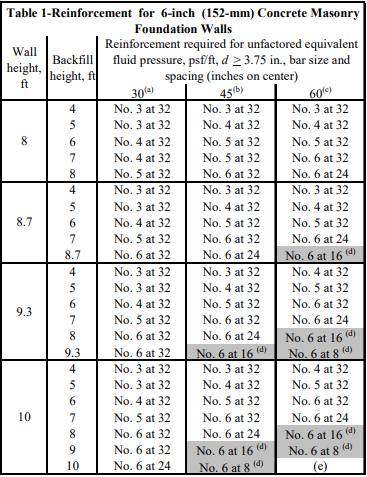
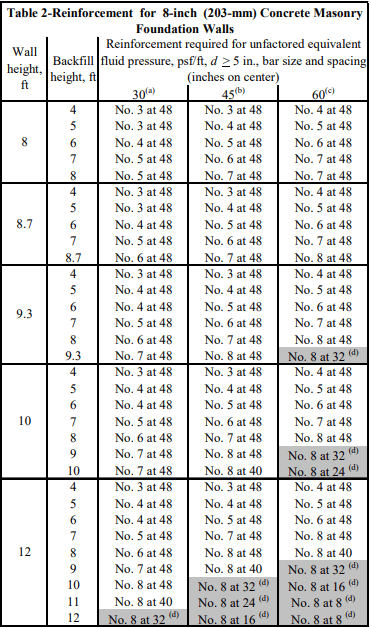
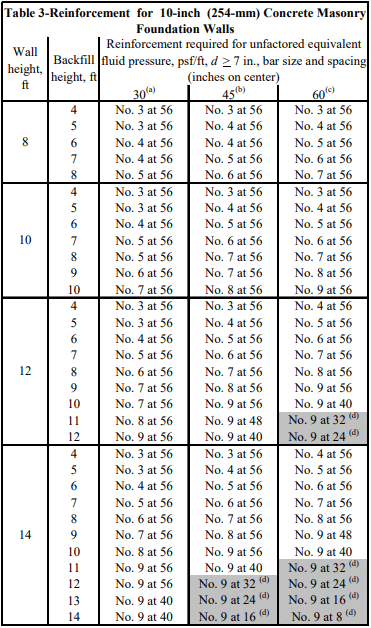
Tables 1 through 4 present reinforcement schedules for 6, 8, 10 and 12-in. (152, 203, 254 and 305-mm) walls, respectively. Additional reinforcement alternatives may be appropriate, and can be verified with an engineering analysis. Walls from 8 to 16 ft (2.4 to 4.9 m) high and soil pressures of 30, 45 and 60 psf/ft (4.7, 7.0, and 9.4 kN/m²/m) are included.
The effective reinforcement depth, d, assumed for the analyses are practical values, taking into account variations in face shell thickness, a range of reinforcing bar sizes, minimum required grout cover and construction tolerances for placing the reinforcement.
The following assumptions also apply to the values in Tables 1 through 4:
there are no surcharges on the soil adjacent to the wall,
there are negligible axial loads on the wall,
the wall is simply supported at top and bottom,
the wall is grouted at cells containing reinforcement (although solid grouting is acceptable),
section properties are based on minimum face shell and web thickness requirements of ASTM C 90 (ref. 3),
the specified compressive strength of masonry, f’m, is 1500 psi (10.3 MPa),
Grade 60 (413 MPa) reinforcement,
reinforcement requirements listed account for a soil load factor of 1.6 (ref. 6),
the maximum width of the compression zone is limited to six times the wall thickness, or a 72 in. (1,829 mm) vertical bar spacing, whichever is smaller,
reinforcing steel is placed toward the tension (interior) face of the wall (as shown in Figure 1), and
the soil is well drained to preclude the presence of saturated soil.
Table 1-Reinforcement for 6-inch (152-mm) Concrete Masonry Foundation Walls
Table 2-Reinforcement for 8-inch (203-mm) Concrete Masonry Foundation Walls
Table 3-Reinforcement for 10-inch (254-mm) Concrete Masonry Foundation Walls
Table 4-Reinforcement for 12-inch (305-mm) Concrete Masonry Foundation Walls
DESIGN EXAMPLE
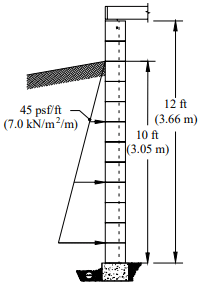
Wall: 12-in. (305 mm) thick concrete masonry foundation wall, 12 ft (3.66 m) high
Soil: equivalent fluid pressure is 45 psf/ft (7.0 kN/m²/m) (excluding soil load factors), 10 ft (3.05 m) backfill height
Using Table 4, the wall can be adequately reinforced using No. 9 bars at 72 in. o.c. (M# 29 at 1,829 mm).
Design Example
CONSTRUCTION ISSUES
This section discusses those issues which directly relate to structural design assumptions. See TEK 03-11, Concrete Masonry Basement Wall Construction and TEK 05-03A, Concrete Masonry Foundation Wall Details (refs. 4, 5) for more complete information on building concrete masonry foundation walls.
Figure 1 illustrates wall support conditions, drainage and protection from water. Before backfilling, the floor diaphragm must be in place, or the wall must be properly braced to resist the soil load. Ideally, the backfill should be free-draining granular material, free from expansive soils or other deleterious materials.
The assumption that there are no surcharges on the soil means that heavy equipment should not be operated directly adjacent to any basement wall system. In addition, the backfill materials should be placed and compacted in several lifts. Care should be taken when placing backfill materials to prevent damaging the drainage, waterproofing or exterior insulation systems.
Figure 1—Typical Reinforced Basement Wall
REFERENCES
Building Code Requirements for Masonry Structures, ACI 530-02/ASCE 5-02/TMS 402-02. Reported by the Masonry Standards Joint Committee, 2002.
Strength Design Provisions for Concrete Masonry, TEK 14-04B, Concrete Masonry & Hardscapes Association, 2008.
Standard Specification for Loadbearing Concrete Masonry Units, ASTM C 90-03. ASTM International, 2003.
Basements provide: economical living, working and storage areas; convenient spaces for mechanical equipment; safe havens during tornadoes and other violent storms; and easy access to plumbing and ductwork. Concrete masonry is well suited to basement and foundation wall construction due to its inherent durability, compressive strength, economy, and resistance to fire, termites, and noise.
Traditionally, residential basement walls have been constructed of plain (unreinforced) concrete masonry, often designed empirically. Walls over 8 ft (2.4 m) high or with larger soil loads are typically designed using reinforced concrete masonry or using design tables included in building codes such as the International Building Code (ref. 4).
DESIGN LOADS
Soil imparts a lateral load on foundation walls. For design, the load is traditionally assumed to increase linearly with depth resulting in a triangular load distribution. This lateral soil load is expressed as an equivalent fluid pressure, with units of pounds per square foot per foot of depth (kPa/m). The maximum force on the wall depends on the total wall height, soil backfill height, wall support conditions, soil type, and the existence of any soil surcharges. For design, foundation walls are typically assumed to act as simple vertical beams laterally supported at the top and bottom.
Foundation walls also provide support for the structure above, transferring vertical loads to the footing. When foundations span vertically, this vertical compression counteracts flexural tension, increasing the wall’s resistance to flexure. In low-rise construction, these vertical loads are typically small in relation to the compressive strength of concrete masonry. Further, if the wall spans horizontally, vertical compression does not offset the flexural tension. Vertical load effects are not included in the tables and design example presented in this TEK (references 2 and 3 include vertical load effects).
EMPIRICAL DESIGN
The empirical design method uses historical experience to proportion and size masonry elements. Empirical design is often used to design concrete masonry foundation walls due to its simplicity and history of successful performance.
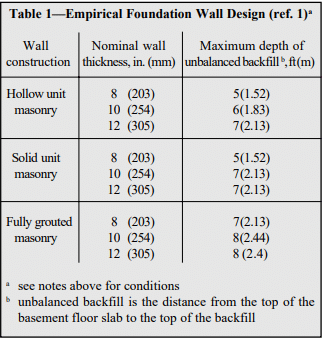
Table 1 lists the allowable backfill heights for 8, 10 and 12-inch (203, 254 and 305 mm) concrete masonry foundation walls. Table 1 may be used for foundation walls up to 8 feet (2.4 m) high under the following conditions (ref. 1):
terrain surrounding the foundation wall is graded to drain surface water away from foundation walls,
backfill is drained to remove ground water away from foundation walls,
tops of foundation walls are laterally supported prior to backfilling,
the length of foundation walls between perpendicular masonry walls or pilasters is a maximum of 3 times the foundation wall height,
the backfill is granular and soil conditions in the area are non-expansive,
masonry is laid in running bond using Type M or S mortar, and
units meet the requirements of ASTM C 90 (ref. 6).
Where these conditions cannot be met, the wall must be engineered using either an allowable stress design (see following section) or strength design procedure (see ref. 5).
Table 1—Empirical Foundation Wall Design (ref. 1)
WALL DESIGN
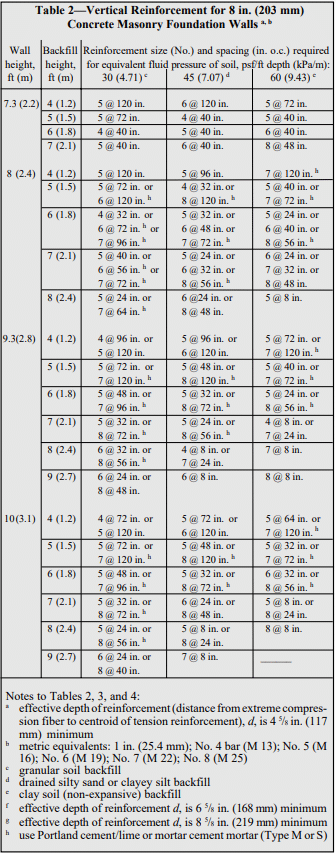
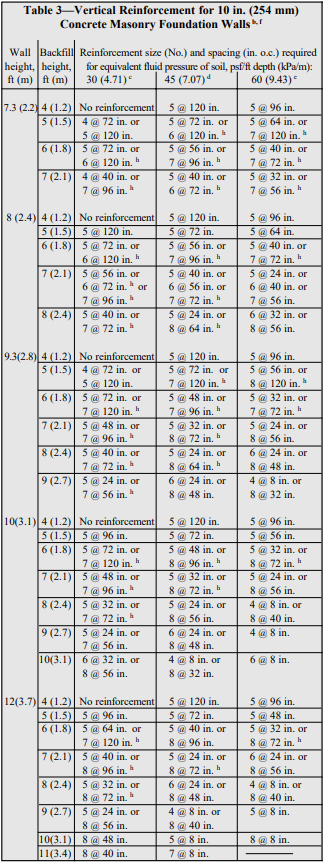
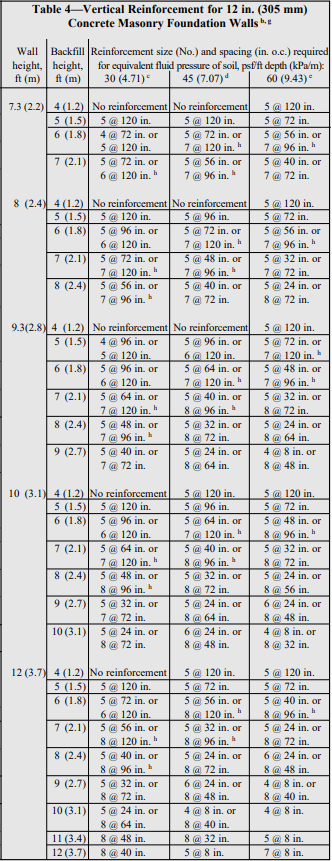
Tables 2 through 4 of this TEK have been rationally designed in accordance with the allowable stress design provisions of Building Code Requirements for Masonry Structures (ref. 1) and therefore meet the requirements of the International Building Code even though the latter limits reinforcment spacing to 72 in. (1829 mm) when using their tables. Additional reinforcement alternatives may be appropriate and can be verified with an engineering analysis.
Tables 2, 3 and 4 list reinforcement options for 8, 10 and 12-in. (203, 254 and 305-mm) thick walls, respectively. The effective depths of reinforcement, d, (see Table notes) used are practical values, taking into account variations in face shell thickness, a range of bar sizes, minimum required grout cover, and construction tolerances for placing the reinforcing bars.
Tables 2 through 4 are based on the following:
no surcharges on the soil adjacent to the wall and no hydrostatic pressure,
negligible axial loads on the wall,
wall is simply supported at top and bottom,
wall is grouted only at reinforced cells,
section properties are based on minimum face shell and web thicknesses in ASTM C 90 (ref. 6),
specified compressive strength of masonry, f’m, is 1,500 psi (10.3 MPa),
reinforcement yield strength, fy, is 60,000 psi (414 MPa),
modulus of elasticity of masonry, Em, is 1,350,000 psi (9,308 MPa),
modulus of elasticity of steel, Es, is 29,000,000 psi (200,000 MPa),
maximum width of compression zone is six times the wall thickness (where reinforcement spacing exceeds this distance, the ability of the plain masonry outside the compression zone to distribute loads horizontally to the reinforced section was verified assuming two-way plate action),
allowable tensile stress in reinforcement, Fs, is 24,000 psi (165 MPa),
allowable compressive stress in masonry, Fb, is ⅓f’m (500 psi, 3.4 MPa),
grout complies with ASTM C 476 (2,000 psi (14 MPa) if property spec is used) (ref. 7), and
masonry is laid in running bond using Type M or S mortar and face shell mortar bedding.
Table 2—Vertical Reinforcement for 8 in. (203 mm) Concrete Masonry Foundation Walls
Table 3—Vertical Reinforcement for 10 in. (254 mm) Concrete Masonry Foundation Walls
Table 4—Vertical Reinforcement for 12 in. (305 mm) Concrete Masonry Foundation Walls
DESIGN EXAMPLE
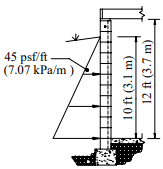
Wall: 12-inch (305 mm) thick, 12 feet (3.7 m) high.
Loads: equivalent fluid pressure of soil is 45 pcf (7.07 kPa/ m), 10 foot (3.1 m) backfill height. No axial, seismic, or other loads.
Using Table 4, #8 bars at 40 in. (M 25 at 1016 mm) o.c. are sufficient.
CONSTRUCTION ISSUES
This section is not a complete construction guide, but rather discusses those issues directly related to structural design assumptions. Figures 1 and 2 illustrate typical wall support conditions, drainage, and water protection.
Before backfilling, the floor diaphragm must be in place or the wall must be properly braced to resist the soil load. In addition to the absence of additional dead or live loads following construction, the assumption that there are no surcharges on the soil also means that heavy equipment should not be operated close to basement wall systems that are not designed to carry the additional load. In addition, the backfill materials should be placed and compacted in several lifts, taking care to prevent wall damage. Care should also be taken to prevent damaging the drainage, waterproofing, or exterior insulation systems, if present.
Figure 1—Typical Base of Foundation Wall
Figure 2—Typical Top of Foundation Wall
REFERENCES
Building Code Requirements for Masonry Structures, ACI 530-99/ASCE 5-99/TMS 402-99. Reported by the Masonry Standards Joint Committee, 1999.
International Building Code. International Code Council, 2000.
Strength Design of Reinforced CM Foundation Walls, TEK 15-02B, Concrete Masonry & Hardscapes Association, 2004.
Standard Specification for Loadbearing Concrete Masonry Units, ASTM C 90-01. American Society for Testing and Materials, 2001.
Standard Specification for Grout Masonry, ASTM C476- 01. American Society for Testing and Materials, 2001.
Masonry infill refers to masonry used to fill the opening in a structural frame, known as the bounding frame. The bounding frame of steel or reinforced concrete is comprised of the columns and upper and lower beams or slabs that surround the masonry infill and provide structural support. When properly designed, masonry infills provide an additional strong, ductile system for resisting lateral loads, in-plane and out-of-plane.
Concrete masonry infills can be designed and detailed to be part of the lateral force-resisting system (participating infills) or they can be designed and detailed to be structurally isolated from the lateral force-resisting system and resist only out-of-plane loads (non-participating infills).
Participating infills form a composite structural system with the bounding frame, increasing the strength and stiffness of the wall system and its resistance to earthquake and wind loads.
Non-participating infills are detailed with structural gaps between the infill and the bounding frame to prevent the unintended transfer of in-plane loads from the frame into the infill. Such gaps are later sealed for other code requirements such as weather protection, air infiltration, energy conservations, etc.
Construction of concrete masonry infilled frames is relatively simple. First, the bounding frame is constructed of either reinforced concrete or structural steel, then the masonry infill is constructed in the portal space. This construction sequence allows the roof or floor to be constructed prior to the masonry being laid, allowing for rapid construction of subsequent stories or application of roofing material.
The 2011 edition of Building Code Requirements for Masonry Structures (MSJC Code, ref. 1) includes a new mandatory language Appendix B for the design of masonry infills that can be either unreinforced or reinforced. Appendix B provides a straightforward method for the design and analysis of both participating and non-participating infills. Requirements were developed based on experimental research as well as field performance.
MASONRY INFILL LOAD RESPONSE
Several stages of in-plane loading response occur with a participating masonry infill system. Initially, the system acts as a monolithic cantilever wall whereby slight stress concentrations occur at the four corners, while the middle of the panel develops an approximately pure shear stress state. As loading continues, separation occurs at the interface of the masonry and the frame members at the off-diagonal corners. Once a gap is formed, the stresses at the tensile corners are relieved while those near the compressive corners are increased.
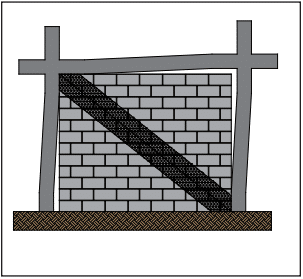
As loading continues, further separation between the masonry panel and the frame occurs, resulting in contact only near the loaded corners of the frame. This results in the composite system behaving as a braced frame, which leads to the concept of replacing the masonry infill with an equivalent diagonal strut, as shown in Figure 1. These conditions are addressed in the masonry standard.
Participating masonry infills resist out-of-plane loads by an arching mechanism. As out-of-plane loads increase beyond the elastic limit, flexural cracking occurs in the masonry panel. This cracking (similar to that which occurs in reinforced masonry) allows for arching action to resist the applied loads, provided the infill is constructed tight to the bounding frame and the infill is not too slender.
Figure 1—Concrete Masonry Infill as a Diagonal Strut
IN-PLANE SHEAR FOR PARTICIPATING INFILLS
For participating infills, the masonry is either mortared tight to the bounding frame so that the infill receives lateral loads immediately as the frame displaces, or the masonry is built with a gap such that the bounding frame deflects slightly before it bears upon the infill. If a gap exists between the infill and the frame, the infill is considered participating if the gap is less than ⅜ in. (9.5 mm) and the calculated displacements, according to MSJC Code Section B3.1.2.1. However, the infill can still be designed as a participating infill, provided the calculated strength and stiffness are reduced by half.
The maximum height-to-thickness ratio (h/t) of the participating infill is limited to 30 in order to maintain stability. The maximum thickness allowed is one-eighth of the infill height.
The MSJC Code requires participating infills to fully infill the bounding frame and have no openings—partial infills or infills with openings may not be considered as part of the lateral force resisting system because structures with partial infills have typically not performed well during seismic events. The partial infill attracts additional load to the column due to its increased stiffness; typically, this results in shear failure of the column.
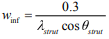
The in-plane design is based on a braced frame model, with the masonry infill serving as an equivalent strut. The width of the strut is determined from Equation 1 (see Figure 1).
where:
The term λstrut, developed by Stafford Smith and Carter (ref. 2) in the late 60s, is the characteristic stiffness parameter for the infill and provides a measure of the relative stiffness of the frame and the infill. Design forces in the equivalent strut are then calculated based on elastic shortening of the compression-only strut within the braced frame. The area of the strut used for that analysis is determined by multiplying the strut width from Equation 1 by the specified thickness of the infill.
The infill capacity can be limited by shear cracking, compression failure, and flexural cracking. Shear cracking can be characterized by cracking along the mortar joints (which includes st epped and horizontal cracks) and by diagonal tensile cracking. The compression failure mode consists of either crushing of the masonry in the loaded diagonal corners or failure of the equivalent diagonal strut. The diagonal strut is developed within the panel as a result of diagonal tensile cracking. Flexural cracking failure is rare because separation at the masonry-frame interface usually occurs first; then, the lateral force is resisted by the diagonal strut.
As discussed above, the nominal shear capacity is determined as the least of: the capacity infill corner crushing; the horizontal component of the force in the equivalent strut at a racking displacement of 1 in. (25 mm); or, the smallest nominal shear strength from MSJC Code Section 3.2.4, calculated along a bed joint. The displacement limit was found to be a better predictor of infill performance than a drift limit.
Generally, the infill strength is reached at lower displacements for stiff bounding columns, while more flexible columns result in the strength being controlled at the 1-in. (25-mm) displacement limit. While MSJC Code Section 3.2 is for unreinforced masonry, use of equations from that section does not necessarily imply that the infill material must be unreinforced. The equations used in MSJC Code Section 3.2 are more clearly related to failure along a bed joint and are therefore more appropriate than equations from MSJC Code Section 3.3 for reinforced masonry.
The equations used in the code are the result of comparing numerous analytical methods to experimental results. They are strength based. The experimental results used for comparison were a mixture of steel and reinforced concrete bounding frames with clay and concrete masonry. While some methods presented by various researchers are quite complex, the code equations are relatively simple.
OUT-OF-PLANE FLEXURE FOR PARTICIPATING INFILLS
The out-of-plane design of participating infills is based on arching of the infill within the frame. As out-of-plane forces are applied to the surface of the infill, a two-way arch develops, provided that the infill is constructed tight to the bounding frame. The code equation models this two-way arching action.
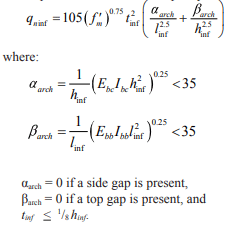
As previously mentioned, the maximum thickness allowed for calculation for the out-of-plane capacity is one-eighth of the infill height. Gaps between the bounding frame on either the sides or top of the infill reduce the arching mechanism to a one-way arch and are considered by the code equations. Bounding frame members that have different cross sectional properties are accounted for by averaging their properties for use in the code equations.
NON-PARTICIPATING INFILLS
Because non-participating infills support only out-of-plane loads, they must be detailed to prevent in-plane load transfer into the infill. For this reason, MSJC Code Section B.2.1 requires these infills to have isolation joints at the sides and the top of the infill. These isolation joints must be at least ⅜ in. (9.5 mm) and sized to accommodate the expected design displacements of the bounding frame, including inelastic deformation due to a seismic event, to prevent the infill from receiving in-plane loadings. The isolation joints may contain filler material as long as the compressibility of the material is taken into consideration when sizing the joint.
Mechanical connectors and the design of the infill itself ensure that non-participating infills support out-of-plane loads. Connectors are not allowed to transmit in-plane loads. The masonry infill may be designed to span vertically, horizontally, or both. The masonry design of the non-participating infill is carried out based on the applicable MSJC Code sections for reinforced or unreinforced masonry (Section 3.2 for unreinforced infill and Section 3.3 for reinforced infill using strength design methods). Note that there are seismic conditions which may require the use of reinforced masonry.
Because they support only out-of-plane loads, non-participating infills can be constructed with full panels, partial height panels, or panels with openings. The corresponding effects on the bounding frame must be included in the design.
BOUNDING FRAME FOR PARTICIPATING INFILLS
The MSJC Code provides guidance on the design loads applied to the bounding frame members; however, the actual member design is governed by the appropriate material code and is beyond the scope of the MSJC Code.
The presence of infill within the bounding frame places localized forces at the intersection of the frame members. MSJC Code Section B.3.5 helps the designer determine the appropriate augmented loads for designing the bounding frame members. Frame members in bays adjacent to an infill, but not in contact with the infill, should be designed for no less than the forces (shear, moment, and axial) from the equivalent strut frame analysis. In the event of infill failure, the loading requirement on adjacent frame members ensures adequacy in the frame design, thus preventing progressive collapse.
The shear and moment applied to the bounding column must be at least the results from the equivalent strut frame analysis multiplied by a factor of 1.1. The axial loads are not to be less than the results of that analysis. Additionally, the horizontal component of the force in the equivalent strut is added to the design shear for the bounding column.
Similarly, the shear and moment applied to the bounding beam or slab must be at least the results from the equivalent strut frame analysis multiplied by a factor of 1.1, and the axial loads are not to be less than the results of that analysis. The vertical component of the force in the equivalent strut is added to the design shear for the bounding beam or slab.
The bounding frame design should also take into consideration the volumetric changes in the masonry infill material that may occur over time due to normal temperature and moisture variations. Shrinkage of concrete masonry infill material may open gaps between the infill and the bounding frame that need to be addressed. Guidance for these volumetric changes is provided in MSJC Code Section 1.7.5.
CONNECTORS
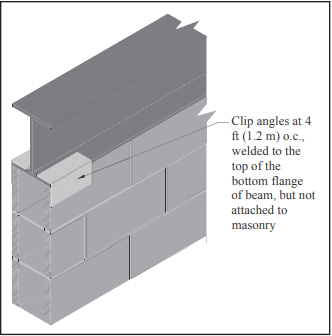
Mechanical connectors between the bounding frame and the infill provide out-of-plane support of the masonry, for both participating and non-participating infills. Connectors are required only for the direction of span (i.e., at the top and bottom of the infill for infill spanning vertically, for example). The connectors must be designed to support the expected out-of-plane loads and may not be spaced more than 4 ft (1.2 m) apart along the perimeter of the infill. Figure 2 shows an example of a mechanical connector composed of clip angles welded to the bottom flange of the steel beam.
Connectors for both participating and non-participating infills are not permitted to transfer in-plane loads from the bounding frame to the infill. For participating infills, in-plane loads are assumed to be resisted by a diagonal compression strut (see Figure 1), which does not rely upon mechanical connectors to transfer in-plane load. Research (ref. 3) has shown that when connectors transmit in-plane loads they create regions of localized stress and can cause premature damage to the infill. This damage then reduces the infill’s out-of-plane capacity because arching action is inhibited.
Figure 2—Example of Mechanical Infill Connector
EXAMPLE 1: DESIGN OF PARTICIPATING MASONRY INFILL WALL FOR IN-PLANE LOADS
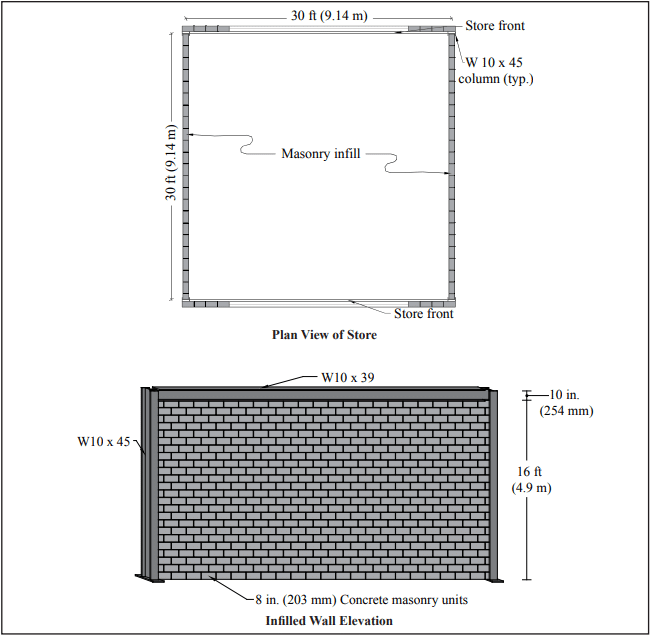
Consider the simple structure of Figure 3. The east and west side walls are concrete masonry infills laid in running bond, while the north and south walls are store-fronts typical of convenience stores. Steel frames support all gravity loads and the lateral load in the east-west direction. The bounding columns are W10x45s oriented with the strong axis in the east-west direction. The bounding beams above the masonry infill are W10x39s. The masonry infill resists the lateral load in the north-south direction.
Use nominal 8-in. (203-mm) concrete masonry units, f’m = 1,500 psi (10.34 MPa), and Type S PCL mortar. Assume hollow units with face-shell bedding only. The total wall height measures 16 ft-10 in. (5.1 m) to the roof with the infill being 16 2 ft (4.9 m). The building is loaded with a wind load of 24 lb/ft² calculated per ASCE 7-10 (ref. 6) in the north-south direction. The roof acts as a one-way system, transmitting gravity loads to the north and south roof beams. Infill and bounding beam properties are summarized in Tables 1 and 2.
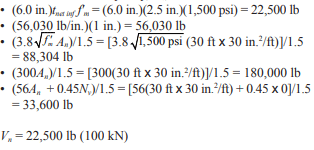
MSJC Code Section B.3.4.3 requires Vn inf to be the smallest of the following:
(6.0 in.)tnet inff’m
the calculated horizontal component of the force in the equivalent strut at a horizontal racking displacement of 1.0 in. (25 mm)
Vn/1.5, where Vn is the smallest nominal shear strength from MSJC Code Section 3.2.4, calculated along a bed joint.
MSJC Code Section 3.2.4 requires the nominal shear strength not exceed the least of the following:
3.8 An √f ′m
300An
56An + 0.45Nv for running bond masonry not fully grouted and for masonry not laid in running bond, constructed of open end units, and fully grouted
90An + 0.45Nv for running bond masonry fully grouted
23An for masonry not laid in running bond, constructed of other than open end units, and fully grouted
Figure 3—Convenience Store Layout for Design Examples 1 & 2
Table 1—Infill Properties
Table 2—Bounding Frame Properties for In-Plane Loads
As a result of the wind loading, the reaction transmitted to the roof diaphragm is:
Reaction = ½ (24lb/ft²)(16.83 ft) = 202 lb/ft (2.95 kN/m)
Total roof reaction acting on one side of the roof is Reaction = (202 lb/ft)(30 ft) = 6,060 lb (27.0 kN)
This reaction is divided evenly between the two masonry infills, so the shear per infill is 3,030 lb (13.5 kN).
Using the conservative loading case of 0.9D + 1.0W, Vu = 1.0 Vunfactored = 1.0 (3,030 lb) = 3,030 lb (13.5 kN)
To be conservative, the axial load to the masonry infill is taken as zero.
To ensure practical conditions for stability, the ratio of the nominal vertical dimension to the nominal thickness is limited to 30 for participating infills. The ratio for this infill is: h/t = 192 in./8 in. = 24 < 30 The ratio is less than 30 and the infill is therefore acceptable as a participating infill.
The width of the equivalent strut is calculated by Equation 1 (MSJC Code Equation B-1):
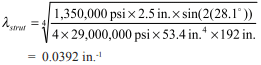
where λstrut is given by Equation 2 (Code Equation B-2).
The angle of the equivalent diagonal strut, θstrut, is the angle of the infill diagonal with respect to the horizontal. θstrut = tan-1 (hinf/linf) = tan-1 (192 in./360 in.) = 28.1°
Using Equation 2, the characteristic stiffness parameter, λstrut, for this infill is then:
The resulting strut width is then:
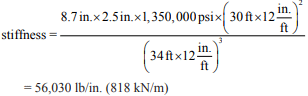
The stiffness of the equivalent braced frame is determined by a simple braced frame analysis where the stiffness is based on the elastic shortening of the diagonal strut. The strut area is taken as the width of the strut multiplied by the net thickness of the infill.
The stiffness is:
where d is the diagonal length of the infill, 34 ft (10.3 m) in this case.
The nominal shear capacity, Vn, is then the least of:
The design shear capacity is:
The design shear capacity far exceeds the factored design shear of 3,030 lb (13.5 kN), so the infill is satisfactory for shear.
Additionally, the provisions of MSJC Code Section B.3.5 require that the designer consider the effects of the infill on the bounding frame. To ensure adequacy of the frame members and connections, the shear and moment results of the equivalent strut frame analysis are multiplied by a factor of 1.1. The column designs must include the horizontal component of the equivalent strut force, while the beam designs must include the verti cal component of the equivalent strut force. The axial forces from the equivalent strut frame analysis must also be considered in both the column and beam designs.
EXAMPLE 2: DESIGN OF PARTICIPATING MASONRY INFILL WALL FOR OUT-OF-PLANE LOADS
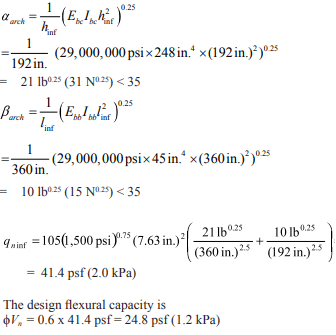
Design the infill from the previous example for an out-of-plane wind load W of 24 lb/ft² (1.2 kPa) per ASCE 7-10 acting on the east wall, using Type S PCL mortar, and units with a nominal thickness of 8 in. (203 mm). Assume hollow units with face-shell bedding only and that the infill is constructed tight to the bounding frame such that there are no gaps at the top or sides of the infill. See Table 3 for frame properties.
MSJC Code Section B.3.6 provides the equations for the nominal out-of-plane flexural capacity. MSJC Code Equation B-5 requires that the flexural capacity of the infill be:
Using the conservative loading case of 0.9D + 1.0W, the design wind load pressure is:
q = 1.0W = 1.0 x 24 psf = 24 psf (1.15 kPa) tinf = 7.625 in. < (⅛)(192 in.), OK
The design flexural capacity exceeds the factored design wind load pressure of 24 lb/ft² (1.2 kPa), so the infill is satisfactory for out-of-plane loading
Table 3—Bounding Frame Properties for Out-of Plane Loads
NOTATIONS
An = net cross-sectional area of a member, in.² (mm²) D = dead load, psf (Pa) d = diagonal length of the infill, in. (mm) Ebb = modulus of elasticity of bounding beams, psi (MPa) Ebc = modulus of elasticity of bounding columns, psi (MPa) Em = modulus of elasticity of masonry in compression, psi (MPa) f’m = specified compressive strength of masonry, psi (MPa) h = effective height of the infill, in. (mm) hinf = vertical dimension of infill, in. (mm) Ibb = moment of inertia of bounding beam for bending in the plane of the infill, in.4 (mm4) Ibc = moment of inertia of bounding column for bending in the plane of the infill, in.4 (mm4) linf = plan length of infill, in. (mm) Nv = compressive force acting normal to shear surface, lb (N) qn inf = nominal out-of-plane flexural capacity of infill per unit area, psf (Pa) t = nominal thickness of infill, in. (mm) tinf = specified thickness of infill, in. (mm) tnet inf = net thickness of infill, in. (mm) Vn = nominal shear strength, lb (N) Vn inf = nominal horizontal in-plane shear strength of infill, lb (N) Vu = factored shear force, lb (N) Vunfactored = unfactored shear force, lb (N) W = out of plane wind load, psf (Pa) winf = width of equivalent strut, in. (mm) αarch = horizontal arching parameter for infill, lb0.25 (N0.25) βarch = vertical arching parameter for infill, lb0.25 (N0.25) λstrut = characteristic stiffness parameter for infill, in.-1 (mm-1) θstrut = angle of infill diagonal with respect to the horizontal, degrees ϕ = strength reduction factor
REFERENCES
Building Code Requirements for Masonry Structures, TMS 402-11/ACI 530-11/ASCE 5-11. Reported by the Masonry Standards Joint Committee, 2011.
Stafford-Smith, B. and Carter, C. (1969) “A Method for the Analysis of Infilled Frames.” Proceedings of the Institution of Civil Engineers, 44, 31-48.
Dawe, J. L., and Seah, C. K. (1989a). “Behavior of Masonry Infilled Steel Frames.” Canadian Journal of Civil Engineering, Ottowa, 16, 865-876.
Tucker, Charles J. “Infilling the Frame With Masonry.” Structure, May 2012.
Tucker, Charles J. “Changing Masonry Standards: Masonry Infills.” Structure, Feb. 2012.
Minimum Design Loads for Buildings and Other Structures, ASCE SEI 7-10. American Society of Civil Engineers Structural Engineering Institute, 2010.
Construction of masonry wall systems is possible without the use of mortar. The use of standard CMU units laid dry and subsequently surface bonded with fiber reinforced surfaced bonding cement has been well documented in the past. (ref. 16) With the use of specially fabricated concrete masonry units known as “dry-stack units,” construction of these mortarless systems is simple, easy and cost effective. This TEK describes the construction and engineering design of such mortarless wall systems.
The provisions of this TEK apply to both specialty units manufactured specifically for dry-stack construction and conventional concrete masonry units with the following system types:
Grouted, partially grouted or surface bonded
Unreinforced, reinforced, or prestressed
Note that dry-stacked prestressed systems are available that do not contain grout or surface bonding. The provisions of this TEK do not apply to such systems due to a difference in design section properties (ref 8).
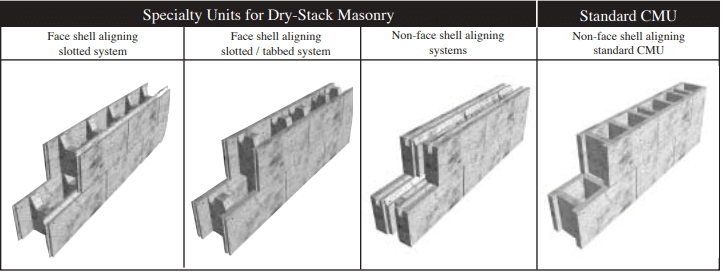
Specially designed units for dry-stack construction are available in many different configurations as shown in Figure 1. The latest and most sophisticated designs incorporate face shell alignment features that make units easier and faster to stack plumb and level. Other units are fabricated with a combination of keys, tabs or slots along both horizontal and vertical faces as shown in Figure 1 so that they may interlock easily when placed. Physical tolerances of dry-stack concrete units are limited to ±1/16 in. (1.58 mm.) which precludes the need for mortaring, grinding of face shell surfaces or shimming to even out courses during construction. Interlocking units placed in running bond resist flexural and shear stresses resulting from out-of-plane loads as a result of the keying action: (a) at the top of a web with the recess in the web of the unit above, (b) at two levels of bearing surface along each face shell at the bed joint, and (c) between adjacent blocks along the head joint. The first of these two interlocking mechanisms also ensures vertical alignment of blocks.
The interlocking features of dry-stack units improve alignment and leveling, reduce the need for skilled labor and reduce construction time. Floor and roof systems can be supported by mortarless walls with a bond beam at the top of the wall which expedites the construction process.
Wall strength and stability are greatly enhanced with grouting which provides the necessary integrity to resist forces applied parallel, and transverse to, the wall plane. Vertical alignment of webs ensures a continuous grout column even when the adjacent cell is left ungrouted. Grouting is necessary to develop flexural tensile stress normal to the bed joints, which is resisted through unit-mortar bond for traditional masonry construction. Strength of grouted dry-stack walls may also be enhanced by traditional reinforcement, prestressing, post-tensioning or with external fiber-reinforced surface coatings (surface bonding) as described in the next section.
Typical applications for mortarless concrete masonry include basement walls, foundation walls, retaining walls, exterior above-grade walls, internal bearing walls and partitions. Dry-stack masonry construction can prove to be a cost-effective solution for residential and low-rise commercial applications because of it’s speed and ease of construction, strength and stability even in zones of moderate and high seismicity. More information on design and construction of dry-stack masonry can be found in Reference 5.
Figure 1–– Dry-Stack Masonry Units
CONSTRUCTION
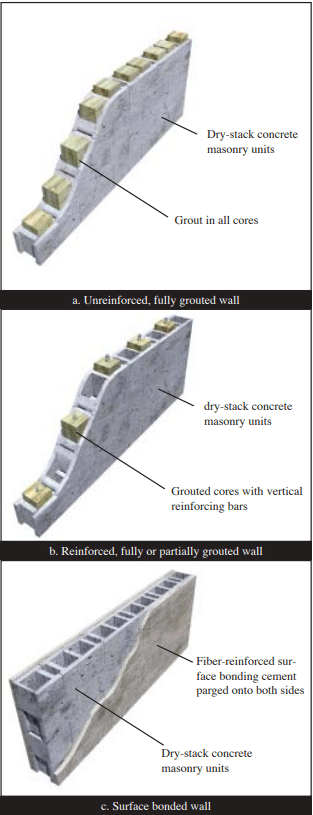
Dry-stack concrete masonry units can be used to construct walls that are grouted or partially grouted; unreinforced, reinforced or prestressed; or surface bonded. With each construction type, walls are built by first stacking concrete masonry units.
For unreinforced construction as shown in Figure 2a, grouting provides flexural and shear strength to a wall system. Flexural tensile stresses due to out-of-plane bending are resisted by the grout cores. Grout cores also interlace units placed in running bond and thus provide resistance to in-plane shear forces beyond that provided by friction developed along horizontal joints. Grout cores can also be reinforced to increase flexural strength.
Reinforcement can be placed vertically, in which case only those cells containing reinforcement may be grouted as shown in Figure 2b, as well as horizontally, in which case the masonry must be fully grouted. Another version is to place vertical prestressing tendons in place of reinforcement. Vertical axial compressive stress, applied via the tendons, increases flexural and shear capacity. Tendons may be bonded to grout, or unbonded, based upon the design. Placement of grout may be optional. Horizontally reinforced bond beam lintels can be created using a grout stop beneath the unit to contain grout.
As an alternative to reinforcing or prestressing, wall surfaces may be parged (coated) with a fiber-reinforced surface bonding cement/stucco per ASTM C887(ref. 14) as illustrated in Figure 2c. This surface treatment, applied to both faces of a wall, bonds concrete units together without the need for grout or internal reinforcement. The parging material bridges the units and fills the joints between units to provide additional bonding of the coating to the units through keying action. The compressive strength of the parging material should be equal to or greater than that of the masonry units.
Figure 2–– Basic Dry-Stack Masonry Wall Types
Laying of Units
The first course of dry-stack block should be placed on a smooth, level bearing surface of proper size and strength to ensure a plumb and stable wall. Minor roughness and variations in level can be corrected by setting the first course in mortar. Blocks should be laid in running bond such that cells will be aligned vertically.
Grout and Reinforcement
Grout and grouting procedures should be the same as used in conventional masonry construction (ref. 1, 10) except that the grout must have a compressive strength of at least 2600 psi (190 MPa) at 28 days when tested in accordance with ASTM C 1019 (ref.12). Placement of grout can be accomplished in one lift for single-story height walls less than 8 ft (2.43 m). Grout lifts must be consolidated with an internal vibrator with a head size less than 1 in. (25 mm).
Vertical Reinforcing
As for conventional reinforced masonry construction, good construction practice should include placement of reinforcing bars around door and window openings, at the ends, top and bottom of a wall, and between intersecting walls. Well detailed reinforcement such as this can help enhance nonlinear deformation capacity, or ductility, of masonry walls in building systems subjected to earthquake loadings – even for walls designed as unreinforced elements. Additional information on conventional grouting and reinforced masonry wall can be found in TEK 09-04A and TEK 03-03B (refs. 9 & 6).
Pre-stressed Walls
Mortarless walls can also be prestressed by placing vertical tendons through the cores. Tendons can be anchored within the concrete foundation at the base of a wall or in a bottom bond beam and are tensioned from the top of a wall.
Surface Bonded Walls
For walls strengthened with a surface bonding, a thin layer of portland cement surface bonding material should be troweled or sprayed on to a wall surface. The thickness of the surface coating should be at least ⅛ in. (3.2 mm.) or as required by the material supplier.
ENGINEERING PROPERTIES
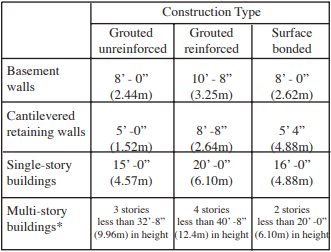
Walls constructed with mortarless masonry can be engineered using conventional engineering principles. Existing building code recommendations such as that produced by the building code (ref. 1) can serve as reference documents, but at the time of this printing it does not address mortarless masonry directly. It is thus considered an alternate engineered construction type. The International Building Code (ref. 7) does list allowable stresses based on gross-cross-sectional area for dry-stacked, surface-bonded concrete masonry walls. These values are the same as presented in TEK 03-05A (ref. 16). Suggested limits on wall or building height are given in Table 1.
Test data (refs. 2, 3 and 4) have shown that the strength of drystack walls exceeds the strength requirements of conventional masonry, and thus the recommended allowable stress design practices of the code can be used in most cases. When designing unreinforced, grouted masonry wall sections, it is important to deduct the thickness of the tension side face shell when determining the section properties for flexural resistance.
Table 1 –– Summary of Wall Heights for 8” (203 mm) Dry-stacked Units (ref. 5)
* Laterally supported at each floor
Unit and Masonry Compressive Strength
Units used for mortarless masonry construction are made of the same concrete mixes as used for conventional masonry units. Thus, compressive strength of typical units could vary between 2000 psi (13.79MPa) and 4000 psi. (27.58 MPa) Standard Methods of Sampling and Testing Concrete Masonry Units (ref. 11) can be referred to for determining strength of dry-stack units.
Masonry compressive strength f’m can conservatively be based on the unit-strength method of the building code (ref . 15), or be determined by testing prisms in accordance with ASTM C1314 (ref. 4). Test prisms can be either grouted or ungrouted depending on the type of wall construction specified.
Because no mortar is used to resist flexural tension as for conventional masonry construction, flexural strength of mortarless masonry is developed through the grout, reinforcement or surface coating. For out-of-plane bending of solid grouted walls allowable flexural strength can be estimated based on flexural tensile strength of the grout per Equation 1.
Consideration should be given to the reduction in wall thickness at the bed joints when estimating geometrical properties of the net effective section.
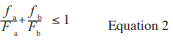
Correspondingly, flexural strength based on masonry compressive stress should be checked, particularly for walls resisting significant gravity loads, using the unity equation as given below.
Buckling should also be checked. (Ref. 8)
In-Plane Shear Strength
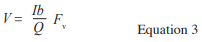
Shear strength for out-of-plane bending is usually not a concern since flexural strength governs design for this case. For resistance to horizontal forces applied parallel to the plane of a wall, Equation 3 may be used to estimate allowable shear strength.
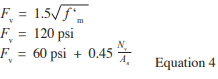
Fv is the allowable shear strength by the lesser of the three values given in Equation 4.
Grouted, Reinforced Construction
Mortarless masonry that is grouted and reinforced behaves much the same as for conventional reinforced and mortared construction. Because masonry tensile strength is neglected for mortared, reinforced construction, flexural mechanisms are essentially the same with or without the bed joints being mortared provided that the units subjected to compressive stress are in good contact. Thus, allowable stress design values can be determined using the same assumptions and requirements of the MSJC code. (ref.1)
Axial and flexural tensile stresses are assumed to be resisted entirely by the reinforcement. Strains in reinforcement and masonry compressive strains are assumed to vary linearly with their distance from the neutral axis. Stresses in reinforcement and masonry compressive stresses are assumed to vary linearly with strains. For purposes of estimating allowable flexural strengths, full bonding of reinforcement to grout are assumed such that strains in reinforcement are identical to those in the adjacent grout.
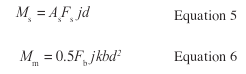
For out-of-plane loading where a single layer of vertical reinforcement is placed, allowable flexural strength can be estimated using the equations for conventional reinforcement with the lower value given by Equations 5 or 6.
In-Plane Shear Strength
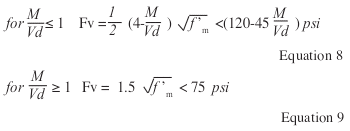
Though the MSJC code recognizes reinforced masonry shear walls with no shear, or horizontal reinforcement, it is recommended that mortarless walls be rein- forced with both vertical and horizontal bars. In such case, allowable shear strength can be determined based on shear reinforcement provisions (ref. 1) with Equations 7, 8 and 9.
Where Fv is the masonry allowable shear stress per Equations 8 or 9.
Solid Grouted, Prestressed Construction
Mortarless masonry walls that are grouted and pre- stressed can be designed as unreinforced walls with the prestressing force acting to increase the vertical compres- sive stress. Grout can be used to increase the effective area of the wall. Flexural strength will be increased because of the increase in the fa term in Equation 1. Shear strength will be increased by the Nv term in Equation 4.
Because the prestressing force is a sustained force, creep effects must be considered in the masonry. Research on the long-term behavior of dry-stacked masonry by Marzahn and Konig (ref. 8) has shown that creep effects may be accentuated for mortarless masonry as a result of stress concentrations at the contact points of adjacent courses. Due to the roughness of the unit surfaces, high stress concentrations can result which can lead to higher non-proportional creep deformations. Thus, the creep coefficient was found to be dependent on the degree of roughness along bed-joint surfaces and the level of applied stress. As a result, larger losses in prestressing force is probable for dry-stack masonry.
Surface-Bonded Construction
Dry-stack walls with surface bonding develop their strength through the tensile strength of small fiberglass fibers in the 1/8” (3.8mm) thick troweled or surface bonded cement-plaster coating ASTM C-887(Ref. 14). Because no grouting is necessary, flexural tension and shear strength are developed through tensile resistance of fiberglass fibers applied to both surfaces of a wall. Test data has shown that surface bonding can result in a net flexural tension strength on the order of 300 psi.(2.07 MPa) Flexural capacity, based on this value, exceeds that for conventional, unreinforced mortared masonry construction, therefore it is considered conservative to apply the desired values of the code (ref. 1) for allowable flexural capacity for portland cement / lime type M for the full thickness of the face shell.
Out-of-Plane and In-Plane Flexural Strength
Surface-bonded walls can be considered as unreinforced and ungrouted walls with a net allowable flexural tensile strength based on the strength of the fiber-reinforcement. Flexural strength is developed by the face shells bonded by the mesh. Allowable flexural strength can be determined using Equation 1 with an Ft value determined on the basis of tests provided by the surface bonding cement supplier. Axial and flexural compressive stresses must also be checked per Equation 2 considering again only the face shells to resist stress.
Surface Bonded In-Plane Shear Strength
In-plane shear strength of surface-bonded walls is attributable to friction developed along the bed joints resulting from vertical compressive stress in addition to the diagonal tension strength of the fiber coating. If the enhancement in shear strength given by the fiber reinforced surface parging is equal to or greater than that provided by the mortar-unit bond in conventional masonry construction, then allowable shear strength values per the MSJC code (ref. 1) may be used. In such case, section properties used in Equation 3 should be based on the cross-section of the face shells.
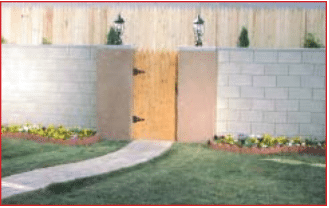
Figure 3 – A Mortarless Garden Wall Application
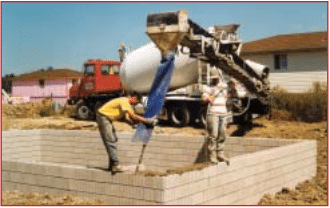
Figure 4 – A Residential, Mortarless, Single-Family Basement – Part of a 520 Home Development
REFERENCES
Building Code Requirements for Masonry Structures), ACI 530-02/ ASCE 5-02/TMS 402-02. Reported by the Masonry Standards Joint Committee (MSJC), 2002.
Drysdale, R.G., Properties of Dry-Stack Block, Windsor, Ontario, July 1999.
Drysdale, R.G., Properties of Surface-Bonded Dry-Stack Block Construction, Windsor, Ontario, January 2000.
Drysdale, R.G., Racking Tests of Dry-Stack Block, Windsor, Ontario, October 2000.
Drysdale, R.G., Design and Construction Guide for Azar Dry-Stack Block Construction, JNE Consulting, Ltd., February 2001.
Grout for Concrete Masonry, TEK 09-04A, Concrete Masonry & Hardscapes Association, 2002.
2000 International Building Code, Falls Church, VA. International Code Council, 2000.
Marzahn, G. and G. Konig, Experimental Investigation of Long-Term Behavior of Dry-Stacked Masonry, Journal of The Masonry Society, December 2002, pp. 9-21.
Hybrid Concrete Masonry Construction Details, TEK 0303B. Concrete Masonry & Hardscapes Association, 2009.
Specification for Masonry Structures, ACI 530.1-02/ASCE 6-02/ TMS 602-02. Reported by the Masonry Standards Joint Committee (MSJC), 2002.
Standard Methods of Sampling and Testing Concrete Masonry Units, ASTM C140-02a, ASTM International, Inc. , Philadelphia, 2002.
Standard Method of Sampling and Testing Grout, ASTM C1019-02, ASTM International, Inc., Philadelphia, 2002.
Standard Specification for Grout for Masonry, ASTM C 476-02. ASTM International, Inc., 2002
Standard Specification for Packaged, Dry, Combined Materials for Surface Bonding Mortar, ASTM C 887-79a (2001). ASTM International, Inc., 2001.
Standard Test Method for Compressive Strength of Masonry Assem blages, ASTM C1314-02a, ASTM International, Inc., Philadelphia, 2002.
An net cross-sectional area of masonry, in² (mm²) As effective cross-sectional area of reinforcement, in2 (mm2) b width of section, in. (mm) d distance from extreme compression fiber centroid of tension reinforcement, in. (mm) Fa allowable compressive stress due to axial load only, psi (MPa) Fb allowable compressive stress due to ß exure only, psi (MPa) Fs allowable tensile or compressive stress in reinforcement, psi (MPa) Ft flexural tensile strength of the grout, psi(MPa) Fv allowable shear stress in masonry psi (MPa) fa calculated vertical compressive stress due to axial load, psi (MPa) fb calculated compressive stress in masonry due to ß exure only, psi (MPa) f’ specified compressive strength of masonry, psi (MPa) I moment of inertia in.4 (mm4) j ratio of distance between centroid of flexural compressive forces and centroid of tensile forces to depth, d k ratio of the distance between compression face of the wall and neu tral axis to the effective depth d M maximum moment at the section under consideration, in.-lb (N-mm) Nv compressive force acting normal to the shear surface, lb (N) Q first moment about the neutral axis of a section of that portion of the cross section lying between the neutral axis and extreme fiber in.³ (mm³) Sg section modulus of uncracked net section in.³ (mm³) V shear force, lb (N)
The 1999 Building Code Requirements for Masonry Structures, ACI 530/ASCE 5/TMS 402 (ref. 1), was the first masonry code in the United States to include general design provisions for prestressed masonry. Prestressing masonry is a process whereby internal compressive stresses are introduced to counteract tensile stresses resulting from applied loads. Compressive stresses are developed within the masonry by tensioning a steel tendon, which is anchored to the top and bottom of the masonry element (see Figure 1). Post-tensioning is the primary method of prestressing, where the tendons are stressed after the masonry has been placed. This TEK focuses on the design of concrete masonry walls constructed with vertical post-tensioned tendons.
Advantages
Prestressing has the potential to increase the flexural strength, shear strength and stiffness of a masonry element. In addition to increasing the strength of an element, prestressing forces can also close or minimize the formation of some cracks. Further, while research (refs. 14, 15) indicates that ductility and energy dissipation capacity are enhanced with prestressing, Building Code Requirements for Masonry Structures (ref. 1) conservatively does not take such performance into account.
Post-tensioned masonry can be an economical alternative to conventionally reinforced masonry. One major advantage of prestressing is that it allows a wall to be reinforced without the need for grout. Also, the number of prestressing tendons may be less than the number of reinforcing bars required for the same flexural strength.
Post-tensioning masonry is primarily applicable to walls, although it can also be used for beams, piers, and columns. Vertical post-tensioning is most effective for increasing the structural capacity of elements subjected to relatively low axial loads. Structural applications include loadbearing, nonloadbearing and shear walls of tall warehouses and gymnasiums, and commercial buildings, as well as retaining walls and sound barrier walls. Post-tensioning is also an option for strengthening existing walls.
Figure 1—Schematic of Typical Post-Tensioned Wall
MATERIALS
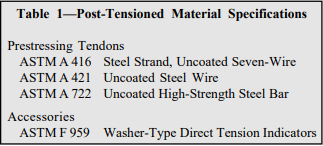
Post-tensioned wall construction uses standard materials: units, mortar, grout, and perhaps steel reinforcement. In addition, post-tensioning requires tendons, which are steel wires, bars or strands with a higher tensile strength than conventional reinforcement. Manufacturers of prestressing tendons must supply stress relaxation characteristics for their material if it is to be used as a prestressing tendon. Specifications for those materials used specifically for post-tensioning are given in Table 1. Other material specifications are covered in references 9 through 12. Construction is covered in Post-Tensioned Concrete Masonry Wall Construction, TEK 03-14 (ref. 3).
Table 1—Post-Tensioned Material Specifications
CORROSION PROTECTION
As with conventionally reinforced masonry structures, Building Code Requirements for Masonry Structures (ref. 1) mandates that prestressing tendons for post-tensioned masonry structures be protected against corrosion. As a minimum, the prestressing tendons, anchors, couplers and end fittings in exterior walls exposed to earth or weather must be protected. All other walls exposed to a mean relative humidity exceeding 75% must also employ some method of corrosion abatement. Unbonded tendons can be protected with galvanizing, epoxy coating, sheathing or other alternative method that provides an equivalent level of protection. Bonded tendons are protected from corrosion by the corrugated duct and prestressing grout in which they are encased.
DESIGN LOADS
As for other masonry structures, minimum required design loads are included in Minimum Design Loads for Buildings and Other Structures, ASCE 7 (ref. 5), or the governing building codes. If prestressing forces are intended to resist lateral loads from earthquake, a factor of 0.9 should be applied to the strength level prestress forces (0.6 for allowable stress design) as is done with gravity loads.
STRUCTURAL DESIGN
The design of post-tensioned masonry is based on allowable stress design procedures, except for laterally restrained tendons which use a strength design philosophy. Building Code Requirements for Masonry Structures (ref. 1) prescribes allowable stresses for unreinforced masonry in compression, tension and shear, which must be checked against the stresses resulting from applied loads.
The flexural strength of post-tensioned walls is governed by either the flexural tensile stress of the masonry (the flexural stress minus the post-tensioning and dead load stress), the masonry compressive stress, the tensile stress within the tendon, the shear capacity of the masonry or the buckling capacity of the wall.
Masonry stresses must be checked at the time of peak loading (independently accounting for both short-term and long-term losses), at the transfer of post-tensioning forces, and during the jacking operation when bearing stresses may be exceeded. Immediately after transfer of the post-tensioning forces, the stresses in the steel are the largest because long-term losses have not occurred. Further, because the masonry has had little time to cure, the stresses in the masonry will be closer to their capacity. Once long-term losses have transpired, the stresses in both the masonry and the steel are reduced. The result is a coincidental reduction in the effective capacity due to the prestressing force and an increase in the stresses the fully cured masonry can resist from external loads.
Effective Prestress
Over time, the level of prestressing force decreases due to creep and shrinkage of the masonry, relaxation of the prestressing tendons and potential decreases in the ambient temperature. These prestressing losses are in addition to seating and elastic shortening losses witnessed during the prestressing operation. In addition, the prestressing force of bonded tendons will decrease along the length of the tendon due to frictional losses. Since the effective prestressing force varies over time, the controlling stresses should be checked at several stages and loading conditions over the life of the structure.
The total prestress loss in concrete masonry can be assumed to be approximately 35%. At the time of transfer of the prestressing force, typical losses include: 1% seating loss + 1% elastic shortening = 2%. Additional losses at service loads and moment strength include:
relaxation
3%
temperature
10%
creep
8%
CMU shrinkage
7%
contingency
5%
total
33%
Prestress losses need to be estimated accurately for a safe and economical structural design. Underestimating losses will result in having less available strength than assumed. Overestimating losses may result in overstressing the wall in compression.
Effective Width
In theory, a post-tensioning force functions similarly to a concentrated load applied to the top of a wall. Concentrated loads are distributed over an effective width as discussed in the commentary on Building Code Requirements for Masonry Structures (ref. 1). A general rule-of-thumb is to use six times the wall thickness as the effective width.
Elastic shortening during post-tensioning can reduce the stress in adjacent tendons that have already been stressed. Spacing the tendons further apart than the effective width theoretically does not reduce the compressive stress in the effective width due to the post-tensioning of subsequent tendons. The applied loads must also be consolidated into the effective width so the masonry stresses can be determined. These stresses must be checked in the design stage to avoid overstressing the masonry.
Flexure
Tensile and compressive stresses resulting from bending moments applied to a section are determined in accordance with conventional elastic beam theory. This results in a triangular stress distribution for the masonry in both tension and compression. Maximum bending stress at the extreme fibers are determined by dividing the applied moment by the section modulus based on the minimum net section.
Net Flexural Tensile Stress
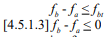
Sufficient post-tensioning force needs to be provided so the net flexural tensile stress is less than the allowable values. Flexural cracking should not occur if post-tensioning forces are kept within acceptable bounds. Flexural cracking due to sustained post-tensioning forces is believed to be more severe than cracking due to transient loading. Flexural cracks due to eccentric post-tensioning forces will remain open throughout the life of the wall, and may create problems related to water penetration, freeze-thaw or corrosion. For this reason, Building Code Requirements for Masonry Structures (ref. 1) requires that the net flexural tensile stress be limited to zero at transfer of the post-tensioning force and for service loadings with gravity loads only.
Axial Compression
Compressive stresses are determined by dividing the sum of the post-tensioning and gravity forces by the net area of the section. They must be less than the code prescribed (ref. 1) allowable values of axial compressive stress.
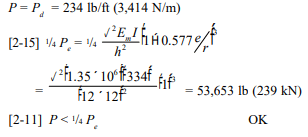
Walls must also be checked for buckling due to gravity loads and post-tensioning forces from unrestrained tendons. Laterally restrained tendons can not cause buckling; therefore only gravity compressive forces need to be checked for buckling in walls using laterally restrained tendons. Restraining the tendons also ensures that the tendons do not move laterally in the wall when the masonry deflects. The maximum compressive force that can be applied to the wall based upon ¼ buckling is Pe, per equation 2-11 of Building Code Requirements for Masonry Structures (ref. 1).
Combined Axial and Flexural Compressive Stress
Axial compressive stresses due to post-tensioning and gravity forces combine with flexural compressive stresses at the extreme fiber to result in maximum compressive stress. Conversely, the axial compressive stresses combine with the flexural tensile stresses to reduce the absolute extreme fiber stresses. To ensure the combination of these stresses does not exceed code prescribed allowable stresses, a unity equation is checked to verify compliance. Employing this unity equation, the sum of the ratios of applied-to-allowable axial and flexural stresses must be less than one. Unless standards (ref. 5) limit its use, an additional one-third increase in allowable stresses is permitted for wind and earthquake loadings, as is customary with unreinforced and reinforced masonry. Further, for the stress condition immediately after transfer of the post-tensioning force, a 20% increase in allowable axial and bending stresses is permitted by Building Code Requirements for Masonry Structures (ref. 1).
Shear
As with all stresses, shear stresses are resisted by the net area of masonry, and the wall is sized such that the maximum shear stress is less than the allowable stress. In addition, the compressive stress due to post-tensioning can be relied on to increase allowable shear stresses in some circumstances.
Post-Tensioning Tendons
The stress in the tendons is limited (ref. 1) such that:
the stress due to the jacking force does not exceed 0.94fpy, 0.80fpu, nor that recommended by the manufacturer of the tendons or anchorages,
the stress immediately after transfer does not exceed 0.82fpy nor 0.74fpu, and
the stress in the tendons at anchorages and couplers does not exceed 0.78fpy nor 0.70fpu.
DETERMINATION OF POST-TENSIONING FORCES
Case (a) after prestress losses and at peak loading:
Assuming that the moment, M, due to wind or earthquake loadings is large relative to the eccentric load moment, the critical location will be at the mid-height of the wall for simply-supported walls, and the following equations apply (bracketed numbers are the applicable Building Code Requirements for Masonry Structures (ref. 1) equation or section numbers):
The 1.33 factor in Equation [2-10] represents the one- third increase in allowable stress permitted for wind and earthquake loadings. If the moment, M, is a result of soil pressures (as is the case for retaining walls), the 1.33 factor in Equation [2-10] must be replaced by 1.00.
Note that if the tendons are laterally restrained, Ppf should not be included in Equation [2-11].
(under the load combination of prestressing force and dead load only)
Additional strength design requirements for laterally restrained tendons:
Equation 4-3 above applies to members with uniform width, concentric reinforcement and prestressing tendons and concentric axial load. The nominal moment strength for other conditions should be determined based on static moment equilibrium equations.
Case (b) at transfer of post-tensioning:
Assuming that vertical live loads are not present during post-tensioning, the following equations apply. The worst case is at the top of the wall where post-tensioning forces are applied.
For cantilevered walls, these equations must be modified to the base of the wall.
If the eccentricity of the live load, Pl, is small, neglecting the live load in Equation [2-10] may also govern.
Case (c) bearing stresses at jacking:
Bearing stresses at the prestressing anchorage should be checked at the time of jacking. The maximum allowable bearing stress at jacking is 0.50f’mi per Building Code Requirements for Masonry Structures (ref. 1) section 4.9.4.2.
DESIGN EXAMPLE
Design a simply-supported exterior wall 12 ft (3.7 m) high for a wind load of 15 psf (0.72 kPa). The wall is constructed of concrete masonry units complying with ASTM C 90 (ref. 6). The units are laid in a full bed of Type S Portland cement lime mortar complying with ASTM C 270 (ref. 7). The specified compressive strength of the masonry (f’m) is 1,500 psi (10.3 MPa). The wall will be post-tensioned with 7/16 in. (11 mm) diameter laterally restrained tendons when the wall achieves a compressive strength of 1,250 psi (8.6 MPa). Axial load and prestress are concentric.
Given: 8 in. (203 mm) CMU tf = 1.25 in. (32 mm) f’m = 1,500 psi (10.3 MPa) f’mi = 1,250 psi (8.6 MPa) Fbt = 25 psi (0.17 MPa) (Type S Portland cement/lime mortar) fpy = 100 ksi (690 MPa) (bars) fpu = 122 ksi (840 MPa) Aps = 0.14 in² (92 mm²) Es = 29 x 106 psi (200 GPa) Em = 900 f’m = 1.35 x 10⁶ psi (9,300 MPa) n = Es/Em = 21.5 d = 7.625/2 in. = 3.81 in. (97 mm) (tendons placed in the center of the wall) unit weight of CMU wall = 39 psf (190 kg/m²) (ref. 13)
Maximum tendon stresses: Determine governing stresses based on code limits (ref. 1):
At jacking:
0.94 fpy = 94.0 ksi (648 MPa)
0.80 fpu = 97.6 ksi (673 MPa)
At transfer:
0.82 fpy = 82.0 ksi (565 MPa)
0.74 fpu = 90.3 ksi (623 MPa)
At service loads:
0.78 fpy = 78.0 ksi (538 MPa) ⇒ governs
0.70 fpu = 85.4 ksi (589 MPa)
Because the tendon’s specified tensile strength is less than 150 ksi (1,034 MPa), fps = fse (per ref. 1 section 4.5.3.3.4).
Prestress losses: Assume 35% total loss (as described in the Effective Prestress section above).
Tendon forces: Determine the maximum tendon force, based on the governing tendon stress determined above for each case of jacking, transfer and service. At transfer, include 2% prestress losses. At service, include the full 35% losses. Tendon capacity at jacking = 0.94 fpyAps = 13.3 kips (59 kN) Tendon capacity at transfer = 0.82 fpyAps A x 0.98 = 11.4 kips (51 kN) (including transfer losses) Tendon capacity at service = 0.78 fpyAps A x 0.65 = 7.2 kips (32 kN) (including total losses)
Try tendons at 48 in. (1,219 mm) on center (note that this tendon spacing also corresponds to the maximum effective prestressing width of six times the wall thickness).
Determine prestressing force, based on tendon capacity determined above: at transfer: Ppi = 11.4 kips/4 ft = 2,850 lb/ft (41.6 kN/m) at service: Ppf = 7.2 kips/4 ft = 1,800 lb/ft (26.3 kN/m)
Wall section properties: (ref. 8) 8 in. (203 mm) CMU with full mortar bedding: An = 41.5 in.²/ft (87,900 mm²/m) I = 334 in.4/ft (456 x 106 mm4/m) S = 87.6 in.³/ft (4.71 x 106 mm³/m) r = 2.84 in. (72.1 mm)
At service loads: At service, the following are checked: combined axial compression and flexure using the unity equation (equation 2-10); net tension in the wall; stability by ensuring the compressive load does not exceed one-fourth of the buckling load, Pe, and shear and moment strength.
Check combined axial compression and flexure:
Check tension for load combination of prestress force and dead load only (per ref. 1 section 4.5.1.3):
Check stability: Because the tendons are laterally restrained, the prestressing force, Ppf, is not considered in the determination of axial load ( per ref. 1 section 4.5.3.2), and the wall is not subject to live load in this case, so equation 2-11 reduces to:
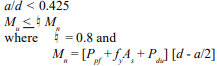
Check moment strength: Building Code Requirements for Masonry Structures section 4.5.3.3 includes the following criteria for moment strength of walls with laterally restrained tendons:
In addition, the compression zone must fall within the masonry, so a < tf.
where 1.3 and 1.2 are load factors for wind and dead loads, respectively.
At transfer: Check combined axial compression and flexure using the unity equation (equation 2-10) and net tension in the wall.
Check tension for load combination of prestress force and dead load only (per ref. 1 section 4.5.1.3):
Therefore, use 7/16 in. (11 mm) diameter tendons at 48 in. (1,219 mm) o.c. Note that although wall design is seldom governed by out-of-plane shear, the shear capacity should also be checked.
NOTATIONS
An net cross-sectional area of masonry section, in.² (mm²) Aps threaded area of post-tensioning tendon, in.² (mm²) As cross-sectional area of mild reinforcement, in.² (mm²) a depth of an equivalent compression zone at nominal strength, in. (mm) b width of section, in. (mm) d distance from extreme compression fiber to centroid of prestressing tendon, in. (mm) Es modulus of elasticity of prestressing steel, psi (MPa) Em modulus of elasticity of masonry, psi (MPa) ed eccentricity of dead load, in. (mm) el eccentricity of live load, in. (mm) ep eccentricity of post-tensioning load, in. (mm) Fa allowable masonry axial compressive stress, psi (MPa) Fai allowable masonry axial compressive stress at transfer, psi (MPa) Fb allowable masonry flexural compressive stress, psi (MPa) Fbi allowable masonry flexural compressive stress at transfer, psi (MPa) Fbt allowable flexural tensile strength of masonry, psi (MPa) fa axial stress after prestress loss, psi (MPa) fai axial stress at transfer, psi (MPa) fb flexural stress after prestress loss, psi (MPa) fbi flexural stress at transfer, psi (MPa) f’m specified compressive strength of masonry, psi (MPa) f’mi specified compressive strength of masonry at time of transfer of prestress, psi (MPa) fps stress in prestressing tendon at nominal strength, psi (MPa) fpu specified tensile strength of prestressing tendon, ksi (MPa) fpy specified yield strength of prestressing tendon, ksi (MPa) fse effective stress in prestressing tendon after all pre-stress losses have occurred, psi (MPa) fy specified yield strength of steel for reinforcement and anchors, psi (MPa) h masonry wall height, in. (mm) I moment of inertia of net wall section of extreme fiber tension or compression, in.4/ft (mm4/m) M moment due to lateral loads, ft-lb (N⋅m) Mn nominal moment strength, ft-lb (N⋅m) Mu factored moment due to lateral loads, ft-lb (N⋅m) n modular ratio of prestressing steel and masonry (Es/Em) Pd axial dead load, lb/ft (kN/m) Pdu factored axial dead load, lb/ft (kN/m) Pe Euler buckling load, lb/ft (kN/m) Pl axial live load, lb/ft (kN/m) Plu factored axial live load, lb/ft (kN/m) Ppi prestress force at transfer, lb/ft (kN/m) Ppf prestress force including losses, lb/ft (kN/m) r radius of gyration for net wall section, in. (mm) S section modulus of net cross-sectional area of the wall, in.³ /ft (mm³/m) tf face shell thickness of concrete masonry, in. (mm) w applied wind pressure, psf (kPa) ¤ strength reduction factor = 0.8
REFERENCES
Building Code Requirements for Masonry Structures, ACI 530-02/ASCE 5-02/TMS 402-02. Reported by the Masonry Standards Joint Committee, 2002.
Building Code Requirements for Structural Concrete, ACI 318-99. Detroit, MI: American Concrete Institute, Revised 1999.
Construction of Post-Tensioned Concrete Masonry Walls, TEK 03-14. Concrete Masonry & Hardscapes Association, 2002.
International Building Code. International Code Council, 2000.
Minimum Design Loads for Buildings and Other Structures, ASCE 7-98, American Society of Civil Engineers, 1998.
Standard Specification for Loadbearing Concrete Masonry Units, ASTM C 90-01a. American Society for Testing and Materials, 2001.
Standard Specification for Mortar for Unit Masonry, ASTM C 270-01. American Society for Testing and Materials, 2001.
Weights and Section Properties of Concrete Masonry Assemblies, CMU-TEC-002-23, Concrete Masonry & Hardscapes Association, 2023.
Concrete Masonry Unit Shapes, Sizes, Properties, and Specifications, CMU-TEC-001-23, Concrete Masonry & Hardscapes Association, 2023.
Mortars for Concrete Masonry, TEK 09-01A. Concrete Masonry & Hardscapes Association, 2001.
Grout for Concrete Masonry, TEK 09-04. Concrete Masonry & Hardscapes Association, 2005.
Steel for Concrete Masonry Reinforcement, TEK 12-04D. Concrete Masonry & Hardscapes Association, 1998.
Weights and Section Properties of Concrete Masonry Assemblies, CMU-TEC-002-23, Concrete Masonry & Hardscapes Association, 2023.
Schultz, A.E., and M.J. Scolforo, An Overview of Prestressed Masonry, TMS Journal, Vol. 10, No. 1, August 1991, pp. 6-21.
Schultz, A.E., and M.J. Scolforo, Engineering Design Provisions for Prestressed Masonry, Part 1: Masonry Stresses, Part 2: Steel Stresses and Other Considerations, TMS Journal, Vol. 10, No. 2, February 1992, pp. 29-64.
Standard Specification for Steel Strand, Uncoated Seven-Wire for Prestressed Concrete, ASTM A 416-99. American Society for Testing and Materials, 1999.
Standard Specification for Uncoated Stress-Relieved Steel Wire for Prestressed Concrete, ASTM A 421-98a. American Society for Testing and Materials, 1998.
Standard Specification for Uncoated High-Strength Steel Bar for Prestressed Concrete, ASTM A 722-98. American Society for Testing and Materials, 1998.
Standard Specification for Compressible-Washer-Type Direct Tension Indicators for Use with Structural Fasteners, ASTM F 959-01a. American Society for Testing and Materials, 2001.
The combination of concrete masonry and steel reinforcement provides a strong structural system capable of resisting large compressive and flexural loads. Reinforced masonry structures have significantly higher flexural strength and ductility than similarly configured unreinforced structures and provide greater reliability in terms of expected load carrying capacity at failure.
Concrete masonry elements can be designed using several methods in accordance with the International Building Code (IBC, ref. 1) and, by reference, Building Code Requirements for Masonry Structures (MSJC Code, ref. 2): allowable stress design, strength design, direct design, empirical design, or prestressed masonry. The design tables in this TEK are based on allowable stress design provisions.
The content presented in this edition of TEK 14-19B is based on the requirements of the 2012 IBC (ref. 1a), which in turn references the 2011 edition of the MSJC Code (ref. 2a). For designs based on the 2006 or 2009 IBC (refs. 1b, 1c), which reference the 2005 and 2008 MSJC (refs. 2b, 3c), respectively, the reader is referred to TEK 14-19B (ref. 3).
Significant changes were made to the allowable stress design (ASD) method between the 2009 and 2012 editions of the IBC. These are described in detail in TEK 14-07C, ASD of Concrete Masonry (2012 IBC & 2011 MSJC) (ref. 4), along with a detailed presentation of all of the allowable stress design provisions of the 2012 IBC.
LOAD TABLES
Tables 1 and 2 list the maximum bending moments and shears, respectively, imposed on walls simply supported at the top and bottom and subjected to uniform lateral loads with no applied axial loads.
Table 1—Required Moment Strength for Walls Subjected to Uniform Lateral Loads
Table 2—Required Shear Strength for Walls Subjected to Uniform Lateral Loads
A Based on walls simply supported at top and bottom, no axial load.
WALL CAPACITY TABLES
Tables 3, 4, 5 and 6 contain the maximum bending moments and shear loads that can be sustained by 8-, 10-, 12-, and 16-in. (203-, 254-, 305-, 406 mm) walls, respectively, without exceeding the allowable stresses defined in the 2012 IBC and 2011 MSJC (refs. 1a, 2a). These wall strengths can be compared to the loads in Tables 1 and 2 to ensure the wall under consideration has sufficient design capacity to resist the applied load.
The values in Tables 3 through 6 are based on the following criteria:
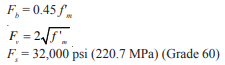
Maximum allowable stresses:
f’m = 1500 psi (10.3 MPa)
Em = 900f’m or 1,350,000 psi (9,310 MPa)
Es = 29,000,000 psi (200,000 MPa)
Type M or S mortar
running bond or bond beams at 48 in. (1,219 mm) max o.c.
reinforcement spacing does not exceed the wall height
only cores containing reinforcement are grouted.
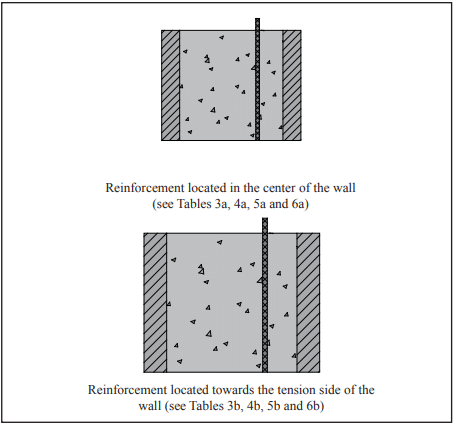
Reinforcing Steel Location
Two sets of tables are presented for each wall thickness. Tables 3a, 4a, 5a and 6a list resisting moment and resisting shear values for walls with the reinforcing steel located in the center of the wall. Centered reinforcing bars are effective for providing tensile resistance for walls which may be loaded from either side, such as an above grade exterior wall which is likely to experience both wind pressure and suction.
Tables 3b, 4b, 5b and 6b list resisting moment and resisting shear values for walls with the reinforcing steel offset from the center.
Placing the reinforcement farther from the compression face of the masonry provides a larger effective depth of reinforcement, d, and correspondingly larger capacities. A single layer of off-center reinforcement can be used in situations where the wall is loaded from one side only, such as a basement wall with the reinforcement located towards the interior. For walls where loads can be in both directions (i.e. pressure or suction), two layers of reinforcement are used: one towards the wall exterior and one towards the interior to provide increased capacity under both loading conditions. In Tables 3b, 4b, 5b and 6b, the effective depth of reinforcement, d, is a practical value which takes into account construction tolerances and the reinforcing bar diameter.
Figure 1 illustrates the two steel location cases.
Figure 1—Reinforcing Steel Locations
Table 3—Allowable Stress Design Capacities for 8-in. (203-mm) WallsA
Figure 1—Reinforcing Steel Locations
Table 4—Allowable Stress Design Capacities for 10-in. (254-mm) WallsA
Table 5—Allowable Stress Design Capacities for 12-in. (305-mm) WallsA
Table 6—Allowable Stress Design Capacities for 16-in. (406-mm) WallsA
DESIGN EXAMPLE
A warehouse wall will span 34 ft (10.4 m) between the floor slab and roof diaphragm. The walls will be constructed using 12 in. (305 mm) concrete masonry units. What is the required reinforcing steel size and spacing to support a wind load of 20 psf (0.96 kPa)?
From interpolation of Tables 1 and 2, respectively, the wall must be able to resist: M = 34,800 lb-in./ft (12.9 kN-m/m) V = 340 lb/ft (4.96 kN/m)
Assuming the use of offset reinforcement, from Table 5b, No. 6 bars at 40 in. on center (M#19 at 1,016 mm) or No. 7 bars at 48 in. (M#22 at 1,219 mm) on center provides sufficient strength: for No. 6 bars at 40 in. o.c. (M#19 at 1,016 mm): Mr = 35,686 lb-in./ft (13.3 kN-m/m) > M OK Vr = 2,299 lb/ft (33.5 kN/m) > V OK
for No. 7 bars at 48 in. (M#22 at 1,219 mm) : Mr = 40,192 lb-in./ft (14.9 kN-m/m) > M OK Vr = 2,133 lb/ft (31.1 kN/m) > V OK
As discussed above, since wind loads can act in either direction, two bars must be provided in each cell when using off-center reinforcement—one close to each faceshell.
Alternatively, No. 6 bars at 24 in (M#19 at 610 mm) or No. 8 at 40 in (M#25 at 1,016 mm) could have been used in the center of the wall.
NOTATION
As = area of nonprestressed longitudinal reinforcement, in.² (mm²) b = effective compressive width per bar, in. (mm) d = distance from extreme compression fiber to centroid of tension reinforcement, in. (mm) Em = modulus of elasticity of masonry in compression, psi (MPa) Es = modulus of elasticity of steel, psi (MPa) Fb = allowable compressive stress available to resist flexure only, psi (MPa) Fs = allowable tensile or compressive stress in reinforcement, psi (MPa) Fv = allowable shear stress, psi (MPa) f’m = specified compressive strength of masonry, psi (MPa) M = maximum calculated bending moment at section under consideration, in.-lb, (N-mm) Mr = flexural strength (resisting moment), in.-lb (N-mm) V = shear force, lb (N) Vr = shear capacity (resisting shear) of masonry, lb (N)
REFERENCES
International Building Code. International Code Council.
2012 Edition
2009 Edition
2006 Edition
Building Code Requirements for Masonry Structures. Reported by the Masonry Standards Joint Committee.
2011 Edition: TMS 402-11/ACI 530-11/ASCE 5-11
2008 Edition: TMS 402-08 /ACI 530-08/ASCE 5-08
2005 Edition: ACI 530-05/ASCE 5-05/TMS 402-05
Allowable Stress Design Tables for Reinforced Concrete Masonry Walls, TEK 14-19B. Concrete Masonry & Hardscapes Association, 2009.
Allowable Stress Design of Concrete Masonry Based on the 2012 IBC & 2011 MSJC, TEK 14-07C. Concrete Masonry & Hardscapes Association, 2011.
Historically, degree of seismic risk and the resulting design loads have been linked to seismic zones, with higher seismic zones associated with higher anticipated ground motion. More recently, design codes and standards (refs. 1, 2, 3) have replaced the use of seismic zones with Seismic Design Categories (SDCs). While seismic zones and design categories share similar concepts, there are also specific considerations that make each unique. The information that follows outlines the procedure for defining a project’s SDC, the permissible design methods that can be used with each SDC, and the prescriptive reinforcement associated with each SDC level.
This TEK is based on the requirements of the 2006 and 2009 editions of the International Building Code (IBC) (refs. 3a, 3b). While the applicable seismic provisions covered have not changed significantly over the last several code cycles, designers and contractors should be aware of several key revisions that have been introduced in recent years.
SEISMIC DESIGN CATEGORIES
SDCs range from SDC A (lowest seismic risk) through SDC F (highest seismic risk). Several factors contribute to defining the seismic design category for a particular project, including:
Maximum earthquake ground motion. Ground acceleration values are obtained from maps published in the IBC (ref. 3) or the ASCE 7 Minimum Design Loads for Buildings and Other Structures (ref. 2).
Local soil profile. Soil profiles are classified as Site Class A (hard rock) through Site Class F (organic or liquefiable soils). When the soil properties are not know in sufficient detail to determine the site class, Site Class D (moderately stiff soil) is assumed.
Use or occupancy hazard of the structure. Each structure is assigned to one of four unique Occupancy Categories corresponding to its use or hazard to life safety. Structures assigned to Occupancy Category I include those with a very low hazard to human life in the event of failure (including many agricultural buildings and minor storage facilities). Structures assigned to Occupancy Category III include those that would present a substantial public hazard including schools, jails, and structures with an occupancy load greater than 5,000. Structures assigned to Occupancy Category IV are designated essential facilities (such as hospitals and fire stations) and structures that contain substantial quantities of hazardous materials. Structures assigned to Occupancy Category II are those not included in any of the other three categories.
Figures 1 and 2 define the SDC for 0.2 and 1 second spectral response acceleration, respectively. Each figure is based on Site Class D (the default class when the soil profile is not known) and is applicable to structures assigned to Occupancy Categories I, II, and III (buildings other than high hazard exposure structures). Note that if the soil profile is known and is lower than D, a correspondingly lower SDC may be realized.
Structures are assigned to the highest SDC obtained from either Figure 1 or Figure 2. Alternatively, Section 1613.5.6.1 of the 2006 or 2009 IBC (refs. 3a, 3b) permits the SDC to be determined based solely on Figure 1 (0.2 second spectral response acceleration) for relatively short, squat structures (common for masonry buildings) meeting the requirements of that section. Table 1 may be used to apply Figures 1 and 2 to structures assigned to Occupancy Category IV.
Figure 1—Seismic Design Categories for Site Class D, Seismic Use Group I and II, for a 0.2-Second Spectral Response Acceleration
Figure 2—Seismic Design Categories for Site Class D, Seismic Use Group I and II, for a 1-Second Spectral Response Acceleration
Table 1—SDC for Structures Assigned to Occupancy Category IV
DESIGN LIMITATIONS
Based on the assigned SDC, limitations are placed on the design methodology that is permitted to be used for the design of the seismic force-resisting system (i.e., the masonry shear walls).
Designers have the option of using several design methods for masonry structures: empirical design (ref. 4); allowable stress design (ref. 5); strength design (ref. 6); or prestressed masonry design (ref. 7), each of which is based on the provisions contained in the Masonry Standards Joint Committee Building Code Requirements for Masonry Structures (MSJC) (ref. 1). There are, however, restrictions placed on the use of both empirical design and unreinforced masonry, neither of which considers reinforcement, if present, as contributing to the structure’s strength or ductility. Table 2 summarizes the design procedures that may be used for each SDC.
Similarly, as the seismic risk/hazard increases, codes require more reinforcement to be incorporated into the structure. This reinforcement is prescriptively required as a minimum and is not a function of any level of determined loading on the structure. That is, design loads may require a specific reinforcement schedule to safely resist applied loads, which cannot be less than the minimum prescriptive seismic reinforcement triggered by the assigned SDC. For convenience, each level of prescriptive seismic reinforcement is given a unique name as summarized in Table 3.
The following discussion reviews in detail the seismic design requirements for loadbearing and nonloadbearing concrete masonry assemblies as required under the 2006 and 2009 IBC, which in turn reference the 2005 and 2008 MSJC, respectively. While many of the seismic design and detailing requirements between these two code editions are similar, there are unique differences that need to be considered when using one set of provisions over the other. The information presented covers the seismic design and detailing requirements for all concrete masonry construction with the exception of concrete masonry veneers, which is addressed in TEK 03-06C, Concrete Masonry Veneers (ref. 8).
The requirements listed below for each SDC and shear wall type are cumulative. That is, masonry assemblies in structures assigned to SDC B must meet the requirements for SDC A as well as those for SDC B. Buildings assigned to SDC C must meet the requirements for Categories A, B and C, and so on.
Table 2—Permitted Design Procedures for Elements Participating in the Lateral Force-Resisting System
Table 3—Permitted Shear Wall Types for Seismic Design Categories
2006 IBC SEISMIC DESIGN AND DETAILING REQUIREMENTS
The seismic design and detailing provisions for masonry are invoked through Section 2106 of the IBC (ref. 3a), which in turn references the 2005 MSJC (ref. 1a). The IBC provisions detail a series of modifications and additions to the seismic requirements contained in the MSJC, which include:
IBC Section 2106.1 requires all masonry walls, regardless of SDC, not designed as part of the seismic force-resisting system (partition and nonloadbearing walls, eg.) to be structurally isolated, so that in-plane loads are not inadvertently imparted to them. The MSJC, conversely, requires isolation of such elements only for SDC C and higher.
IBC Section 2106.1.1 outlines minimum prescriptive detailing requirements for three prestressed masonry shear wall types: ordinary plain, intermediate, and special prestressed masonry shear walls. While the MSJC contains general design requirements for prestressed masonry systems, it does not contain prescriptive seismic requirements applicable to this design approach.
Anchorage requirements are addressed by Section 2106.2 of the IBC. Although analogous requirements are included in MSJC Section 1.14.3.3, the MSJC requirements are based on antiquated design loads that are no longer compatible with those of the IBC.
For structures assigned to SDC C and higher that include columns, pilasters and beams, and that are part of the seismic force-resisting system and support discontinuous masonry walls, IBC Section 2106.4.1 requires these elements to have a minimum transverse reinforcement ratio of 0.0015, with a maximum transverse reinforcement spacing of one-fourth the least nominal dimension for columns and pilasters and one-half the nominal depth for beams.
For structures assigned to SDC D and higher, IBC Section 2106.5 includes modifications that are an indirect means of attempting to increase the flexural ductility of elements that are part of the seismic force-resisting system. For elements designed by allowable stress design provisions (MSJC Chapter 2), in-plane shear and diagonal tension stresses are required to be increased by 50 percent. For elements designed by strength design provisions (MSJC Chapter 3) that are controlled by flexural limit states, the nominal shear strength at the base of a masonry shear wall is limited to the strength provided by the horizontal shear reinforcement in accordance with Eqn. 1.
Due to a shear capacity check in MSJC Section 3.1.3 that requires the nominal shear strength of a shear wall to equal or exceed the shear corresponding to the development of approximately 156% of the nominal flexural strength, Equation 1 controls except in cases where the nominal shear strength equals or exceeds 250% of the required shear strength. For such cases, the nominal shear strength is determined as a combination of the shear strength provided by the masonry and the shear reinforcement.
2005 MSJC Seismic Design and Detailing Requirements
The majority of the prescriptive seismic design and detailing requirements for masonry assemblies are invoked by reference to Section 1.14 of the 2005 MSJC. The following summarizes these requirements as they apply to concrete masonry construction.
Masonry Shear Wall Types
In addition to the prestressed masonry shear walls outlined by the IBC, the MSJC includes detailing requirements for six different shear wall options. A summary of these shear wall types follows. Table 3 summarizes the SDCs where each shear wall type may be used.
Empirically Designed Masonry Shear Walls—Masonry shear walls designed by the empirical design method (MSJC Chapter 5). Empirically designed masonry shear walls do not account for the contribution of reinforcement (if present) in determining the strength of the system.
Ordinary Plain (Unreinforced) Masonry Shear Walls—Ordinary plain masonry shear walls are designed as unreinforced elements, and as such rely entirely on the masonry to carry and distribute the anticipated loads. These shear walls do not require any prescriptive reinforcement. As such, they are limited to SDCs A and B.
Detailed Plain (Unreinforced) Masonry Shear Walls—Detailed plain masonry shear walls are also designed as unreinforced elements, however some prescriptive reinforcement is mandated by the MSJC to help ensure a minimum level of inelastic deformation capacity and energy dissipation in the event of an earthquake. As the anticipated seismic risk increases (which corresponds to higher SDCs), the amount of prescriptive reinforcement also increases. The minimum prescriptive reinforcement for detailed plain masonry shear walls is shown in Figure 3.
Ordinary Reinforced Masonry Shear Walls—Ordinary reinforced masonry shear walls, which are designed using reinforced masonry procedures, rely on the reinforcement to carry and distribute anticipated tensile stresses, and on the masonry to carry compressive stresses. Although such walls contain some reinforcement, the MSJC also mandates prescriptive reinforcement to ensure a minimum level of performance during a design level earthquake. The reinforcement required by design may also serve as the prescriptive reinforcement. The minimum prescriptive vertical and horizontal reinforcement requirements are identical to those for detailed plain masonry shear walls (see Figure 3).
Intermediate Reinforced Masonry Shear Walls—Intermediate reinforced masonry shear walls are designed using reinforced masonry design procedures. Intermediate reinforced shear wall reinforcement requirements differ from those for ordinary reinforced in that the maximum spacing of vertical reinforcement is reduced from 120 in. (3,048 mm) to 48 in. (1,219 mm) (see Figure 4).
Special Reinforced Masonry Shear Walls—Prescriptive reinforcement for special reinforced masonry shear walls must comply with the requirements for intermediate reinforced masonry shear walls and the following (see also Figure 5):
The sum of the cross-sectional area of horizontal and vertical reinforcement must be at least 0.002 times the gross cross- sectional wall area.
The cross-sectional reinforcement area in each direction must be at least 0.0007 times the gross cross-sectional wall area.
The vertical and horizontal reinforcement must be uniformly distributed.
The minimum cross-sectional area of vertical reinforcement must be one-third of the required horizontal reinforcement.
All horizontal reinforcement must be anchored around the vertical reinforcement with a standard hook.
The following additional requirements pertain to stack bond masonry shear walls assigned to SDC D, E or F. These walls must be constructed using fully grouted open-end units, fully grouted hollow units laid with full head joints, or solid units. The maximum reinforcement spacing for stack bond masonry shear walls assigned to SDC D is 24 in. (610 mm). For those assigned to SDC E or F, the cross-sectional area of horizontal reinforcement must be at least 0.0025 times the gross cross-sectional area of the masonry, and it must be spaced at 16 in. (406 mm) o.c., maximum.
Prescriptive Seismic Detailing for Nonloadbearing Elements
When incorporated into structures assigned to SDC C, D, E or F, masonry partition walls and other nonloadbearing masonry elements (i.e., those not designed to resist loads other than those induced by their own mass) must be isolated from the lateral force-resisting system. This helps ensure that forces are not inadvertently transferred from the structural to the nonstructural system. Nonstructural elements, such as partition walls, assigned to SDC C and above must be reinforced in either the horizontal or vertical direction (see Figure 6).
Figure 3—Prescriptive Seismic Detailing for Detailed Plain (Unreinforced) Masonry Shear Walls and for Ordinary Reinforced Masonry Shear Walls
Figure 4—Prescriptive Seismic Detailing for Intermediate Reinforced Masonry Shear Walls
Figure 5—Prescriptive Seismic Detailing for Special Reinforced Masonry Shear Walls
Figure 6—Reinforcement Options for Nonloadbearing Elements in SDC C and Higher
2009 IBC SEISMIC DESIGN AND DETAILING REQUIREMENTS
Unlike the 2006 IBC, the 2009 edition, which references the 2008 MSJC, contains no modifications to the seismic design and detailing provisions of the referenced standard. A summary of the substantive differences between the seismic design and detailing provisions of the 2005 and 2008 editions of the MSJC follows.
2008 MSJC Seismic Design and Detailing Requirements
The 2008 MSJC includes a comprehensive reorganization of the seismic design and detailing requirements intended to clarify the scope and intent of these provisions. In addition to the reorganization, several substantive changes applicable to concrete masonry construction have been incorporated, and these are detailed below. The prescriptive seismic detailing requirements for masonry shear walls remains substantially the same as under the 2005 MSJC and 2006 IBC.
Participating versus Nonparticipating Members—Elements of a masonry structure must now be explicitly classified either as participating in the seismic force-resisting system (for example, shear walls) or as nonparticipating members (for example, nonloadbearing partition walls). Elements designated as shear walls must satisfy the requirements for one of the designated shear wall types. Nonparticipating members must be appropriately isolated to prevent their inadvertent structural participation. This provision is similar in intent to the 2006 IBC requirement to isolate partition walls in SDC A and higher.
Connections—In previous editions of the MSJC, a minimum unfactored (service level) connection design force of 200 lb/ ft (2,919 N/m) was prescribed for all masonry shear wall assemblies except ordinary plain (unreinforced) masonry shear walls. In the 2008 MSJC, this minimum design load has been removed and replaced with a reference to the minimum loads prescribed by the adopted model building code. When the adopted model building code does not prescribe such loads, the requirements of ASCE 7 are to be used, which require a factored design force (strength level) of 280 lb/ft (4,087 N/m).
Story Drift—Due to the inherent stiffness of masonry structures, designers are no longer required to check the displacement of one story relative to adjacent stories for most masonry systems, simplifying the design process. Shear wall systems that are not exempted from checks for story drift include prestressed masonry shear walls and special reinforced masonry shear walls.
Stack Bond Prescriptive Detailing—Special reinforced masonry shear walls constructed of masonry laid in stack bond must now have a minimum area of horizontal reinforcement of 0.0015 times the gross cross-sectional wall area. This is an increase from the 0.0007 required in such walls in structures assigned to SDC D, and is a decrease from the 0.0025 required in such walls in structures assigned to SDC E and F by earlier editions of the MSJC.
Shear Capacity Check—In the 2005 MSJC, all masonry elements (both reinforced and unreinforced) designed by the strength design method were required to have a design shear strength exceeding the shear corresponding to the development of 125 percent of the nominal flexural strength, but need not be greater than 2.5 times the required shear strength. Because this provision is related primarily to the seismic performance of masonry structures, the 2008 MSJC requires it only for special reinforced masonry shear walls. Similarly, when designing special reinforced masonry shear walls by the allowable stress design method, the shear and diagonal tension stresses resulting from in-plane seismic forces are required to be increased by a factor of 1.5. Each of these checks is intended to increase flexural ductility while decreasing the potential for brittle shear failure.
Stiffness Distribution—In Chapter 1 of the 2008 MSJC, prescriptive seismic detailing requirements for masonry shear walls are related to an implicit level of inelastic ductile capacity. Because these detailing provisions apply primarily to shear walls, which in turn provide the principal lateral force-resistance mechanism for earthquake loads, the 2008 MSJC requires that the seismic lateral force-resisting system consist mainly of shear wall elements. At each story, and along each line of lateral resistance within a story, at least 80 percent of the lateral stiffness is required to be provided by shear walls. This requirement is intended to ensure that other elements, such as masonry piers and columns, do not contribute a significant amount of lateral stiffness to the system, which might in turn inadvertently change the seismic load distribution from that assumed in design. The 2008 MSJC does permit, however, the unlimited use of non-shear wall elements such as piers and columns provided that design seismic loads are determined using a seismic response modification factor, R, of 1.5 or less, consistent with the assumption of essentially elastic response to the design earthquake. In previous editions of the MSJC, these requirements were imposed only for masonry designed by the strength design method. In the 2008 MSJC, this requirement applies to all structures assigned to SDC C or higher.
Support of Discontinuous Elements—New to the 2008 MSJC, which was previously found in the 2006 IBC provisions, are the prescriptive detailing requirements for masonry columns, pilasters, and beams supporting discontinuous stiff elements that are part of the seismic force-resisting system. Such elements can impose actions from gravity loads, and also from seismic overturning, and therefore require that the columns, pilasters and beams supporting them have stricter prescriptive reinforcement requirements. These requirements apply only to structures assigned to SDC C and higher.
System Response Factors for Prestressed Masonry—In determining seismic base shear and story drift for structures whose seismic lateral force-resisting system consists of prestressed masonry shear walls, the value of the response modification coefficient, R, and of the deflection amplification factor, Cd, are required to be taken equal to those used for ordinary plain (unreinforced) masonry shear walls. The requirement previously existed as a recommendation in the MSJC Code Commentary. These values, as they apply to all types of masonry shear walls, are summarized in Table 4.
Table 4—Seismic Design Coefficients and Factors for Masonry Bearing Wall Systems
REFERENCES
Building Code Requirements for Masonry Structures, Reported by the Masonry Standards Joint Committee.
2005 Edition: ACI 530-05/ASCE 5-05/TMS 402-05
2008 Edition: TMS 402-08/ACI 530-08/ASCE 5-08
Minimum Design Loads for Buildings and Other Structures, ASCE 7-05. American Society of Civil Engineers, 2005.
International Building Code. International Code Council.
2006 Edition
2009 Edition
Empirical Design of Concrete Masonry Walls, TEK 14-08B. Concrete Masonry & Hardscapes Association, 2008.
ASD of Concrete Masonry (2012 IBC & 2011 MSJC), TEK 14-07C, Concrete Masonry & Hardscapes Association, 2004.
Strength Design of Concrete Masonry, TEK 14-04B. Concrete Masonry & Hardscapes Association, 2008.
Concrete masonry fences and garden walls are used to fulfill a host of functions, including privacy and screening, security and protection, ornamentation, sound insulation, shade and wind protection.
In addition, concrete masonry provides superior durability, design flexibility and economy. The wide range of masonry colors and textures can be used to complement adjacent architectural styles or blend with the natural landscape.
Because fences are subjected to outdoor exposure on both sides, selection of appropriate materials, proper structural design and quality workmanship are critical to maximize their durability and performance.
STRUCTURAL DESIGN
Masonry fences are generally designed using one of five methods:
as cantilevered walls supported by continuous footings;
as walls spanning between pilasters, that are, in turn, supported by a footing pad or caisson;
as walls spanning between wall returns that are sufficient to support the wall;
as curved walls with an arc-to-chord relationship that provides stability; or
as a combination of the above methods.
This TEK covers cases (a) and (d) above, based on the provisions of the 2003 and 2006 editions of the International Building Code (refs. 1, 2). Although fences up to 6 ft (1,829 mm) high do not require a permit (refs. 1 and 2, Ch.1), this TEK provides guidance on design and construction recommen- dations. Fences designed as walls spanning between pilasters (case b) are covered in TEK 14-15B, Allowable Stress Design of Pier and Panel Highway Sound Barrier Walls (ref. 3). In addition, fences can be constructed by dry-stacking and surface bonding conventional concrete masonry units (see ref. 4), or by utilizing proprietary dry-stack fence systems.
Figure 1—Typical Construction Requirements for a Cantilevered Fence
CANTILEVERED FENCE STRUCTURAL DESIGN
Tables 1, 2 and 3 provide wall thickness and vertical reinforcement requirements for cantilevered walls for three lateral load cases: lateral load, w ≤ 15 psf (0.71 kPa), 15 < w ≤ 20 psf (0.95 kPa), and 20 < w ≤ 25 psf (1.19 kPa), respectively. For each table, footnote A describes the corresponding wind and seismic conditions corresponding to the lateral load, based on Minimum Design Loads for Buildings and Other Structures, ASCE 7 (ref. 5).
Assumptions used to develop Tables 1, 2 and 3 are:
strength design method
except as noted, designs comply with both the 2003 and 2006 International Building Code,
ASTM C 270 (ref. 7) mortar as follows: Type N, S or M portland cement /lime mortar or Type S or M masonry cement mortar (note that neither Type N nor masonry cement mortar is permitted to be used in SDC D),
ASTM C 476 (ref. 8) grout,
Grade 60 reinforcing steel, reinforcement is centered in the masonry cell,
depth from grade to top of footing is 18 in. for 4- and 6-ft (457 mm for 1.2- and 1.8-m) high fences; 24 in. for 8-ft (610 mm for 2.4-m) high fences, and
reinforcement requirements assume a return corner at each fence end with a length at least equal to the exposed height. Where fence ends do not include a return, increase the design lateral load on the end of the fence (for a length equal to the exposed height) by 5 psf (34.5 kPa).
Table 1—Cantilevered Fences Subject to Lateral Loads up to 15 psf (0.71 kPa)
Table 2—Cantilevered Fences Subject to Lateral Loads up to 20 psf (0.95 kPa)
Table 3—Cantilevered Fences Subject to Lateral Loads up to 25 psf (1.19 kPa)
FOOTINGS
For cantilevered walls, the footing holds the wall in position and resists overturning and sliding due to lateral loads. Dowels typically extend up from the footing into the wall to transfer stresses and anchor the wall in place. Dowels should be at least equal in size and spacing to the vertical fence reinforcement. The required length of lap is determined according to the design procedure used and type of detail employed. For the design conditions listed here, the No. 4 (M#13) reinforcing bars require a minimum lap length of 15 in. (381 mm), and the No. 5 (M#16) bars require a minimum lap length of 21 in. (533 mm). Refer to TEK 12-06a, Splices, Development and Standard Hooks for Concrete Masonry (ref. 9) for detailed information on lap splice requirements.
Footings over 24 in. (610 mm) wide require transverse reinforcement (see footnotes to Table 4). For all footings, the hook should be at the bottom of the footing (3 in. (76 mm) clearance to the subgrade) in order to develop the strength of the bar at the top of the footing.
The footing designs listed in Table 4 conform with Building Code Requirements for Reinforced Concrete, ACI 318 (ref. 10). Note that concrete for footings placed in soils containing high sulfates are subject to additional requirements (refs. 1, 2).
Table 4—Footing Sizes for Cantilevered Fences
SERPENTINE WALLS
Serpentine or “folded plate” wall designs add interesting and pleasing shapes to enhance the landscape. The returns or bends in these walls also provide additional lateral stability, allowing the walls to be built higher than if they were straight.
Serpentine and folded plate walls are designed using empirical design guidelines that historically have proven successful over many years of experience. The guidelines presented here are based on unreinforced concrete masonry for lateral loads up to 20 psf (0.95 kPa). See Table 2, footnote A for corresponding wind speeds and seismic design parameters.
Design guidelines are shown in Figure 2, and include:
wall radius should not exceed twice the height,
wall height should not exceed twice the width (or the depth of curvature, see Figure 2),
wall height should not exceed fifteen times the wall thickness, and
the free end(s) of the serpentine wall should have additional support such as a pilaster or a short-radius return.
A wooden template, cut to the specified radius, is helpful for periodically checking the curves for smoothness and uniformity. Refer to TEK 5-10A, Concrete Masonry Radial Wall Details (ref. 11) for detailed information on constructing curved walls using concrete masonry units.
Figure 2—Serpentine Garden Walls
CONSTRUCTION
All materials (units, mortar, grout and reinforcement) should comply with applicable ASTM standards. Additional material requirements are listed under the section Cantilevered Fence Structural Design, above.
To control shrinkage cracking, it is recommended that horizontal reinforcement be utilized and that control joints be placed in accordance with local practice. In some cases, when sufficient horizontal reinforcement is incorporated, control joints may not be necessary. Horizontal reinforcement may be either joint reinforcement or bond beams. See CMU-TEC-009-23, Crack Control Strategies for Concrete Masonry Construction (ref. 12) for detailed guidance.
In addition, horizontal reinforcement in the top course (or courses if joint reinforcement is used) is recommended to help tie the wall together. For fences, it is not structurally necessary to provide load transfer across control joints, although this can be accomplished by using methods described in CMU-TEC-009-23 if deemed necessary to help maintain the fence alignment.
Copings provide protection from water penetration and can also enhance the fence’s appearance. Various materials such as concrete brick, cast stone, brick and natural stone are suitable copings for concrete masonry fences. Copings should project at least ½ in. (13 mm) beyond the wall face on both sides to provide a drip edge, which will help keep dripping water off the face of the fence. In cases where aesthetics are a primary concern, the use of integral water repellents in the masonry units and mortar can also help minimize the potential formation of efflorescence.
REFERENCES
2003 International Building Code. International Code Council, 2003.
2006 International Building Code. International Code Council, 2006.
Allowable Stress Design of Pier and Panel Highway Sound Barrier Walls, NCMA TEK 14-15B. Concrete Masonry & Hardscapes Association, 2004.
Design and Construction of Dry-Stack Masonry Walls, TEK 14-22. National Concrete Masonry Association, 2003.
Minimum Design Loads for Buildings and Other Structures, ASCE 7-02 and ASCE 7-05. American Society of Civil Engineers, 2002 and 2005.
Standard Specification for Loadbearing Concrete Masonry Units, ASTM C 90-01a and C 90-03. ASTM International, Inc., 2001 and 2003.
Standard Specification for Mortar for Unit Masonry, ASTM C 270-01a and C 270-04. ASTM International, Inc., 2001 and 2004.
Standard Specification for Grout for Masonry, ASTM C 476-01 and C 476-02. ASTM International, Inc., 2001 and 2002.
Splices, Development and Standard Hooks for Concrete Masonry, TEK 12-06A. Concrete Masonry & Hardscapes Association, 2007.
Building Code Requirements for Structural Concrete, ACI 318-02 and ACI 318-05. Detroit, MI: American Concrete Institute, 2002 and 2005.
Sound barrier walls are increasingly being used to reduce the impact of traffic noise on properties abutting major urban traffic routes. Because concrete masonry possesses many desirable features and properties—excellent sound resistance, low cost, design flexibility, structural capability and durability, it is an excellent material for the design and construction of highway sound barrier walls.
Aesthetics is also an important consideration. Noise barriers significantly impact a highway’s visual impression. Visual qualities of noise barriers include overall shape, end conditions, color, texture, plantings and artistic treatment.
The variety of concrete masonry surface textures, colors and patterns has led to its extensive use in sound barrier walls.
Various types of concrete masonry walls may be used for sound barriers. Pier and panel walls are relatively easy to build and are economical due to the reduced thickness of the walls and the intermittent pier foundations. In addition, the piers can be offset with respect to the panels to achieve desired aesthetic effects. Pier and panel walls are also easily adapted to varying terrain conditions and are often used in areas that have expansive soils.
This TEK presents information on the structural design of concrete masonry pier and panel sound barrier walls. Requirements and considerations for reduction of highway traffic noise are discussed in TEK 13-03A, Concrete Masonry Highway Noise Barriers (ref. 2).
DESIGN
Building Code Requirements for Masonry Structures, ACI 530/ASCE 5/TMS 402 (ref. 1) includes requirements for allowable stress design, strength design and prestressed approaches. The allowable stress design approach was used to develop the designs in this TEK. Allowable stresses were increased by one-third, as permitted for load combinations which include wind or seismic loads. Allowable Stress Design of Concrete Masonry, TEK 14-07C (ref. 4), describes the basic design approach.
Materials and Workmanship
Since concrete masonry sound barrier walls are subject to a wide range of load conditions, temperatures and moisture conditions, the selection of proper materials and proper workmanship is very important to ensure durability and satisfactory structural performance. Accordingly, it is recommended that materials (concrete masonry units, mortar, grout and reinforcement) comply with applicable requirements contained in Building Code Requirements for Masonry Structures (ref. 1).
Lateral Loads
Design lateral loads should be in accordance with those specified by local or state building and highway departments. If design lateral loads are not specified, it is recommended that they conform to those specified in Minimum Design Loads for Buildings and Other Structures, ASCE 7 (ref. 3). Wind and earthquake loads required in this standard are briefly described in the following paragraphs.
Design wind loads (F) on sound barrier walls may be determined as follows:
For the wall designs in this TEK, G is taken as 0.85 and C as 1.2. The minimum wind load specified in ASCE 7 is f 10 psf (479 Pa). For basic wind speeds of 85 mph (minimum), 90 mph, 100 mph, and 110 mph (53, 145, 161, and 177 kmph), the corresponding wind loads are listed in Table 1.
Earthquake loads (F ) on sound barrier walls may be p determined as follows, considering the wall system as a reinforced masonry non-building structure (ref. 3):
Seismic loads for a range of conditions are listed in Table 3.
Table 1—Wind Loads for Sound Barrier Walls
Table 2— Design Assumptions for Tables 4, 5, and 6
Table 2—Seismic Loads for Sound Barrier Walls
Deflections
Deflection considerations typically govern wall design for long spans and taller walls with greater lateral loads. Deflections are imposed to limit the development of vertical flexure cracks within the wall panel and horizontal flexure cracks near the base of the pier. The design information presented in this TEK is based on a maximum allowable deflection of L/240, where L is the wall span between piers.
DESIGN TABLES
Design information for pier and panel walls is presented in Tables 4 through 7. Tables 4 and 5 provide horizontal reinforcing steel requirements for 6 in. and 8 in. (152 and 203 mm) panels, respectively. Horizontal reinforcement requirements can be met using either joint reinforcement or bond beams with reinforcing bars.
Table 6 provides pier size and reinforcement requirements for various lateral loads. Table 7 lists minimum sizes for pier foundations, as well as minimum embedment depths. These components of pier and panel walls are illustrated in Figure 1.
When pier and panels are used, walls are considered as deep beams, spanning horizontally between piers. Walls support their own weight, vertically, and also must resist lateral out-of-plane wind or seismic loads. The panels are built to be independent of the piers to accommodate masonry unit shrinkage and soil movement. For this design condition, wall reinforcement is located either in the horizontal bed joints or in bond beams. Wall reinforcement is based on maximum moments (M) and shears (V) in the wall panels, determined as follows:
The wall panels themselves are analyzed as simply supported beams, spanning from pier to pier.
In addition to the horizontal reinforcement, which transfers lateral loads to the piers, vertical reinforcement in the panels is required in Seismic Design Categories (SDC) C, D, E and F. Building Code Requirements for Masonry Structures (ref. 1) includes minimum prescriptive reinforcement as follows. In SDC C, vertical No. 4 (M #13) bars are located within 8 in. (203 mm) of the wall ends, and at 10 ft (3.0 m) on center along the length of the wall; minimum horizontal reinforcement requirements are satisfied by the primary reinforcement listed in Tables 4 and 5. In SDC D, E and F, vertical No. 4 (M #13) bars are located within 8 in. (203 mm) of the wall ends, and at 4 ft (1.22 m) on center along the length of the wall.
Table 6 shows pier size and vertical reinforcement requirements. Piers are designed as vertical cantilevers, not bonded with the walls, and pier reinforcement is based on maximum moment and shear, determined as follows:
Design assumptions for the pier and panel walls are given in Table 2. Note that allowable stresses were increased by one-third, as permitted for load combinations which include wind or seismic loads (ref. 1).
Requirements for concrete foundations supporting the concrete masonry piers are given in Table 7. These foundations can be constructed economically by drilling. The concrete foundation piers should contain vertical reinforcement (same as shown in Table 6) which should be properly lapped with vertical reinforcement in the concrete masonry piers. The embedment depths given in Table 7 are based on an allowable lateral passive soil pressure of 300 psf (14.4 kPa).
Table 4—6 in. (152 mm) Panel Wall Reinforcement
Table 5—8 in. (203 mm) Panel Wall Reinforcement
Table 6—Pier Size and Reinforcement
Table 7—Pier Foundation Requirements, Minimum Embedment/Diameter
DESIGN EXAMPLE
A pier and panel highway sound barrier is to be designed using the following parameters:
6 in. (152 mm) panel thickness
10 ft (3.05 m) wall height
14 ft (4.27 m) wall span
open terrain, stiff soil
basic wind speed is 90 mph (145 km/h)
SS = 0.25, SDC B
From Table 1, the design wind load is 14.1 psf (674 Pa) for a basic wind speed of 90 mph (145 km/h) and exposure C. Using Table 3, the design seismic load is determined to be 2.8 psf (0.13 kPa) for a 6 in. (152 mm) wall grouted at 48 in. (1219 mm), or less, on center, for SS = 0.25. Since the wind load is s greater, the wall will be designed for 14.1 psf (674 Pa).
Using Table 4, minimum horizontal panel reinforcement is either W1.7 (MW 11) joint reinforcement at 8 in. (203 mm) on center, or bond beams at 48 in. (1220 mm) on center reinforced with one No. 5 (M #16) bar. At the bottom, the panel requires a beam 16 in. (406 mm), or two courses, deep reinforced with one No. 5 (M # 16) bar (last column of Table 4). Because the wall is located in SDC B, vertical reinforcement is not required to meet prescriptive seismic requirements.
The minimum pier size is 16 x 18 in. (406 x 460 mm), reinforced with four No. 4 (M #13) bars, per Table 6. The pier foundation diameter is 18 in. (457 mm), and should be embedded at least 7.5 ft (2.29 m), per Table 7.
NOTATIONS
Af = area normal to wind direction, ft² (m²) Cf = force coefficient (see ref. 3) d = distance from extreme compression fiber to centroid of tension reinforcement, in. (mm) Em = modulus of elasticity of masonry in compression, psi (MPa) Es = modulus of elasticity of steel, psi (MPa) F = design wind load, psf (Pa) (see ref. 3) Fa = acceleration-based site factor (at 0.3 second period) (see ref. 3) Fm = allowable masonry flexural compression stress, psi (Pa) Fp = seismic force, psf (Pa) (see ref. 3) Fs = allowable tensile or compressive stress in reinforcement, psi (MPa) Fv = allowable shear stress in masonry, psi (MPa) f’m = specified compressive strength of masonry, psi (MPa) G = gust effect factor (see ref. 3) H = wall height, ft (m) I = importance factor (see ref. 3) Ip = component importance factor (assume equal to 1.0 for sound barrier walls) (see ref. 3) Kd = wind directionality factor (see ref. 3) Kz = velocity pressure exposure coefficient (see ref. 3) Kzt = hill and escarpment factor (see ref. 3) L = wall span, ft (m) M = maximum moment at the section under consideration, in.-lb (N-mm) n = ratio of elastic moduli, Es/Em P = applied lateral force, lb (N) qz = velocity pressure, psf (Pa) (see ref. 3) = 0.00256K KzKztKdv²I R = response modification coefficient (see ref. 3) Rp = component response modification factor (equal to 3.0 for reinforced masonry non-building structures) (see ref. 3) SDS = design short period spectral acceleration =⅔(FaSS), where SS varies from less than 0.25 to greater than 1.25, and Fa is dependent on SS and soil conditions at the site (see ref. 3) Ss = mapped maximum considered earthquake spectral response acceleration at short periods (see ref. 3) V = shear force, lb (N) v = basic wind speed, mph (km/h) (see ref. 3) Wp = weight of wall, psf (Pa) w = wind or seismic load, psf (Pa)
REFERENCES
Building Code Requirements for Masonry Structures, ACI 530-02/ASCE 5-02/TMS 402-02. Reported by the Masonry Standards Joint Committee, 2002.
The masonry arch, one of mans’ oldest architectural forms, is defined as a rigid span curving upward between two points of support. The arch appears in a wide variety of structures ranging from the purely decorative triumphal arch to the masonry arch bridge where it sustains great loads.
The round arch, Figure 1, was used by the early Chinese in all types of buildings. In ancient Egypt, this arch and others were used in nonceremonial structures such as engineering works and private dwellings. The Babylonians, on the other hand, used their arches in temples, palaces, and tombs. The Romans used the arch freely in their secular structures, as in the Colosseum, and in their engineering works like the aqueduct, but in their temples they followed the Greek style with the horizontal entablature.
Many forms of the arch have been developed during the centuries of its use, ranging from the flat or jack arch through the segmental, circular, parabolic to the pointed Gothic. Used freely in the great cathedrals of Europe, the Gothic or pointed arch had a structural use more important than the ornamental effect, as it minimized the outward thrust, making possible the firmness and stability combined with the lofty and spacious interior characteristic of the Gothic cathedral.
Two distinct types of arches have been recognized based on span, rise, and loading. The more common concrete masonry arch is the minor arch where maximum span is limited to about 6 feet (1.8 m) with a rise-to-span ratio not exceeding 0.15, and carrying loads up to 1500 lb per foot of span (21,891 N/m). The second type of arch is the major arch where span, rise, and loading may exceed those of the minor. Illustrations of both types of arches are shown in Figure 1. However, the design section of this TEK discusses only minor arches.
Figure 1—Masonry Arch Forms
ANALYSIS
Fixed masonry arches are statically indeterminate to the third degree, that is, they have three reaction components or force paths that could be eliminated without adversely effecting their stability. This redundancy is a hidden asset of masonry; the tendency for “arching action” provides a masonry wall with resistance to progressive type failure. When a hole is caused suddenly in a masonry wall, an arch is created over the opening and the wall continues to carry load rather than fall down.
This redundancy of the masonry arch is, however, a nuisance when one considers design. Because the masonry arch is statically indeterminate, arches in building walls are generally designed or analyzed by approximate methods; the degree of exactness of the design procedure depends upon the size (span & rise) of the arch. Minor arches with spans of up to 6 feet (1.8 m) and rise-to-span ratios not exceeding 0.15 may be satisfactorily designed by the hypothesis of least crown thrust first proposed by Mosely in 1837. Major arches may be designed by considering them as essentially thick curved elastic beams. Many methods of elastic analysis have been developed; however, in most instances the application is complicated and time consuming. And, it is still an approximate analysis since the equations are developed assuming that deformations within the arch are small enough that the stresses are not affected if these deformations are ignored. This is not true of long span bridges where secondary stresses are significant and are taken into account. In masonry arches for building walls they can be ignored safely.
Figure 2 shows the forces and reactions within and upon a minor concrete masonry arch. The external load may consist of a uniform load, w, as shown, a concentrated load, or other. A horizontal thrust, H, is assumed to act at the crown, and its point of application is assumed to be at the upper middle-third limit (upper edge of kern) of the arch section. At the skewback (left-hand reaction), a reaction, F, is assumed to act at the lower middle-third limit (lower edge of kern) of the section. These assumptions for the design of minor arches, that the equilibrium polygon lies entirely within the middle third of the arch section, preclude the rotation of one section of the arch about the edge of a joint or the development of tensile stresses in either the intrados or extrados. The assumptions appear reasonable for symmetrical arches loaded equally and symmetrically, but may not be tenable for unsymmetrical arches or nonuniform loading. A vertical shear, VO, is shown also at the crown of the arch. This shear will equal zero when both halves of the arch are loaded equally, i.e., the general case.
There are four items to consider regarding structural failure of minor unreinforced concrete masonry arches:
failure due to tensile stresses (already eliminated by the assumption that the force polygon remains within the section kern)
crushing of the masonry due to compression by the horizontal thrust, H
shear sliding failure of one section of the arch along another, or along the skewback
the ability of supporting adjacent masonry wall or abutment to safely resist the horizontal thrust, H, of the arch.
Consider first the crushing of the masonry due to horizontal thrust. For minor arches (segmental or jack arches) the relationship between vertical loading or vertical reaction, V1 or W, and horizontal thrust, H, depends on the rise-to-span ratio, r/S, of the arch, and on the span/depth ratio, S/d. This relationship is shown in Figure 3. Knowing r/S and S/d of an arch, read the value W/2 H at the left-hand side of the graph. (Note: flat or jack arches are represented as r/S = 0).
Once the horizontal thrust has been determined, the maximum compressive stress in the masonry is determined by the following formula:
This value is twice an axial compressive stress on the arch due to a load H because the horizontal thrust is located at the edge of the kern.
Shear stress, or sliding of one section of the arch on another or on the skewback, requires consideration of the angular relationship of the reaction and the mortar joint, Figure 4. Stresses acting on the joint will depend on the angle formed between the reaction, F, and the inclined joint. This angle is:
For segmental arches with radial joints, the angle between the skewback and the vertical is:
or in terms of radius of curvature, R:
For jack or flat arches in which the skewback equals ½ inch per foot of span (83 mm/m) for each 4 inches (102 mm) of arch depth, the angle that the skewback makes with the vertical is:
In these ratios all terms of length must be expressed in the same units; for example, in computing S/r, S/d, and S/R, if S is in feet (m), r, d, and R must be in feet (m) also.
Shear force, Q, along the mortar joint is then equal to:
Finally, a check should be made to make certain the supporting adjacent masonry wall has sufficient shear strength and resistance to overturning against the horizontal thrust, H, of the concrete masonry arch. Figure 5 illustrates how shear resistance may be calculated. It is assumed that the horizontal thrust of the arch attempts to move a volume of masonry enclosed by the boundary lines ABCD and CDEF. The thrust, H, is acting against two shear planes of resistance, CF and DE. Shear stress along either plane can then be calculated as:
The tendency for the arch thrust, H, to overturn the supporting masonry wall must be checked, especially when the arch is near the wall top. No tension due to overturning moment should be permitted in the supporting wall section. Applicable equations are:
M = overturning moment due to thrust H h = wall height f = stress at bottom of wall P = vertical load on wall An = net area of wall I = moment of inertia of wall based on length and equivalent solid thickness c = distance from neutral axis, 1/2 wall length
Figure 2—Assumed Conditions for Static Analysis of Small Concrete Masonry Arch
Figure 3—Relationship of Vertical Load, W, and Horizontal Thrust, H, in Small Concrete Masonry Arches
Figure 4—Angular Relationship Between Forces and Stresses in Radial Joint of Segmental and/or Jack Arches
Figure 5—Supporting Adjacent Masonry Must Resist the Horizontal Thrust of the Arch
CONSTRUCTION
Since any section of an arch may be subjected to shear, moment, and thrust, it is important that arches be constructed with high quality concrete masonry units, mortar, and good workmanship. For this reason, the use of mortar conforming to ASTM C 270 (ref. 5), Type M, S, or N is recommended. Bond is an important factor in building arches with sufficient shear resistance to withstand the imposed loads. To obtain good bond, all mortar joints in the arch need to be completely filled. This is sometimes very difficult to do, especially where the concrete masonry units are laid in soldier bond or rowlock header bond. It is also hard to do where the curvature of the arch is of short radius, and mortar joints of varying thickness are used. But completely filled joints are paramount to a strong arch, and can be achieved with quality workmanship.
Concrete masonry units for arch construction should be either 100 percent solid units, or filled units, or filled cell construction. Applicable ASTM Specifications are: Concrete Building Brick, ASTM C 55 (ref. 3); Calcium Silicate Face Brick, ASTM C 73 (Sand-Lime Brick) (ref. 2); Load-Bearing Concrete Masonry Units, ASTM C 90 (ref. 4).
Concrete masonry arches are constructed with the aid of a form or temporary support. After construction, the form is kept in place until the arch is strong enough to carry the loads to which it will be subjected. For unreinforced concrete masonry arches, the form should remain in place about one week after construction.
Finally, the wall supporting the concrete masonry arch must be considered. With a masonry arch, three conditions relating to the supporting wall must be maintained in order to ensure arch action: the length of the span must remain constant; the elevation of the arch ends must remain unchanged; and the inclination of the skewback must remain fixed. If any of these conditions are violated by sliding, settlement, or rotation of the supporting abutments, critical stresses for which the arch was not designed may result.
DESIGN EXAMPLE—SEGMENTAL ARCH
A segmental arch is to be supported on an unreinforced 8-inch (203 mm) hollow loadbearing wall. One end of the arch will be 24 inches (610 mm) from the end of the wall. Other given data are:
Span, S = 72 in. (1829 mm) Depth, d = 12 in. (305 mm) Breadth, b = 8 in. (203 mm) Rise, r = 6 in. (152 mm) Uniform load = 1000 lb/ft (14.6 kN/m) f’m = 2000 psi (13.8 MPa) vm = 34 psi (0.23 MPa), Type S mortar
ANALYSIS:
r/S = 6/72 = 0.083 S/d = 72/12 = 6 W = 6 x 1000 lb/ft = 6000 lb
From Figure 3, W/2H = 0.53
Check thrust against wall:
SUMMARY: The arch is sufficient to carry the loads, but the supporting wall will require reinforcement to increase its shear capacity.
REFERENCES
Leontorich, V. Frames and Arches. McGraw-Hill, 1959.
Standard Specification for Calcium Silicate Face Brick (Sand-Lime Brick), ASTM C 73-94. American Society for Testing and Materials, 1994.
Standard Specification for Concrete Building Brick, ASTM C 55-94. American Society for Testing and Materials, 1994.
Standard Specification for Load-Bearing Concrete Masonry Units, ASTM C 90-94. American Society for Testing and Materials, 1994.
Standard Specification for Mortar for Unit Masonry, ASTM C 270-92a. American Society for Testing and Materials, 1992.