
Industry Pioneer Ed Bryant Passes
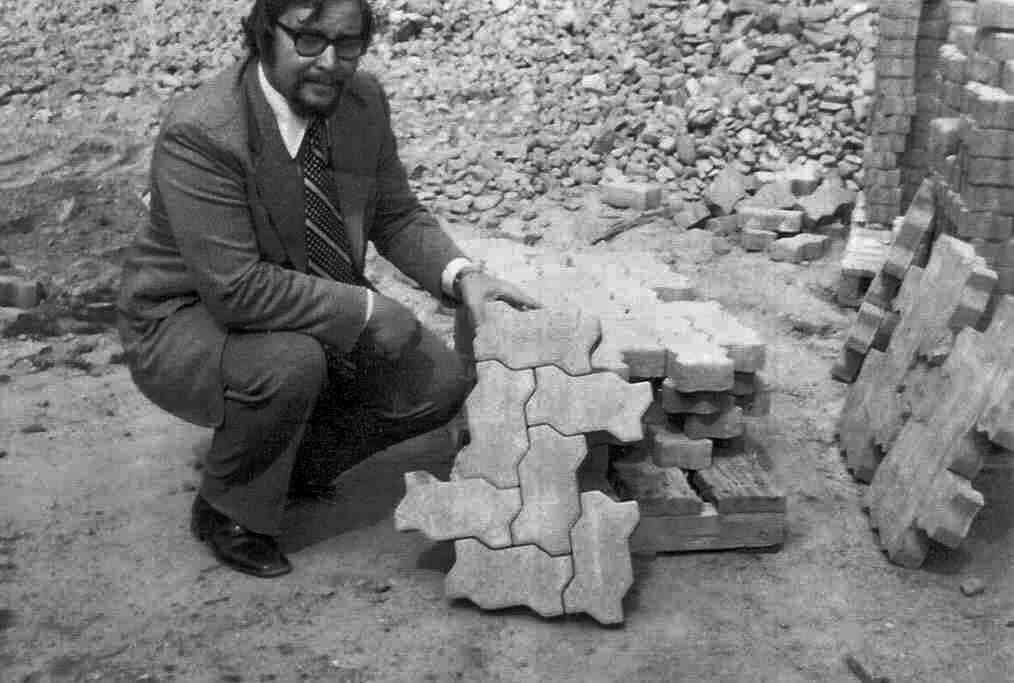
With a construction and computer background, serendipity came to Canadian Ed Bryant in 1971 that pointed him toward establishing the first permanent concrete paver manufacturing factory in North America. The story begins with Mr. Bryant building a home near Barrie, Ontario. He had a Swiss stone mason assisting with his project. During their conversation the stone mason introduced Mr. Bryant to a concrete ‘paving stone’ (translation of German pflasterstein aus beton). Mr. Bryant was captivated by the benefits of what the stone mason described as a superior paving method to asphalt or cast-in-place concrete. The mason complaining about the absence of concrete pavers in North America was viewed by Mr. Bryant as a significant business opportunity. At the time, Mr. Bryant owned a successful computer travel business, in retrospect he saw more opportunity in paving stones than in computers. For the immediate project, the Swiss stone mason convinced Mr. Bryant that paving stones were the answer for his sloped driveway. If Mr. Bryant wanted them, however, he had to manufacture them himself.
Mr. Bryant traveled to Switzerland to meet with a paving stone manufacturer who in turn introduced him to Fritz von Langsdorff, German owner and licensor of patented Uni concrete paver designs throughout Europe and other countries. By the fall of 1972, Mr. Bryant incorporated his first manufacturing company, North American Stone Company, and established a plant in Barrie, Ontario.
Before making his first concrete paver, Mr. Bryant purchased a license from Mr. von Langsdorff to produce Uni-Stone, as well as an old concrete batch plant, and a used Schlosser paver machine that made only twelve pavers at a time. It was a rudimentary operation, but the fledgling company proved the market potential for this new paving product.
With the help of Mr. Von Langsdorff, Mr. Bryant found German investors to purchase shares in his fledgling company, which provided capital to purchase a new Hess multi-layer machine. The company initially produced Uni-Stone in one color, natural gray, i.e., without iron oxide pigments. German immigrants in southern Ontario took an interest in becoming paver installation contractors and Mr. Bryant’s company helped train them, as well as promoting the German guidelines for interlocking concrete pavement construction to help ensure quality installations.
In 1977, Mr. Bryant purchased two other merged, nascent paver companies in Ontario and renamed the enlarged company Unilock. Sales were strong until 1982, when an economic recession reduced commercial sales in the Toronto region. Mr. Bryant raised demand within the residential market via mass media. He was the first to place ads on television and radio, using infomercials. He promoted the DIY market, conducting hands-on training seminars while using instructional videos. As a result, Unilock from 1980s to the early 1990s succeeded in turning a profit during that recession and the company transitioned from a manufacturing company to a marketing company. This emphasis expanded the manufacturing side with paver plants today in New York, Illinois, Michigan, Massachusetts, Ohio and Wisconsin.
Mr. Bryant received honorary membership in ICPI in 2006 for his pioneering contribution to the industry. Unilock has made generous donations to the ICPI Foundation for Education and Research. His son Andrew is on the Foundation’s Program Committee and the Board of Trustees. Click here for an obituary and celebration of life service.

Florida DOT Approves Concrete Pavers for Low-Speed Streets
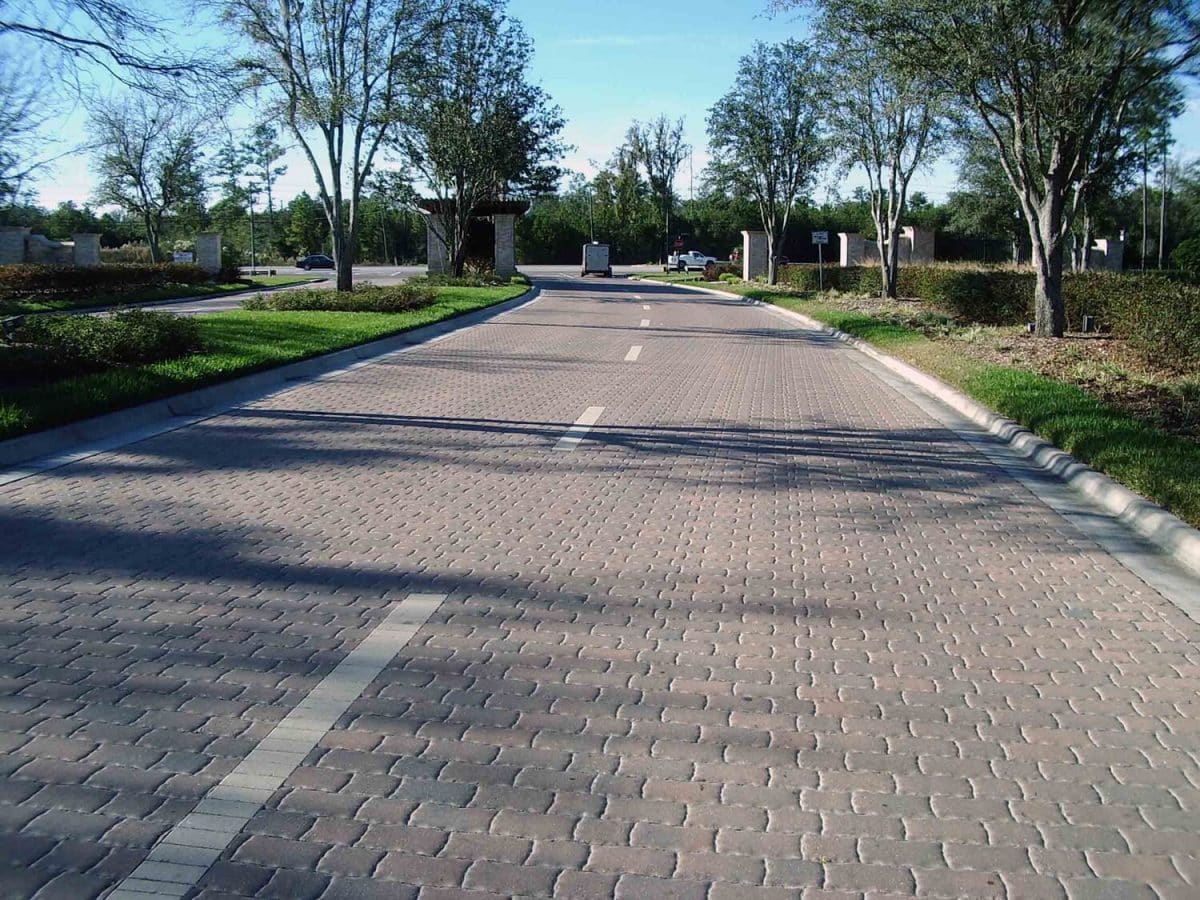
Thanks to joint efforts by an ICPI member and ICPI technical staff, the Florida Department of Transportation Specification 526 on Architectural Pavers now allows their use in local side streets with posted speed limits of 35 mph or lower. Previous FDOT specifications prohibited their use in such applications. Florida’s concrete paver market is estimated at well over 100 million sf, much of which goes to residential applications, private commercial projects and municipal sidewalks. This FDOT revision opens the door to wider use of interlocking concrete pavements and permeable interlocking concrete pavements by FDOT and municipalities in publicly owned streets.
Rewarding Excellence Achieved in the Most Challenging of Times
Presenting the 2020 Hardscape North America Awards
Hardscape contractors, producers, and designers claimed top honors at the 2020 Virtual Hardscape North America Awards ceremony on January 26th during ICPI’s special Virtual HNA education event. Each year, HNA Awards recognize leading residential and commercial hardscape achievements creating walkways, patios, pool decks, outdoor living kitchens and living spaces, and driveways as well as commercial plazas and streets.
While conditions in 2020 were quite different, these projects proved the pursuit of excellence can prevail.
Hardscape teams received awards for a diverse and awe-inspiring group of projects juried by industry experts for excellence in project design, quality, compatibility, and construction. HNA Awards reveal the highest level of detail from planning through project completion to produce exceptional results for project owners. The presentations demonstrated that designers, product manufacturers, distributors, and installers must all play collaborative roles to achieve successful projects worthy of industry-wide recognition.
Each year entries received from across the United States and Canada continues to grow. This year, a record 169 projects competed among 18 hardscape categories, including clay brick, segmental retaining walls, porcelain, vintage installations, concrete pavers, a combination of hardscape products, natural stone, and outdoor living features. Projects completed between November 1st, 2016, and June 30th, 2020, were eligible for entry into the competition.
“Despite the unprecedented challenges we all faced in 2020, HNA Award honorees remained dedicated to delivering excellence. The impressive projects recognized reflect great creativity, attention to detail, and collaboration between designers, manufacturers, and installers. We’re proud to honor their exceptional accomplishment.”
– Dr. Marshall Brown, Chair, ICPI
The HNA Awards are produced by the Interlocking Concrete Pavement Institute (ICPI) and endorsed by the Brick Industry Association (BIA) and National Concrete Masonry Association (NCMA). The 2020 awards program is made possible through sponsors’ generous support: Belgard, Blades Direct, Keystone Hardscapes, and SiteOne.
The organizers and judges of the Hardscape North America contests are pleased and honored to recognize the following award recipients for their exceptional work.
2020 HNA Awards Recipients:
Clay Brick – Residential Winner
Skiff House
Project Location: Covington, KY
Contractor: Lichtenberg Landscaping Inc.
Manufacturer: Pine Hall Brick Company
Designer: Steve Lichtenberg
Clay Brick – Commercial Winner
Urby Harrison
Project Location: Harrison, New Jersey
Contractor: Twin Resources
Manufacturer: Pine Hall Brick Company
Designer: Tom Bauer
Clay Brick – Commercial Honorable Mention
Lemon Avenue
Project Location: Sarasota, FL
Contractor: Preferred Concrete and Pavers
Manufacturer: Pine Hall Brick Company
Designer: Phil Smith – DWJA Landscape Architects
Clay Brick – Permeable Winner
Scotts Miracle-Gro Corporate Campus
Project Location: Marysville, Ohio
Contractor: Hidden Creek Landscaping, Inc.
Manufacturer: The Belden Brick Company
Designer: Hidden Creek Landscaping, Inc.
Concrete Paver – Residential – Size less than 3,000 SF Winner
Staycation
Project Location: Chambly, Quebec, Canada
Contractor: Zamco
Manufacturer: Techo-Bloc
Designer: Zamco
Concrete Paver – Residential – Size less than 3,000 SF Honorable Mention
Entertaining in Farmington
Project Location: Farmington, CT
Contractor: Clarke Landscapes
Manufacturer: Unilock
Designer: Mather Clarke
Concrete Paver – Residential – Size more than 3,000 SF Winner
Party Spot in Coventry
Project location: Coventry, CT
Contractor: Clarke Landscapes
Manufacturer: Unilock
Designer: Mather Clarke
Concrete Paver – Residential – Size more than 3,000 SF Honorable Mention
Resort Living
Project Location: Davison, MI
Contractor: Atlas Outdoor
Manufacturer: Unilock
Designer: Atlas Outdoor
Concrete Paver – Commercial – Size less than 15,000 SF Winner
19th St. Improvements/VIBE District
Project Location: Virginia Beach, VA
Contractor: Westwood Contractors
Manufacturer: Interlock Paving Systems
Designer: Clark Nexsen
Concrete Paver – Commercial – Size less than 15,000 SF Honorable Mention
University of Delaware: Biopharmaceutical Innovations Building (CPI)
Project Location: Newark, DE
Contractor: Interlock Paving
Manufacturer: Unilock
Designer: Ground Reconsidered
Concrete Paver – Commercial – Size more than 15,000 SF Winner
Olympic Museum/Vermijo Street Improvements
Project Location: Colorado Springs, CO
Contractors: Brightview Landscape & Stone Creek Hardscapes
Manufacturer: Keystone Hardscapes
Designer: DIG Studio in Denver, CO
Concrete Paver – Commercial – Size more than 15,000 SF Honorable Mention
The Sound
Project Location: Dallas, TX
Contractor: PavePro
Manufacturer: Keystone Hardscapes
Designer: Tary Arterburn w/StudioOutside in Dallas, TX
Concrete Paver – Permeable Winner
True North Driveway
Project Location: Elizabethtown, PA
Contractor: Willow Gates Landscaping
Manufacturer: Techo-Bloc
Designer: Jeremy Martin
Concrete Paver – Permeable Honorable Mention
Binghamton High School
Project Location: Binghamton, NY
Contractor: Syrstone, Inc.
Manufacturer: Techo-Bloc
Designer: Appel Osborne
Segmental Retaining Walls – Residential Winner
Walk-Out Poolscape in Farmington
Project Location: Farmington, CT
Contractor: Clarke Landscapes
Manufacturer: Unilock
Designer: Mather Clarke
Segmental Retaining Walls – Residential Honorable Mention
Winston Project
Project Location: Winston, GA
Contractor: McPlants
Manufacturer: Belgard
Designer: Craig McManus
Segmental Retaining Walls – Commercial Winner
Zilber Industries
Project Location: Kenosha, Wisconsin
Contractor: Reesman’s Service Corp
Manufacturer: County Materials Corporation
Segmental Retaining Walls – Commercial Honorable Mention
Alta Green Mountain Apartments
Project Location: Lakewood, CO
Contractor: Miller Walls
Manufacturer: Keystone Hardscapes
Designer: Norris Design (Specifier) & Ground Engineering (Engineer)
Combination of Hardscape Products – Residential – Size less than 4,000 SF Winner
Farmington Backyard Oasis
Project Location: Farmington, CT
Contractor: Clarke Landscapes
Manufacturer: Unilock
Designer: Mather Clarke
Combination of Hardscape Products – Residential – Size less than 4,000 SF Honorable Mention
Ware Residence
Project Location: Erie, CO
Contractor: Rock N Roll Stoneworks
Manufacturer: Belgard
Designer: Jordan Jackson
Combination of Hardscape Products – Residential – Size less than 4,000 SF Honorable Mention
Hudson’s Outdoor Living Space
Project Location: Laurel, Delaware
Contractor: C Vargas Construction, LLC
Manufacturer: Techo-Bloc
Designer: Cesar Vargas
Combination of Hardscape Products – Residential – Size more than 4,000 SF Winner
Larger than Life
Project Location: Drummondville, Quebec, Canada
Contractor: Alain Carrier Paysagiste
Manufacturer: Techo-Bloc
Designer: Alain Carrier
Combination of Hardscape Products – Residential – Size more than 4,000 SF Honorable Mention
Laid Back Backyard in Farmington
Project Location: Farmington, CT
Contractor: Clarke Landscapes
Manufacturer: Unilock
Designer: Mather Clarke
Combination of Hardscape Products – Commercial Winner
Permeable
Project Location: Chambly, Quebec, Canada
Contractor: City of Chambly
Manufacturer: Techo-Bloc
Designer: City of Chambly
Combination of Hardscape Products – Commercial Honorable Mention
The View at Woodstock
Project Location: Woodstock, GA
Contractors: Pavers: Worthing Southeast Builders / Walls: Reinforced Wall Systems LLC
Manufacturer: Keystone Hardscapes
Designer: Ironwood Design Group in Roswell, GA
Porcelain Paver – Residential Winner
Avenida Apice – Cross
Project Location: Rancho Santa Fe, CA
Contractor: Western Outdoor design & build
Manufacturer: Belgard
Designer: Joe Trinh
Porcelain Paver – Residential Honorable Mention
Outdoor Entertainment Paradise
Project Location: Walnut Creek, CA
Contractor: DPG Design
Manufacturer: Arterra
Designer: Dave Garcia
Porcelain Paver – Commercial Winner
Power Design Business Campus
Project location: St. Petersburg, FL
Contractor: Pat O’Hara Pavers
Manufacturer: Belgard
Designer: Kimley Horn and Associates
Porcelain Paver – Commercial Honorable Mention
Big Horn Project
Project Location: Reno, NV
Contractor: Reliance Home Services
Manufacturer: Belgard
Designer: Rob McCalla
Natural Stone Residential/Commercial Winner
Backyard Renovation in Farmington
Project Location: Farmington, CT
Contractor: Clarke Landscapes
Manufacturer: Natural Stone
Designer: Mather Clarke
Natural Stone Residential/Commercial Honorable Mention
Relax and Unwind
Project Location: Grand Blanc, MI
Contractor: Atlas Outdoor
Manufacturer: Oakville Stone
Designer: Atlas Outdoor
Outdoor Living Features Winner
Personal Resort in Hebron
Project Location: Hebron, CT
Contractor: Clarke Landscapes
Manufacturer: Unilock
Designer: Mather Clarke
Outdoor Living Features Honorable Mention
Staycation
Project Location: Chambly, Quebec, Canada
Contractor: Zamco
Manufacturer: Techo-Bloc
Designer: Zamco
Vintage Installation Winner
TCU Brown Lupton Student Center
Project Location: Fort Worth, TX
Contractor: Arlington Pavers
Manufacturer: Keystone Hardscapes
Designer: NJB in Dallas, TX
Vintage Installation Honorable Mention
Tempe Market Place
Project Location: Tempe, Arizona
Contractor: European Pavers Southwest
Manufacturer: Ackerstone
EDITOR’S NOTES:
Additional project images are available at: https://flic.kr/s/aHsmTVdEZG

Thomas Young Inducted Into NCMA’s Hall of Fame
Thomas Young, executive director of the Northwest Concrete Masonry Association, Mill Creek, Washington, was presented with NCMA’s Hall of Fame award on February 4 at the association’s Annual Convention which was held virtually.
NCMA’s Hall of Fame award is presented to the industry’s most valued participants whose careers are highlighted by continual accomplishments on the industry’s behalf, and who have demonstrated unquestioned dedication to NCMA’s highest values.
Tom is credited with spending nearly the last half a century promoting concrete masonry as a premier building material. Tom’s masonry roots started as a child. Tom had the opportunity to see how masonry could provide practical solutions directly from his father, who was a bricklayer and later a masonry salesman, working for the U.S. Lime Company. Tom grew up in Colorado and then Utah, graduating from Skyline High School in Salt Lake City. Tom attended the University of Utah, studying engineering principles such as Young’s Modulus and graduating with a bachelor’s degree of civil engineering in 1971.
Right after college, he started his own concrete sawing business while working for the Utah State Department of Transportation in Salt Lake City, but he soon began his career in masonry promotion, relocating to Arizona and joining the program staff of the Arizona Masonry Guild as their Technical Director. While at the Guild in Phoenix, he was introduced to and married the boss’ daughter Val, the beginning of a partnership that is 48 years and counting.
By 1975, Tom was working for one of the most innovative concrete block manufacturers in the country, Superlite Builders Supply. He contributed to their strong residential construction market, addressing technical issues such as the development of a wind resistance standard for CMU houses, and working directly with NCMA’s Paul Lenchuck and Kevin Callahan on Arizona energy code requirements.
In 1978, Tom and Val moved to the Northwest to raise their family. Tom accepted the position of Executive Director of the Masonry and Ceramic Tile Institute of Oregon. Among other accomplishments here, he established a new technical support service for designers using masonry.
By 1984, Tom was working as a Sales Manager for Jim Anderegg of the Mutual Materials Company. There he helped integrate concrete block production operations and sales into a business that was focused on brick manufacturing.
In 1990, Tom became the Executive Director of the Northwest Concrete Masonry Association, a position he has held for the past 30 plus years. He has played a significant role in the growth of concrete masonry as a structural building material throughout the Northwest supporting state-of-the-art, and state of practice design and building code requirements that are most applicable to the climate and environment of the area. Tom has developed relationships and the respect of area engineers, architects, educators, building officials, contractors and industry partners. He has lectured and consulted extensively; supported the creation of masonry education curriculums in universities as well as design competitions, scholarships and masonry research fellowships in these schools.
Tom has also been an active supporter of the National Concrete Masonry Association, contributing to the development of technical knowledge, industry resources such as TEK, and recently as a member of the NCMA Board of Directors representing other regional masonry associations. Between 1997 and 2021, he served on numerous NCMA committees. He was recognized along with several other leading executive directors of these regional associations by the 2016 NCMA Chairman of the Board, Joe Bowen of Mutual Materials.
Tom has invested significant energy in supporting coalitions and partnerships to better accomplish common missions. He has served as chair or co-chair of the Masonry Alliance of Codes and Standards’ Structural Task Group. He has been very active in The Masonry Society, earning a recognition of Fellow in 2012. Examples of more recent collaborations include working with the Pacific Northwest Building Resistance Coalition to help frame concrete and masonry performance relative to claims from the wood industry and working with the US Resiliency Council to bestow Silver Ratings for their designed resistance to threats posed by possible earthquakes.
“I first met Tom in Seattle, when I attended one of his many engineering presentations, in a hotel conference room filled with engineers. Tom’s knowledge and experience of masonry, and his energy and enthusiasm in presenting, captivated this audience and the many audiences he has presented to. Tom is a great communicator and is amazing at engaging people. His leadership skills have been a role model to so many people in the masonry industry.” – Blair Harter, Basalite Concrete Products, LLC.
Tom has been supported through his career by his wife Valerie, daughter Corinne, son Chris and granddaughter Kaylee.
For a PDF copy of this press release, click here.

ICPI Hosts Virtual Canadian PICP Symposium
ICPI along with Calgary, AB, London, ON, and Fredericton, NB hosted a successful Canadian Permeable Interlocking Concrete Pavement (PICP) Online Symposium on Wednesday, December 2, 2020.
The free PICP training was offered to government agencies and design professionals and provided tools to design, specify, construction and maintain PICP. Symposium sessions included Municipal Perspective, Site Selection and Design, Construction and Maintenance. Speakers included Bert van Duin, M.Sc., P.Eng., Technical Lead at the City of Calgary Water Resources, David Hein, P.Eng., Robert Bowers, P.Eng., Director of Engineering at ICPI, and Jennifer Drake, P.Eng., Associate Professor of Civil Engineering at the University of Toronto. The event had 74 attendees and the registrants received copies of the presentations, a list of available resources and a free copy of the PICP manual.
The event was sponsored by the Canadian Activities Fund. Platinum sponsors included Abbotsford Concrete Products, Basalite, Best Way Stone, Brooklin Concrete Products, Brown’s Concrete Products, Ltd., Expocrete, Fortress, Krete, MASA, Master Builders Solutions, Mutual Materials, Oaks Landscape Products, Permacon, Rekers, Techo-Bloc and Topwerk America. Gold sponsors were ACM Chemistries, Barkman, Bolduc, Rinox and St Marys.

ICPI and NCMA Update Product Category Rules
UL Environmental (ULE) recently issued Product Category Rules (PCRs) that address creation of environmental product declarations (EPDs) that emerge from environmental life cycle assessments or LCAs. EPDs are becoming increasingly requested by government agencies and design professionals as a means to assess environmental impacts associated with building and paving products. Entitled Concrete Masonry and Segmental Concrete Paving Product EPD Requirements, this document updates a 2015 version previously issued by ASTM that expired earlier this year. The ULE PCR applies to all commercially available concrete masonry units, segmental retaining wall units, articulating concrete block, interlocking concrete pavers, segmental concrete paving slabs, and concrete grid paving units manufactured in conformance to applicable ASTM and CSA product standards. Led by Anna Lasso, Senior Product Manager with ULE, a PCR template conforming to ISO standards was edited by representatives from Jandris Block, Anchor Block Company, Taylor Concrete Products, Big River Industries an Oldcastle Company, Nicolock, Brampton Brick, and the Canada Masonry Design Centre as well as staff from the National Concrete Masonry Association and the Interlocking Concrete Pavement Institute. The document also received independent review and is available at no charge from ULE here.
In Memoriam: John Heslip
John A. Heslip, NCMA’s fourth chief executive, is being remembered for his unwavering passion in promoting the benefits of masonry to any architect that would listen. Mr. Heslip, who served as NCMA’s president from 1985-1995, died on November 21, 2020 surrounded by family in Chapel Hill, NC.
“John demonstrated throughout his career that it was possible to advance an aggressive agenda needed to proactively compete for market position while developing deep and lasting relationships,” recalls Robert D. Thomas, current president of NCMA. “He was known for his caring ways and an unassailable presence based on integrity and commitment. He had a penchant for identifying and mentoring young talent, leading by example. And others have often remarked how welcome he made people feel.”
While marking NCMA’s 100th anniversary in 2018, Thomas visited with Heslip to reflect on his long career and tenure with the association. “Early on I knew we had to talk turkey to the engineers who designed buildings and also the architects,” said Heslip. “We had to make better contacts. I spent plenty of evenings and weekends inviting the president of the American Institute of Architects (AIA) over for a beer and we’d have talks about what our industry could do for them.”
While head of the Masonry Institute of Michigan, those informal talks paid off. In 1980, Heslip was recognized by the Detroit chapter of the AIA as a “credible, impartial source of information and counsel to the architectural profession”, a role he cherished and carried over into his tenure at the NCMA.
Leading NCMA
In 1985 Heslip became President of the National Concrete Masonry Association (NCMA) after serving one year as Executive Vice President. During his tenure at NCMA, Heslip spearheaded efforts to improve marketing in the industry; strengthened ties on Capitol Hill; improved communication of the industry’s fire safety message and invested in important research efforts.

He implemented an industry technical education program: the Certified Consultants of Concrete Masonry (CCCM) with the Construction Specifications Institute (CSI); expanded the industry’s convention and tradeshow to partner with a number of masonry-related organizations and worked closely with the AIA to establish a nationally recognized design awards program.
“It worked out well,” Heslip said. “The awards program was a real winner. What it really did was help focus on the importance of each component to the whole. It helped the brick industry and the block industry and the concrete industry to see that you could work together, satisfying the needs of the architect and his design with his design efforts. It was a big program.”
He personally lectured extensively on masonry subjects at universities throughout the United States, initiated the University Professors Masonry Workshop to advance architectural and engineering education among university professors and authored a number of papers on masonry construction.
Changing Times
Heslip also noted in his 2018 interview that the masonry industry was undergoing dramatic changes in the 1980s. “In the earlier part of the 20th century, empirical design was a way of life, so that whenever an architect or an engineer would get a building commissioned and they wished to build it in masonry, they were using empirical designs. It was an out-of-date system,” Heslip said.
“The competitive industries, the steel industry and the reinforced concrete industries were not empirically designing buildings. They were all rationally designed buildings and proved to be very competitive in terms of cost. A rationally designed building of masonry fit a whole lot of different building types, and we were able to do more for less because we were stretching the fibers of the masonry system to utilize its full characteristics.”
Coming Together
Heslip is also being remembered for his efforts to bring the entire industry together. “I spent a lot of time with the mason contractors. I knew them. I had had experience with them because I was one. I knew how they thought so that came natural to me. We had to get everybody talking on the same merits of the same systems. The brick industry, the reinforced concrete people, the metal building people, the structural steel people. When I hit NCMA, each segment was doing their own thing and trying to outdo each other, and I don’t operate that way. I said, let’s bring it all in. Let’s sort it out and see what kind of a better end result we can come up with.”
Heslip said that, eventually, NCMA was able to get the major players in the masonry industry to sit down and plan programs together. “They had to forget about the competition and start going after their customer. It took a while because the industry traditionally was splintered.”
John’s wife, Marlene, was also part of that inclusiveness, actively participating in NCMA conventions and building a culture within the organization to form personal relationships to better support professional collaboration.

“Many of the leaders of today’s family-owned concrete masonry block producing companies developed their understanding of a broader industry and their eventual professional network by attending NCMA conventions with their family while in their youth,” notes Thomas.
Scholarship Programs
In 1988, Heslip led the effort to establish the Paul and Helen Lenchuk Engineering Student Scholarship Program to support students pursuing a graduate degree in the engineering field.

Recognizing the Heslips’ passion for masonry and supporting the personal growth of those within the industry, the NCMA Education and Research Foundation later established the John and Marlene Heslip Scholarship Program for full-time students engaged in the pursuit of an architecture undergraduate or graduate degree.
The purpose of both scholarship programs is to support students pursuing degrees in their respective fields while encouraging innovative design, application, or utilization of manufactured concrete masonry and hardscape products in the built environment.
Storied Career
Heslip was a native of River Rouge, Michigan and studied Engineering at Michigan State University. He served two years in the U. S. Army Corps of Engineers. After returning home, he worked evenings with a friend who was a mason contractor, and in 1957 started his own masonry business in Saginaw, Michigan. From 1963 to 1969 Heslip was a masonry product manager for the Huron Cement Division of the National Gypsum Co., in Detroit.
In 1969 Heslip was hired as the first Executive Director of the Masonry Institute of Michigan (MIM) and opened its own office on West Eight Mile Road in Livonia as a branch of the DMCA. He expanded the MIM from a Detroit area operation, to all of Michigan.
Daniel Zechmeister, retiring Executive Director of the Masonry Institute of Michigan, thinks of Heslip as a legend and recalls his move to the NCMA in 1984. “I was intimidated and awestruck by everything the Institute accomplished under the direction of John,” says Zechmeister. “He made my job easier. He laid a foundation that we could build on and was a true pioneer who blazed a path for others to follow.”
During his 15 years with the Institute, John established a solid reputation as an administrator, innovator and authority on masonry construction. In 1998 the MIM inducted Heslip as an Honorary Member recognized for his outstanding contributions to the masonry industry.
Heslip was active in the American Society of Testing and Materials (ASTM) beginning in 1965. He served as the Chair of ASTM Committee C-12 on Mortar and Grout for Unit Masonry from 1976-1982. He was also active on Committees C-1 on Cement, C-15 on Manufactured Masonry Units, and E-6 on Performance of Buildings and served on the ASTM Board of Directors.

Updated Product Category Rule for Manufactured Concrete Products Published
The updated Product Category Rule (PCR) that covers concrete masonry units, segmental retaining wall units, segmental concrete paving units, manufactured stone veneer units and other related manufactured concrete products was recently published by UL Environmental. This PCR enables manufacturers of these products to develop Environmental Product Declarations (EPDs) for their products.
An EPD is a declaration by a product manufacturer about the environmental impacts of their products – like an environmental nutrition label. To ensure that EPDs are developed according to established methodology, a PCR is used, which provides the requirements for how the EPD is prepared, including requirements for the underlying Life Cycle Analysis (LCA).
Every PCR must be reviewed and updated at five year intervals. The recently published PCR was the result of this review, and consolidates requirements for a variety of units into one document. Key updates to the PCR as include:
- Updating references to more recent ISO standards relative to life cycle reporting. These more recent ISO standards have more detailed transparency requirements relative to data sources and reporting.
- Expanding information and reporting requirements for EPDs that go beyond the ‘gate’. The ‘gate’ is a system boundary that only considers environmental impacts for products until they leave the production location. The new PCR includes the optional ability for manufacturers to factor in the use, operation, and end-of-life phases of a product for more complete reporting.
- New options that allow for reporting of carbon sequestration of concrete products when determining environmental impacts.
The PCR covers products such as:
- Concrete masonry products, including CMU, concrete brick, prefaced concrete masonry units, and concrete roof pavers;
- Segmental concrete paving products, including interlocking concrete pavers, concrete grid pavers, and concrete paving slabs;
- Segmental retaining wall units;
- Articulating concrete block;
- Adhered manufactured stone veneer units; and
- Cast stone units.
The development of the updated PCR was facilitated by UL Environmental. An industry stakeholder group consisting of representatives of the National Concrete Masonry Association, Interlocking Concrete Pavement Institute, and Climate Earth. Manufactured concrete product companies that participated included Jandris Block, Taylor Concrete Products, Arcosa, and Brampton Brick.
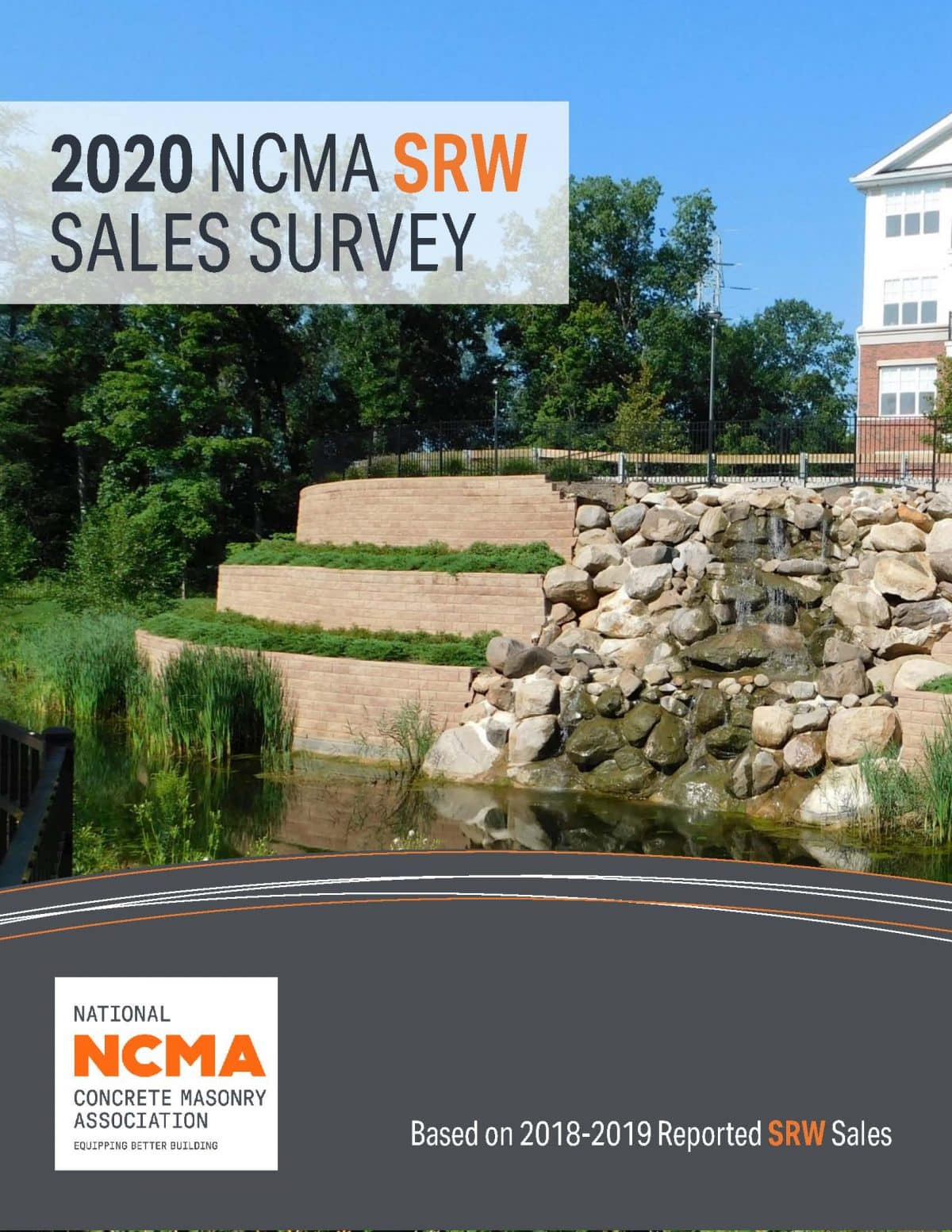
2020 SRW Sales Survey Released, 2.3% Increase Reported
Compared to sales in 2019, the overall sales of segmental retaining wall (SRW) units increased 2.6% in the US and decreased by 0.1% in Canada between 2018 and 2019, according to a study released by the National Concrete Masonry Association (NCMA).
The 2020 NCMA SRW Sales Survey is the fifth year of this industry survey. In total, 39 individual companies provided data for the survey, from both SRW producers and SRW licensors. The producers that responded represent 174 plant locations across the United States and Canada in 2019. Data was submitted in four different categories of SRW products: ‘DOT quality products’, ‘8 in. height SRW units’, ‘6 in. height SRW units’, ‘Boundary wall units’ (such as those used for fences or other vertical applications not retaining soil) and ‘other’ (which includes all other SRW products smaller than 6 in. high).
The category with the largest growth in 2019 was ‘Other SRW products’, which experienced a 2.5% increase in sales from 2018. Increases in sales in 2019 were also seen for ‘8 in. height SRW units’ and ‘DOT quality products’.
Wayne Villaluna, Basalite and NCMA SRW Committee Chair said “this survey and the data it conveys truly speaks for itself. Altogether, it shows the continued strength of the segmental retaining wall unit market and its overall demand. The continued sales growth year-over-year benefits all in the industry, including producers, designers, engineers, and those who supply machinery, materials, and other products to segmental retaining wall producers. It’s extremely promising.”
From the available data it is estimated that the total sales of SRWs in the US and Canada was 237.7 million sq. ft. of wall face.
The complete survey is available for purchase for $1,500 to individuals who are not members of NCMA. NCMA members pay only $250. Click here to buy it online. NCMA members should contact NCMA at (703) 713-1900 for member discounts and other purchase options.
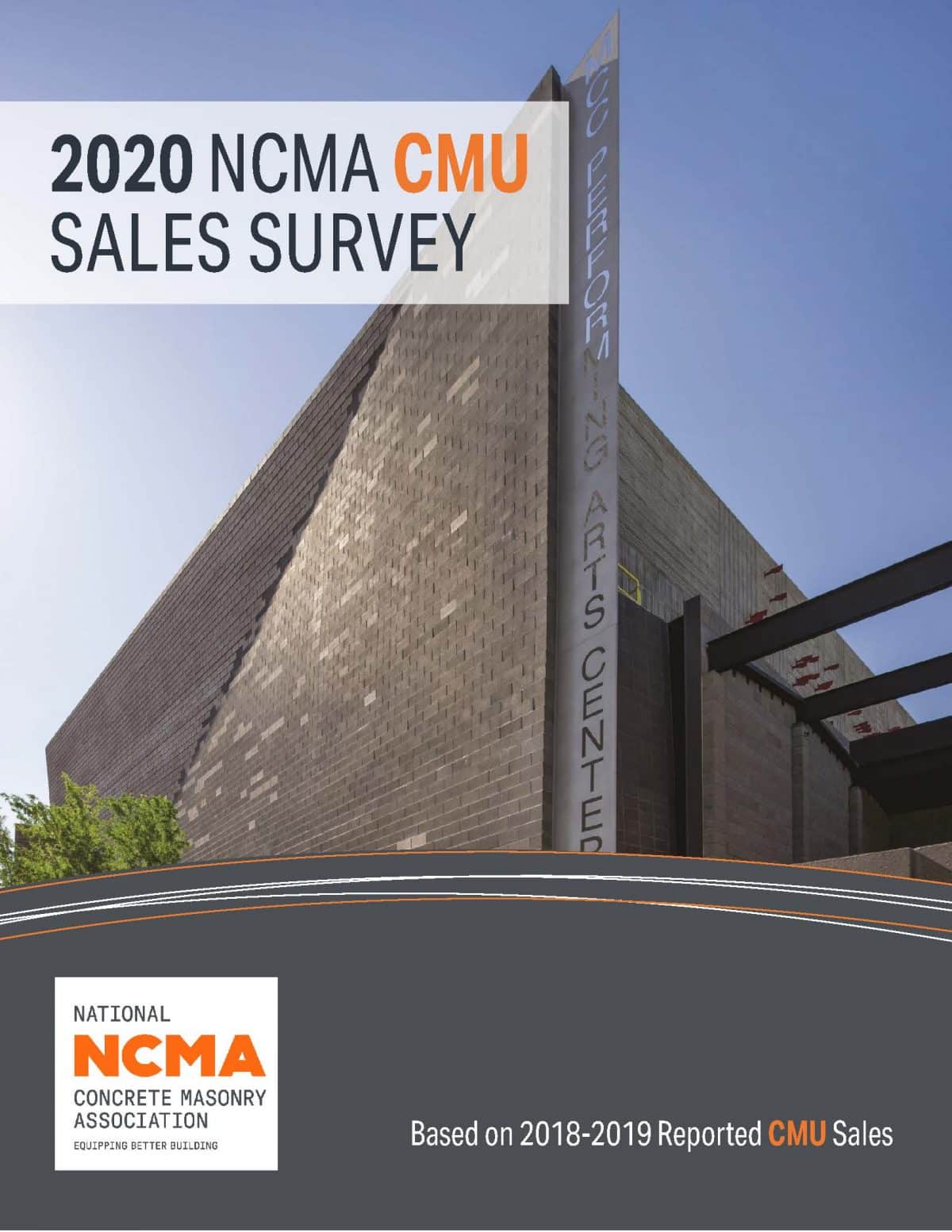
2020 CMU Sales Survey Released, 1.6% Increase Reported
Compared to sales in 2018 and 2019, the overall sales of concrete masonry units (CMU) increased 1.9% in the United States and 0.9% in Canada, according to a study released by the National Concrete Masonry Association (NCMA). For manufacturers, more than 90% of reported production in the United States was gray block as compared to nearly 40% of production in Canada.
The 2020 NCMA CMU Sales Survey is in its third year for this industry sales survey for concrete masonry units. In total, 39 individual companies provided data for the survey, all of which were manufacturers. The producers that responded represent 187 plant locations across the United States and Canada. Data was submitted in three different categories of CMU products: the aforementioned gray block, architectural block, and concrete masonry veneer (anchored and dry-cast adhered).
The category with the largest growth year over year in the United States was gray block, which experienced a 2.3% increase in sales. In Canada, the concrete masonry veneer category showed the largest growth, which experienced a 2.2% increase in sales. Since this survey started in 2017, the industry has shown yearly growth in the United States and Canada markets.
Gary Hensley, Adams an Oldcastle Company and NCMA Masonry Committee chair said “this third CMU Sales Survey is providing important growth data to the industry and the association. We see the increase in sales of concrete masonry products in the United States and Canada, as a very encouraging trend for all in the industry. The annual updates from the survey provide essential information, and demonstrates that what we are doing as an industry is working or that we need to make changes to increase market share.”
It is estimated that total production in the United States was 1.15 billion units in 2018 and 1.17 billion units in 2019. Estimated production in Canada was 101.8 million units in 2018 and 101.5 million units in 2019.
The complete survey is available for purchase through the NCMA Bookstore. Click here to buy it online. NCMA members should contact NCMA at (703) 713-1900 for member discounts and other purchase options.