Resources

Concrete Masonry Highway Sound Barriers

INTRODUCTION

As urban areas continually expand, a large percentage of high volume, high speed roadways are located within metropolitan areas, resulting in a great number of people being exposed to high levels of roadway noise. Controlling this noise is often a required part of highway construction or suburban expansion. Although the perception of unwanted sound varies from individual to individual and from one activity to another, objective criteria have been established to help designers determine when noise abatement is required, and the levels of noise reduction that will relieve the problem.

Noise abatement measures should be individually evaluated for each project, based on the project’s noise reduction goal and budget, the community needs, and longer-term maintenance and durability issues. Alternatives for reducing traffic noise include:

  1. land use planning: separating noise-sensitive uses from highways,
  2. controlling noise at the source: such as by reducing speed limits or prohibiting truck traffic, and
  3. attenuating noise by modifying the horizontal or vertical alignment of the highway, using larger right-of-ways, or shielding the noise with a barrier.

Sound barriers are solid obstructions built between the noise source and the receiver – they are often chosen as the most expedient and effective method to reduce highway traffic noise. Although earth berms can act as sound barriers, solid walls are more often used. An effective barrier can significantly reduce the level of unwanted noise, while providing an attractive durable element in the community.

Concrete masonry construction successfully fills all of the requirements for effective sound barrier walls, providing excellent noise insulation and a wide choice of aesthetic styles, excellent stability, strength, durability, and low maintenance. These benefits are well recognized; concrete masonry sound barriers represent over five times the wall area than the next popular choice, wood post and plank (ref. 4).

This TEK covers acoustic requirements for concrete masonry highway sound barriers. For structural design considerations, the reader is referred to Allowable Stress Design of Pier and Panel Highway Sound Barrier Walls (refs. 3).

NOISE REDUCTION REQUIREMENTS

The Federal Highway Administration (FHWA) publishes two criteria for determining when highway noise abatement is required. Values are expressed in dBA which is defined as a time weighted average sound level when measured on the A-scale of a standard sound meter at slow response. The two criteria are:

  1. when predicted noise levels exceed FHWA’s noise abatement criteria (see Table 1), or
  2. when predicted noise levels represent a substantial increase over existing noise levels.

The term “substantial increase” is defined by state highway agencies, but is most often taken as a 10 to 15 dBA increase in noise levels (ref. 2). Once either one of these criteria triggers the need for abatement considerations, the designer is required to provide a substantial reduction in noise levels, typically defined as a 5 to 10 dBA reduction (a 10 dBA reduction will generally be perceived as halving the noise; a reduction less than 5 dBA would probably not be noticeable).

The noise abatement criteria (NAC) in Table 1 are not meant as a design goal nor to represent desirable noise levels. If predicted levels exceed the NAC, abatement measures must be taken to reduce the predicted level by 5 to 10 dBA, not just to the level indicated in Table 1. Likewise, if predicted noise levels are 15 dBA above current levels, noise abatement must be considered even if the predicted level is below the NAC.

BARRIERS FOR NOISE REDUCTION

Total noise reduction by a barrier is commonly referred to as insertion loss. Simply defined, insertion loss is the difference in sound level before and after a barrier is placed next to a highway.

Insertion loss has five components:

  1. barrier attenuation due to the diffraction of sound waves over and around a barrier placed in the line-of- sight between the source and receiver,
  2. transmission loss of sound through the barrier,
  3. reductions in barrier attenuation resulting from multiple reflections caused by double barriers,
  4. shielding attenuation from other barriers between the source and the receiver, and
  5. loss of excess attenuation already received from soft ground cover.

For most highway applications, the first two of these components are by far the most significant.

Barrier Attenuation

Barrier attenuation due to sound wave diffraction is controlled by designing the barrier to be both tall enough and long enough to adequately shield the receiver. The noise barrier should be tall enough to break the line of sight between the highway and the receiver – noise barriers adjacent to the highway do very little for homes on a hillside overlooking that highway. Sound travelling around the ends of sound barriers can degrade the barrier performance. To avoid these end effects, one rule of thumb is to extend the barrier four times as far in each direction as the distance from the receiver to the barrier. If this is not possible, the sound barrier can often be combined with the natural terrain, such as knolls. Another alternative is to provide returns on the ends of the barrier back towards the community to reduce the noise level near the end of the barrier.

Barrier Physical Characteristics

Transmission loss through the barrier is controlled by the barrier material (see next section) and by eliminating holes and other openings in the barrier. FHWA and the American Association of State Highway and Transportation Officials (AASHTO) both recommend that the transmission loss be at least 10 dBA above the attenuation resulting from diffraction over the top of the barrier (refs. 1, 2).

Barrier insertion loss can be compromised if there are holes or openings in the barrier. For large openings, sound energy incident on the barrier will be directly transmitted through the opening to the receiver. When the opening is small, an additional phenomenon occurs: upon striking the barrier wall, the sound pressure can increase, effectively amplifying the transmitted sound. Maintenance openings and doorways can be placed behind a baffle or recessed wall area to minimize the effect of the opening. When sound walls terminate at an earth berm, care should be taken to ensure that there are no gaps between the wall and berm.

Barrier location also impacts effectiveness. For a given barrier height, moving the wall closer to the receiver, or closer to the source, will provide additional noise reduction (ref. 1). Barriers placed on hilly terrain above the highway can typically be shorter and still provide the same noise reduction as a taller barrier placed closer to the highway. Changes in wall height impact the barrier’s acoustic performance. Abrupt height changes of 2 ft (0.61 m) or more can significantly reduce effectiveness. A better alternative is to gradually step the height down to the lower level. This is particularly easy to accomplish with concrete masonry, as the modular size facilitates such changes.

Barrier Reflection

Recent research has clarified the impact of acoustic reflections, particularly between two parallel barriers, and in the case where a barrier is placed on only one side of the highway. In theory, multiple noise reflections between two parallel walls can reduce the effectiveness of the individual barriers and contribute to overall noise levels. To avoid reducing the performance of parallel barriers, it is suggested that the ratio of the distance between barriers to the average height of barrier above the roadway be at least 10:1 (see Figure 1). In these cases, measured increases in noise levels due to reflected noise have been below the threshold of normal human hearing (ref. 1).

Similarly, when a barrier is constructed on only one side of the highway, highway noise levels on the opposite side of the highway are not significantly affected. Measurements made to try to quantify the increase in noise level have shown maximum increases of 1 to 2 dBA, an increase not detectable to the average human ear (ref. 2).

Barrier Types

Many types of materials are used to construct highway noise barriers. For maximum performance, however, the material should be rigid and of sufficient density to provide a transmission loss of 10 dBA greater than the expected reduction in noise due to diffraction over the top of the barrier alone (ref. 2). The preferred method of rating a material’s ability to transmit noise is by the transmission loss (TL), which is related to the ratio of incident acoustical energy to transmitted acoustical energy. For highway noise sources and their typical sound spectral content, the transmission loss of common barrier materials increases with increasing surface weight of the material.

For many common heavyweight materials used in barrier construction, such as concrete masonry, transmission loss values are usually more than adequate. For less massive materials, such as steel, aluminum, and wood, transmission loss values may not be adequate, especially where large insertion losses are required. Typical TL values for common materials are given in Table 2.

Under certain conditions, vegetation can provide sound attenuation. AASHTO suggests that vegetation at least 15 ft (4.5 m) tall, and 98 ft (30 m) deep with sufficient density to completely block the line of sight can achieve a noise reduction of up to approximately 5 dBA (ref. 1). However, since it is usually impossible to plant enough vegetation to achieve a substantial noise reduction, the FHWA does not consider vegetation to be a noise abatement measure (ref. 2). Vegetation can, however, provide visual interest and relief, thus providing a psychological benefit, if not an acoustic one.

REFERENCES

  1. Guide on Evaluation and Abatement of Traffic Noise 1993. American Association of State Highway and Transportation Officials, 1993.
  2. Highway Traffic Noise Analysis and Abatement: Policy and Guidance. Federal Highway Administration, Washington, D.C., 1995.
  3. Allowable Stress Design of Pier and Panel Highway Sound Barrier Walls. TEK 14-15B, Concrete Masonry & Hardscapes Association, 2004.
  4. Highway Traffic Noise in the United States: Problems and Response. Federal Highway Administration, Washington, D.C., 1997.
  5. Procedures for Abatement of Highway Traffic Noise and Construction Noise. Code of Federal Regulations, 23CFR Part 772, U. S. Government Printing Office, 1997.
  6. Noise Barrier Design Handbook, FHWA-RD-76-58. Federal Highway Administration, Washington, D.C., 1976.

TEK 13-03A, Revised 1999. CMHA and the companies disseminating this technical information disclaim any and all responsibility and liability for the accuracy and the application of the information contained in this publication.

Noise Control With Concrete Masonry

INTRODUCTION

Sound control is an important design consideration in most buildings. Sound control involves two important properties: sound transmission and sound absorption, as depicted in Figure 1. The International Building Code (IBC, refs. 1, 2) contains minimum requirements for sound transmission in certain situations (see Sound Transmission Class Ratings of Concrete Masonry Walls, TEK 13-01D, ref. 3). However, the IBC does not contain minimum requirements for sound absorption, although proper control of sound reflected back into the room is a very important design function in many buildings as well, such as concert halls, gymnasiums, places of assembly, rooms containing loud equipment.

Concrete masonry is an ideal noise control material for both properties: it can act as a barrier by diffusing incident noise over a wide range of frequencies; and it can be an effective sound absorption material for absorbing noise generated within a room. This TEK discusses the sound absorption and sound transmission properties of concrete masonry, and provides general design guidance to help provide a good acoustic environment.

MAXIMIZING SOUND ABSORPTION

Sound absorption control involves minimizing sound reflection, so that the noise generated within the space is not echoed back into the space. Sound absorption is most important in applications like assembly areas or concert halls. The extent of control provided by a particular surface depends on that surface’s ability to absorb rather than reflect sound waves. This ability is estimated by the surface’s sound absorption coefficient: an indication of its sound absorbing efficiency. A surface which can theoretically absorb 100% of incident sound would have a sound absorption coefficient of 1. Similarly, a surface capable of absorbing 45% of incident sound has a sound absorption coefficient of 0.45.

Because the sound absorption coefficient typically varies with the frequency of the incident sound, the sound absorption coefficients measured at various frequencies are averaged together to produce an overall absorption coefficient. Standard Test Method for Sound Absorption and Sound Absorption Coefficients by the Reverberation Room Method, ASTM C423 (ref. 4) prescribes the test method and calculations. Traditionally, sound absorption has been reported in terms of the noise reduction coefficient (NRC), determined by taking a mathematical average of the sound absorption coefficients obtained at frequencies of 250, 500, 1,000 and 2,000 Hertz. More recently, the Sound Absorption Average (SAA) has been added to ASTM C423. Although the SAA is very similar to NRC, it is determined by averaging the sound absorption coefficients obtained at the twelve one-third octave bands from 200 through 2,500 Hz. ASTM C423 requires that both NRC and SAA be reported. Experience in the concrete masonry industry has shown that the new SAA values and the old NRC values vary little and generally are within 1 or 2 percentage points of each other.

Sound absorption values depend primarily on the surface texture and porosity of the material under consideration. More porous and open-textured surfaces are able to absorb more sound and, hence, have a higher value. This is reflected in the concrete masonry NRC values listed in Table 1. Note that painting a concrete masonry wall closes small surface openings, and hence decreases the wall’s sound absorption value.

MINIMIZING SOUND TRANSMISSION

Sound insulation, as between dwelling units, is accomplished by designing walls to minimize sound transmission. For this purpose, effectiveness primarily depends on wall weight, rather than on surface texture. In general, the heavier a concrete masonry wall is, the more effectively it will block sound transmission.

The sound transmission class (STC) rating provides an indication of how effectively a given wall prevents sound transmission across a range of frequencies. STC ratings for concrete masonry walls are determined using Standard Method for Determining the Sound Transmission Class Rating for Masonry Walls, TMS 0302 (ref. 5). TEK 13-01D, Sound Transmission Class Ratings of Concrete Masonry Walls, contains a complete discussion on determining STC ratings, applicable building code requirements, as well as tabulated values for various concrete masonry walls.

WALL SELECTION

When used for noise control, concrete masonry walls should be evaluated for both surface texture and density. Sound transmission is reduced by using heavier walls, but may be increased by using units with a very open surface texture. Transmission loss characteristics of unpainted, open-textured units can be increased by plastering or painting, although this will also result in a corresponding reduction in the sound absorption (SAA or NRC) of the block.

In some cases, the designer may wish to use both the transmission loss and absorption properties of concrete masonry to advantage. For example, using open textured units in a cavity wall with back plastering on the inside face of one or both wythes provides sound absorption on both sides of the wall as well as sound transmission reduction. Another option for providing both effective sound absorption and sound transmission loss is the use of acoustical concrete masonry units, such as those shown in Figure 2. These units typically have an opening molded into the face shell, to allow sound energy to readily enter the masonry cells. The cells are designed to incorporate systems such as metal septa and/or fibrous fillers to dissipate the sound energy and minimize sound transmission.

DESIGN AND CONSTRUCTION

Early in the design, a detailed noise survey should be conducted to determine the outside noise level and the anticipated background noise level in the various building areas. A building layout can then be developed which will help reduce noise transmission from one area to another. Effective sound control depends on proper layout and wall selection as well as good construction techniques.

Sound will be easily transmitted through any opening in a wall. An improperly fitted corridor door is a prime source of sound leakage, as well as openings around ducts, piping and electrical outlets which are improperly fitted or sealed. A crack just 0.007 in. (0.178 mm) wide along the top of a 12½ ft (3.8 m) wall will allow as much transmitted sound as a 1 in.² (645 mm²) hole. Hence, it is very important to seal all cracks, joints and gaps to maintain the acoustical integrity of the wall.

Building design and layout can also impact the building’s acoustic effectiveness. Planning early in the design process can help alleviate potential problem areas farther down the line. For example, individual spaces should be planned to minimize common walls whenever possible (see Figure 3), and to place adjacent spaced such that quieter areas (such as bedrooms) abut each other, and noisy areas (such as kitchens) abut similar noisy areas (see Figure 4).

When considering building layout, also note that sound travels most effectively in straight lines. Every time sound energy changes direction, some of it is absorbed and some diffused, hence reducing the amount that is transmitted. For example, Figure 5 shows that simply offsetting hallway doors can decrease the sound transmitted from one space to another through the doors. Separating windows will have a similar effect (see Figure 6).

Any wall penetration will potentially transmit sound. Therefore, plan to eliminate penetration whenever possible (see Figure 7). When unavoidable, partial wall penetrations such as electrical boxes should be completely sealed with joint sealant. Through-wall openings should be completely sealed, after first filling gaps with foam, cellulose fiber, glass fiber, ceramic fiber or mineral wool. See Sound Transmission Class Ratings of Concrete Masonry Walls, TEK 13-01D, for a more complete discussion of minimizing sound transmission through wall penetrations.

Finally, building heating and cooling ducts offer a potential noise pathway throughout a building. There are many ways to absorb or dissipate this noise, including acoustic linings and splitters to help break up and disperse the sound energy (see Figure 8). Any changes to the building’s ductwork will also potentially impact heating and cooling distribution. These effects should be considered during the HVAC system design.

REFERENCES

  1. 2003 International Building Code. International Code Council, 2003.
  2. 2006 International Building Code. International Code Council, 2006.
  3. Sound Transmission Class Ratings of Concrete Masonry Walls, TEK 13-01D. Concrete Masonry & Hardscapes Association, 2012.
  4. Standard Test Method for Sound Absorption and Sound Absorption Coefficients by the Reverberation Room Method, ASTM C423-07. ASTM International, 2007.
  5. Standard Method for Determining the Sound Transmission Class Rating for Masonry Walls, TMS 0302-07. The Masonry Society, 2007.

TEK 13-02A, Revised 2007. CMHA and the companies disseminating this technical information disclaim any and all responsibility and liability for the accuracy and the application of the information contained in this publication.

Sound Transmission Class Ratings for Concrete Masonry Walls

INTRODUCTION

Unwanted noise can be a major distraction, whether at school, work or home. Concrete masonry walls are often used for their ability to isolate and dissipate noise. Concrete masonry offers excellent noise control in two ways. First, it effectively blocks airborne sound transmission over a wide range of frequencies. Second, concrete masonry effectively absorbs noise, thereby diminishing noise intensity. Because of these abilities, concrete masonry has been used successfully in applications ranging from party walls to hotel separation walls, and even highway sound barriers.

Sound is caused by vibrations transmitted through air or other mediums, and is characterized by its frequency and intensity. Frequency (the number of vibrations or cycles per second) is measured in hertz (Hz). Intensity is measured in decibels (dB), a relative logarithmic intensity scale. For each 20 dB increase in sound there is a corresponding tenfold increase in pressure.

This logarithmic scale is particularly appropriate for sound because the perception of sound by the human ear is also logarithmic. For example, a 10 dB sound level increase is perceived by the ear as a doubling of the loudness.

The speed of sound through a particular medium, such as a party wall, depends on both the density and stiffness of the medium. All solid materials have a natural frequency of vibration. If the natural frequency of a solid is at or near the frequency of the sound which strikes it, the solid will vibrate in sympathy with the sound, which will be regenerated on the opposite side. The effect is especially noticeable in walls or partitions that are light, thin or flexible. Conversely, the vibration is effectively stopped if the partition is heavy and rigid, as is the case with concrete masonry walls. In this case, the natural frequency of vibration is relatively low, so only sounds of low frequency will cause sympathetic vibration. Because of its mass (and resulting inertia) and rigidity, concrete masonry is especially effective at reducing sound transmission.

DETERMINING SOUND TRANSMISSION CLASS (STC) FOR CONCRETE MASONRY

Sound transmission class (STC) provides an estimate of the acoustic performance of a wall in certain common airborne sound insulation applications.

The STC of a wall is determined by comparing sound transmission loss (STL) values at various frequencies to a standard contour. STL is the decrease or attenuation in sound energy, in dB, of airborne sound as it passes through a wall. In general, the STL of a concrete masonry wall increases with increasing frequency of the sound.

Many sound transmission loss tests have been performed on various concrete masonry walls. These tests have indicated a direct relationship between wall weight and the resulting STC—heavier concrete masonry walls have higher STC ratings. A wide variety of STC ratings is available with concrete masonry construction, depending on wall weight, wall construction and finishes.

In the absence of test data, standard calculation methods exist, which tend to be conservative. Standard Method for Determining Sound Transmission Ratings for Masonry Walls, TMS 0302 (ref. 1), contains procedures for determining STC values of concrete masonry walls. According to the standard, STC can be determined by field or laboratory testing in accordance with standard test methods or by calculation. The calculation in TMS 0302 is based on a best-fit relationship between concrete masonry wall weight and STC based on a wide range of test results in accordance with the following:

Equation 1 is applicable to uncoated fine- or medium- textured concrete masonry and to coated coarse-textured concrete masonry. Because coarse-textured units may allow airborne sound to enter the wall, they require a surface treatment to seal at least one side of the wall. At least one coat of acrylic latex, alkyd or cement-based paint, or plaster are specifically called out in TMS 0302, although other coatings that effectively seal the surface are also acceptable. One example is a layer of drywall with sealed penetrations, as shown in Figure 2. Architectural concrete masonry units are considered sealed without surface treatment for the purposes of using Equation 1.

Equation 1 also assumes the following:

  1. walls have a thickness of 3 in. (76 mm) or greater,
  2. hollow units are laid with face shell mortar bedding, with mortar joints the full thickness of the face shell,
  3. solid units are fully mortar bedded, and
  4. all holes, cracks and voids in the masonry that are intended to be filled with mortar are solidly filled.

Calculated values of STC are listed in Table 1.

Because the best-fit equation is based solely on wall weight, the calculation tends to underestimate the STC of masonry walls that incorporate dead air spaces, which contribute to sound attenuation. See the following section for the effect of drywall with furring spaces on STC.

For multi-wythe walls where both wythes are concrete masonry, the weight of both wythes is used in Equation 1 to determine STC. For multi-wythe walls having both concrete masonry and clay brick wythes, however, a different procedure must be used, because concrete and clay masonry have different acoustical properties. In this case, Equation 2, representing a best-fit relationship for clay masonry, must also be used. To determine a single STC for the wall system, first calculate the STC using both Equations 1 and 2, based on the combined weight of both wythes, then linearly interpolate between the two resulting STC ratings based on the relative weights of the wythes. Equation 2 is the STC equation for clay masonry (ref. 1):

For example, consider a masonry cavity wall with an 8-in. (203-mm) concrete masonry backup wythe (W = 33 psf, 161 kg/m²) and a 4-in. (102-mm) clay brick veneer (W = 38 psf, 186 kg/m²).

The installed weight of concrete masonry assemblies can be determined in accordance with CMU-TEC-002-23 (ref. 10). When STC tests are performed, the TMS 0302 requires the testing to be in accordance with ASTM E90, Standard Test Method for Laboratory Measurement of Airborne Sound Transmission Loss of Building Partitions and Elements (ref. 2) for laboratory testing or ASTM E413, Standard Classification for Rating Sound Insulation (ref. 3) for field testing.

CONTRIBUTION OF DRYWALL

Drywall attached directly to the surface of a concrete masonry wall has very little effect on sound attenuation other than the same benefit as sealing the surface. Adding ½ or in. (13 or 16 mm) gypsum wall board to one side of the wall with an unfilled furring space will generally result in a slight increase in STC. However, when placed on both sides of the wall with a furring space of less than 0.8 in. (19 mm) a reduction in STC is realized due to mass-air-mass resonance similar to the action of drum. Better results are realized when the furring space is filled with sound insulation. Sound insulation consists of fibrous materials, such as cellulose fiber, glass fiber or rock wool insulation, are good materials for absorbing sound; closed-cell materials, such as expanded polystyrene, are not, as they do not significantly absorb sound (refs. 1, 7). Note that most of these materials are susceptible to moisture so care must be taken when applying these types of insulation to exterior walls.

Equations to determine the change in STC when adding drywall are as follows (Table 2 lists calculated values of ΔSTC based on Equations 3 through 6):

  • For drywall on one side of the wall with no sound absorbing material in the furring space:
  • For drywall on both sides of the wall and no sound absorbing material in the furring spaces:
  • For drywall on one side of the wall with sound absorbing material in the furring space:
  • For drywall on both sides of the wall and sound absorbing material in the furring spaces:

In addition to this TEK, CMHA has generated a calculator for determining the sound transmission class (STC) of a user defined assembly. See CMU-XLS-003-19, CMU Sound and Assemblies Properties Calculator (ref. 8).

BUILDING CODE REQUIREMENTS

The International Building Code (ref. 4) contains requirements to regulate sound transmission through interior partitions separating adjacent dwelling units and separating dwelling units from adjacent public areas, such as hallways, corridors, stairs or service areas. Partitions serving the above purposes must have a sound transmission class of at least 50 dB for airborne noise when tested in accordance with ASTM E90. If field tested, an STC of 45 must be achieved. In addition, penetrations and openings in these partitions must be sealed, lined or otherwise treated to maintain the STC. Guidance on achieving this for masonry walls is contained below in Design and Construction.

The International Residential Code (ref. 5) contains similar requirements, but with a minimum STC rating of 45 dB when tested in accordance with ASTM E90 for walls and floor/ceiling assemblies separating dwelling units.

DESIGN AND CONSTRUCTION

In addition to STC values for walls, other factors also affect the acoustical environment of a building. For example, a higher STC may be warranted between a noisy room and a quiet one than between two noisy rooms. This is because there is less background noise in the quiet room to mask the noise transmitted through the common wall.

Seemingly minor construction details can also impact the acoustic performance of a wall. For example, screws used to attach gypsum wallboard to steel furring or resilient channels should not be so long that they contact the face of the concrete masonry substrate, as this contact area becomes an effective path for sound vibration transmission.

TMS 0302 includes requirements for sealing openings and joints to ensure these gaps do not undermine the sound transmission characteristics of the wall. These requirements are described below and illustrated in Figures 1 and 2.

Through-wall openings should be completely sealed, After first filling gaps with foam, cellulose fiber, glass fiber, ceramic fiber or mineral wool. Similarly, partial wall penetration openings and inserts, such as electrical boxes, should be completely sealed with joint sealant.

Control joints should also be sealed with joint sealants to minimize sound transmission. The joint space behind the sealant backing can be filled with mortar, grout, foam, cellulose fiber, glass fiber or mineral wool (see Figure 2).

To maintain the sound barrier effectiveness, partitions should be carried to the underside of the structural slab, and the joint between the two should be sealed against sound transmission in a way that allows for slab deflection. If the roof or floor is metal deck rather than concrete, joint sealants alone will not be effective due to the shape of the deck flutes. In this case, specially shaped foam filler strips should be used. For fire and smoke containment walls, safing insulation should be used instead of foam filler strips.

Additional nonmandatory design and building layout considerations will also help minimize sound transmission. These are covered in detail in TEK 13-02A (ref. 6). The design of exterior walls for the mitigation of outdoor-indoor sound transmission is covered under TEK 13-04B (ref. 9).

NOTATIONS

ΔSTC = the change in STC rating compared to a bare concrete masonry wall
d         = the thickness of the furring space (when drywall is used on both sides of the masonry, d is the thickness of the furring space on one side of the wall only), in. (mm)
STC     = Sound Transmission Class
STL     = Sound Transmission Loss
W        = the average wall weight based on the weight of the masonry units; the weight of mortar, grout and loose fill material in voids within the wall; and the weight of surface treatments (excluding drywall) and other components of the wall, psf (kg/m²)

REFERENCES

  1. Standard Method for Determining Sound Transmission Ratings for Masonry Walls, TMS 0302-12. The Masonry Society, 2012.
  2. Standard Test Method for Laboratory Measurement of Airborne Sound Transmission Loss of Building Partitions and Elements, ASTM E90-09. ASTM International, 2009.
  3. Standard Classification for Rating Sound Insulation, ASTM E413-10. ASTM International, 2010.
  4. 2003, 2006, 2009, and 2012 International Building Code. International Code Council, 2003, 2006, 2009, 2012.
  5. 2003, 2006, 2009, and 2012 International Residential Code. International Code Council, 2003, 2006, 2009, 2012.
  6. Noise Control with Concrete Masonry, TEK 13-02A. Concrete Masonry & Hardscapes Association, 2007.
  7. Controlling Sound Transmission Through Concrete Block Walls, Construction Technology Update No. 13. National Research Council of Canada, 1998.
  8. CMU Sound and Assemblies Properties Calculator, CMU XLS-003-19, Concrete & Hardscapes Association, 2019,
  9. Outdoor-Indoor Transmission Class of Concrete Masonry Walls, TEK 13-04A, Concrete & Masonry Hardscapes Association, 2012.

TEK 13-10D, Revised 2012. CMHA and the companies disseminating this technical information disclaim any and all responsibility and liability for the accuracy and the application of the information contained in this publication.

Splices, Development & Standard Hooks for Concrete Masonry Based on the 2009 & 2012 IBC

INTRODUCTION

Building codes include requirements for minimum reinforcement development lengths and splice lengths, as well as requirements for standard hooks, to ensure the adequate transfer of stresses between the reinforcement and the masonry. This TEK presents these requirements, based on the provisions of both the 2012 and 2009 editions of the International Building Code (IBC) (refs. 1, 2). Masonry design in these codes is primarily based on Building Code Requirements for Masonry Structures (MSJC) (refs. 3, 4). Differences between the MSJC and IBC are noted in the text when they occur.

There are two main differences between the 2008 and 2011 editions of the MSJC that impact reinforcement development and splice lengths in the corresponding 2009 and 2012 editions of the IBC:

  1. under 2011 MSJC allowable stress design, the allowable tensile stress, Fs, of Grade 60 steel was increased from 24,000 psi (166 MPa) to 32,000 psi (221 MPa), and
  2. the 2011 MSJC includes new lap splice length provisions for when confinement reinforcement is used at lap splices.

TEK 12-04D (ref. 5) includes basic material requirements, corrosion protection and placement tolerances for reinforcement used in concrete masonry construction. In addition, prestressing steel is discussed in Post-Tensioned Concrete Masonry Wall Construction, TEK 03-14 (ref. 6).

SPLICES AND DEVELOPMENT LENGTH

Minimum development lengths are necessary to adequately transfer stresses between reinforcement and the grout or mortar in which it is embedded. Splicing of reinforcement serves a similar purpose: to adequately transfer stresses from one reinforcing bar to another.

Reinforcement can be developed by embedment length, hook, or mechanical anchoring device. The development of the reinforcing bars relies on mechanical interlock of the bar deformations, hook, and/or anchor along with sufficient masonry cover to prevent splitting of the masonry. Reinforcing bars may be spliced by lapping the reinforcement, by proprietary mechanical splices or by welding.

The required length of lap or development is determined according to the design procedure used (allowable stress design or strength design). In addition, these detailing requirements have been frequently revised in recent years. As a result, the minimum lap and development lengths can vary considerably from one code to the next as well as from one design method to another.

The following sections present the requirements for both the 2009 IBC and 2012 IBC for both allowable stress and strength design.

2009 IBC SPLICE & DEVELOPMENT REQUIREMENTS

2009 IBC Allowable Stress Design

Development Length & Lap Splicing

While the 2008 MSJC includes an equation to determine development and lap splice lengths, the 2009 IBC modifies the MSJC lap splice length. In accordance with the 2009 IBC, the minimum required lap length for spliced reinforcing bars is determined using Equation 1 (see Table 1).

Further, in regions of flexure where the design tensile stresses in the reinforcement, fs, exceed 80% of the allowable steel tensile stress, Fs, the IBC requires that the required length of lap determined by Equation 1 must be increased by 50%. Alternatively, equivalent means of stress transfer to accomplish the same 50% increase is permitted. Where epoxy coated bars are used, lap length is also required to be increased by 50% but does not apply to the 12 in. (305 mm) minimum.

Development length requirements for allowable stress design are determined in accordance with Equation 3 except that there is no maximum length limit of 72db.

When noncontact lap splices are used, the bars must be spaced no farther apart than one-fifth the required length of lap nor more than 8 in. (203 mm).

When using the allowable stress design method, development of wires in tension is determined using Equation 2 (see Table 2). The development length of epoxy-coated wires is increased 50% above the value determined using Equation 2 but does not apply to the 6 in. (152 mm) minimum.

Alternatives to Lap Splicing

Reinforcing bars can also be spliced by welding, mechanical splicing and in some cases end-bearing splicing. Reinforcing bars larger than No. 9 (M#29) are required to be spliced using mechanical connectors.

Welded splices require the bars to be butted or shortly lapped and welded to develop in tension at least 125% of the specified yield strength of the bar. All welding is required to conform to AWS D1.4 (ref. 7), and steel for welded splices must conform to ASTM A706 (ref. 8). In practice, however, welding tends to be an expensive splicing option.

Mechanical splicing of reinforcement typically employs proprietary couplers specifically designed for this application. Mechanical splices are required to have the bars connected to develop in tension or compression, as required, at least 125% of the specified yield strength of the bar.

Reinforcing bars can also be spliced using end-bearing splices, but only in members containing closed ties, closed stirrups or spirals for bars subject to compression only. End-bearing splices rely on the transmission of compressive stress by bearing of square-cut ends held in concentric contact by a suitable device. The bar ends are required to terminate in flat surfaces within 11/2 degrees of a right angle to the axis of the bars and be fitted within 3 degrees of full bearing after assembly. 

2009 IBC Strength Design

Development Length & Lap Splice Length

For development and lap splice length requirements, the 2009 IBC references the 2008 MSJC (see Equation 3 and Table 3), but adds a maximum length limit of 72db.

For Equation 3, the reinforcement size factor, g, is taken equal to 1.0 for No. 3 through No. 5 (M#10–M#16) reinforcing bars; 1.3 for No. 6 and No. 7 (M#19, M#22) bars; and 1.5 for No. 8 and No. 9 (M#25, M#29) bars. When epoxy coated bars are used, the development length determined by Equation 3 is required to be increased by 50%.

Bars spliced by noncontact lap splices must be spaced no farther apart than one-fifth the required length of lap and no more than 8 in. (203 mm).

Alternatives to Lap Splicing

Mechanical splices are required to have the bars connected to develop at least 125% of the specified yield strength of the bar in tension or compression, as required.

The IBC further stipulates that mechanical splices be classified as Type 1 or 2 according to Section 21.2.6.1 of ACI 318, Building Code Requirements for Structural Concrete and Commentary (ref. 10). Type 1 splices may not be used within the plastic hinge zone nor within a beam-column joint of intermediate or special reinforced masonry shear walls or special moment frames. Type 2 are permitted at any location.

A Type 2 splice is defined as a full mechanical splice that develops in tension or compression, as required, at least 1.25fy of the bar. This requirement is intended to avoid a splice failure when the reinforcement is subjected to expected stress levels in yielding regions. Type 1 splices are not required to satisfy the more stringent requirements for Type 2 splices, and so their use is limited as noted above.

Welded splices must have the bars butted and welded to develop at least 125% of the bar’s specified yield strength in tension or compression, as required. Welded splices must use ASTM A706 (ref. 9) steel reinforcement. Welded splices are not permitted to be used in plastic hinge zones of intermediate or special reinforced walls nor in special moment frames of masonry.

2012 IBC SPLICE & DEVELOPMENT REQUIREMENTS

Regarding development and splice lengths, two significant changes were incorporated into the 2011 MSJC, which are included by reference in the 2012 IBC:

  1. in the 2011 MSJC, the allowable tensile stress, Fs, of Grade 60 steel when using allowable stress design was increased from 24,000 psi (166 MPa) to 32,000 psi (221 MPa), and
  2. the 2011 MSJC includes new provisions for confinement reinforcement, for both allowable stress and strength design methods.

2012 IBC Allowable Stress Design

Equation 1 is still applicable for use in the 2012 IBC but with the increase in F the splice lengths of fully stressed bars will increase by 33%. Significant reductions of splice lengths in low stress areas are achieved, however. The minimums of 12 in. (305 mm) or 40db whichever is greater still apply as well.

The 2012 IBC allows the MSJC development length equation (Equation 3) to be used as an alternate to the IBC equation (Equation 1). When using Equation 3 under the 2012 IBC, however, the value of K is defined as the least of the masonry cover, 9db (vs. 5db in the 2009 IBC) and the clear spacing between adjacent reinforcement.

Tabulated values are presented in Tables 4a through 4d. Note, however, that there is no maximum length limit of 72db for allowable stress design.

Tables 4a and 4b present minimum lap splice lengths for reinforcement placed in the center of the wall, for f’m = 1,500 and 2,000 psi (10.3 and 13.7 MPa), respectively.

Tables 4c and 4d present minimum lap splice lengths for reinforcement offset in the wall, for f’m = 1,500 and 2,000 psi (10.3 and 13.7 MPa), respectively.

Other requirements for lap, mechanical, welded and end-bearing splices are identical to those under the 2009 IBC, with the exception of the new provisions for confinement reinforcement, presented below.

2012 IBC Strength Design

Requirements for development length as well as lap, mechanical and welded splices are identical to those for allowable stress design, and are presented in Tables 4a through 4d.

2012 IBC Lap Splices With Confinement Reinforcement

The 2012 IBC, by reference to the 2011 MSJC, includes new lap splice criteria where confinement reinforcement is placed. The criteria are the same for both allowable stress design and strength design.

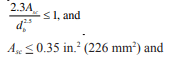
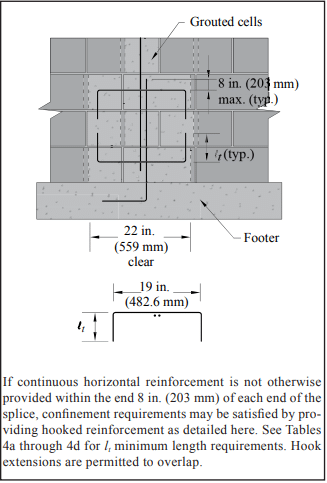
The confinement reinforcement criteria allow a reduced lap splice length when reinforcement is provided transverse to lapped bars. Research has found that the transverse, or confinement, reinforcement increases the lap performance significantly, as long as there is at least one No. 3 (M#10) or larger transverse bar placed within the last 8 in. (203 mm) of each end of the lap (see Figure 1). Because of this effect, calculated lap splice lengths are permitted to be reduced by a confinement factor, ξ, determined using Equation 4:

where

db is the bar diameter of the vertical reinforcement

The reduced lap splice length is not permitted to be less than 36db. The clear space between the transverse bars and the lapped bars may not exceed 1.5 in. (38 mm), and the transverse bars must be fully developed in grouted masonry at the point where they cross the lapped reinforcement (see Figure 1). These provisions are included in Tables 4a through 4d

STANDARD HOOKS

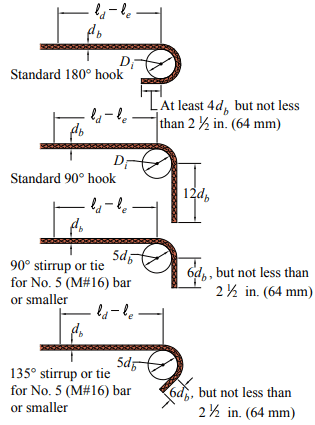
Figure 2 illustrates the requirements for standard hooks, when reinforcing bars are anchored by hooks or by a combination of hooks and development length. These requirements apply to both the 2009 and 2012 IBC, for both allowable stress and strength design. Table 5 lists minimum dimensions and equivalent embedment lengths for standard hooks of various sizes. A combination of hook and development length must be used when the equivalent embedment length of the hook, le, is less than the required minimum development length, ld. In this case, development length equal to (ldle) must be provided in addition to the hook. This additional development length is measured from the start of the hook (point of tangency with the main portion of the bar).

JOINT REINFORCEMENT SPLICES

Joint reinforcement must have a minimum splice length of 6 in. (152 mm) to transfer shrinkage stresses. Slippage of the deformed side wires is resisted by surface bond as well as by mechanical anchorage of the embedded portions of the cross wires.

NOTATIONS:

Asc = area of the transverse bars at each end of the lap splice, in.² (mm²)
Di = min. inside diameter of bend for standard hooks, in. (mm)
db = nominal diameter of reinforcement, in. (mm)
K = the least of the masonry cover, 9db for the 2012 IBC (5db for the 2009 IBC) and the clear spacing between adjacent reinforcement, in. (mm)
Fs = allowable tensile stress in reinforcement, psi (MPa)
f’m = specified compressive strength of masonry, psi (MPa)
fs = calculated tensile or compressive stress in steel, psi (MPa)
fy = specified yield strength of steel, psi (MPa)
ld = embedment length or lap splice length of straight reinforcement, in. (mm)
le = equivalent embedment length provided by standard hooks measured from the start of the hook (point of tangency), in. (mm)
lt = length of bar extension of hooked confinement reinforcement, in. (mm)
γ = reinforcement size factor
ξ = lap splice confinement reinforcement factor

REFERENCES

  1. International Building Code 2012. International Code Council, 2012.
  2. International Building Code 2009. International Code Council, 2009.
  3. Building Code Requirements for Masonry Structures, TMS 402-11 /ACI 530-11/ASCE 5-11. Reported by the Masonry Standards Joint Committee, 2011.
  4. Building Code Requirements for Masonry Structures, TMS 402-08 /ACI 530-08/ASCE 5-08. Reported by the Masonry Standards Joint Committee, 2008.
  5. Steel Reinforcement for Concrete Masonry, TEK 12-04D. Concrete Masonry & Hardscapes Association, 2007.
  6. Post-Tensioned Concrete Masonry Wall Construction, TEK 03-14. Concrete Masonry & Hardscapes Association, 2002.
  7. Structural Welding Code—Reinforcing Steel, AWS D 1.4-05. American Welding Society, 2005.
  8. Standard Specification for Low-Alloy Steel Deformed and Plain Bars for Concrete Reinforcement, ASTM A706/A706M-09b. ASTM International, Inc., 2009.
  9. Building Code Requirements for Structural Concrete and Commentary, ACI 318-11. American Concrete Institute, 2011.

TEK 12-06A, Revised 2013. CMHA and the companies disseminating this technical information disclaim any and all responsibility and liability for the accuracy and the application of the information contained in this publication.

Fasteners for Concrete Masonry

INTRODUCTION

Buildings use a variety of connectors including anchors, wall ties and fasteners. The distinction between the these types of connectors can be confusing. The broad term “connector” is defined as “a mechanical device for securing two or more pieces, parts, or members together, including anchors, wall ties, and fasteners” (refs. 1, 2). While the terms are often used interchangeably even in technical literature and codes, anchors, wall ties and fasteners each have different purposes. Typical industry usage is:

  • anchors secure masonry to its support. Examples are an anchor bolt or a column flange strap anchor used to connect a masonry wythe to a steel column.
  • Ties, such as adjustable wire ties, are used to connect wythes of masonry in a multiwythe wall.
  • Fasteners connect nonmasonry materials or objects to masonry. An example is a toggle bolt used to install a shelf.

This TEK discusses the use of fasteners in concrete masonry assemblies. TEK 12-01B, Anchors and Ties for Masonry (ref. 3) presents information on anchors and wall ties.

TYPES OF FASTENERS

Many fastener types are available. Fasteners for masonry are typically designed to be inset into a mortar joint, penetrate the face shell of a unit into its hollow core, or bore into a solid unit or solidly grouted wall.

Mortared-In Fasteners

Mortared-in refers to bolts not used for structural purposes, threaded rods and other fasteners that are placed in the masonry mortar joints while the wall is being constructed. This eliminates the need to drill or nail into the masonry, but placement must be exact, as these fasteners cannot be moved or adjusted after placement. Although most fasteners are post-applied rather than mortared in, nailer blocks of pressure-treated wood or metal can be installed during wall construction.

Post-Applied Fasteners

Post-applied fasteners fall into three broad categories: hand-driven mechanical or expansion fasteners, power-actuated fastening systems and chemical/adhesive fasteners.

Hand-Driven Mechanical or Expansion Fasteners

Probably the most familiar fasteners are the hand-driven, mechanical or expansion varieties. These fasteners are offered in several types of metal and, in some cases, plastic.

There are many fastener manufacturers and a large array of mechanical and expansion fastener types (see Figure 1). Some of the most common include:

Self-tapping screws (Figure 1a) that cut threads into the concrete masonry unit or mortar joint through a predrilled hole. Most manufacturers produce these in assorted small diameters and in several lengths.

Toggle fasteners (Figure 1b) frequently called toggle bolts come in several configurations but the most common consists of a threaded bolt and a spring-loaded toggle. Once inserted through a predrilled hole into the core of a hollow concrete masonry unit, the toggle expands and bears against the masonry, holding the bolt in place.

Sleeve fasteners (Figure 1c) consist of a threaded stud with a flared cone-shaped end and an expander sleeve assembled over the stud. A washer and nut are then attached to the end of the stud. After insertion, the nut is tightened, drawing the cone-shaped end into the expander sleeve forcing it to expand and bear against the masonry.

Wedge fasteners (Figure 1d) use a nut, washer and a tapered steel stud bolt. This is surrounded by a steel clip or wedges. As the nut is tightened, the stud is drawn up into the clip or wedge, lodging them against the side of the masonry.

Drop-in fasteners (Figure 1e) typically use steel expansion shells and internal plugs which are forced into the shells, causing them to expand against the substrate.

Strike, hit or split-drive fasteners (Figure 1f) rely on a driving or hammering force on a pin, stud or nail to cause the fastener to expand against the concrete masonry unit.

Power-Actuated Fastening Systems

These systems use means such as explosive powder, gas combustion, compressed air or other gas or fuel to embed fasteners into concrete masonry. Of these, powder-actuated systems are most common. Powder-actuated systems use explosive powder to embed the fastener using pressure similar to that of a bullet being fired. The charges used can be more powerful than those in hand guns, so training in the proper use of the tools is critical and in many jurisdictions certification is required. These fastener systems must be fully embedded in masonry (i.e., they cannot extend into hollow areas), so manufacturers recommend that when not used in solid or solid grouted masonry, the concrete masonry face shell thickness be at least 1 ¼ in. (32 mm) thick to accommodate the length of the fastener and withstand the force of the fastener insertion.

When a powder-actuated fastener is driven into concrete masonry, the material around the fastener shank is displaced. This causes the displaced material to compress against the fastener, creating a friction hold. The heat generated during the firing process also causes a sintering, or welding, of the concrete masonry to the fastener (see Figure 2).

There are several types of powder-actuated tools: some shoot the fastener down a barrel while others use pistons to drive the fastener into the wall. The tools are divided into classes according to the velocity of the fastener. The charges also come in a range of power levels.

The fasteners for powder-actuated tools are special heat- treated steel, resulting in a very hard yet ductile fastener, which can penetrate concrete masonry without breaking. The fastener may be threaded or smooth and has a guide to align it in the tool as it is being driven. Fasteners may be packaged in multi-cartridge magazines for rapid repetitive fastening.

Chemical/Adhesive Fasteners

These fastener systems consist of smooth or deformed steel bars or rods placed in a predrilled hole and set with chemical bonding compounds such as epoxies, polyesters, vinylesters or cementitious material (see Figure 3). Loads are transferred from the fastener through the bonding compound to the masonry. Surface-mounted adhesive fasteners are available and are typically used for light-duty conditions such as attaching mirrors and frames to a finished masonry surface. Adhesive fasteners can have some advantages over mechanical expansion fasteners, such as the potential for superior strength, especially pull-out. Adhesive systems may also be more resistant to vibration than mechanical expansion anchors, and the adhesive encapsulates the steel fastener providing additional corrosion protection. Closer edge distances may also be possible with adhesive systems.

DESIGN CONSIDERATIONS AND SELECTION CRITERIA

Because of the variety of fasteners and their applications, fastener design is not addressed in detail in building codes.

Structural Considerations

Structural considerations for fasteners are similar to those for anchors, but the loads on fasteners are typically less. Fastener tension and shear capacities should be considered when selecting a fastener.

Tension is typically transferred from the fastener to the masonry by friction (as for the screw or hit fasteners), keying effects (toggle bolts or expansion systems), bonding (adhesive and chemical systems), or a combination of these mechanisms. Shear is primarily resisted by the fastener itself. As such, shear strength depends on the fastener material and its cross section.

Failure modes for fasteners are also similar to those for anchors and depend on the type of fastener, type of concrete masonry unit, concrete masonry unit compressive strength, depth of embedment, loading conditions, edge distance and fastener load/spacing between fasteners. Typical tension failure modes are fastener breakage, concrete masonry unit cone failure, concrete masonry unit splitting, edge breakouts, pull-out and, in the case of adhesive or chemical fasteners, bond failure. Shear failures include fastener breakage and back pry-out (especially with a group of fasteners or those attached into hollow CMU through the face shell) and edge breakout.

Because fasteners are in most cases proprietary products, it is important to consult the specific manufacturer’s technical data for the fastener being used. Values for pull-out, shear capacity, edge distance and embedment length criteria are given, as well as acceptable substrates and the minimum required concrete masonry unit face shell thickness.

Other Selection Criteria

In addition to the structural requirements, some other basic considerations when selecting a fastener include:

  • the size, especially weight, and configuration of the item being connected to the masonry,
  • whether the fastener will be subject to significant vibration,
  • whether the fastener will be installed in solid or hollow concrete masonry at the attachment point,
  • the minimum edge distance to keep the concrete masonry unit from splitting or spalling,
  • the fastener exposure conditions,
  • whether there is a need for repetitive fastener installation, in which case power-actuated systems offer an advantage,
  • installer qualifications to place adhesive systems or to use powder-actuated fastener tools,
  • restricted access to work areas,
  • power or lighting availability,
  • moisture content of masonry,
  • local availability of fasteners and fastener tools, and
  • other project-specific requirements or conditions.

Codes and Standards

Codes (refs. 1, 2) require that connectors be capable of resisting applied loads and that all pertinent information be included in the project documents. Manufacturer’s literature should be consulted for data pertinent to the fastener and its application. A partial list of national test methods and standards applicable to fasteners includes references 4 through 8.

Corrosion Protection

Specification for Masonry Structures (ref. 9) requires that all metal accessories be stored off the ground and protected from permanent distortions. Since most fasteners include some type of metal, corrosion protection is important. Stainless steel fasteners should conform to ASTM A480, A240 or A580 (refs. 10, 11, 12), as a minimum.

The most common form of corrosion protection for carbon steel fasteners is zinc coating or galvanizing which can be applied in several methods to achieve different coating thicknesses. Table 1 lists minimum corrosion protection requirements (ref. 9).

Galvanic Action

Because fasteners connect nonmasonry items to masonry, the potential for corrosion from galvanic action between the fastener and the item being connected to the masonry must be considered when selecting fasteners.

All metals have electrical potential relative to each other. When metals with different potentials come into contact while in the presence of moisture, the more “active” metal—the one with the more negative potential—corrodes and the other metal is galvanically protected. Table 2 presents the ranking of metals based on their electrical potential from anodic (least noble) to cathodic (most noble). The farther apart two metals are in the table, the more severe and faster the galvanic attack. The relative surface areas of the connecting metals also affect the severity of the galvanic action.

To limit galvanic corrosion, use metals that are close in the galvanic series (Table 2). If this is not possible, separate the dissimilar metals with coatings, gaskets, plastic washers, etc. The fastener should also be selected so that it is the most noble, or protected, component. Drainage is also important to ensure the fastener is not subjected to a continually moist or wet condition.

INSTALLATION

Given the number of fastening options, no one installation method fits all. It is therefore important to follow the specific fastener manufacture’s installation procedures. Some general guidelines include:

  • Place fasteners with proper edge distance and spacing to prevent cracking and spalling of the concrete masonry.
  • Drill holes for insertion anchors the exact diameter specified and to the specified embedment depth.
  • Remove dust from predrilled holes, especially for chemical or adhesive fasteners.
  • For adhesive fasteners, dispense the entire cartridge of adhesive at one time with no interruption in flow.
  • With power-actuated fasteners, use test fastenings to determine the lowest power level that will insert the fastener to the proper depth and position without damaging the concrete masonry.
  • Hold power-actuated tools perpendicular to the masonry surface when firing to avoid ricocheting fasteners.
  • Never fire powder-actuated fasteners into masonry head joints.
  • Store powder loads in separate locked containers away from heat sources. Store the tool unloaded in a locked case.
  • Verify any required installer certification for operation of powder-actuated tools. Sources of information on installation methods include references 17 and 18.
  • Follow all recommended safety procedures.

REFERENCES

  1. International Building Code 2003. International Code Council, 2003.
  2. Building Code Requirements for Masonry Structures, ACI 530-05/ASCE 5-05/TMS 402-05. Reported by the Masonry Standards Joint Committee, 2005.
  3. Anchors and Ties for Masonry, TEK 12-01B. Concrete Masonry & Hardscapes Association, 2011.
  4. Acceptance Criteria for Fasteners Power-Driven into Concrete, Steel and Masonry Elements, ICC Engineering Services Report AC 70 – October 2004. International Code Council Engineering Services Evaluation Committee, Whittier, CA, 2004.
  5. Standard Test Method for Strength of Anchors in Concrete and Masonry Elements, ASTM E488-96 (2003). ASTM International, 2003.
  6. Standard Test Method for Pullout Resistance of Ties and Anchors Embedded in Masonry Mortar Joints, ASTM E754-80 (2000)e1. ASTM International, 2000.
  7. Standard Test Methods for Strength of Power-Actuated Fasteners Installed in Structural Members, ASTM E1190-95 (2000)e1. ASTM International, 2000.
  8. Standard Test Methods for Testing Bond Performance of Bonded Anchors, ASTM E1512-01. ASTM International, 2001.
  9. Specification for Masonry Structures, ACI 530.1-05/ASCE 6-05/TMS 602-05. Reported by the Masonry Standards Joint Committee, 2005.
  10. Standard Specification for General Requirements for Flat-Rolled Stainless and Heat- Resisting Steel Plate, Sheet, and Strip. A480/A480M-05. ASTM International, 2005.
  11. Standard Specification for Chromium and Chromium-Nickel Stainless Steel Plate, Sheet, and Strip for Pressure Vessels and for General Applications. A240/A240M- 05a. ASTM International, 2005.
  12. Standard Specification for Stainless Steel Wire. A580/A580-98(2004). ASTM International, 2004.
  13. Standard Specification for Steel Sheet, Zinc-Coated (Galvanized) or Zinc-Iron Alloy- Coated (Galvannealed) by the Hot-Dip Process, ASTM A653/A653M-05. ASTM International, 2005.
  14. Standard Specification for Zinc Coating (Hot-Dip) on Iron and Steel Hardware, ASTM A153/A153-05. ASTM International, 2005.
  15. Standard Specification for Zinc (Hot-Dip Galvanized) Coatings on Iron and Steel Products, ASTM A123/A123M-02. ASTM International, 2002.
  16. Standard Specification for Steel Wire, Epoxy-Coated, ASTM A899-91(2002). ASTM International, 2002.
  17. PATMI Basic Training Manual, Powder Actuated Tool Manufacturers’ Institute, 2005.
  18. Using Powder Activated (Ammunition) Tools – Study Materials for the Certificate of Fitness Exam for E-21. New York City Fire Department, 2001.


Steel Reinforcement for Concrete Masonry

INTRODUCTION

Reinforcement in concrete masonry walls increases strength and ductility, increases resistance to applied loads, and in the case of horizontal reinforcement, also provides increased resistance to shrinkage cracking. This TEK covers non-prestressed reinforcement for concrete masonry construction. Prestressing steel is discussed in Post-Tensioned Concrete Masonry Wall Construction, TEK 03-14 (ref. 1). Unless otherwise noted, the information is based on the 2003 International Building Code (IBC) (ref. 2). For masonry design and construction, the IBC references Building Code Requirements for Masonry Structures and Specification for Masonry Structures (MSJC Code and Specification) (refs. 4, 5). In some cases, the IBC has adopted provisions different from the MSJC provisions. These instances have been noted where applicable.

MATERIALS

Reinforcement used in masonry is principally reinforcing bars and cold-drawn wire products. Wall anchors and ties are usually formed of wire, metal sheets or strips. Table 1 lists applicable ASTM Standards governing steel reinforcement, as well as nominal yield strengths for each steel type.

Reinforcing Bars

Reinforcing bars are available in the United States in 11 standard bar sizes designated No. 3 through 11, No. 14 and No. 18 (M#10-36, M#43, M#57). The size of a reinforcing bar is designated by a number corresponding to its nominal diameter. For bars designated No. 3 through No. 8 (M#10-25), the number indicates the diameter in eighths of an inch (mm), as shown in Table 2.

To help address potential problems associated with reinforcement congestion and grout consolidation, the IBC limits the reinforcing bar diameter to the lesser of one-eighth the nominal member thickness, and one-fourth the least dimension of the cell, course or collar joint into which it is placed. For typical single wythe walls, this corresponds to a maximum bar size of No. 8, 9 and 11 for 8-, 10- and 12- in. walls, respectively (M#25, 29 and 36 for 203-, 254- and 305-mm walls). In addition, the following limits apply:

  • maximum bar size is No. 11 (M#36),
  • the area of vertical reinforcement may not exceed 6% of the grout space area (i.e., about 1.26 in.² , 1.81 in.² , or 2.40 in.² of vertical reinforcement for 8-, 10- and 12-in. concrete masonry, respectively (815, 1,170 or 1,550 mm² for 203-, 254- and 305-mm units, respectively), and
  • for masonry designed using strength design procedures, the maximum bar size is No. 9 (M#29) and the maximum area of reinforcement is 4% of the cell area (i.e., about 0.84 in.² , 1.21 in.² , or 1.61 in.² of vertical reinforcement for 8-, 10- and 12-in. concrete masonry, respectively (545, 781 or 1,039 mm² for 203-, 254- and 305-mm units, respectively).

The prescriptive limits on reinforcement sizes, above, are construction-related. Additional design limits to prevent over-reinforcing and brittle failures may also apply depending on the design method used and the design loads resisted. Manufacturers mark the bar size, producing mill identification and type of steel on reinforcing bars (see Figure 1). Note that the bar size indicates the size in SI units per ASTM standards.

The ASTM standards include minimum requirements for various physical properties including yield strength and stiffness. While not all reinforcing bars have a well-defined yield point, the modulus of elasticity, Es , is roughly the same for all reinforcing steels and for design purposes is taken as 29,000,000 psi (200 GPa).

When designing by the allowable stress design method, allowable tensile stress is limited to 20,000 psi (138 MPa) for Grade 40 or 50 reinforcing bars and 24,000 psi (165 MPa) for Grade 60 reinforcing bars. For reinforcing bars enclosed in ties, such as those in columns, the allowable compressive stress is limited to 40% of the specified yield strength, with a maximum of 24,000 psi (165 MPa). For strength design, the nominal yield strength of the reinforcement is used to size and distribute the steel.

Cold-Drawn Wire

Cold-drawn wire for joint reinforcement, ties or anchors varies from W1.1 to W4.9 (MW7 to MW32) with the most popular size being W1.7 (MW11). Table 3 shows standard wire sizes and properties. Because the IBC limits the size of joint reinforcement to one half the joint thickness, the practical limit for wire diameter is 3/16 in. (W2.8, 4.8 mm, MW18) for a in. (9.5 mm) bed joint. Wire for masonry is plain with the exception that side wires for joint reinforcement are deformed by means of knurling wheels.

Stress-strain characteristics of reinforcing wire have been determined by extensive testing programs. Not only is the yield strength of cold-drawn wire close to its ultimate strength, but the location of the yield point is not clearly indicated on the stress-strain curve. ASTM A 82 (ref. 15) defines yield as the stress determined at a strain of 0.005 in./in. (mm/mm).

CORROSION PROTECTION

Grout, mortar and masonry units usually provide adequate protection for embedded reinforcement provided that minimum cover and clearance requirements are met. Reinforcement with a moderate amount of rust, mill scale or a combination is allowed to be used without cleaning or brushing, provided the dimensions and weights (including heights of deformations) of a cleaned sample are not less than those required by the applicable ASTM standard. When additional corrosion protection is needed, reinforcement can be galvanized or epoxy coated.

Joint Reinforcement

Carbon steel can be protected from corrosion by coating the steel with zinc (galvanizing). The zinc protects in two ways: first, as a barrier separating the steel from oxygen and water, and second during the corrosion process, the zinc is sacrificed before the steel is attacked. Increasing the zinc coating thickness improves the level of corrosion protection.

Required levels of corrosion protection increase with the severity of exposure. When used in exterior walls or in interior walls exposed to a mean relative humidity over 75%, carbon steel joint reinforcement must be hot-dip galvanized or epoxy-coated, or stainless steel joint reinforcement must be used. When used in interior walls exposed to a mean relative humidity less than or equal to 75%, it can be mill galvanized, hot-dip galvanized, or be stainless steel. The corresponding minimum protection levels are:

  • Mill galvanized—ASTM A 641 (ref. 16) 0.1 oz/ft² (0.031 kg/m²)
  • Hot-dip galvanized—ASTM A 153 (ref. 17), Class B, 1.5 oz/ft² (458 g/m²)
  • Epoxy-coated—ASTM A 884 (ref. 18) Class A, Type 1 ≥ 7 mils (175 µm) (ref. 3). Note that both the 2003 IBC and 2002 MSJC code incorrectly identify Class B, Type 2 epoxy coated joint reinforcement, which is not applicable for masonry construction.

In addition, joint reinforcement must be placed so that longitudinal wires are embedded in mortar with a minimum cover of ½ in. (13 mm) when not exposed to weather or earth, and in. (16 mm) when exposed to weather or earth.

Reinforcing Bars

A minimum amount of masonry cover over reinforcing bars is required to protect against steel corrosion. This masonry cover is measured from the nearest exterior masonry surface to the outermost surface of the reinforcement, and includes the thickness of masonry face shells, mortar and grout. The following minimum cover requirements apply:

  • masonry exposed to weather or earth
    bars larger than No. 5 (M#16) …………………….2 in. (51 mm)
    No. 5 (M#16) bars or smaller……………………1½ in. (38 mm)
  • masonry not exposed to weather or earth … 1½ in. (38 mm)

PLACEMENT

Installation requirements for reinforcement and ties help ensure that elements are placed as assumed in the design, and that structural performance is not compromised due to mislocation. These requirements also help minimize corrosion by providing for a minimum amount of masonry and grout cover around reinforcing bars, and providing sufficient clearance for grout and mortar to surround reinforcement and accessories so that stresses can be properly transferred.

Reinforcing Bars

Tolerances for placing reinforcing bars are:

  • variation from d for walls and fl exural elements:
    d ≤ 8 in. (203 mm) ………………………. ±½ in. (13 mm)
    8 in. (203 mm) < d ≤ 24 in. (610 mm) ±1 in. (25 mm)
    d > 24 in. (610 mm) ……………………. ±1¼ in. (32 mm)
  • for vertical bars in walls ………..±2 in. (51 mm) from the specified location along the length of the wall.

In addition, a minimum clear distance between reinforcing bars and the adjacent (interior of cell) surface of a masonry unit of ¼ in. (6.4 mm) for fine grout or ½ in. (13 mm) for coarse grout must be maintained so that grout can flow around the bars.

DEVELOPMENT

Development length or anchorage is necessary to adequately transfer stresses between the reinforcement and the grout in which it is embedded. Reinforcing bars can be anchored by embedment length, hook or mechanical device. Reinforcing bars anchored by embedment length rely on interlock at the bar deformations and on sufficient masonry cover to prevent splitting from the reinforcing bar to the free surface. Detailed information and requirements for development, splice and standard hooks are contained in TEK 12-06A, Splices, Development and Standard Hooks for CM Based on the 2009 & 2012 IBC (ref. 19).

REFERENCES

  1. Post-Tensioned Concrete Masonry Wall Construction, TEK 03-14. Concrete Masonry & Hardscapes Association, 2002.
  2. International Building Code 2003. International Code Council, 2003.
  3. International Building Code 2006. International Code Council, 2006.
  4. Building Code Requirements for Masonry Structures, ACI 530-02/ASCE 5-02/TMS 402-02. Reported by the Masonry Standards Joint Committee, 2002.
  5. Specification for Masonry Structures, ACI 530.1-02/ASCE 6-02/TMS 602-02. Reported by the Masonry Standards Joint Committee, 2002.
  6. Standard Specification for Deformed and Plain Billet-Steel Bars for Concrete Reinforcement, ASTM A615/A615M-00. ASTM International, Inc., 2000.
  7. Standard Specification for Low-Alloy Steel Deformed and Plain Bars for Concrete Reinforcement, ASTM A706/A706M- 01. ASTM International, Inc., 2001.
  8. Standard Specification for Zinc-Coated (Galvanized) Steel Bars for Concrete Reinforcement, A767/A767M-00b. ASTM International, Inc., 2000.
  9. Standard Specification for Epoxy-Coated Steel Reinforcing Bars, A775/A775M-01. ASTM International, Inc., 2001.
  10. Standard Specification for Rail-Steel and Axle-Steel Deformed Bars for Concrete Reinforcement, A996/A996M-00. ASTM International, Inc., 2000.
  11. Standard Specification for Masonry Joint Reinforcement, ASTM A951-00. ASTM International, Inc., 2000.
  12. Standard Specification for Stainless and Heat-Resisting Steel Wire, ASTM A580-98. ASTM International, Inc., 1998.
  13. Standard Specification for Steel Wire, Deformed, for Concrete Reinforcement, A496/A496M-01. ASTM International, Inc., 2001.
  14. Manual of Standard Practice, MSP 1-01. Concrete Reinforcing Steel Institute, 2001.
  15. Standard Specification for Steel Wire, Plain, for Concrete Reinforcement, ASTM A82-01. ASTM International, Inc., 2001.
  16. Standard Specification for Zinc-Coated (Galvanized) Carbon Steel Wire, ASTM A641-98. ASTM International, Inc., 1998.
  17. Standard Specification for Zinc Coating (Hot-Dip) on Iron and Steel Hardware, ASTM A153-01a. ASTM International, Inc., 2001.
  18. Standard Specification for Epoxy-Coated Steel Wire and Welded Wire Fabric for Reinforcement, ASTM A884/A884M-99. ASTM International, Inc., 1999.
  19. Reinforcement Detailing Requirements for Concrete Masonry, TEK 12-06A. Concrete Masonry & Hardscapes Association, 2007.

TEK 12-04D, Revised 2006. Disclaimer: Although care has been taken to ensure the enclosed information is as accurate and complete as possible, CMHA does not assume responsibility for errors or omissions resulting from the use of this TEK.

Design of Anchor Bolts Embedded in Concrete Masonry

INTRODUCTION

The function of anchor bolts is to transfer loads to the masonry from attachments such as ledgers, sills, and bearing plates. Both shear and tension are transferred through anchor bolts to resist design forces such as uplift due to wind at the top of a column or wall or vertical gravity loads on ledgers supporting joists or trusses (see Figure 1). The magnitude of these loads varies significantly with the application.

This TEK summarizes the requirements to properly design, detail and install anchor bolts embedded in concrete masonry construction based on the provisions of the 2013 edition of Building Code Requirements for Masonry Structures (ref. 1). It should be noted that the 2012 editions of the International Building Code and International Residential Code (refs. 3 and 4) reference the provisions of the 2011 edition of Building Code Requirements for Masonry Structures (ref. 5) which contain no significant differences from the following analysis and design methodologies.

Anchor bolt configurations covered by Building Code Requirements for Masonry Structures fall into one of two categories:

• Bent-bar anchors, which include the customary J and L bolts, are threaded steel rods with hooks on the end embedded into the masonry. Bent-bar anchor bolts must meet the material requirements of Standard Specification for Carbon Structural Steel, ASTM A36/A36M (ref. 6).

• Headed anchors include conventional square head or hexhead threaded bolts, but also include plate anchors (where a steel plate is welded to the end of the bolt). Headed anchor bolts must meet the requirements of Standard Specification for Carbon Steel Bolts and Studs, 60,000 psi Tensile Strength, ASTM A307, Grade A (ref. 7).

For other anchor bolt configurations, including post-installed anchors, design loads are determined from testing a minimum of five specimens in accordance with Standard Test Methods for Strength of Anchors in Concrete and Masonry Elements, ASTM E488 (ref. 8) under stresses and conditions that represent the intended use. Allowable stress design values are limited to 20% of the average tested anchor bolt strength. Using strength design provisions, nominal design strengths are limited to 65% of the average tested strength.

GENERAL DESIGN AND DETAILING REQUIREMENTS

Building Code Requirements for Masonry Structures (ref. 1) contains anchor bolt design provisions for both the allowable stress design and strength design methods (Chapters 2 and 3, respectively). An overview of these design philosophies can be found in Allowable Stress Design of Concrete Masonry, TEK 14-07C, and Strength Design Provisions for Concrete Masonry, TEK 14-04B (refs. 9, 10). Note that Chapter 5 of the code also includes prescriptive criteria for floor and roof anchorage that are applicable to empirically designed masonry, but these provisions are not covered here.

While many of the requirements for anchor design vary between the allowable stress and strength design methods, some provisions are commonly shared between the two design approaches. The following discussion and topics apply to anchors designed by either the allowable stress or strength design methods.

Effective Area of Anchor Bolts

For both design methods, the anchor bolt net area used to determine the design values presented in this TEK are taken equal to the following, which account for the reduction in area due to the presence of the anchor threading:

½ in. anchor = 0.142 in.² (91.6 mm²)
⅝ in. anchor = 0.226 in.² (145.8 mm²)
¾ in. anchor = 0.334 in.² (215.4 mm²)
⅞ in. anchor = 0.462 in.² (298.0 mm²)

Effective Embedment Length

The minimum effective embedment length for anchor bolts is four bolt diameters (4db) or 2 in. (51 mm), whichever is greater (see Figure 2). The embedment length of headed bolts, lb, is measured parallel to the bolt axis from the surface of the masonry to the bolt head bearing surface. For bent-bar anchors, the effective embedment length is measured parallel to the bolt axis from the masonry surface to the bearing surface on the bent end minus one anchor bolt diameter.

Placement

Anchor bolts are required to be embedded in grout, with the exception that ¼ in. (6.4 mm) diameter anchors are permitted to be placed in mortar bed joints that are at least ½ in. (12.7 mm) thick. Excluding anchors placed in mortar bed joints, a minimum clearance of ¼ in. (6.4 mm) and ½ in. (12.7 mm) is required between the anchor bolt and the nearest surface of masonry for fine grout and coarse grout, respectively. This requirement applies to anchor bolts embedded in the top of a masonry element as well as those penetrating through the face shells of masonry as illustrated in Figure 2. While research (ref. 11) has shown that placing anchors in oversized holes in masonry unit face shells has no significant impact on the strength or performance of anchors compared to those placed in holes only slightly larger than the anchor diameter, the code has opted to maintain these clearance requirements as a convenient means of verifying that grout has adequately consolidated around the anchor bolt.
Although it rarely controls in typical masonry design, Building Code Requirements for Masonry Structures also requires that the distance between parallel anchors be at least equal to the diameter of the anchor, but not less than 1 in. (25.4 mm) to help ensure adequate anchor performance and grout consolidation around the anchor.

Existing masonry codes do not address tolerances for anchor bolt placement. In the absence of such criteria, construction tolerances used for placement of structural reinforcement could be modified for application to anchor bolts. In order to keep the anchor bolts properly aligned during grout placement, templates can be used to hold the bolts within the necessary tolerances. Templates, which are typically made of wood or steel, also prevent grout leakage in cases where anchors protrude from the side of a wall.

Projected Shear and Tension Areas

The projected tension breakout area, Apt, and the projected shear breakout area, Apv, for headed and bent-bar anchors are determined by Equations 1 and 2 as follows:

The anchor bolt edge distance, lbe, is measured in the direction of the applied load from the center of the anchor bolt to the edge of the masonry. When the projected areas of adjacent anchor bolts overlap, the portion of the overlapping area is reduced by one-half for calculating Apt or Apv as shown in Figure 3. Any portion of the projected area that falls within an open cell, open core, open head joint, or falls outside of the masonry element is deducted from the calculated value of Apt and Apv. A graphical representation of a tension breakout cone is shown in Figure 4.

ALLOWABLE STRESS DESIGN OF ANCHOR BOLTS

Tension

The allowable axial tensile load, Ba, for headed and bent-bar anchor bolts is taken as the smaller of Equation 3, allowable axial tensile load governed by masonry breakout, and Equation 4, allowable axial tensile load governed by anchor yielding. For bent-bar anchors, the allowable axial tensile load must also be less than that determined by Equation 5 for anchor pullout.

Shear

The allowable shear load, Bv, for headed and bent-bar anchor bolts is taken as the smallest of Equation 6, allowable shear load governed by masonry breakout, Equation 7, allowable shear load as governed by crushing of the masonry, Equation 8, allowable shear load as governed by masonry pryout, and Equation 9, allowable shear load as governed by anchor yielding.

Combined Shear and Tension

Anchor bolts subjected to combined axial tension and shear must also satisfy the following unity equation:

The relationship between applied tension and shear loads versus allowable tension and shear loads is illustrated in Figure 5.

STRENGTH DESIGN OF ANCHOR BOLTS

The design provisions for anchor bolts using the strength design method is nearly identical to that used for allowable stress design, with appropriate revisions to convert the requirements to produce nominal axial tension and shear design strengths. The strength reduction factors, Φ, for use in Equations 11 through 18 are taken equal to the following values:

  • when the nominal anchor strength is controlled by masonry breakout, masonry crushing, or anchor pryout, Φ is taken equal to 0.50,
  • when the nominal anchor strength is controlled by anchor bolt yielding, Φ is taken equal to 0.90,
  • when the nominal amchor strength is controlled by anchor pullout, Φ is taken equal to 0.65.

Tension

The nominal axial tensile strength, Ban, for headed and bent-bar anchor bolts is taken as the smaller of Equation 11, nominal axial tensile strength governed by masonry breakout, and Equation 12, nominal axial tensile strength governed by anchor yielding. For bent-bar anchors, the nominal axial tensile strength must also be less than that determined by Equation 13 for anchor pullout.

Shear

The nominal shear strength, Bvn, for headed and bent-bar anchor bolts is taken as the smallest of Equation 14, nominal shear strength governed by masonry breakout, Equation 15, nominal shear strength as governed by crushing of the masonry, Equation 16, nominal shear strength as governed by masonry pryout, and Equation 17, nominal shear strength as governed by anchor yielding.

Combined Shear and Tension

As with allowable stress design, anchor bolts subjected to combined axial tension and shear must also satisfy the following unity equation:

DESIGN EXAMPLE

Two ½ in (12.7 mm) headed anchors comprise a bolted connection for a roof beam to the side of an 8 in. (203mm) masonry wall, see Figure 5 below. The wall has a minimum specified compressive strength, f’m of 2,000 psi (13.8 MPa). The bolts have an effective yield stress of 60 ksi (413.7 MPa) with and effective embedment length and spacing between bolts of 6 in. (50.8 mm).

Allowable Stress Design

It can be assumed that the D + LR is the governing load combination. With this, the total design shear force for the connection is 1,600 lb (7.12 kN), with each anchor bolt resisting half of the total load. As is typical with bolted connections subjected to shear, the load is imparted at an offset distance, e which is equivalent to the additive thickness of the ledger and connector elements. This eccentric load generates a force couple with tensile forces in the anchor and bearing of the masonry wall. Using engineering judgment, the moment arm can be approximated as times the distance from the center line of the bolt to the edge of the ledger, denoted as x for this example. The induced tension force on the entire connection can be calculated as follows:

Using Equation 1, one can determine the area of tensile breakout for each bolt to be 113.10 in² (729.68 cm²), however due to the proximity of the bolts to one another, there is an overlap in projected breakout area. To account for this, one must reduce the projected breakout area by one half of the overlap area when analyzing an individual bolt. The modified projected area for each bolt becomes:

Using the above equation, the modified Apt is found to be 90.99 in² (578.03 cm²).

In turn, the axial tensile strength is controlled by either masonry breakout (Equation 3) or anchor yielding (Equation 4) and determined as follows (Equation 5 is explicitly for bent-bar anchors and need not be checked):

For this example, the axial tensile strength is controlled by the masonry breakout strength, Bab.

Similarly, to determine the allowable shear strength, one would typically calculate the shear breakout area for each anchor. For this particular example, given the direction of shear loading and large edge distance, masonry shear breakout will not be the governing failure mode. Calculated strengths for masonry crushing (Equation 7), anchor pryout (Equation 8), and anchor yielding (Equation 9) are as follows:

In this instance, shear strength of each anchor is controlled by the masonry crushing strength, Bvc.

Checking the combined loading effects for an individual anchor against Equation 10 yields the following:

Because the demand to capacity ratio is less than 1.0, the design is satisfied.

Strength Design

It is assumed that the governing load combination for the connection is 1.2D+1.6LR. With that, the effects of the eccentric shear load are analyzed similarly to the allowable stress design example yielding a factored tensile force of 2,688 lb (11.96 kN) acting on the whole connection. The factored shear load acting on the connection is determined to be 2,240 lb (9.96 kN).

Again, citing Equation 1 and modifying it for the overlap of projected breakout area, Apt for each anchor bolt is found to be 90.99 in.² (578.03 cm²). Refer to the allowable stress design example for clarification.

Axial tensile strength determined by calculating masonry breakout (Equation 11) and anchor yielding (Equation 12) are as follows (as was the case before, Equation 13 need not be checked as this applies only to bent-bar anchors):

The nominal axial tensile strength is governed by the anchor yielding, Bans.

Nominal shear strength is controlled by masonry crushing (Equation 15), anchor pryout (Equation 16), and anchor yielding (Equation 17) and is checked as follows (as explained previously, for this example the wall geometry and direction of loading indicate shear breakout to be an unlikely failure mode):

For this example, the nominal shear strength for each anchor is controlled by masonry crushing, Bvnc.

Applying the appropriate strength reduction factors of Φ = 0.9 for anchor yielding under tensile loads and Φ = 0.5 for masonry crushing under shear loads, and checking the combined loading effects for an individual anchor against Equation 18 yields the following:

With the demand to capacity ratio less than 1.0, the design is satisfied.

ADDITIONAL RESOURCES

A supplemental anchor design spreadsheet (CMU-XLS-002-19, Ref. 12) is available for the design of both face and top mounted masonry anchors in accordance with the 2013 edition of Building Code Requirements for Masonry Structures.

NOTATIONS

Ab          = cross-sectional area of anchor bolt, in.² (mm²)
Apt         = projected area on the masonry surface of a right circular cone for calculating tensile breakout capacity of anchor bolts, in.² (mm²)
Apv        = projected area on the masonry surface of one-half of a right circular cone for calculating shear breakout capacity of anchor bolts, in.² (mm²)
Ba         = allowable axial force on anchor bolt, lb (N)
Bab       = allowable axial tensile load on anchor bolt when governed by masonry breakout, lb (N)
Ban       = nominal axial strength of anchor bolt, lb (N)
Banb     = nominal axial tensile strength of anchor bolt when governed by masonry breakout, lb (N)
Banp     = nominal axial tensile strength of anchor bolt when governed by anchor pullout, lb (N)
Bans      = nominal axial tensile strength of anchor bolt when governed by steel yielding, lb (N)
Bap       = allowable axial tensile load on anchor bolt when governed by anchor pullout, lb (N)
Bas       = allowable axial tensile load on anchor bolt when governed by steel yielding, lb (N)
Bv         = allowable shear force on anchor bolt, lb (N)
Bvb       = allowable shear load on an anchor bolt when governed by masonry breakout, lb (N)
Bvc       = allowable shear load on anchor bolt when governed by masonry crushing, lb (N)
Bvn       = nominal shear strength of anchor bolt, lb (N)
Bvnb     = nominal shear strength of anchor bolt when governed by masonry breakout, lb (N)
Bvnc     = nominal shear strength of anchor bolt when governed by masonry crushing, lb (N)
Bvnpry  = nominal shear strength of anchor bolt when governed by anchor pryout, lb (N)
Bvns     = nominal shear strength of anchor bolt when governed by steel yielding, lb (N)
Bvpry   = allowable shear load on an anchor bolt when governed by anchor pryout, lb (N)
Bvs       = allowable shear load on an anchor bolt when governed by steel yielding, lb (N)
ba        = unfactored axial force on anchor bolt, lb (N)
baf       = factored axial force in anchor bolt, lb (N)
bv        = unfactored shear force on anchor bolt, lb (N)
bvf       = factored shear force in anchor bolt, lb (N)
db        = nominal diameter of anchor bolt, in. (mm)
e          = eccentricity of applied loads on bolted connection, in. (mm)
eb        = projected leg extension of bent bar anchor, measured from inside edge of anchor at bend to farthest point of anchor in the plane of the hook, in. (mm)
f’m       = specified compressive strength of masonry, psi (MPa)
fy         = specified yield strength of steel for anchors, psi (MPa)
lb         = effective embedment length of anchor bolts, in. (mm)
lbe        = anchor bolt edge distance, measured in direction of load, from edge of masonry to center of the cross section of anchor bolt, in. (mm)
s          = spacing between anchors, in. (mm)
x          = depth from center line of anchor to edge of ledger
Φ         = strength reduction factor

REFERENCES

  1. Building Code Requirements for Masonry Structures, TMS 402-13/ACI 530-13/ASCE 5-13, Reported by the Masonry Standards Joint Committee, 2013.
  2. Specification for Masonry Structures, TMS 605-13/ACI 530.1-13/ASCE 6-13, Reported by the Masonry Standards Joint Committee, 2013.
  3. International Building Code, International Code Council, 2012.
  4. International Residential Code, International Code Council, 2012.
  5. Building Code Requirements for Masonry Structures, TMS 402-11/ACI 530-11/ASCE 5-11, Reported by the Masonry Standards Joint Committee, 2011.
  6. Standard Specification for Carbon Structural Steel, ASTM A36-12, ASTM International, 2012.
  7. Standard Specification for Carbon Steel Bolts and Studs, 60,000 psi Tensile Strength, ASTM A307-12, ASTM International, 2012.
  8. Standard Test Methods for Strength of Anchors in Concrete and Masonry Elements, ASTM E488-10, ASTM International, 2010.
  9. Allowable Stress Design of Concrete Masonry, TEK 14-07C, Concrete Masonry & Hardscapes Association, 2011.
  10. Strength Design Provisions for Concrete Masonry, TEK 14-04B, Concrete Masonry & Hardscapes Association, 2008.
  11. Testing of Anchor Bolts in Concrete Block Masonry, Tubbs, J. B., Pollock, D. G., and McLean, D. I., The Masonry Society Journal, 2000.

TEK 12-03C, Revised 2013. CMHA and the companies disseminating this technical information disclaim any and all responsibility and liability for the accuracy and the application of the information contained in this publication.

Joint Reinforcement for Concrete Masonry

INTRODUCTION

Standard joint reinforcement for concrete masonry is a factory fabricated welded wire assembly consisting of two or more longitudinal wires connected with cross wires forming a truss or ladder configuration. It was initially conceived primarily to control wall cracking associated with thermal or moisture shrinkage or expansion and as an alternative to masonry headers when tying masonry wythes together. Note that horizontal steel requirements for crack control can be met using joint reinforcement or reinforcing bars. See Crack Control Strategies for Concrete Masonry Construction, CMU TEC-009-23 (ref. 6).

Joint reinforcement also increases a wall’s resistance to horizontal bending, but is not widely recognized by the model building codes for structural purposes. In some instances, it may be used in design for flexural resistance or to meet prescriptive seismic requirements.

This TEK discusses the code and specification requirements for joint reinforcement and presents a general discussion of the function of joint reinforcement in concrete masonry walls. Detailed information on additional uses for joint reinforcement can be found in other TEK as referenced throughout this publication.

MATERIALS

Reinforcement types used in masonry principally are reinforcing bars and cold-drawn wire products. Joint reinforcement is governed by Standard Specification for Masonry Joint Reinforcement, ASTM A 951 (ref. 1), or Standard Specification for Stainless Steel Wire, ASTM A 580/580M Type 304 or Type 316 (ref. 2), if the joint reinforcement is stainless steel according to the Specification for Masonry Structures (ref. 3). Cold-drawn wire for joint reinforcement varies from W1.1 to W4.9 (11 gage to 1/4 in. diameter; MW7 to MW32), the most popular size being W1.7 (9 gage, MW11). Wire for masonry is plain, except side wires for joint reinforcement are deformed by means of knurling wheels.

Because Building Code Requirements for Masonry Structures (ref. 4) limits the size of joint reinforcement to one half the joint thickness, the practical limit for wire diameter is W2.8, (3/16 in., MW17) for a 3/8 in. (9.5 mm) bed joint. Joint reinforcement of this thickness may be difficult to install however, if a uniform mortar joint thickness of 3/8 in. (9.5 mm) is to be maintained.

Types of Joint Reinforcement

Reflecting its multiple purposes in masonry walls, joint reinforcement comes in several configurations. One longitudinal wire is generally required for each bed joint (i.e., two wires for a typical single wythe wall), but code or specification requirements may dictate otherwise. Typical joint reinforcement spacing is 16 in. (406 mm) on center. Adjustable ties, tabs, third wires and seismic clips are also available in combination with joint reinforcement for multi-wythe and veneer walls.

  • Ladder-type joint reinforcement (Figure 1) consists of longitudinal wires flush welded with perpendicular cross wires, creating the appearance of a ladder. It is less rigid than truss type joint reinforcement and is recommended for multi-wythe walls with cavity spaces or unfilled collar joints. This permits the two wythes to move independently, yet still transfers outof-plane loads from the exterior masonry to the interior masonry wall. Cross wires 16 in. (406 mm) on center should be used for reinforced concrete masonry construction, to keep cross wires out of the core spaces, thus preventing them from interfering with the placement of vertical reinforcement and grout.
  • Truss-type joint reinforcement (Figure 2) consists of longitudinal wires connected with diagonal cross wires. This shape is stiffer in the plane of the wall than ladder-type joint reinforcement and if used to connect multiple wythes restricts differential movement between the wythes. For this reason, it should be used only when differential movement is not a concern, as in single wythe concrete masonry walls. Because the diagonal cross wires may interfere with the placement of vertical reinforcing steel and grout, truss type joint reinforcement should not be used in reinforced or grouted walls.
  • Tabs, ties, anchors, third wires and seismic clips of assorted configurations are often used with the joint reinforcement to produce a system that works to: control cracking; bond masonry wythes together; anchor masonry; and, in some cases, resist structural loads. Tie and anchor spacing and other requirements are included in Anchors and Ties for Masonry, TEK 12-01B (ref.5).

Recommendations for the use of some of the different types of joint reinforcement are listed in Table 1.

CORROSION PROTECTION

Grout, mortar and masonry units usually provide adequate protection for embedded reinforcement, provided that minimum cover and clearance requirements are met.

Coating Requirements

The carbon steel in joint reinforcement can be protected from corrosion by coating with zinc (galvanizing). The zinc protects steel in two ways. First, it provides a barrier between the steel and oxygen and water. Second, during the corrosion process, the zinc provides a sacrificial coating. The protective value of the zinc coating increases with increased coating thickness; therefore the required amount of galvanizing increases with the severity of exposure, as listed below (refs. 3, 4):

  • Interior walls exposed to a mean relative humidity less than or equal to 75%:
    Mill galvanized, ASTM A 641 (0.1oz/ft2)
    (0.031 kg/m2)
    Hot-dip galvanized, ASTM A 153 (1.5 oz/ft2)
    (458 g/m2)
    Stainless steel AISI Type 304 or Type 316
    conforming to ASTM A 580
  • Exterior walls or interior walls exposed to a
    mean relative humidity > 75%:
    Hot-dip galvanized, ASTM A 153 (1.5 oz/ft2 (0.46 kg/m2)
    Epoxy coated, ASTM A 884 Class A Type 1, >
    7 mils (175 mm)
    Stainless steel AISI Type 304 or Type 316
    conforming to ASTM A 580

Cover Requirements

Specification for Masonry Structures also lists minimum cover requirements for joint reinforcement as a further means of corrosion protection. It must be placed so that longitudinal wires are embedded in mortar with a minimum cover of:

  • 1/2 in. (13 mm) when not exposed to weather or earth,
  • 5/8 in. (16 mm) when exposed to weather or earth.

PRESCRIPTIVE CODE REQUIREMENTS

Building Code Requirements for Masonry Structures includes prescriptive requirements for joint reinforcement. There are multiple uses for joint reinforcement in masonry structures. Joint reinforcement can be used to provide crack control, horizontal reinforcement, and bond for multiple wythes, corners and intersections. The following list highlights only those requirements specific to joint reinforcement. Crack control topics are covered in CMU-TEC-009-23 (ref. 6). For information on anchors and ties, see Anchors and Ties for Masonry, TEK 12-01B (ref. 5). There is also a useful discussion on joint reinforcement as structural reinforcing in Steel Reinforcement for Concrete Masonry, TEK 12-04D (ref. 7).

General Requirements for Joint Reinforcement

  • For masonry in other than running bond: Horizontal reinforcement shall be 0.00028 times the gross vertical cross-sectional area of the wall. This requirement can be met with joint reinforcement placed in the horizontal bed joints. For 8in. (203-mm) masonry walls, this amounts to W1.7 (9 gage, MW11) joint reinforcement every other course. There are additional criteria for stack bond masonry in Seismic Design Categories D, E and F.
  • Seismic Requirements: In Seismic Design Category C and higher (for concrete masonry other than veneer), horizontal joint reinforcement spaced not more than 16 in. (406 mm) on center vertically with at least two wires of W1.7 (MW11) is required. Horizontal reinforcement also must be provided at the bottom and top of all wall openings and must extend at least 24 in. (610 mm) past the opening. Additional details on seismic requirements, including shear walls, are covered in Seismic Design and Detailing Requirements for Masonry Structures, CMHA TEK 14-18B (ref. 8).

Allowable Stress Design Requirements

  • In addition to the requirements above, concrete masonry walls designed by the allowable stress method and bonded by wall ties must have a maximum tie spacing of 36 in. (914 mm) horizontally and 24 in. (610 mm) vertically. Joint reinforcement cross wires can be used in place of wall ties to meet this requirement.
  • When the walls are designed for noncomposite action, truss-type joint reinforcing is not to be used for tying the wythes.
  • Combination joint reinforcement with tabs or adjustable ties are popular options for bonding multiwythe walls and are governed by additional code requirements.

Empirical Design Requirements

  • When two wythes of masonry are bonded with joint reinforcement, at least one cross wire must serve as a tie for each 22/3 ft2 (0.25 m2) of wall area. The vertical spacing of the joint reinforcement can not exceed 24 in. (610 mm), and the cross wires must be W1.7 (9 gage, MW11) minimum, without drips, and embedded in mortar.
  • Intersecting walls, when depending on each other for lateral support, can be anchored by several prescriptive methods including the use of joint reinforcement spaced no more than 8 in. (203 mm) on center vertically. The longitudinal wires must extend at least 30 in. (762 mm) in each direction at the intersection and be at least W1.7 (9 gage, MW11).
  • Interior nonloadbearing wall intersections may be anchored by several prescriptive methods, including joint reinforcement at a maximum spacing of 16 in. (406 mm) o.c. vertically.

Requirements for Use in Veneer

  • Prescriptive requirements for joint reinforcement in masonry veneer are included in Building Code Requirements for Masonry Structures, Chapter 6. These provisions are limited to areas where the basic wind speed does not exceed 110 mph (177 km/hr) as listed in ASCE 7-02 (ref. 9). Additional limitations are covered in the Code. The information below is for joint reinforcement or the joint reinforcement portion of a tie/anchor system. For information on anchor and tie requirements see Concrete Masonry Veneers, TEK 03-06C (ref. 10).
  • Ladder-type or tab-type joint reinforcement is permitted in veneer construction with the cross wires used to anchor the masonry veneer. Minimum longitudinal and cross wire size is W1.7 (9 gage, MW11), and maximum spacing is 16 in. (406 mm) on center vertically.
  • Adjustable anchors combined with joint reinforcement may be used as anchorage with the longitudinal wire of the joint reinforcement being W1.7 (9 gage, MW11) minimum.
  • Joint reinforcement may also be used to anchor masonry veneer to masonry provided the maximum distance between the inside face of the veneer and the outside face of the concrete masonry backup wythe is 4 1/2 in. (114 mm).
  • In Seismic Design Categories E and F, the 2005 edition of Building Code Requirements for Masonry Structures requires continuous single wire joint reinforcement, W1.7 (9 gage, MW11) minimum, in the veneer wythe at a maximum spacing of 18 in. (457 mm) on center vertically. Clips or hooks must attach the wire to the joint reinforcement. The International Building Code 2003 (ref. 11) also mandates this requirement for Seismic Design Category D.
  • Anchor spacings, and, as a result, possibly joint reinforcement spacing, are reduced for Seismic Design Categories D, E and F and in high wind areas.

Requirements for Use in Glass Unit Masonry

  • Horizontal joint reinforcement is to be spaced no more than 16 in. (406 mm) on center, located in the mortar bed joint, and must not span across movement joints.
  • Minimum splice length is 6 in. (152 mm).
  • Joint reinforcement must be placed immediately above and below openings in the panel.
  • Joint reinforcement must have at least 2 parallel, longitudinal wires of size W1.7 (9 gage, MW11) and have welded cross wires of W1.7 (9 gage, MW11) minimum.

INSTALLATION

Joint reinforcement installation is a routine task for masons. The joint reinforcement is placed on the face shells and mortar is placed over it. Cover requirements must be maintained. Installing the correct type of joint reinforcement with the specified corrosion resistant coating is important, as is making sure it is installed at the proper spacings and locations. Quality assurance provisions related to joint reinforcement generally include:

Submittals

Material Certificate indicating compliance should include:

  • material meets specified ASTM standard,
  • corrosion protection specified has been supplied,
  • configuration specified has been supplied, and
  • other criteria as required or specified.

Inspection

Oil, dirt and other materials detrimental to bond should be
removed. Light rust and mill scale are permissible.

  • Cover requirements are met.
  • Splices are a minimum of 6 in. (152 mm) (see Figure 3) to properly transfer tensile stresses. Tying is not necessary. Construction documents may specify longer splices, especially if the joint reinforcement is being used as part of the structural horizontal reinforcing steel.
  • Verify that joint reinforcement utilized for crack control does not continue through movement joints.
  • If ties or anchors are part of the joint reinforcement, check that embedment in the adjoining wythe, alignment and spacing are within specified values.

REFERENCES

  1. Standard Specification for Masonry Joint Reinforcement, ASTM A 951-02. ASTM International, 2002.
  2. Standard Specification for Stainless Steel Wire, ASTM A 580/580M-98(2004). ASTM International, 2004.
  3. Specification for Masonry Structures, ACI 530.1-05/ASCE 6 05/TMS 602-05. Reported by the Masonry Standards Joint Committee, 2005.
  4. Building Code Requirements for Masonry Structures, ACI 530 05/ASCE 5-05/TMS 402-05. Reported by the Masonry Standards Joint Committee, 2005.
  5. Anchors and Ties for Masonry, TEK 12-01B, Concrete Masonry & Hardscapes Association 2011.
  6. Crack Control Strategies for Concrete Masonry Construction, CMU-TEC-009-23, 2023.
  7. Steel Reinforcement for Concrete Masonry, TEK 12-04D, Concrete Masonry & Hardscapes Association, 2023.
  8. Seismic Design and Detailing Requirements for Masonry Structures, TEK 14-18B, Concrete Masonry & Hardscapes Association, 2003.
  9. Minimum Design Loads for Buildings and Other Structures, ASCE 7-02, American Society of Civil Engineers, 2002.
  10. Concrete Masonry Veneers, TEK 03-06C, Concrete Masonry & Hardscapes Association, 2012.
  11. International Building Code 2003. International Code Council, 2003.

Anchors and Ties for Masonry

INTRODUCTION

Masonry connectors can be classified as wall ties, anchors or fasteners. Wall ties connect one masonry wythe to an adjacent wythe. Anchors connect masonry to a structural support or frame. Fasteners connect an appliance to masonry. This TEK covers metal wall ties and anchors. Fasteners are discussed in TEK 12-05 (ref. 1).

The design of anchors and ties is covered by the International Building Code and Building Code Requirements for Masonry Structures (refs. 2, 3).These provisions require that connectors be designed to resist applied loads and that the type, size and location of connectors be shown or indicated on project drawings. This TEK provides a guide to assist the designer in determining anchor and tie capacity in accordance with the applicable standards and building code requirements.

DESIGN CRITERIA

Connectors play a very important role in providing structural integrity and good serviceability. As a result, when selecting connectors for a project, designers should consider a number of design criteria. Connectors should:

  1. Transmit out-of-plane loads from one wythe of masonry to another or from masonry to its lateral support with a minimum amount of deformation. It is important to reduce the potential for cracking in masonry due to deflection. There is no specific criteria on connector stiffness, but some authorities suggest that a stiffness of 2,000 lb/in. (350 kN/m) is a reasonable target.
  2. Allow differential in-plane movement between two masonry wythes connected with ties. This is especially significant as more insulation is used between the outer and inner wythes of cavity walls and where wythes of dissimilar materials are anchored together. On the surface, it may appear that this criterion is in conflict with Item 1, but it simply means that connectors must be stiff in one direction (out-of-plane) and flexible in the other (in plane). Note that some connectors allow much more movement than unreinforced masonry can tolerate (see ref. 27 for a discussion of potential masonry wall movements). In order to preserve the in-plane and out-of-plane wall tie stiffness, current codes (refs. 2, 3) allow cavity widths up to 4 1/2 in. (114 mm) without performing wall tie analysis. With an engineered analysis of the wall ties, cavity widths may be significantly increased to accommodate thicker insulation.
  3. Meet applicable material requirements:
  • plate and bent-bar anchors—ASTM A36 (ref. 4)
  • sheet-metal anchors and ties—ASTM A1008 (ref. 5)
  • wire anchors and ties—ASTM A82 (ref. 6), and adjustable wire ties must also meet the requirements illustrated in Figure 1
  • wire mesh ties – ASTM A185 (ref. 7)
  1. Provide adequate corrosion protection. Where carbon steel ties and anchors are specified, corrosion protection must be provided by either galvanizing or epoxy coating in conformance with the following (ref. 8):

A. Galvanized coatings:

  • Joint reinforcement in interior walls exposed to a mean relative humidity of 75% or less—ASTM A641 (ref. 13), 0.1 oz zinc/ft2 (0.031 kg zinc/m2)
  • Joint reinforcement, wire ties and wire anchors, exterior walls or interior walls exposed to a mean relative humidity greater than 75%—ASTM A153 (ref. 14), 1.5 oz zinc/ft2 (458 g/m2)
  • Sheet metal ties or anchors, interior walls exposed to a mean relative humidity of 75% or less—ASTM A653 (ref. 15) Coating Designation G60
  • Sheet metal ties or anchors, exterior walls or interior walls exposed to a mean relative humidity greater than 75%—ASTM A153 Class B
  • Steel plates and bars, exterior walls or interior walls exposed to a mean relative humidity greater than 75%—ASTM A123 (ref. 16) or ASTM A153 Class B
  • Plate and bent-bar anchors—ASTM A480 and ASTM A666 (refs. 10, 11)
  • Sheet metal anchors and ties—ASTM A480 and ASTM A240 (refs. 10, 12)
  • Wire ties and anchors—ASTM A580

B. Epoxy coatings:

  • Joint reinforcement—ASTM A884 (ref. 17) Class A
    Type 1 > 7 mils (175 µm)
  • Wire ties and anchors—ASTM A899 (ref. 18) Class C
    20 mils (508 µm)
  • Sheet metal ties and anchors—20 mils (508 µm) per
    surface or per manufacturer’s specification
  • Where stainless steel anchors and ties are specified,
    Specification for Masonry Structures (ref. 8) requires
    that AISI Type 304 or 316 stainless steel be provided
    that complies with:
  • Joint reinforcement—ASTM A580 (ref. 9)
  1. Accommodate construction by being simple in design and easy to install. Connectors should not be so large and cumbersome as to leave insufficient room for mortar in the joints, which can result in a greater tendency to allow water migration into the wall. In the same way, connectors should readily accommodate insulation in wall cavities.

WALL TIE AND ANCHOR REQUIREMENTS

Multiwythe Masonry Wall Types

Wall ties are used in all three types of multiwythe walls (composite, noncomposite and veneer), although some requirements vary slightly depending on the application. The primary differences between these wall systems are in construction details and how the applied loads are assumed to be distributed.

Composite walls are designed so that the masonry wythes act together as a single structural member. This requires the masonry wythes to be connected by masonry headers or by a mortar- or grout filled collar joint and wall ties to help ensure adequate load transfer. TEKs 16-01A and 16-02B (refs. 19, 20) more fully describe composite walls.

In noncomposite masonry (also referred to as a cavity wall), wythes are connected with metal wall ties, but they are designed such that each wythe individually resists the loads imposed on it. Noncomposite walls are discussed in TEKs 16-01A and 16-04A (refs. 19, 21).

In a veneer wall, the backup wythe is designed as the load-resisting system, with the veneer providing the architectural wall finish. Information on veneer walls can be found in TEKs 05-01B and 03 06C (refs. 22, 23). Note that although a cavity wall is defined as a noncomposite masonry wall (ref. 3), the term cavity wall is also commonly used to describe a veneer wall with masonry backup.

Building Code Requirements for Masonry Structures also includes empirical requirements for wire wall ties and strap-type ties used to connect intersecting walls. These requirements are covered in TEK 14-08B (ref. 24).

Wall Ties

Wire wall ties can be either one piece unit ties, adjustable two piece ties, joint reinforcement or prefabricated assemblies made up of joint reinforcement and adjustable ties (see Figure 2). Note that the 2011 edition of Specification for Masonry Structures allows adjustable pintle ties to have only one leg (previously, two legs were required for this type of wall tie).

Wall ties do not have to be engineered unless the nominal width of the wall cavity is greater than 4 1/2 in. (114 mm). These wall tie analyses are becoming more common as a means to accommodate more thermal insulation in the wall cavity. Masonry cavities up to 14 in. (356 mm) have been engineered. Of note for these analyses is that the span of wire is a more critical factor than cavity width, i.e. the span length of the pintel component typically controls the mode of failure.

The prescribed size and spacing is presumed to provide connections that will be adequate for the loading conditions covered by the code. These wall tie spacing requirements can be found in TEK 03-06C (for veneers) and TEK 16-01A (for composite and noncomposite walls). Note that truss-type joint reinforcement is stiffer in the plane of a wall compared to ladder-type, so it is more restrictive of differential movement. For this reason, laddertype joint reinforcement is recommended when significant differential movement is expected between the two wythes or when vertical reinforcement is used. See TEK 12-02B (ref. 25) for more information.

Additional tests are needed for adjustable anchors of different configurations and for one piece anchors. Proprietary anchors are also available. Manufacturers of proprietary anchors should furnish test data to document comparability with industry-tested anchors.

Anchors are usually designed based on their contributory area. This is the traditional approach, but some computer models suggest that this approach does not always reflect the actual behavior of the anchorage system. However, there is currently no accepted computer program to address this point, so most designers still use the contributory area approach with a factor of safety of three. The use of additional anchors near the edges of wall panels is also recommended and required around large openings and within 12 in. (305 mm) of unsupported edges.

CONSTRUCTION

When typical ties and anchors are properly embedded in mortar or grout, mortar pullout or pushout will not usually be the controlling mode of failure. Specification for Masonry Structures requires that connectors be embedded at least 1 1/2 in. (38 mm) into a mortar bed of solid units. The required embedment of unit ties in hollow masonry is such that the tie must extend completely across the hollow units. Proper embedment can be easily attained with the use of prefabricated assemblies of joint reinforcement and unit ties. Because of the magnitude of loads on anchors, it is recommended that they be embedded in filled cores of hollow units. See TEK 03-06C for more detailed information.

REFERENCES

  1. Fasteners for Concrete Masonry, TEK 12-05. Concrete Masonry & Hardscapes Association, 2005.
  2. International Building Code. International Code Council, 2012.
  3. Building Code Requirements for Masonry Structures, TMS 402-11/ACI 530-11/ASCE 5-11. Reported by the Masonry Standards Joint Committee, 2011.
  4. Standard Specification for Carbon Structural Steel, A36-ASTM International, 2008.
  5. Standard Specification for Steel, Sheet, Cold-Rolled, Carbon, Structural, High-Strength Low-Alloy with Improved Formability, A1008-11. ASTM International, 2011.
  6. Standard Specification for Steel Wire, Plain for Concrete Reinforcement, A82-07. ASTM International, 2007.
  7. Standard Specification for Steel Welded Wire Reinforcement, Plain, for Concrete, A185-07. ASTM International, 2007.
  8. Specification for Masonry Structures, TMS 602 -11/ACI 530.1-11/ASCE 6-11. Reported by the Masonry Standards Joint Committee, 2011.
  9. Standard Specification for Stainless Steel Wire, ASTM A580-08. ASTM International, 2008.
  10. Standard Specification for General Requirements for Flat Rolled Stainless and Heat-Resisting Steel Plate, Sheet, and Strip, ASTM A480-11a. ASTM International, 2011.
  11. Standard Specification for Annealed or Cold-Worked Austenitic Stainless Steel, Sheet, Strip, Plate and Flat Bar, ASTM A666-10. ASTM International, 2010.
  12. Standard Specification for Chromium and Chromium Nickel Stainless Steel Plate, Sheet and Strip for Pressure Vessels and for General Applications, ASTM A240-11a. ASTM International, 2011.
  13. Standard Specification for Zinc-Coated (Galvanized) Carbon Steel Wire, ASTM A641-09a. ASTM International, 2009.
  14. Standard Specification for Zinc Coating (Hot-Dip) on Iron and Steel Hardware, ASTM A153-09. ASTM International, 2009.
  15. Standard Specification for Steel Sheet, Zinc-Coated Galvanized or Zinc-Iron Alloy-Coated Galvannealed by the Hot-Dip Process, ASTM A653-10. ASTM International, 2010.
  16. Standard Specification for Zinc (Hot-Dip Galvanized) Coating on Iron and Steel Products, ASTM A123-09. ASTM International, 2009.
  17. Standard Specification for Epoxy-Coated Steel Wire and Welded Wire Fabric for Reinforcement, ASTM A884-06. ASTM International, 2006.
  18. Standard Specification for Steel Wire Epoxy Coated, ASTM A899-91(2007). ASTM International, 2007.
  19. Multiwythe Concrete Masonry Walls, TEK 16-01A, Concrete Masonry & Hardscapes Association, 2005.
  20. Structural Design of Unreinforced Composite Masonry, TEK 16-02B, Concrete Masonry & Hardscapes Association, 2002.
  21. Design of Concrete Masonry Noncomposite (Cavity) Walls, TEK 16-04A, Concrete Masonry & Hardscapes Association, 2004.
  22. Concrete Masonry Veneer Details, TEK 05-01B, Concrete Masonry & Hardscapes Association, 2003.
  23. Concrete Masonry Veneers, TEK 03-06C, Concrete Masonry & Hardscapes Association, 2012.
  24. Empirical Design of Concrete Masonry Walls, TEK 14-08B, Concrete Masonry & Hardscapes Association, 2008.
  25. Joint Reinforcement for Concrete Masonry, TEK 12-02B, Concrete Masonry & Hardscapes Association, 2005.
  26. Porter, Max L., Lehr, Bradley R., Barnes, Bruce A., Attachments for Masonry Structures, Engineering Research Institute, Iowa State University, February 1992.
  27. Crack Control Strategies for Concrete Masonry Construction, CMU-TEC-009-23, Concrete Masonry & Hardscapes Association, 2023.

Articulating Concrete Block (ACB) Installation

INTRODUCTION

Articulating concrete block (ACB) revetment systems are used to provide erosion protection. The ACB system is a matrix of individual concrete blocks placed together to form an erosion-resistant revetment with or without a geotextile underlay for subsoil retention. General information on ACB systems can be found in ACB-TEC-001-14 Articulated Concrete Block for Erosion Control (ref. 1).

Proper installation of an ACB revetment system is essential to achieve suitable hydraulic performance and maintain stability against the erosive force of flowing water during the design hydrologic event. Quality workmanship is important throughout the installation, including subgrade preparation, geotextile placement, block system placement, backfilling and finishing, and inspection.

These guidelines apply to the installation of ACB revetment systems, whether hand-placed or placed as a mattress. They are based on Design Manual for Articulating Concrete Block (ACB) Revetment Systems (ref. 2) and comply with ASTM D6884, Standard of Practice for the Installation of Articulating Concrete Block (ACB) Revetment Systems (ref. 3). These guidelines do not purport to address the safety issues associated with installation of ACB revetment systems, including use of hazardous materials, mechanical equipment, and operations. It is the responsibility of the contractor to establish and adopt appropriate safety and health practices, and comply with prevalent regulatory codes, such as OSHA (Occupational Health and Safety Administration) regulations.

SOIL SAMPLES

When rough grading is complete, soil samples representative of the subgrade conditions should be obtained in accordance with the contract documents/project specifi cations or at a minimum frequency of one sample per 50,000 blocks, or additional fraction thereof, and tested for:

  1. particle size distribution (ASTM D422, ref. 4)
  2. Atterberg limits (ASTM D4318, ref. 5)
  3. Standard Proctor density (ASTM D698, ref. 6)

The system includes a geotextile underlay compatible with the subsoil that allows hydraulic infiltration and exfiltration to occur while providing particle retention. Granular filters may be used in place of, or in combination with, the geotextile per the engineer’s design drawings and specifications. When a granular filter is used, its gradation must meet the design gradation stated in the contract documents/project specification and should be tested for grain size distribution at the same frequency as the subgrade soil testing. Prior to placing the geotextile and ACB revetment system, laboratory test results must be submitted to the engineer to ensure conformance with design parameters.

SUBGRADE PREPARATION

Stable and compacted subgrade soil should be prepared to the lines, grades and cross sections shown on the contract drawings. Termination trenches and transitions between slopes and embankment crests, benches, berms, and toes should be compacted, shaped and uniformly graded to facilitate intimate contact between the ACB revetment system and the underlying grade. Secure the revetment in a manner that prevents soil migration when the ACB matrix is terminated at a structure, such as a concrete slab or wall.

Subgrade soil should be approved by the engineer to confirm that it meets the required material and compaction standards. Soils not meeting the required standards should be removed and replaced with approved material, as specified by the project specification or the engineer.

Care should be taken not to excavate below the grades shown on the contract drawings, unless directed by the engineer. Subgrade excavation above the water line should not be more than 2 in. (51 mm) below the grade indicated on the contract drawings. Subgrade excavation below the water line should not be more than 4 in. (102 mm) below the grade indicated on the contract drawings.

Where such areas are below the allowable grades, they should be brought to grade by placing approved material and compacting in lifts not exceeding 6 in. (152 mm) in thickness. Where it is impractical, in the opinion of the engineer, to dewater the area to be filled, over-excavations should be backfilled with crushed rock or stone conforming to the grading and quality requirements of well-graded coarse aggregate in ASTM C33, Standard Specification for Concrete Aggregates (ref. 7), or as directed by the engineer.

Where such areas are above the allowable grades, they should be brought to grade by removing material, or reworking existing material, and compacting as directed by the engineer.

When preparing dry areas to receive the ACB system, the surface should be graded smooth to ensure intimate contact between the subgrade surface and the geotextile and between the geotextile and the bottom surface of the ACB revetment system. Unsatisfactory soils, soils too wet to achieve desired compaction, and soils containing roots, sod, brush or other organic materials, should be removed, replaced with approved material and compacted. The subgrade should be uniformly compacted to a minimum 90 percent of the Standard Proctor density (ASTM D698) or as required by the project specification, whichever is more stringent. Should the subgrade surface for any reason become rough, eroded, corrugated, uneven, textured or traffic marked prior to ACB installation, such unsatisfactory portion should be scarified, reworked, recompacted or replaced as directed by the engineer.

The subgrade should be raked, screeded or rolled by hand or machine to achieve a smooth compacted surface that is free of loose material, clods, rocks, roots or other materials that would prevent satisfactory contact between the geotextile and the subgrade.

Immediately prior to placing the geotextile and ACB system, the prepared subgrade should be inspected and approved by the engineer.

GEOTEXTILE PLACEMENT

The geotextile should be placed directly on the prepared subgrade, in intimate contact with the subgrade and free from folds or wrinkles. The geotextile must be placed such that placement of the overlying materials will not excessively stretch or tear the geotextile.

The geotextile should be placed so that the upstream strips of fabric overlap downstream strips, and so that upslope strips overlap down-slope strips. Overlaps should be in the direction of flow wherever possible. Geotextile joints should be overlapped a minimum of 3 ft (1 m) for below-water installations and a minimum 1 ½ ft (0.5 m) for dry installations in accordance with ASTM D6884 (ref. 3). When a sewn seam is used for seaming of woven geotextile, the thread should be high-strength, UV-resistant polypropylene or polyester.

When a granular filter is used, the geotextile should be placed to encapsulate the granular filter as shown in Figure 1. The distance between encapsulation points should not exceed 20 ft (6 m). The geotextile should extend to the edge of the revetment within the top, toe and side termination points of the revetment. If necessary to expedite construction and to maintain the recommended overlaps, anchoring pins or 11 gauge, 6- by 1-in. (152 by 25 mm) U-staples may be used; however, weights (e.g., sand-fi lled bags) are preferred to prevent creating holes in the geotextile.

After geotextile placement, the work area should not be disturbed so the intimate contact between the geotextile and the subgrade is maintained. The geotextile should not be left exposed longer than the manufacturer’s recommendation, to minimize damage due to ultraviolet radiation.

ACB SYSTEM PLACEMENT

The articulating concrete block system should be placed on the geotextile in such a manner as to produce a smooth plane surface in intimate contact with the geotextile. For blocks within the mat and blocks that are hand set, the joint spacing between adjacent blocks must be maintained to prevent binding of blocks and to achieve block-to-block interlock.

In curvature and grade change areas, alignment of the individual block and the orientation of the adjacent block must provide for intimate block-to-fabric contact and block-to-block interlock. Care should be taken during block installation to avoid damage to the geotextile or subgrade. When a geotextile is used, the ACB system placement should preferably begin at the upstream end and proceed downstream to minimize undermining of the revetment system if flows occur before installation is complete. If the ACB system is to be installed from downstream up, a contractor option is to place a temporary toe on the front edge of the ACB system to protect against undermining when flows are anticipated.

On sloped sections, when practical, placement should begin at the toe of the slope and proceed up the slope. Block placement should not bring block-to-block interconnections into tension. Individual blocks within the plane of the finished system must not exceed the protrusion tolerance used in the stability design of the system. The typical protrusion tolerance is ½ in. (13 mm).

If assembled and placed as large mattresses, the articulating mats can be attached to a spreader bar to aid in lifting and placing the mats into their proper positions using a crane. The mats should be placed side-by-side and/or end-to-end so the mats abut each other. Mat seams or openings between mats greater than 2 in. (51 mm) between blocks should be filled with grout.

Whether ACBs are placed by hand or in large mattresses, distinct grade changes should be accommodated with a well-rounded transition (i.e., minimum radius determined by individual system characteristics). Figure 2 shows a conceptual detail of a minimum radius for a top and toe-of-slope transition for bed and bank protection, while Figure 3 shows a top-of-slope transition and a typical toe detail for bank protection. Conceptual details for additional conditions are illustrated in Design Manual for Articulating Concrete Block (ACB) Revetment Systems (ref. 2).

If a discontinuous revetment surface exists in the direction of flow, a grout seam at the grade change location should be provided to produce a continuous, flush-finished surface. Grout seams should not be wider than one-half the maximum dimension of a single block.

Termination trenches should be backfilled with approved fill material and compacted flush with the top of the blocks. The integrity of a soil trench backfill must be maintained to ensure a surface that is flush with the top surface of the ACBs throughout the entire service life. Top, toe and side termination trenches should be backfilled with suitable fill material and compacted immediately after the block system has been placed.

Anchors or other penetrations through the geotextile should be grouted or otherwise repaired in a permanent fashion to prevent migration of subsoil through the penetration point.

Do not use the ACB revetment system as a road for heavy construction traffic unless it is designed as a flexible pavement that can handle the expected wheel loads. Light traffic, such as single axle trucks and mowing equipment, may operate on installed ACB systems.

FINISHING

The open area of the articulating concrete block system is typically either backfilled with suitable soil for revegetation or with – to ¾-in. (9.5 to 19 mm) diameter uniform crushed stone, or a mixture thereof. Crushed stone can enhance the interlock restraint, but can make the ACB revetment system less flexible. Backfilling with soil or granular fill within the cells of the system should be completed as soon as possible after the revetment has been installed. When topsoil is used as a fill material above the normal waterline, overfilling by 1 to 2 in. (25 to 51 mm) may be desirable to allow for consolidation.

INSPECTION

Each step of installation—subgrade preparation, geotextile and granular filter placement, ACB revetment placement, and the overall finished condition, including termination points, should be inspected and approved by the engineer.

REFERENCES

  1. Articulated Concrete Block for Erosion Control, ACB-TEC-001-14, Concrete Masonry & Hardscapes Association, 2014.
  2. Design Manual for Articulating Concrete Block (ACB) Revetment Systems, ACB-MAN-001-20, Concrete Masonry & Hardscapes Association, 2020.
  3. Standard Practice for Installation of Articulating Concrete Block (ACB) Revetment Systems, ASTM D6884-03. ASTM International, Inc., 2003.
  4. Standard Test Method for Particle-Size Analysis of Soils, ASTM D422-63(2002). ASTM International, Inc., 2002.
  5. Standard Test Methods for Liquid Limit, Plastic Limit, and Plasticity Index of Soils, ASTM D4318-05. ASTM International, Inc., 2005.
  6. Standard Test Methods for Laboratory Compaction Characteristics of Soil Using Standard Effort (12,400 ft-lbf/ft³ (600 kN-m/m³), ASTM D698-00ae1. ASTM International, Inc., 2001.
  7. Standard Specification for Concrete Aggregates, ASTM C33-03. ASTM International, Inc., 2003.