Press Releases

ICPI and NCMA Members Approve Unification 

The votes have been submitted and tallied, and the memberships of both ICPI and NCMA have approved unification by wide margins. Both organizations achieved the 2/3 majority vote required for approval with ICPI members voting 81% in favor and NCMA members voting 97% in favor, with both associations significantly exceeding quorum requirements for the vote. Thanks to all voting members for their attention to this important issue and to the ICPI-NCMA Unification Committee members for their hard work.

With this approval, NCMA and ICPI will unify effective July 1, 2022 under the transition name ‘ICPI-NCMA’. Until that time, each association will operate as they do now.

The unified association will accomplish more for members as a stronger, more influential single organization focused on the advancement and greater use of manufactured concrete products.

A Transition Committee is in place to work through the details of facilitating unification. This committee, jointly appointed by the Boards of ICPI and NCMA, consists of the officers of each association, the chairs of the Unification Committee, and Transition Task Group chairs.

Until July 1, 2022, each association will continue to operate as normal. You will continue to receive all the member benefits of the association(s) of which you are a member and dues will be remitted to your association(s) as usual. The Transition Committee will keep you informed of its efforts and plans for transition to the unified association. The first official meeting of the unified association will be the Midyear Meeting.

Transition Committee Update

Purpose: The purpose of the Transition Committee is to oversee the process associated with preparing the two organizations to efficiently unify into a single association by making recommendations to the ICPI and NCMA Boards for approval. Specific transition efforts include, but are not limited to, developing more detailed governance documents, supporting staffing structure development, strategic planning, providing feedback to the Leadership Development Committee, committee chair and member appointment process, budget development, and property recommendations. The Committee is also responsible for communicating progress to the boards and membership.

ICPI-NCMA Transition Committee

Co-Chairs: Marshall Brown, ICPI Board Chair and Rocky Jenkins, NCMA Board Chair

Members:
Steve Berry
Dave Carter
Sam Hoehner
Kevin Earley
Matt Lynch
Paul Pignatelli
Tom Finch
David Pitre
Fred Adams
Kendall Anderegg (Chair of Staffing Task Group)
Rocky Fizzano (Chair of Property Task Group)
Dean Jurik (Chair of Communications Task Group)

Staff Liaisons: Bob Thomas, Charles McGrath, and Merry Beth Hall

Paver Sales Continue to Climb

Hardscape contractors continue to see a high demand for pavers.

The results of the 2020 Contractor Industry Survey reported the average amount of pavers installed in 2019 increased by 77 percent. The trend continued in the 2021 report and showed the average paver sales per contractor increased an additional 8% to reach a record high of 33,240 sq. ft.

The survey of interlocking concrete pavement contractors is conducted yearly to identify trends and changes within the industry. Contractors who complete the 2021 survey receive a free copy of the final report. Survey participants can compare their practices and situations with those of their peers detailed in the final report.


Cost-Competitive Concrete Masonry

A hardening up of the property and casualty insurance market and new data showing the true economy of concrete masonry construction are boosting block’s advantage against competitive building systems.

That was the takeaway from a webinar – “Resilient Community Risk Reduction, an Economic Approach to Multi-Residential Structures” sponsored Sept. 16, 2021, by the Pennsylvania Concrete Masonry Association (PCMA). The webinar featured a detailed presentation from Walter G. M. Schneider III, Ph.D., P.E., CBO, MCP, CFO, MIFireE, FACSE – The Pennsylvania State University. Schneider, who serves as an adjunct professor in the Architectural Engineering and Agricultural & Biological Engineering Departments, reviewed data from a multi-city comparison of construction system costs that confirms block’s economic competitiveness with other building systems.

Also presenting was Patrick Riley, CPCU, ARM, CRIS, vice president, property and casualty, USI Insurance Services LLC. Riley told attendees that environmental factors are causing insurers to take a harder look at building materials and construction systems when writing policies and setting insurance rates

Wood Frame Sees Increases in Both Builder’s and Property and Casualty Costs

“The builders’ risk market, along with property and casualty, has been increasing and hardening significantly — particularly for wood frame projects and multi residential structures,” Riley said. “Wood frame projects have always been more expensive to insure than concrete or steel, but that gap has widened significantly over the past two years. We started putting together this presentation back in November 2020. I think we’ve had to change the rates on the builders’ risk at least three times already. That’s how quickly this market is changing,” he added.

“There’s adequate capacity, but the loss ratios have just been too high to support the pricing that’s been in place in the past. For that reason, we don’t expect it to really cool off anytime soon. Some of the main drivers are a lot of different events that weren’t drivers before, such as the civil unrest that occurred over the past year, a record number of named storms with $670 billion in losses. And there are a few other types of losses that have been occurring at a higher than normal level — such as wildfires and freeze events.”

Riley noted that “many of the large fires over the last year impacting wood frame construction have been a result of arson, which is obviously a troubling sign. Iin addition to the increased rates on insurance, underwriters are requiring 24/7 site security and video monitoring for these frame projects, which is further driving up the cost of using wood frame.”

Using the example of a $30 million building, Riley said “the builders risk rates for a wood frame project could be 3-4x higher than rates for a masonry project. For a $30M project, that could add over $100,000 to the total project costs.”  And once a building is complete, “the owner of a stick building faces considerably higher insurance rates. The property and casualty insurance on a wood frame building in the example would come in between $180,100 to $195,000 more than a comparable block building over a five-year ownership period,” he added.

“The big takeaway really is just to factor in the insurance when we’re making these decisions. We’ve had design firms asking us whether owners and developers are getting this message. I think they’re starting to. But from the insurance standpoint, I know that some of them are still surprised… So it’s something where a lot of people are getting shocked and surprised by this, but it’s not something that is going away anytime soon. If anything, we’ll probably see the markets for frame construction get a little harder before it gets under control.”

Block Shines

Schneider told attendees that in a series of cost comparisons of six building systems, in locations across the US — at a variety of times — concrete masonry performed very competitively against other building systems. And the inherent robustness of masonry construction protects more than just the residents of a single building. “Entire communities are impacted and at risk when multifamily residential structures are destroyed or severely damaged by storms, fire, flooding, or other disasters,” he said.

“We’re going to introduce you to the advantages of utilizing building materials that are inherently resilient —  to reduce community risk from naturally occurring weather related events as well as terrorist attacks and more. We want you to be thinking about building more robust buildings, so that the impact is less and normal comes back quicker.”

“I’m not saying you’ve got to build to resist something that the code isn’t telling you to. But we can make choices. And we can inherently build buildings so that they recover quicker, more efficiently, or have minimized impact. And we can do so in a very knowledgeable and deliberate way. A resilient community is able to resist, absorb or accommodate and recover from the effects of a hazard in a timely and effective manner. Think about if you’re the family that is living in this building. What is timely? How fast do you want to get back in? One of the things we saw after some of the major events in Louisiana, is that the population that migrated out of Louisiana because there was no housing available to them never came back. They moved. And the recovery time was so long that they started a new life somewhere else.”

In the study initiated by Schneider and PCMA, “we looked at the design of a multi-family residential structure of four stories, and everybody said, you know, you can’t do this economically using anything other than stick. You can’t compete with it. And so evaluations were done to look at a representative building. It’s 25,000 square feet per floor. It’s a mixed bedroom floor plan with a brick facade so that it was an apples- to-apples comparison on the exterior look. Alright, and yes, we already know that it’s a code violation to use brick on the fourth story of light wood frame, but we wanted it to be consistent across the board. Six construction types were looked at.”

The six construction types are:

  • Conventional wood framing with wood floor system (Type VA Construction)
  • Light Gage Steel Framing with cast-in-place concrete floor system on metal form deck (Type IIB Construction)
  • Load bearing concrete masonry construction with precast concrete plank floor system (Type IIB Construction)
  • Precast concrete walls and precast concrete floor system (Type IIB Construction)
  • Insulated Concrete Form (ICF) walls and precast concrete plank floor system (Type IIB Construction)
  • Insulated Concrete Form (ICF) walls and ICF concrete floor system (Type IIB Construction)

The initial study, released in 2017, considered three markets: Dallas, Edgewater, NJ, and Towson, MD — over discreet times — December 2016, May 2017, and September 2017. Concrete masonry and precast flooring performed very well economically across the US, and across the different time periods, occasionally beating stick built construction in terms of cost, and in other cases, coming in within a few percentage points.

Each market and time frame is covered in detail in the study and in the addendums for additional locations. For example, from the study:

“In the May 2017 cost estimate… where the least expensive system was the concrete masonry system with precast concrete plank floor. The relative cost of this system to the conventional wood frame system was 96 percent. The relative cost of the most expensive framing systems, the precast concrete wall system with precast concrete floor system and the insulated concrete form wall system with insulated concrete form floor system were 19 percent higher than the conventional wood frame system. In September 2017 the relative cost of the concrete masonry system rebounded, being 4 percent higher than the conventional wood frame system. This is still very favorable and well within the normal amount typically held for contingency”

Since the publication of the initial report, addendums have been published that cover 29 additional cities in the US and eight cities in Canada. These addendums also highlight the stability of concrete masonry pricing compared with wood frame, as they capture costs at different times from 2017 to 2021. In nearly all cases, concrete masonry is the most cost-competitive or within a small percentage of wood-framed construction.

The additional cities studied in the US are: Phoenix and Tucson AZ; Los Angeles, Sacramento, and San Jose CA; Washington DC; Tampa and Orlando FL;  Atlanta and Savannah GA; Chicago IL; Kansas City MO: Des Moines IA; Baltimore MD; Boston and Waltham MA; Omaha NE; Syracuse and Mineola NY; Charlotte and Raleigh NC; Toledo OH; Portland OR; Lehigh Valley, Pittsburgh and Harrisburg PA; Columbia SC; Knoxville TN;  Houston and Dallas TX; and Richmond, VA. The cities studied in Canada are: Calgary, Alberta; Halifax, Nova Scotia; Montreal, Quebec; Regina, Saskatchewan; Saskatoon, Saskatchewan; Toronto, Ontario; Vancouver, British Columbia; and Winnipeg, Manitoba.

View the the initial report, along with the addendums for the cities above, on the Buildingstudies.org website.


ICPI and NCMA Approve Unification

The results are in, and by an overwhelming margin, the members of both ICPI and NCMA have voted to unify the two associations. While the election is now complete, there is much to do as we prepare for the July 2022 launch of your new association.

Very soon, the unification website will begin providing regular updates to keep members up to date on activities and progress.

To all the voting members of ICPI, thank you for weighing in at this important moment in our shared history. Please stay engaged. Your voice will be important in the days, months, and years ahead!

CueCareer Recognizes HardscapingIs and ICPI for Workforce Development Excellence

Cue Career whose mission is to provide students with an easy and effective way to access information about careers and professional development opportunities chose ICPI, now known as CMHA, as the top industry association for 2021. Cue Career showcases careers in healthcare, manufacturing, construction, education and others to high school students exploring opportunities for their future. ICPI was recognized with the Patty Alper Family Foundation award.

Mississippi State University Takes First Place in National Unit Design Competition During NCMA’s Midyear Event

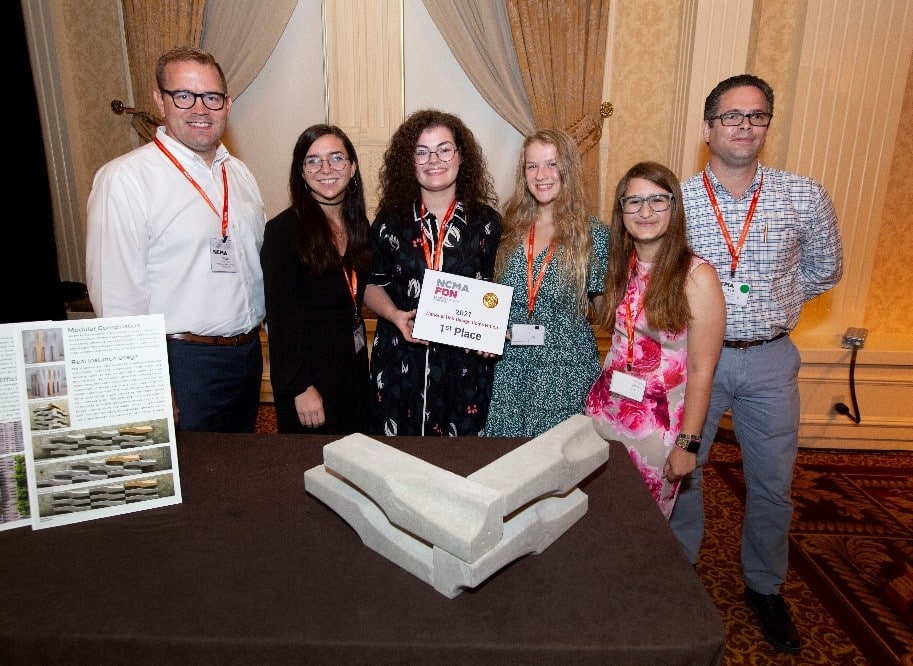
Two college teams presented their unique, fresh concrete masonry unit (CMU) designs at the 2021 Unit Design Competition (UDC) during NCMA’s Midyear event at the Pfister Hotel in Milwaukee, Wisconsin. Judges reviewed and scored the designs prior to the event and the results were announced during the meeting. The team from Mississippi State University took the top prize over second place Iowa State.

“It is always good to see new ideas and young minds looking into the future and making our world a better place to live,” said Kevin Mueggenborg, Dolese Brothers, Production Technologist and UDC Judge. “This is a great competition and I learn something every year”

The team of Jenny Hutton, Sarah Mixon, Gabbi Morelli, and Skylar Sloan, all students at Mississippi State University under the tutelage of Professor Jacob Gines, took first place. The team’s design, dubbed “Ellipse”, wowed the audience with its innovation. The jury loved the hands-on prototyping of the units, which provided not just great visuals, but real world, practical engagement for the students.

In a search for innovative ways to combine curves and deep reliefs within the rectilinear form of a unit, the design of Ellipse was developed. Having incorporated ellipsoid voids that reach halfway through the overall width of the unit, the design benefits from the deep shadows and arcs without compromising the stability and structural integrity of a traditional unit. The face of this design included rounded rather than sharp edges, not only aiding to the aesthetic flow, but also creating a more chip-resistant material by eliminating corners that may be damaged in transport.

The team created the form through the combination of a simple rectangle and ellipse both with the same base dimensions, 3⅝ʺ x 3⅝ʺ x 15⅝ʺ. The team then used the ellipsoid shape produced to subtract two of the corners from the basic monarch brick form. The voids have dimensions equal to one half of the length, width, and height, allowing the brick to have enough depth to create significant shadows while leaving the brick thick enough to be structurally sound.

The team from Iowa State University in Ames, Iowa, claimed second place in the competition. The team consisted of Aaron Howe, Jorge Nunez and Devin Palmberg under the guidance of Professor Bosuk Hur. They presented their design, “The CMU Green Block” and highlighted their applied skills.

The Iowa State team noticed a problem in urban communities where modern highway sound barriers are drastically underachieving. This is caused by concrete being an economically viable option for these sound barriers while the current design does not optimize the sound dampening qualities. The team’s goal with The Green Block was to take an economically efficient material in concrete and combine it with practically efficient methods of absorption and diffusion. Through the use of a curved extension from the block, sound is diffused into various directions. They also incorporated a green wall which uses sound absorbing properties of both the vegetation and the substrate.  These elements provide a more efficient wall system both practically and economically.

“It always amazes me how the next generation of designers can re-envision the conventional while concurrently educating and provoking thought in those more seasoned,” expressed Jason Thompson, NCMA, VP of Engineering and UDC Judge.

Pete Hoyt Bestowed With NCMA Lifetime Achievement Award

Peter B. Hoyt from Atlanta, GA, and retiree from Oldcastle Architectural, Inc., was presented with NCMA’s Lifetime Achievement Award on August 5 at the association’s Midyear meeting held at The Pfister Hotel in Milwaukee, WI.

This award is NCMA’s highest recognition for achievement or service by individuals through a member company (or companies). The award recognizes those individuals who have made extraordinary contributions to directly advance the industry and/or the association in a profound and lasting manner.

Hoyt and his two siblings grew up in the Westover neighborhood of Arlington, VA. His dad worked as a Naval architect at the nearby shipyards. Hoyt met his wife, Diane, in high school while living in Westover. They didn’t start dating until their fourth year of college. When Diane was at East Carolina University, Pete was studying business at The University of Virginia. He was also working his way through school as a platoon leader, as part of UVA’s Army ROTC. To this day, he credits the army as providing great management training. Hoyt was stationed at the Army’s Aberdeen Proving Ground, but traveled up and down the east coast for various training programs. After two years in active service, he applied for and received early release to pursue a law degree at George Washington University. Despite working full-time and taking most of his classes at night, it took him only three years to complete law school.

It was 1966 when Hoyt joined the firm of Touche Ross and Company, where he served in their tax division working on behalf of some of the biggest companies in the U.S. It was Diane’s father, Stanley Burroughs, that first exposed him to the concrete block business. Eventually, discussions came around to joining the family business. He finally decided to make the leap in 1971 and quickly found his footing with the company. Needing extra capacity for the growing business, they added a new plant in Bethesda and bought Washington Concrete Products in 1983. Hoyt credits his two partners, Kathy Wack and Harry Newman, for much of Betco and his success. Harry pushed for diversifying the business beyond traditional gray units and into patio block, installing a machine in the only place they had room– under a set of stairs. With their new machine, Betco supplied concrete pavers to Hechingers, a regional home improvement chain. Building on that success, Betco pursued similar retailers outside of the Washington Metro area, securing an appointment with a then new company called Lowe’s in North Carolina. A relationship with rival Home Depot soon followed.

By the early nineties, Betco outgrew their ever urbanizing location in Bethesda. Hoyt secured 12 acres in Gainesville, Virginia, for a site which would eventually host three manufacturing machines. Having confidence in himself and the business model his team created, he sought opportunities to take his experience to the national stage. Oldcastle, a quickly expanding company, intrigued him and he valued an opportunity to work with longtime company chairman, Joe McCullough. He and Joe structured a business acquisition plan that kept his team in place and tapped Hoyt to serve as president of Oldcastle’s Eastern region. Hoyt said he appreciated Oldcastle’s philosophy to buy only successful companies and infuse them with capital and best practices, retaining leaders who made those companies successful when possible. He also credits his professional success with his early involvement in the NCMA.

Most every idea, whether it be with production technology or product or market, has come from networking within NCMA. He translated his lifetime love of tennis into a new way of networking at NCMA meetings.

In 1998, he was elected NCMA Chairman of the Board and drew upon his business experience to tackle serious industry issues. After working hard to support the creation of the NCMA Education and Research Foundation, he’s the only individual to continuously serve in a direct leadership capacity since the foundation’s inception. Hoyt was inducted into NCMA’s Hall of Fame in 2001, and presented with the NCMA Chairman’s Award in 2018.

A few of the accolades and congratulations received for Hoyt are below.

“There’s been a lot of changes in our industry since 40 years ago when we first met. We’ve become good friends in those 40 years and had some interesting experiences. Congratulations on your award.” – James Weber, retiree of Oldcastle Architectural, Inc. and NCMA 2006 Chair

“We know how much of a blessing you’ve been to NCMA and to our industry and we are just thankful for all you’ve done for us. And you’re very deserving of this award.” – Harry Horn, retiree of Devening Block, Inc. and NCMA 1990 Chair.

“I know NCMA and its members occupy a special place in your heart. And this is a very meaningful and well-deserved honor.” – Patricia Pick, VWG Wealth Management

At 56 years and counting, Pete and Diane consider themselves blessed with an amazing family consisting of three children and nine grandchildren. When he’s not playing tennis or pickleball, concrete masonry and the industry continues to be at the forefront of Pete’s thoughts, even when traveling.

NCMA is proud to bestow the Lifetime Achievement Award to Pete Hoyt for all his contributions and his years of exemplary service to NCMA and the industry.

Jim Weber Bestowed With NCMA Lifetime Achievement Award

James L. Weber, retiree from Oldcastle Architectural, Inc., was presented with NCMA’s Lifetime Achievement Award on August 5 at the association’s Midyear meeting held at The Pfister Hotel in Milwaukee, WI.

This award is NCMA’s highest recognition for achievement or service by individuals through a member company (or companies). The award recognizes those individuals who have made extraordinary contributions to directly advance the industry and/or the association in a profound and lasting manner.

Weber is known for his sense of humor and sharp wit, traits that are prevalent in all aspects of his life, including business. In addition to his humor, he’s also known as being the consummate devil’s advocate. Weber was exposed to the value of hard work and the concrete block industry early in life when his dad, Wally, who bought Appleton Concrete Products in 1946. His official start date was 1957, the year that he graduated from Appleton High School. In those days, Weber drove the delivery truck, the forklift, the front-end loader, and did every other job to support the family business.

But not for long. He was preparing to see more of the world and gain new experiences and he made full use of those life opportunities. After high school, Weber spent the next four years at St. Norbert College as an ROTC cadet, graduating with a degree in business administration. He was commissioned into the U.S. Army as a Second Lieutenant in June of 1961. It was at St. Norbert he married his wife Janet in 1962. Jim and Janet lived the military life as Jim served his country with distinction over the next six years. He attended armor school at Fort Knox and later became part of the Ordinance Corps, rising to the rank of captain. In 1964, he served at several weapons depots, and his final posting was commanding an ammunition depot in England.

Jim and Janet were busy during this time, and that included building a new family. They were blessed with the births of all three of their children, Debbie, Darcy, and Jim in a span of just two and a half years. Following military service, the family returned to Appleton where Jim resumed work with his father, Wally. Weber considers his father his first and most influential mentor. In 1972, Appleton Concrete Products merged with West Bend Concrete Products and formed Bend Industries. West Bend’s, Fred Yahr, became the president of the expanded company with Weber serving as the vice president of sales and marketing. Fred Yahr, who served as the NCMA chairman of the board in 1981, is the second most influential mentor cited by Weber saying, “He had more confidence in me than I deserved.”

Jim and Janet attended their first NCMA convention in 1968. Weber remarked how those conventions have provided him the opportunity to meet the most interesting and daring people. In 2003 Weber, as president of Bend Industries, negotiated their sale to Oldcastle Architectural Products Group. His more than five decades of involvement with NCMA has included service on dozens of committees. Weber served as Chair of the NCMA Board in 2006 and was inducted into NCMA’s Hall of Fame in 2009.

A few of the accolades and congratulations received for Weber are below.

“What really sets you apart is your committee involvement and what you bring to the table, which with each meeting, you’re always prepared, always challenging, always have the guts to be the contrarian and I think in the end helps NCMA reach its goal of being a member-driven organization.” – Peter B. Hoyt, retiree of Oldcastle Architectural, Inc. and NCMA 1998 Chair.

“Jim has been very supportive of NCMA and he’s also been very supportive of the NCMA Foundation and in both of those I have had the opportunity to work hand and glove together in.” – Bill Holden, CarbonCure Technologies and NCMA 1990 Chair.

These days, life just seems to continue to get even better for Jim and Janet. Their plans for the future include “doing everything we are doing now, only slower.” It sure doesn’t look like they are slowing down yet. And it doesn’t look like the Weber clan, including seven grandchildren, are ready for that either.

NCMA recognizes Jim Weber’s encompassing legacy and it is fitting that he be recognized with NCMA’s highest recognition – the Lifetime Achievement Award.

Kevin Curtis Inducted Into NCMA’s Hall of Fame

Kevin L Curtis, retired CEO of the Besser Company, Alpena, MI, was presented with NCMA’s Hall of Fame award on August 5 at the association’s Midyear meetings held at The Pfister Hotel in Milwaukee, WI.

NCMA’s Hall of Fame award is presented to the industry’s most valued participants whose careers are highlighted by continual accomplishments on the industry’s behalf, and who have demonstrated unquestioned dedication to NCMA’s highest values.

Born on St. Patrick’s Day in the small town of Rogers City, MI, Curtis grew up with his siblings at Grand Lake. It’s here he developed his love for the great outdoors and for small-town living. He’s proud to share that he’s a product of the Posen school system, graduating in 1971 from Posen High School. He spent some time during his summers working alongside his father, Galen at a satellite Besser research and development site where the Dynapac® was being designed and built. Working in the concrete lab and Besser plant housed on the campus of Alpena Community College gave him more exposure to the industry. And if that weren’t enough, he also found time to help Phil Park, then CEO and chairman of Besser with odd jobs, including Mason tending during the construction of the Besser Bell facility. It was Phil Park who influenced Curtis’s decision to attend Olivet College as Phil and his wife, Maxine, both graduated from Olivet.

While attending Olivet, Curtis quickly fell in love with Paula Murray from Newberry, MI. Kevin and Paula were married in 1974 and both graduated in 1975 from Olivet. This began the 47-year journey that continues today. Upon graduation, Curtis managed a hotel and restaurant complex in Flint, MI, and learned about customer service. In 1978, he began his Besser career as a management trainee. Later that year, he was assigned to the Minnesota district as a service engineer and was promoted five years later to a sales representative. His early success can be attributed to his work ethic, willingness to learn, and the strong relationships he forged with customers. Some of Curtis’s best mentors were customers from this district. In 1985, he and his young family returned to Northern Michigan, where he took on the challenging role of national sales manager, a promotion to vice-president of sales and marketing took place in 1993, which was followed by a promotion to company president in 1999. He became CEO in 2004, the same year that Besser became an employee-owned company. His ability to lead and coach has been instrumental to the successful creation of Besser’s current corporate culture, which is now centered around an employee stock ownership plan. Curtis takes great pride in furthering the tradition of supporting the association that supports Besser.

“Jessie Besser got us into NCMA. We’ve been a strong supporter because we do believe it’s the best way to promote the industry, grow the industry, and it’s a great place to network. And so we’re just a strong believer that you will get value if you participate.”

Curtis’s first NCMA meeting was at the Cincinnati machinery show in 1981. His impact has been felt in roles that are numerous and varied, including serving on the membership committee, the associates division board, the board of directors, and the foundation. Likewise, supporting the local community is important to Curtis. As a parent of hockey players, he served as treasurer of the Blue Line Club, served on the ACC Concrete Technology advisory board, and currently serves as a director for the World Center for Concrete Technology. At Besser, his notable achievements are many, but the closest to his heart is the development of the Servopac® Family of Machines while maintaining improved versions of the cam machines, the engineering and production of big board molds, many acquisitions, and the vision to forge partnerships with creative thinkers inside and outside of our industry. Beyond steel and deals, the positive impact he’s had on the people of the industry is what we’ll all remember the most. The drive to get everyone on the same page through effective communication has permeated Besser and the industry. Forever humble, when he announced his retirement, Curtis was surprised by the outpouring of admiration from former employees, retirees, industry friends that have moved on, and those currently active. Many thanked him for his coaching, friendship and guidance, how he shaped them professionally and personally, his impact is sure to shape our industry for years to come. Curtis’s career has taken him across North America and over 40 countries around the globe where he’s taken the opportunity to develop strong relationships with industry members. Likewise, he’s enjoyed welcoming hundreds of guests to Alpena and introducing them to the culture and people that make Besser unique. Although retired, Curtis will remain as an active member on Besser’s Board of Directors.

Above all else, family is his priority. He and Paula are incredibly proud of their sons. Both sons are married, both are attorneys and both have given Kevin and Paula very active grandchildren to keep them young. Much of their retirement will be spent creating memories with Cory, Angie, Olivia, and Jake in the Houston area and with Alan, Chrissy, and Forrest in Alpena, and of course, their dogs will accompany them. Whether in Alpena, Houston, Florida, or spending time with extended family and friends while traveling in their motor home, one thing is for sure, Curtis will always carry a passion for all things concrete.

A few of the accolades and congratulations received for Curtis are below.

“No one’s more deserving than you. What a distinguished career with Besser, what you brought that company and your contributions to our industry.” – Scott Weber, Basalite Concrete Products.

“I remember you breaking a sweat during intense negotiations with my dad, on new plant equipment. Our family truly appreciates and is grateful for the support you gave in establishing the Deborah Hunt scholarship fund at Alpena Community College. And on a personal note, I really appreciate your friendship and support for me and my annual birthday card I look forward to getting every year.” – Steve Hunt, BlockUp.

NCMA thanks Kevin Curtis for everything you have done for the concrete products industry and congratulations on earning this Hall of Fame award.