Press Releases

Daniel Zechmeister Inducted Into NCMA’s Hall of Fame

Daniel Zechmeister, retired Executive Director of the Masonry Institute of Michigan, Southfield, MI, was presented with NCMA’s Hall of Fame award on August 5 at the association’s Midyear meeting held at The Pfister Hotel in Milwaukee, WI.

NCMA’s Hall of Fame award is presented to the industry’s most valued participants whose careers are highlighted by continual accomplishments on the industry’s behalf, and who have demonstrated unquestioned dedication to NCMA’s highest values.

Dan Zechmeister is a natural promoter and educator. His induction into NCMA’s Hall of Fame is based on his skills and passion throughout a tremendously productive career promoting masonry as a superior building material. His 1978 civil engineering degree from Wayne State University provided him with a technical understanding of materials and construction systems that he would ultimately rely upon to craft his messaging. The city of Detroit has a rich history of masonry structures built to their full potential. Shortly after college, he took a job as a structural engineer with a firm founded by Albert Kahn, one of the city’s notable architectural pioneers. He recalls an early assignment to design an addition to a manufacturing plant using 12-inch concrete masonry units. Having no previous experience with masonry, he asked his chief structural engineer for help. His supervisor tossed him copies of the NCMA TEK binder and the BIA technical notes calling them bibles for concrete and brick masonry. In 1986, Zechmeister joined the Masonry Institute of Michigan as a structural engineer. He quickly developed a working relationship with the engineering staff at NCMA. He also had the added benefit of a connection with NCMA’s then president John Heslip. “In the very beginning, I was awestruck by John Heslip and everything he accomplished at MIM.” By 1990, Zechmeister himself would be promoted to executive director of MIM. “I thought I would never measure up to John.”

After that 34 years in the position at MIM, Zechmeister can feel comfortable in his own legacy. He worked hard to develop relationships with architects, engineers, and Mason contractors. He was just as comfortable interacting with building officials and inspectors as he was with masonry suppliers, bricklayers, and block layers. And he didn’t just show up with an educational message. Zechmeister actively participated in their professional organizations. The level of respect and appreciation he garnered is evident by recognition from those organizations. He has been recognized as a life member of the American Society of Civil Engineers. In 2002, was presented with the award of merit, recognizing him for his committee work on masonry units and mortars and grouts. To dispel the impression Zechmeister was simply a buttoned-up engineer, it’s appropriate to highlight the impressive range of creativity and zaniness he brought to his passionate promotion of masonry. He was the driving force in transforming MIM’s black and white newsletter into a full-color magazine and putting the masonry solutions in front of designers and contractors. Zechmeister was regularly in the field, visiting job sites and solving problems. But he focused more on providing solutions to prevent problems and bridging the disconnect between masonry design and masonry installation. He especially enjoyed the grouting workshop that he created for masonry contractors at the request of design professionals.

He builds relationships with various agencies in Michigan associated with construction inspection and safety, such as an Alliance between MIM and the Michigan Occupation and Health Administration, which included an advisory committee on masonry wall bracing. While most of his efforts to gain market share were focused in Michigan, he also traveled throughout the country to support the efforts of his compatriots managing masonry promotion associations in other states.

Zechmeister is certainly drawn to noble causes. His relentless energy and passion for service is rooted in his Christian faith. He and his wife are active members of their local church and are personally involved every week in the preparation and distribution to those in need throughout the Detroit area.

And he is certainly blessed with a wonderful family that has supported him throughout his career. He gives special credit to his wife Deb who he met at age 5. They have been married for 43 years and raised two daughters, Jenna and Michelle. Zechmeister’s family and his peers definitely consider Zechmeister to be a trouble starter, but they might also say that he has been the kind of trouble starter that we need. It is appropriate that we celebrate all he has done for the masonry industry. No one will be surprised by this quote from him: “No other building system can provide enclosure, aesthetics, structure, sustainability, and resiliency. It’s America’s building block.”

Many of those who worked with Zechmeister over his career provided congratulations to him, and this collection was provided to him with his award. Below are just a few.

“Congratulations on your NCMA Hall of Fame award. You’ve been a mentor to me. I learned valuable attributes from you from the way that you did your job. You always acted with integrity and you taught me the value of teamwork. Now you’re retiring, but Dan, I feel this one and I’m going to miss you.” – Todd Dailey, Dailey Engineering, Inc.

“Dan Zechmeister is a man with conviction, passion, loyalty, and compassion.” – Jim Gendron, Fendt Builder’s Supply, Inc.

NCMA congratulates Dan Zechmeister on his induction into the NCMA Hall of Fame.

Pat Sauter Receives Emerging Leadership Award

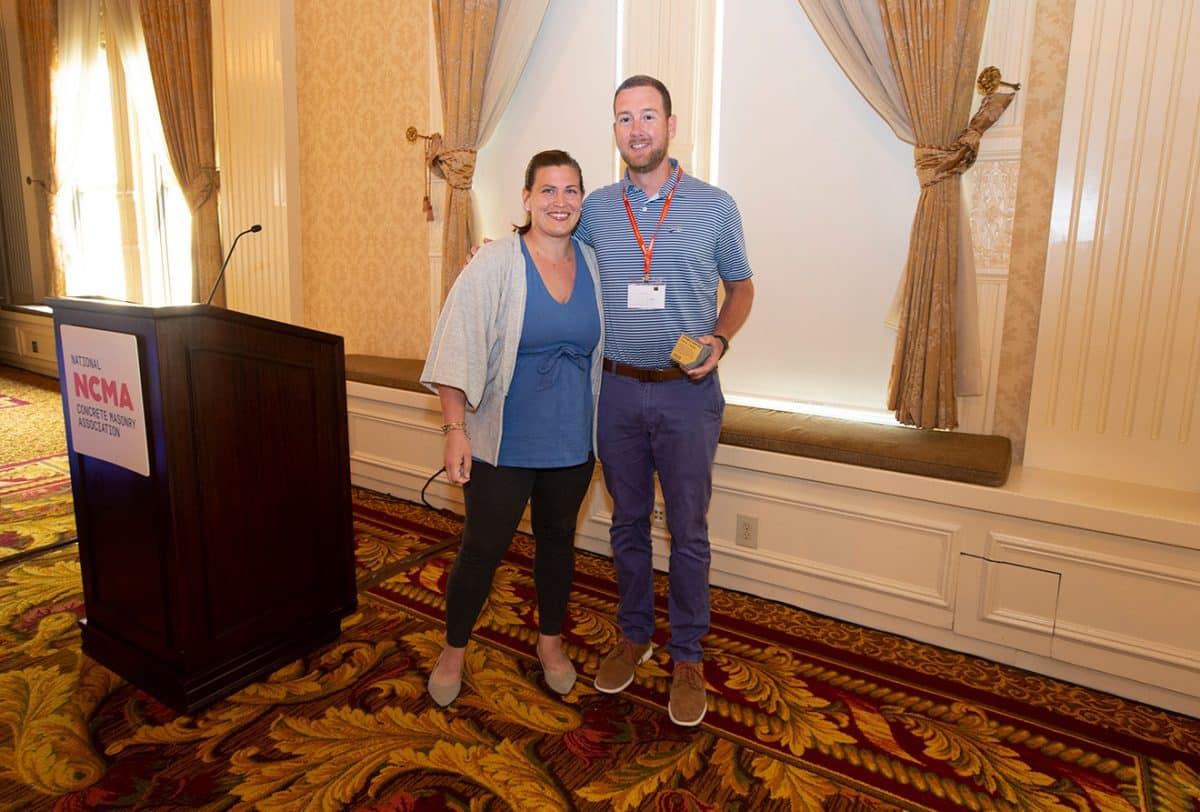
Patrick J. Sauter, Vice President of King’s Materials, Inc. in Cedar Rapids, IA, was presented with NCMA’s Emerging Leadership Award on August 3 at the association’s Midyear meetings held at The Pfister Hotel in Milwaukee, WI.

The Emerging Leadership Award recognizes professionals within the industry that have demonstrated excellence and great promise through their companies, through regional industry efforts, or through NCMA service.

Pat is a founding member of NCMA’s Young Professionals Group (YPG). His contributions helped to ensure the success of the YPG, and he also quickly became engaged in many NCMA activities and served on numerous committees, notably with the Government Affairs Committee. Pat was elected to the NCMA Board of Directors in 2012, and also began service on the Executive Committee in 2014. He was elected as NCMA’s Chair of the Board in 2016, becoming the first Chair who was also a YPG member and the second youngest Board Chair in NCMA’s history.

He has also been instrumental in efforts to develop the Concrete Masonry Checkoff program, being involved in discussions from the beginning and being a part of the Checkoff Governance Team. He made countless visits to Washington DC to meet with elected representatives throughout the Checkoff process.

In addition to his service to the concrete masonry industry, Pat is also active in his local area, such as serving on the board for the Cedar Rapids Public Library Foundation.

“I’ve always considered myself to be an old soul, but you are an ancient soul. While perhaps not the best delivery, it was a genuine compliment. You are a role model for people like me who work in a family business – you are someone who has the job not because you have the right last name, but because you’re really, really good at what you do,” said Starling Johnson, Johnson Concrete Products and Chair of NCMA’s Young Professionals Group, who presented Pat with the award.

For Pat’s outstanding service to NCMA and the industry and providing leadership and motivation to other young professionals, it is fitting that he was presented with the first ever Emerging Leadership Award.

Keeping 2017 Tax Reform in Place is Essential for CMU Producers

Tax provisions enable CMU producers to invest in their companies, creating economic benefits.

Ask Rick Muth, president of ORCO Block and Hardscape, Los Angeles, what he thinks the CMU industry needs from Washington, and he doesn’t hesitate for a second: “Keep the provisions of the Tax Reform Act of 2017 in place — particularly the provision that allows manufacturers to expense equipment in the year it was put in service — rather than requiring depreciation over seven years.”

“Now, more than ever — coming out of COVID — we need to preserve a favorable tax climate for business. We’re feeding the economy. The expensing provisions of the 2017 tax reform bill are helping encourage us to buy equipment. That benefits the equipment manufacturers and all of the companies that build and ship the equipment we need.  It benefits our employees. There is a huge multiplier effect to incentivizing the expansion of US manufacturing,” Muth said.

Muth isn’t alone in his assessment of the importance of a favorable tax climate for manufacturers.  Both the National Association of Manufacturers and the U.S. Chamber of Commerce have made the preservation of the provisions of the 2017 Tax Reform Act top priorities. In fact, NAM has just published a study indicating that reversal of the current expensing provision or the tax law, increasing the corporate tax rate to 28 percent, increasing the top marginal tax rate, and repealing the 20 percent pass-through deduction would mean that investments in equipment and structures, would drop by $80 billion in 2023 and $83 billion and $66 billion in 2026 and 2031, respectively.  It also projects that gross domestic product (GDP) would be down by $117 billion in 2023, by $190 billion in 2026, and by $119 billion in 2031.

“The conclusion of this study is inescapable—follow through with tax hikes that give other countries a clear advantage and we’ll see far fewer jobs created in America…  One million jobs would be lost in the first two years, to be exact,” said NAM President and CEO Jay Timmons.

And like NAM, the US Chamber of Commerce lists “preventing rollback of any parts of the pro-growth tax reform bill enacted in 2017 and opposition of anti-growth tax policy proposals” among its top priorities.

Favorable Tax Policy Feeds Growth, Muth Says

For Muth, the idea of spurring the growth of US manufacturing just makes sense. “We make the products that make the buildings and the infrastructure our country relies on. When we buy a new machine, it’s going to be more efficient, and probably safer than the old technology too. New equipment allows us to increase our production and worker productivity. If we invest in new technology, our employees have to learn that technology. They gain new skills. Skills that are transferable.  It makes them more marketable.”

A belief in the importance of keeping up with technology and market demand has been driving ORCO since its inception, according to Muth.   Rick’s father, Pete Muth — and Pete’s father, brother-in-law, along with an outside business partner — established ORCO 75 years ago by happy accident, really. The Muths were operating a donut business, Muth Donuts when they stumbled upon a fellow whose partner wanted out of a recently established concrete business.  “They had to get up a 4 am to make the donuts, which they sold for 30 cents a dozen for plain and 35 cents for fancy.  So after the block business took hold, they decided to go that way.”

When ORCO was born in 1946 in Orange County, CA, there were 256 block producers in California. Today, ORCO has seven plants, with has facilities in the Inland Empire and San Diego Counties, and is one of 9 CMU producers.  Muth credits the company’s dogged focus on keeping up with modernization and efficiency — both of which require capital investment — on helping ORCO to continue to prosper.

Staying Current With Technology is Essential to Remaining Competitive

“We really work to keep our equipment in top shape, to get the right equipment in here to help us expand and go where the market is.”  Over 75 years, that has meant expanding from simple four-inch gray block to architectural block in a wide range of shapes, sizes, and colors, concrete pavers, several kinds of segmental retaining wall units, bagged mortar products, concrete fireplaces, and other hardscaping elements. Rick joined the company in 1975 as assistant office manager.  As president, he has led ORCO into the future.  A competitive runner from college on, with a three-mile time that still stands in the record books, Muth brought his runner’s grit to the block business.

“We’re survivors, and we at ORCO have very strong capital reserves.  We’re doing great. Our company will be all right no matter what the tax policy turns out to be. But ORCO, all CMU producers — and our country as a whole — will be a lot better off with a tax policy that preserves the right to expense equipment in the year it was purchased — and a tax policy that generally encourages business to upgrade equipment and to increase production. Manufacturing employs more than 12.3 million people in this country, contributes $2.32 trillion to the U.S. economy annually.  It also has the largest economic multiplier of any major sector.  If you want to stimulate the economy. stimulate manufacturing.” he said.

That was certainly the case immediately after the 2017 tax reform act was passed, according to NAM.  In 2018, manufacturers added 263,000 new jobs. That was the best year for job creation in manufacturing in 21 years.  In 2018, manufacturing wages increased 3 percent and continued going up—by 2.8 percent in 2019 and by 3 percent in 2020. Those were the fastest rates of annual growth since 2003.  Manufacturing capital spending grew by 4.5 percent and 5.7 percent in 2018 and 2019, respectively.  Overall, manufacturing production grew 2.7 percent in 2018, with December 2018 being the best month for manufacturing output since May 2008.

“What more evidence do you need?  We need to preserve the 2017 tax reform changes.  It’s the right thing to do — not just for concrete products manufacturers and other manufacturers — but for America,” Muth said.

NCMA/ICPI 2020 Safety Awards Program Winners Announced

160 plants were honored for their commitment to keeping safe manufacturing environments.

[HERNDON, Va. – June 3, 2020] The National Concrete Masonry Association (NCMA) and the Interlocking Concrete Pavement Institute (ICPI), two of the premiere trade associations within the concrete products industry, are pleased to announce the winners of the 2020 NCMA/ICPI Safety Awards.

The prestigious honor is bestowed annually upon plants that demonstrate a commitment to the well-being of their employees and their work environment. An impressive 160 awards were given out to manufacturing locations throughout North America that boast exemplary records. This represents an increase of more than 20% in award winners from the previous year.

To view the list of winners, click here.

“The winners of safety awards are those who consistently promote and implement safe manufacturing practices,” said NCMA President Bob Thomas. “It is encouraging to see members of both ICPI and NCMA demonstrate their commitment to safety. The increase in award winners shows a continued focus on safety and improvement for our industry.”

“This program recognizes the positive safety-conscious work culture of our members,” said ICPI Executive Director Charles McGrath. “Safety Award winners set an example for all manufacturing industries that safety is paramount to a successful business. All winners should be proud of their accomplishments and commitment to their employees.”

Participants were eligible for awards through their OSHA 300A logs or equivalent Canadian injury reports from January 1 to December 31, 2020. Milestone Awards are given to facilities with more than five consecutive years of Safety Award Program entries with zero OSHA/Canadian injury report injuries. Platinum (highest level of single year achievement), Gold and Silver awards are given based on two formulas, one for Incident Rate (IR) and Days Away for Restrictions and Transfer Rate (DART).

For more on the awards, click here.

For a PDF of this announcement, click here.

….

About NCMA: The National Concrete Masonry Association unites, supports, and represents our members who are producers and suppliers of concrete masonry systems – including concrete masonry, manufactured stone veneer, segmental retaining walls, and other hardscape systems. From small family-owned businesses to large corporations, our membership reflects the full spectrum of companies that provide the foundation for resilient building construction. www.ncma.org.

NCMA Contact: Nick Lang, (703) 713-1900, nlang@ncma.org

About ICPI: The Interlocking Concrete Pavement Institute (ICPI), founded in 1993, is the trade association representing the segmental concrete pavement industry in the United States and Canada. ICPI is considered by peer associations around the world as the leader in development and dissemination of technical information for design professionals and contractors.  ICPI engages in a broad range of technical, marketing, educational, government relations and communications activities. www.icpi.org.

ICPI Contact: Steven Hawkins, (703) 657-6900, shawkins@icpi.org.

NCMA and ICPI Join Precast Show 2022

The National Precast Concrete Association (NPCA) announced today that the National Concrete Masonry Association (NCMA) and the Interlocking Concrete Pavement Institute (ICPI) will join NPCA and the Precast/Prestressed Concrete Institute (PCI) at The Precast Show 2022 on March 3-5 in Kansas City, Mo.

With more than 100,000 square feet of exhibitor space and 5,000 individuals in attendance, The Precast Show is the largest precast-specific trade show in North America and the one place to find the industry’s most important suppliers and foremost equipment experts under one roof.

“We are excited to have NCMA, ICPI and their members officially join us at The Precast Show,” NPCA Chairman of the Board Ron Sparks said. “This decision to renew our relationship underscores our shared interests in the industry and our joint efforts to promote the use of precast concrete, concrete masonry and hardscape products across America.”

The Precast Show is the premier event within the concrete products industry,” NCMA Chairman of the Board Rocky Jenkins said. “Our members will benefit greatly from the integration of ICON EXPO into this event, as will the companies that supply our members, through increased exposure and the opportunity to come together with so many others across the industry.”

In addition to the trade show floor, The Precast Show includes industry educational sessions and networking events where the latest technology and ideas are shared and discussed. Precast concrete infrastructure products account for approximately $2.4 billion annually, and that figure is expected to increase as the United States looks to repair its aging roads, bridges, highways and rail system.

Along with NCMA’s ICON EXPO and ICON-Xchange tradeshow and events, NCMA and ICPI support an industry that produces and annually sells an estimated 2.5 billion concrete masonry and hardscape products in the United States and Canada with substantial gains from the previous year as a result of increased residential investments in outdoor living spaces.

“NCMA and ICPI members work side by side with NPCA and other organizations participating in The Precast Show on projects every day across the United States and around the world,” NCMA President Bob Thomas said. “We have much in common.”

“Setting the highest standards in product quality, sustainability and safety are at the foundation of all of our groups, making this a natural relationship,” ICPI Board Chair Marshall Brown said.

“With the introduction of the American Jobs Plan, we hopefully are entering a time of national investment in infrastructure that hasn’t been seen since the Interstate Highway System was launched in the 1950s under President Eisenhower,” NPCA President Fred Grubbe said. “It never has been more important for precast concrete associations and their members to work together in order to achieve common goals.”

###
Based in Carmel, Ind., NPCA has represented manufacturers of industrial plant-produced precast concrete products and the suppliers of products and services for the industry since 1965, providing members with the programs and information required to operate a successful precast plant. NPCA operates the industry’s largest and most comprehensive plant certification program, which is accredited by the ANSI National Accreditation Board (ANAB).

Chicago-based PCI develops, maintains and disseminates the knowledge for the design, fabrication and erection of precast and prestressed concrete structures and systems. As a collaborative group of industry stakeholders dedicated to promoting the broader use of precast concrete systems, PCI engages its constituents through standards development, certification, research, marketing and education.

NCMA, based in Herndon, Va., represents the producers and suppliers of the manufactured concrete masonry and hardscape industry in the United States and Canada. NCMA advocates to safeguard the work of its members and promotes its members’ products as the first choice for designers, builders and property owners so communities are improved and made more resilient.

ICPI, based in Chantilly, Va., promotes the value of segmental concrete pavement systems. ICPI delivers education and technical guidance leading to awareness acceptance and use of segmental concrete pavement systems in the United States and Canada.

###
NPCA Contact: To speak with NPCA Chairman Ron Sparks or NPCA President Fred Grubbe, contact Joe Frollo by email  or (317) 582-2320.

NCMA Contact: To speak with NCMA Chairman Rocky Jenkins or NCMA President Bob Thomas, contact Brittaney Kamhong Thompson by email  or (703) 713-1900.

ICPI Contact: To speak with ICPI Chairman Marshall Brown or ICPI Executive Director Charles McGrath, contact Charles McGrath by email or (703) 657-6900.

Sales Continue to Increase Among Concrete Paver Contractors Despite Significant Workforce Shortage

Gross sales for concrete paver contractors in the United States and Canada increased by 7.8% during 2020, while four of every five contractors reported difficulty in recruiting and hiring quality employees, according to a new survey soon to be released by the Interlocking Concrete Pavement Institute (ICPI).

The 2021 ICPI Contractor Business Report identified business trends from 187 segmental concrete pavement contractors. Respondents included ICPI members and non-members. Industry Insights of Columbus, Ohio conducted the study in January 2020 for ICPI.

“Contractors in the segmental concrete pavement industry are experiencing significant growth in sales,” said Marshall Brown, ICPI Board Chair. “However, this report also confirms a challenge for our industry. There is a large shortage of skilled installers. That is why ICPI has launched a workforce development program to attract more people into the industry and better train the people who are already involved.  We have developed a career resource website hardscapingis.com, as well as an online learning center, The Hardscape Institute, where people can better access the industry’s top education programs.  We are also working on marketing materials to help member contractors recruit more young people into the craft.”

Other key findings include:

  • The residential market remains strong representing 72.7% of sales, while commercial/ government projects comprised 27.3% of sales (a decrease of 3.2% from the previous year).

  • 72.7% require crew members to review and participate in a formal, documented, safety program.

  • A 6.7% average wage/salary increase occurred in 2020, while a similar 5.8% average rise is forecasted for 21

The study also includes data on technologies contractors use to monitor and reduce exposure of crew members to respirable silica, as well as on company promotion and certification trends. Besides reporting overall data, results provide insight into the industry regarding gross sales, ICPI membership level, and number of employees during the construction season. The full report will be available for purchase at https://icpi.org/bookstore.

ICPI Releases 2020 Annual Report

ICPI has released the 2020 Annual Report. Contents include:

  • Industry Health Report

  • Institute Report Card

  • ICPI 2019-22 Strategic Plan

  • Workforce Development

  • Working with Schools

  • Education Highlights

  • Course Sponsors

  • ICPI Website

  • Concrete Business Update

  • Virtual HNA

  • Technical Highlights

  • ICPI Foundation

  • Paveshare

  • Statement of Financial Position

  • Statement of Activities

  • Foundation Board of Trustees

  • Foundation Donors

  • Board of Directors

  • ICPI Member Producers

  • ICPI Member Associates

  • ICPI Member Voting Contractors

  • ICPI Contacts

Florida DOT Approves Concrete Pavers for Low-Speed Streets

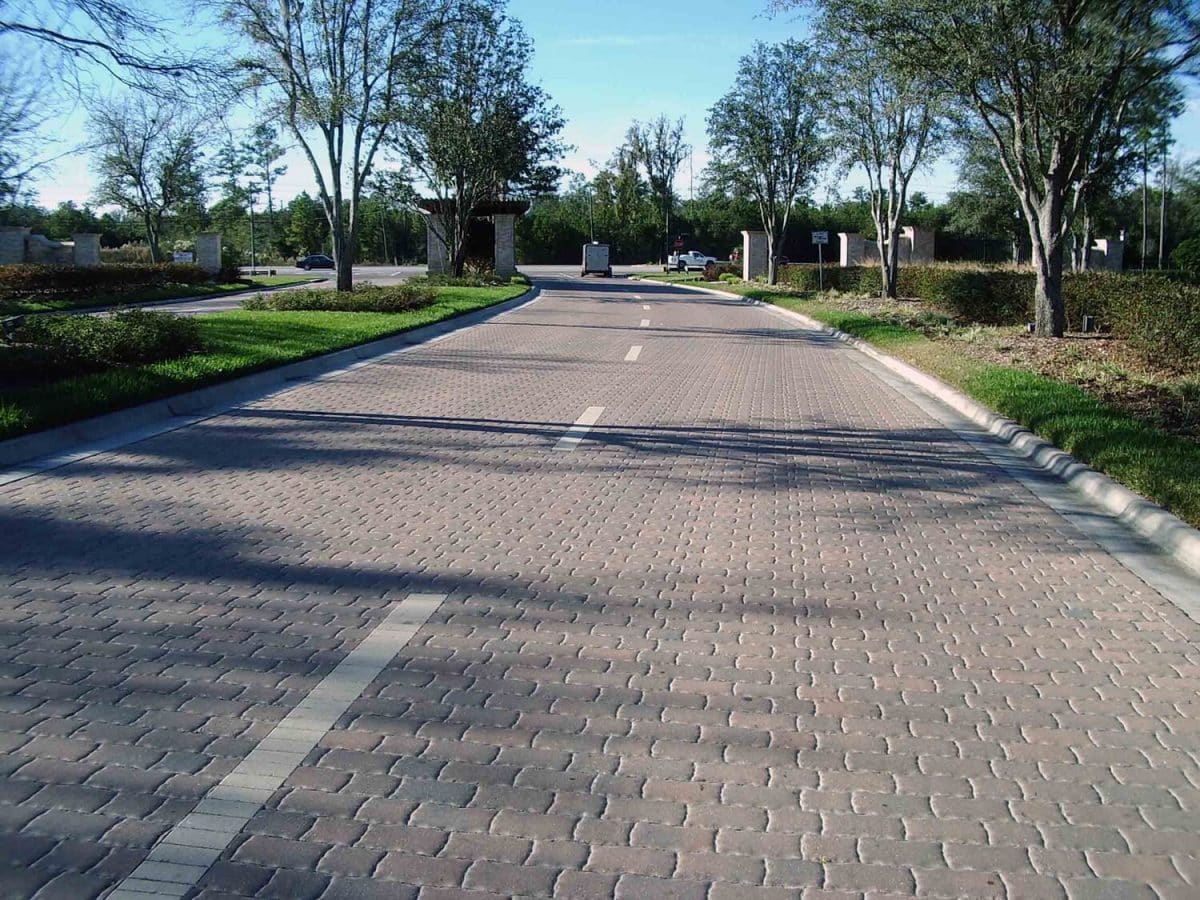
Thanks to joint efforts by an ICPI member and ICPI technical staff, the Florida Department of Transportation Specification 526 on Architectural Pavers now allows their use in local side streets with posted speed limits of 35 mph or lower. Previous FDOT specifications prohibited their use in such applications. Florida’s concrete paver market is estimated at well over 100 million sf, much of which goes to residential applications, private commercial projects and municipal sidewalks. This FDOT revision opens the door to wider use of interlocking concrete pavements and permeable interlocking concrete pavements by FDOT and municipalities in publicly owned streets.

Thomas Young Inducted Into NCMA’s Hall of Fame

Thomas Young, executive director of the Northwest Concrete Masonry Association, Mill Creek, Washington, was presented with NCMA’s Hall of Fame award on February 4 at the association’s Annual Convention which was held virtually.

NCMA’s Hall of Fame award is presented to the industry’s most valued participants whose careers are highlighted by continual accomplishments on the industry’s behalf, and who have demonstrated unquestioned dedication to NCMA’s highest values.

Tom is credited with spending nearly the last half a century promoting concrete masonry as a premier building material. Tom’s masonry roots started as a child. Tom had the opportunity to see how masonry could provide practical solutions directly from his father, who was a bricklayer and later a masonry salesman, working for the U.S. Lime Company. Tom grew up in Colorado and then Utah, graduating from Skyline High School in Salt Lake City. Tom attended the University of Utah, studying engineering principles such as Young’s Modulus and graduating with a bachelor’s degree of civil engineering in 1971.

Right after college, he started his own concrete sawing business while working for the Utah State Department of Transportation in Salt Lake City, but he soon began his career in masonry promotion, relocating to Arizona and joining the program staff of the Arizona Masonry Guild as their Technical Director. While at the Guild in Phoenix, he was introduced to and married the boss’ daughter Val, the beginning of a partnership that is 48 years and counting.

By 1975, Tom was working for one of the most innovative concrete block manufacturers in the country, Superlite Builders Supply. He contributed to their strong residential construction market, addressing technical issues such as the development of a wind resistance standard for CMU houses, and working directly with NCMA’s Paul Lenchuck and Kevin Callahan on Arizona energy code requirements.

In 1978, Tom and Val moved to the Northwest to raise their family. Tom accepted the position of Executive Director of the Masonry and Ceramic Tile Institute of Oregon. Among other accomplishments here, he established a new technical support service for designers using masonry.

By 1984, Tom was working as a Sales Manager for Jim Anderegg of the Mutual Materials Company. There he helped integrate concrete block production operations and sales into a business that was focused on brick manufacturing.

In 1990, Tom became the Executive Director of the Northwest Concrete Masonry Association, a position he has held for the past 30 plus years. He has played a significant role in the growth of concrete masonry as a structural building material throughout the Northwest supporting state-of-the-art, and state of practice design and building code requirements that are most applicable to the climate and environment of the area. Tom has developed relationships and the respect of area engineers, architects, educators, building officials, contractors and industry partners. He has lectured and consulted extensively; supported the creation of masonry education curriculums in universities as well as design competitions, scholarships and masonry research fellowships in these schools.

Tom has also been an active supporter of the National Concrete Masonry Association, contributing to the development of technical knowledge, industry resources such as TEK, and recently as a member of the NCMA Board of Directors representing other regional masonry associations. Between 1997 and 2021, he served on numerous NCMA committees. He was recognized along with several other leading executive directors of these regional associations by the 2016 NCMA Chairman of the Board, Joe Bowen of Mutual Materials.

Tom has invested significant energy in supporting coalitions and partnerships to better accomplish common missions. He has served as chair or co-chair of the Masonry Alliance of Codes and Standards’ Structural Task Group. He has been very active in The Masonry Society, earning a recognition of Fellow in 2012. Examples of more recent collaborations include working with the Pacific Northwest Building Resistance Coalition to help frame concrete and masonry performance relative to claims from the wood industry and working with the US Resiliency Council to bestow Silver Ratings for their designed resistance to threats posed by possible earthquakes.

“I first met Tom in Seattle, when I attended one of his many engineering presentations, in a hotel conference room filled with engineers. Tom’s knowledge and experience of masonry, and his energy and enthusiasm in presenting, captivated this audience and the many audiences he has presented to. Tom is a great communicator and is amazing at engaging people. His leadership skills have been a role model to so many people in the masonry industry.” – Blair Harter, Basalite Concrete Products, LLC.

Tom has been supported through his career by his wife Valerie, daughter Corinne, son Chris and granddaughter Kaylee.

For a PDF copy of this press release, click here.

In Memoriam: John Heslip

John A. Heslip, NCMA’s fourth chief executive, is being remembered for his unwavering passion in promoting the benefits of masonry to any architect that would listen.  Mr. Heslip, who served as NCMA’s president from 1985-1995, died on November 21, 2020 surrounded by family in Chapel Hill, NC.

“John demonstrated throughout his career that it was possible to advance an aggressive agenda needed to proactively compete for market position while developing deep and lasting relationships,” recalls Robert D. Thomas, current president of NCMA. “He was known for his caring ways and an unassailable presence based on integrity and commitment.  He had a penchant for identifying and mentoring young talent, leading by example.  And others have often remarked how welcome he made people feel.”

While marking NCMA’s 100th anniversary in 2018, Thomas visited with Heslip to reflect on his long career and tenure with the association. “Early on I knew we had to talk turkey to the engineers who designed buildings and also the architects,” said Heslip. “We had to make better contacts. I spent plenty of evenings and weekends inviting the president of the American Institute of Architects (AIA) over for a beer and we’d have talks about what our industry could do for them.”

While head of the Masonry Institute of Michigan, those informal talks paid off. In 1980, Heslip was recognized by the Detroit chapter of the AIA as a “credible, impartial source of information and counsel to the architectural profession”, a role he cherished and carried over into his tenure at the NCMA.

Leading NCMA

In 1985 Heslip became President of the National Concrete Masonry Association (NCMA) after serving one year as Executive Vice President. During his tenure at NCMA, Heslip spearheaded efforts to improve marketing in the industry; strengthened ties on Capitol Hill; improved communication of the industry’s fire safety message and invested in important research efforts.

He implemented an industry technical education program: the Certified Consultants of Concrete Masonry (CCCM) with the Construction Specifications Institute (CSI); expanded the industry’s convention and tradeshow to partner with a number of masonry-related organizations and worked closely with the AIA to establish a nationally recognized design awards program.

“It worked out well,” Heslip said. “The awards program was a real winner. What it really did was help focus on the importance of each component to the whole. It helped the brick industry and the block industry and the concrete industry to see that you could work together, satisfying the needs of the architect and his design with his design efforts. It was a big program.”

He personally lectured extensively on masonry subjects at universities throughout the United States, initiated the University Professors Masonry Workshop to advance architectural and engineering education among university professors and authored a number of papers on masonry construction.

Changing Times

Heslip also noted in his 2018 interview that the masonry industry was undergoing dramatic changes in the 1980s. “In the earlier part of the 20th century, empirical design was a way of life, so that whenever an architect or an engineer would get a building commissioned and they wished to build it in masonry, they were using empirical designs. It was an out-of-date system,” Heslip said.

“The competitive industries, the steel industry and the reinforced concrete industries were not empirically designing buildings. They were all rationally designed buildings and proved to be very competitive in terms of cost. A rationally designed building of masonry fit a whole lot of different building types, and we were able to do more for less because we were stretching the fibers of the masonry system to utilize its full characteristics.”

Coming Together

Heslip is also being remembered for his efforts to bring the entire industry together. “I spent a lot of time with the mason contractors. I knew them. I had had experience with them because I was one. I knew how they thought so that came natural to me. We had to get everybody talking on the same merits of the same systems. The brick industry, the reinforced concrete people, the metal building people, the structural steel people. When I hit NCMA, each segment was doing their own thing and trying to outdo each other, and I don’t operate that way. I said, let’s bring it all in. Let’s sort it out and see what kind of a better end result we can come up with.”

Heslip said that, eventually, NCMA was able to get the major players in the masonry industry to sit down and plan programs together. “They had to forget about the competition and start going after their customer. It took a while because the industry traditionally was splintered.”

John’s wife, Marlene, was also part of that inclusiveness, actively participating in NCMA conventions and building a culture within the organization to form personal relationships to better support professional collaboration.

“Many of the leaders of today’s family-owned concrete masonry block producing companies developed their understanding of a broader industry and their eventual professional network by attending NCMA conventions with their family while in their youth,” notes Thomas.

Scholarship Programs

In 1988, Heslip led the effort to establish the Paul and Helen Lenchuk Engineering Student Scholarship Program to support students pursuing a graduate degree in the engineering field.

Recognizing the Heslips’ passion for masonry and supporting the personal growth of those within the industry, the NCMA Education and Research Foundation later established the John and Marlene Heslip Scholarship Program for full-time students engaged in the pursuit of an architecture undergraduate or graduate degree.

The purpose of both scholarship programs is to support students pursuing degrees in their respective fields while encouraging innovative design, application, or utilization of manufactured concrete masonry and hardscape products in the built environment.

Storied Career

Heslip was a native of River Rouge, Michigan and studied Engineering at Michigan State University. He served two years in the U. S. Army Corps of Engineers.  After returning home, he worked evenings with a friend who was a mason contractor, and in 1957 started his own masonry business in Saginaw, Michigan.  From 1963 to 1969 Heslip was a masonry product manager for the Huron Cement Division of the National Gypsum Co., in Detroit.

In 1969 Heslip was hired as the first Executive Director of the Masonry Institute of Michigan (MIM) and opened its own office on West Eight Mile Road in Livonia as a branch of the DMCA. He expanded the MIM from a Detroit area operation, to all of Michigan.

Daniel Zechmeister, retiring Executive Director of the Masonry Institute of Michigan, thinks of Heslip as a legend and recalls his move to the NCMA in 1984. “I was intimidated and awestruck by everything the Institute accomplished under the direction of John,” says Zechmeister. “He made my job easier. He laid a foundation that we could build on and was a true pioneer who blazed a path for others to follow.”

During his 15 years with the Institute, John established a solid reputation as an administrator, innovator and authority on masonry construction.  In 1998 the MIM inducted Heslip as an Honorary Member recognized for his outstanding contributions to the masonry industry.

Heslip was active in the American Society of Testing and Materials (ASTM) beginning in 1965.  He served as the Chair of ASTM Committee C-12 on Mortar and Grout for Unit Masonry from 1976-1982.  He was also active on Committees C-1 on Cement, C-15 on Manufactured Masonry Units, and E-6 on Performance of Buildings and served on the ASTM Board of Directors.