Press Releases

Don Beers Receives NCMA Lifetime Achievement Award

SALT LAKE CITY, UT – Don Beers, staff engineer for the Masonry Association of Florida, was presented with NCMA’s Lifetime Achievement Award on February 24, 2020 at the association’s Annual Convention held at The Grand America Hotel in Salt Lake City, Utah.

The Lifetime Achievement Award is NCMA’s highest recognition for achievement or service by individuals through a member company (or companies). The award recognizes those individuals who have made extraordinary contributions to directly advance the industry and/or the association in a profound and lasting manner.

“A review of Don Beers accomplishments over the past 40+ years is overwhelming by any comparison”, said Rocky Jenkins, CEMEX Director – Commercial Development, who presented Don with the award. “More significant however, is that no one individual has influenced a market like Don Beers has done for concrete masonry in Florida.”

Don spent 29 years at Rinker Materials using his structural engineering degree, PE license and general contractor license. For the past 10 years Don has worked as a structural engineer with Adrian Engineering and staff engineer for the Masonry Association of Florida. His accomplishments while in these roles has had a substantial and lasting impact to the Florida masonry market and the masonry industry as a whole.

Don’s contributions are notable and significant in a number of different areas.

    • Manufacturing and Plant Design – Don was a key figure in the growth and prosperity of the concrete masonry industry in Florida from the perspective of supporting the introduction of concrete block production capacity to lead and to meet increasing demand. As an employee of Rinker Materials, he led the efforts to construct more than 40 concrete block and ready-mix plants.
    • Educator – Following his manufacturing roles with Rinker, Don evolved as a technical support resource for the industry. He has personally performed hundreds of presentations to thousands of architects, engineers, industry personnel, contractors and students. He was instrumental in developing a concrete masonry designer certification program. He is known and respected for his passion and ability to communicate as a speaker. He has also been a prolific writer and has been published in various national and regional industry publications and in trade journals – mostly about concrete masonry solutions.
    • Technical Resource and Advocate – Don has been a key player for the concrete masonry industry to identify challenges and provide technical solutions. He has been an advocate of appropriate code provisions at the regional and national level; he has advocated and supported research and development projects to document concrete masonry’s attributes; he has provided technical support for designers and contractors on a regular and ongoing basis.
    • NCMA Advocate – Don has always been complimentary of the support and resources that NCMA provides towards the growth of concrete masonry in Florida. He has advocated strongly for collaborative efforts between NCMA and state associations and has encouraged companies in Florida to join and support NCMA.

Don has been supported through his career by his wife, Angela. In his personal life, has had made four mission trips to Haiti, been committee chair for his Parish outreach program, performed prison outreach for the past 13 years, and with his wife hold a Catholic Eucharist Service at three local nursing homes each week.

For a PDF of this story, click here.

Dale Puskas Inducted Into NCMA Hall of Fame

SALT LAKE CITY, UT – Dale Puskas, special projects advisor and former vice president of Basalite Concrete Products, Dixon, California, was presented with NCMA’s Hall of Fame award February 24 at the association’s Annual Convention held at The Grand America Hotel in Salt Lake City, Utah.

NCMA’s Hall of Fame award is presented to the industry’s most valued participants whose careers are highlighted by continual accomplishments on the industry’s behalf, and who have demonstrated unquestioned dedication to NCMA’s highest values.

“Basalite is very proud that one of our own is being honored by the NCMA with the Hall of Fame award. Dale Puskas has committed his career to the concrete industry and with his leadership Basalite and the NCMA have benefited greatly” said Scott Weber, who was CEO of Basalite for twenty years and now member of the Basalite Board of directors. Scott presented Dale with this award. “We thank Dale and his family for the years of dedication that have helped build Basalite into the company it is today.”

Dale is credited with initiating the effort culminating in approval of changes to the NCMA bylaws in 2017 and a new structure beginning in 2018. He identified the need for a smaller and more efficient Board and actively worked with task groups, the Board and the membership initiatives to enact changes.

He has made multiple trips to Washington, DC to lobby for the CMU Checkoff program and was instrumental in securing bill co-sponsorships from western members of the House and Senate. He has also been active in developing governance structures and models for the Checkoff and been an advocate of the program within the Western states.

Dale has been a leader in our industry’s pursuit of developing digital modeling tools for concrete masonry with a particular emphasis on how such tools can change the nature of how business is done and how we can better present concrete masonry solutions.

Between 2002 and 2018, he chaired and served on numerous NCMA and Foundation committees including Chairman of the Board from 2014 to 2015.

Other accomplishments-

  • Actively involved in the development of NCMA’s Plant Certification program and Basalite became the first company with plants to achieve that certification.
  • Provided a valuable role as a liaison to the Concrete Masonry Association of California and Nevada
  • Instrumental in the integration of the Masonry Veneer Manufacturers Association into NCMA, beginning in 2013.
  • Played a leadership role in the recognition of 25 years of NCMA representation of the SRW Industry
  • Invested significant energy in improving collaboration with the Mason Contractors Association of America and the Interlocking Concrete Pavement Institute.

Dale has been supported through his career by his wife, René and two sons, Matt and Trent.

For a PDF of this story, click here.

ICPI and NCMA Boards Approve Exploration of Additional Collaboration and Possible Unification Into a New Organization

At the ICPI Annual Meeting Board of Directors meeting last week, Charles McGrath, ICPI’s Executive Director announced his planned retirement in August 2022.  The ICPI Board of Directors voted to create a joint special committee and hire an outside consultant to pursue a closer relationship with NCMA, including the possibility of unification. The Special Committee will be charged to come back to the ICPI Board of Directors meeting in February 2021 whether to move forward with unification or for ICPI to engage a search consultant to begin a search for a new Executive Director. Special Committee members will provide an update on progress at the 2020 ICPI Summer Meeting in Annapolis, MD.

The Board agreed to pass on the following messages to all members:

  • Initial exploratory efforts only

  • No decisions made and no foregone conclusions

  • Typical unifications (once agreed) take approximately 2 years.

  • Dues structure and impacts not yet considered

  • No current staffing changes under consideration

DATE February 26th, 2020

ICPI Reports Results From 2020 Member Needs Assessment

This year’s Member Needs Assessment was sent to all ICPI Standing Committee members (including Board of Directors and Executive Committee members), Commercial Technical Promotion Team and all ICPI member representatives. The overall response rate for this year’s survey was approximately 10%.

The survey contained extra questions regarding the importance and satisfaction of various ICPI programs and services. This line of questioning represents the beginning of a portfolio analysis that was proposed during the strategic planning process that intends to review all ICPI programming and services. It is a top priority of ICPI leadership and staff to make sure the programs and services offered are meeting the need of our members.

Some highlights from this year’s survey were:

  • ICPI Mission: 96% of survey participants believe that ICPI is achieving its mission.

  • What is the most important thing ICPI does for your company? The most common answers included education, networking opportunities and technical support.

  • ICPI Value: 80.9% overall value of ICPI equal to or greater than other trade associations.

  • Obstacles: Members are still reporting that a labor shortage is still the greatest obstacle facing their companies. Other notable answers were industry consolidation and the economy.

Future Trends: Members note that the labor shortage is still top of mind for future concerns regarding the industry.

DATE February 26th, 2020

ICPI Publishes the 2019 Annual Report

ICPI published and released the 2019 Annual Report this month.

Highlights include information on:

  • Industry Health Report

  • Institute Report Card

  • ICPI 2019-22 Strategic Plan

  • Workforce Development

  • Education

  • Digital Presence

  • Technical Guidance

  • Municipal Markets

  • Hardscape North America

  • ICPI Foundation

Be sure to check your mailbox or view the digital version of the Annual Report here.

DATE February 26th, 2020

Paver Industry Father Passes

William (Bill) Schneider passed away on January 20, 2020 at Midwest Medical Center in Galena, Illinois.  Bill is known for his significant contributions to the segmental concrete pavement industry and to the Interlocking Concrete Pavement Institute (ICPI). Founding LPS Pavement Company in the Chicago area in 1976 after being convinced that concrete pavers were a better pavement solution. He left ready-mix concrete pavement contracting, instead selling many commercial paver projects in the early years of the industry. 

With this experience, Bill Schneider became a charter member of ICPI when it formed in 1993 and was first to Chair the ICPI Construction Committee. He developed content for the Concrete Paver Installer Course and the Commercial Paver Specialist Course. He was the first instructor of the Concrete Paver Installer Course with over 30,000 participants since 1995. The program includes over 2,500 ICPI active certified installers today. Additionally, he served on ICPI’s Board of Directors, Executive Committee, and numerous standing and special committees.  

Bill Schneider always maintained that educating contractors on industry best practices is paramount to their success. He demonstrated this by developing and instructing ICPI installer courses. He was known for telling engaging stories from his installation experiences to make his points in certification classes. In addition, he helped to found and instructed at the School for Advanced Segmental Paving. He was an inspiration to countless paver installation contractors across the country.

In 2014, Bill received the first ICPI Lifetime Achievement Award which recognizes significant contributions to the industry. The award emphasizes dedication to safety and well-being of employees, demonstrated leadership, and outstanding contribution to the industry via volunteer service.   

Besides LPS Pavement Company, Bill’s pioneering included creating a company specializing in permeable interlocking concrete pavement (PICP) design and specification called Advanced Pavement Technology in 2002.  He also created a company specializing in PICP installation called Aqua-Paving Construction in 2010. His early PICP installations transformed the Chicago market, making it an early center for PICP sales. This effort was supported by several trademarks and patents on permeable paver shapes as well as design of the Bio-Aquifer Storm System (BASS) using open-graded aggregates for PICP installation that is the accepted method today. He promoted mechanical paver installation to lower project costs and increase efficiency.

Some groundbreaking projects he installed follow:

Morton Arboretum – Built in 2003 for the new visitor’s center, the 173,000 sf PICP parking lot in Lisle, Illinois, proved a viable solution as a best management practice for stormwater management. It was one of the first and largest PICP installations demonstrating that PICP performs in a cold climate.

The Williamsburg Village Project – Built in 1979 in suburban Chicago, this 130,000-sf interlocking concrete pavement project was one of the first street applications in North America. The project was built well before the interlocking concrete pavement industry formed an association, and well before association guide specifications directed designers and contractors on best practices for materials and installation. The 40-year old roadway is still in use and has not had any major maintenance, an impressive performance considering the constant delivery-vehicle traffic, harsh Chicago weather, and regular deicer use in the winter.

Port of Oakland, CA – At five million square feet, this is the largest interlocking concrete pavement project in the western hemisphere. Installed from 2002 to 2004 required over   22 million mechanically installed paving units. Bill’s leadership and participation with other ICPI member contractors resulted in specifications, construction methods, and inspection processes for port paving. The project accelerated use of mechanical paver placement to improve contractor efficiency and reduce installation costs.

Elmhurst College, IL – Another mechanical installation, a campus demonstrated that PICP systems could be used as an alternative to unattractive and space wasting detention ponds as well as decrease flows and volumes to city storm sewers working at capacity.  The 2008 project was inspired by the success at Morton Arboretum five years earlier. 

Hartz Mountain Industries – As one of the largest private real estate owners in the U.S., Hartz has more than 200 properties with over 38 million square feet of building space in the northern New Jersey/New York area. A New Jersey concrete paver manufacturer proposed using interlocking concrete pavers in 1990 but the developer wanted assurance that the pavement would be installed properly by a knowledgeable contractor. Bill Schneider provided that assurance to the developer which resulted in more than one million square feet of concrete pavers installed in various Hartz Mountain properties. This greatly increased the use of concrete pavers in this New Jersey – New York market. 

We are saddened by his loss to the industry and ICPI. Yet, his contribution and inspiration to other contractors and beneficial imprint on ICPI continues. Bill is survived by his wife Ali, sons Derek (Kristina) and David (Denise), daughters Kristi (Scott) and Courtney, and 10 grandchildren.

Per his wishes, there will be no visitation or ceremony at this time.  A celebration of his life will be held in the future once the weather warms for anyone who wants to get together to honor him. In lieu of flowers, donations can be made to the ICPI Foundation for Education and Research to the Hospice of Dubuque (https://hospiceofdubuque.org/cms-view-page.php?page=donate) in his memory. If you have any stories, memories, anecdotes, photos, videos, etc. involving Bill you would like to share, please forward them to Derek Schneider (derek@advancedpavement.com) who would love to hear from you, and compile them for use at the celebration.

Date January 29th, 2020

ICPI Recognizes Richard Morin With Honorary Membership

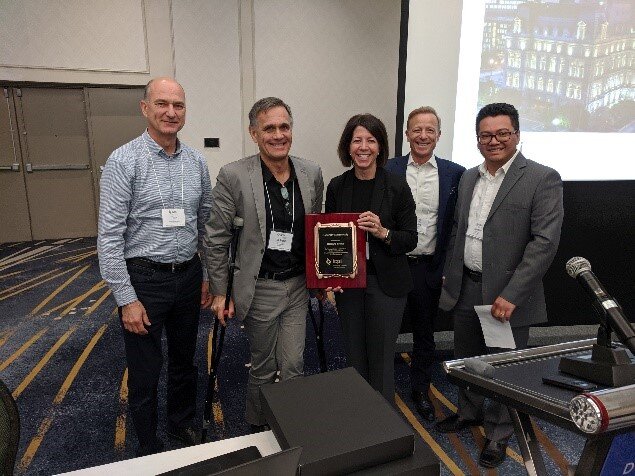
At the 2019 Canadian Activities Meeting, the Interlocking Concrete Pavement Institute recognized Richard Morin, ing, M, Sc. A. for his efforts to support the use of segmental pavements in the City of Montreal by presenting him with an Honorary Membership in the association. Mr. Morin, who is a Technical Advisor for the City of Montreal’s Infrastructure, Roads and Transport Department, Infrastructure Directorate, Division of Expertise and Technical Support, will be retiring from that role in January 2020. Lincoln Paiva, ing., Director – Technical Services, Techo-Bloc briefly introduced Mr. Morin and thanked him for his efforts to help institutionalize segmental pavement systems in the City of Montreal and Canada. Mr. Morin was presented a plaque by ICPI Board Chair Kendall Anderegg and Yvan Bolduc, Bolduc Concrete Products and Charles Ciccarello, Techo-Bloc, who had both submitted letters of support to the ICPI Board of Directors.

At the Canadian Activities Meeting, Mr. Morin presented on the challenges the City has faced related to the use of segmental pavements. He shared project photos installed by the City that had performed poorly and discussed when the City of Montreal was considering banning pavers in the 1990’s due to poor performance of installations completed in the 1980’s. During that time, Mr. Morin researched best installation practices and looked for sound material specifications and designs instead of rejecting the use of pavers in the City. Thanks to Mr. Morin’s research and dedication, the City of Montreal support the use of segmental concrete pavement systems to this day. Additionally, he shared details of the City’s requirements for the use of segmental pavements that he helped developed. Many of these requirements are currently mirrored in ICPI’s best practices.

Mr. Morin was also an active participant in the CSA A231 Technical Committee, responsible for the creation and updating of the National Standard for Concrete Slabs and Pavers, which is now in its third edition. Mr. Morin concluded his presentation with a series of project images around the City of Montreal that are performing well.

Richard, thank you for your sharing your knowledge, your courage, and your dedication with the industry!

Date November 20th, 2019

Iowa State Takes First Place in National Unit Design Competition in Seattle

SEATTLE, WA – Three college teams presented their unique, fresh CMU designs at the 2019 Unit Design Competition during NCMA’s Midyear Meeting last month. After an audience of judges scored the designs upon each presentation wrapping, the results and prizes were announced and awarded.

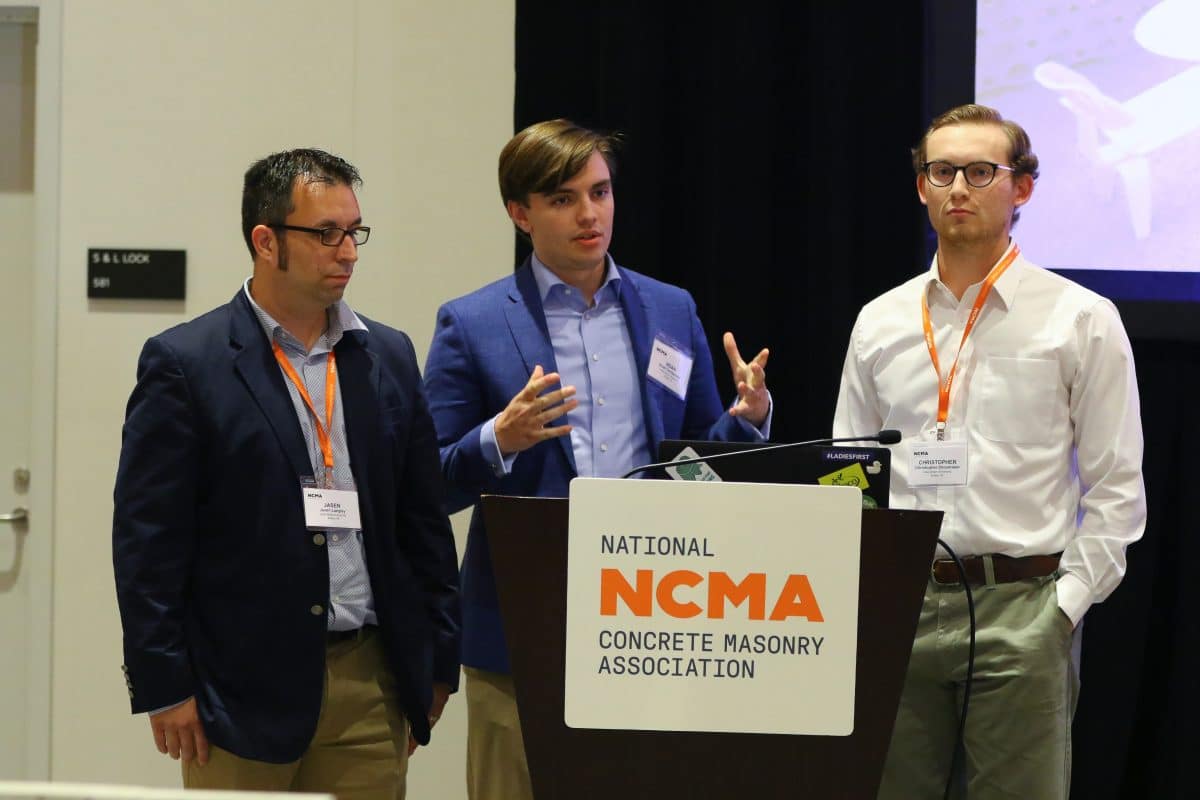
The team of Noah Torstenson, Christopher Shoemaker, Gregorio Melchiorri and Jasen Langley — all students at Iowa State University under the tutelage of Professor Bo Suk Hur — took first place.

The team’s design, dubbed “Pura block”, wowed the crowd with its bow-tie appearance and versatility — including have the potential to be used as a screen block, or as part of a curtain wall. If stacked with a running bond the form could also give an elegant wavelength pattern.

However, the team really turned heads when they revealed that Pura block contains holes (rebar penetrations) that can fit both physical and chemical water filtration systems to help clean highly-polluted rivers.

“There’s a cap to contain interior elements and provide a good looking exterior while also straining out larger elements,” said Jasen Langley. ” The activated charcoal particulate filters out negative chemicals, while the filter itself along with the permeate collector help absorb chemicals. The installed filter is subtle, sealed in place with rod and sealant.”

Second place in the competition was claimed by a team from Starkville, Mississippi under the guidance of Professor Jacob A. Gines at Mississippi State University, and helped along through vital manufacturing and consulting assistance from Fred Dunand, president of NCMA member company Saturn Materials out of Columbus, Mississippi — also one of the competition’s sponsors.

Kayla C. Perez, Grace M. Sheridan and Joseph D. Thompson presented their design, named “The Slant”, which actually was developed during Gines’ spring course and eventually produced as a real, full-scale block at Saturn’s plant.

“We were confident in our design and provided evidence of the feasibility of it by considering all aspects of the competition, such as shipping, mass production and economic efficiency,” said Sheridan.

The design boasted the fact that 216 of them could fit on one pallet.

It also featured acoustic abilities, blocking out sound up to around 1000 Hz.

The team of Nabila Bustilos-Francis, Abigail Gillin and Ashley Teer — from North Carolina State University in Raleigh, North Carolina — rounded out the competition with their design, “Concealed Mortar Unit.”

The design is customized so that when stacked, the mortar isn’t visible from the front, in addition to providing a stronger bond than just mortar on mortar. Inspired by roof shingles and the stylistic philosophy of an architecture firm in Winnipeg, Canada — 5468796 Architecture Inc. — who profess the practice of hiding all joints and fasteners, the custom block is meant to be sustainable too. In the presentation the group talked about precast, recycled aggregate and carbon curing.

“This year’s batch [of finalists] was exceptional,” said Dunand. “And it wasn’t an easy task to determine who would be selected.”

He also said he hopes the competition is inspiring innovation for the next generation.

Manufactured Stone Veneer Program Grants First Ever Certifications

HERNDON, VA – The National Concrete Masonry Association is proud to announce that through their MSV Product Certification Program the first ever certifications for manufactured stone veneer (MSV) products have been awarded. The standout products and recipients are manufactured by ProVia, LLC. and Coastal Stone Company.

The MSV Product Certification Program, developed over the course of several years by dedicated committee members, recognizes products that meet or exceed established product standard requirements made by manufacturers who have established quality systems and educated personnel.

A key requirement for certification is submission of results from a qualified testing laboratory demonstrating that the products meet the requirements of ASTM C1670/C1670M, Standard Specification for Adhered Manufactured Stone Masonry Veneer Units. This standard includes requirements for physical properties of MSV units, including compressive strength, freeze-thaw durability, drying shrinkage, shear bond strength and dimensional tolerances. In addition to test results, applicants must also provide a quality system manual for production and evidence that personnel have completed education courses relative to MSV.

The MSV Product Certification Program recognizes producers and their products that have a commitment to quality and ensures that products comply with the ASTM standard. The “NCMA MSV Certified Manufactured Stone Veneer Product” mark is a visual reminder of that commitment to quality, and can be displayed on packaging and promotional materials for certified products.

“Quality units lead to quality projects” says Bob Thomas, NCMA President. “The MSV Product Certification Program communicates this commitment to specifiers and the design community. ProVia LLC and Coastal Stone Company are commended for becoming the first NCMA members to have completed the certification process.”

The certification program is available to members and non-members of NCMA who are engaged in the production of manufactured stone veneer units. To find out more about this program, click here.

Richard Bennett Honored With NCMA’s Industry Champion Award

SEATTLE, WA – Richard M. Bennett, P.E., PhD, professor and director at the University of Tennessee in Knoxville, was presented with NCMA’s Industry Champion Award August 8, 2019, at the association’s annual Midyear Meeting in Seattle, Washington.

The NCMA Industry Champion Award recognizes individuals that make significant contributions in roles beyond what can be accomplished by the association alone, and honors these meritorious contributions that support the advancement of the use of concrete products.

An award recipient already many times over – including the The Masonry Society’s (TMS) President’s Award in 2016 — Bennett was nominated by ten different individuals who had affiliations with not just NCMA, but other associations, organizations, companies and groups within the industry that collectively demonstrated the highest admiration for both the career and work he’s put forward. In doing so, as peers they have also recognized his legacy for the vision, leadership and passion that have contributed to advancing concrete masonry design and construction.

Bennett’s lauded engineering career started in Ohio in the late 1970s. After receiving his undergraduate degree from Cleveland State University with a civil engineering focus in 1979, he continued to study within the discipline and obtaining both a masters and doctorate from the University of Illinois in Urbana in 1981 and 1983.

Since then, he has been a professor at UT, and while maintaining that growingly prestigious day job, he’s managed to tally many a milestone within the masonry industry.

Bennett has chaired multiple TMS subcommittees throughout the years and served as chair during some of the most important cycles. He is recognized by many as the most prolific developer and reviewer of code change proposals, integrating some of the latest and greatest practices into TMS 402/602. He is also an active member of ASTM Committees C12 and C15; bringing these practical and material-based procedures back to his classroom.

He was instrumental in organizing and participating in a recent veneer summit that managed to bear the fruit of new engineered design methods for both anchored and adhered veneers installed over thick layers of insulation. He was also part of the group of five people that met and developed the latest version of the Direct Design Software, helping to refine functionalities through his insightful input.

“There are those that are highly competent technically and professionally, those that radiate effective leadership and responsibility, and those that have the ability to skillfully communicate delicate and complex topics with seamless ease,” said Jason Thompson, NCMA’s Vice President of Engineering. “Richard encompasses all of these facets in both tangible and intangible ways to help advance the masonry industry. His contributions to the researching, analyzing, and teaching the art of masonry design are immeasurable.”

“He’s been involved with a bunch of things that we as an industry not only need to advance, but he’s also recognized for us some of the drivers out there in the marketplace,” Thompson continued. “He brings all of this back to his classroom and transforms it into practical communication and education for his students while also working with us as an industry and framing his expertise in a very similar practical manner.”

“In and around our industry you simply can’t find someone more dedicated, more knowledgeable than Richard Bennett,” said Robert Thomas, NCMA president. “To be a truly effective educator you have to have a deep, keen understanding of the material you’ve attempting to imbue. And it’s more than just teaching — it’s igniting curiosity and elucidating the big picture. In addition to his many students, we are just thankful that Richard has taken all this time to help inspire us, too. We’re so proud to extend this honor to him.”

Bennett has been supported throughout his career by his wife Linda and his daughters.