

Jim Weber Bestowed With NCMA Lifetime Achievement Award
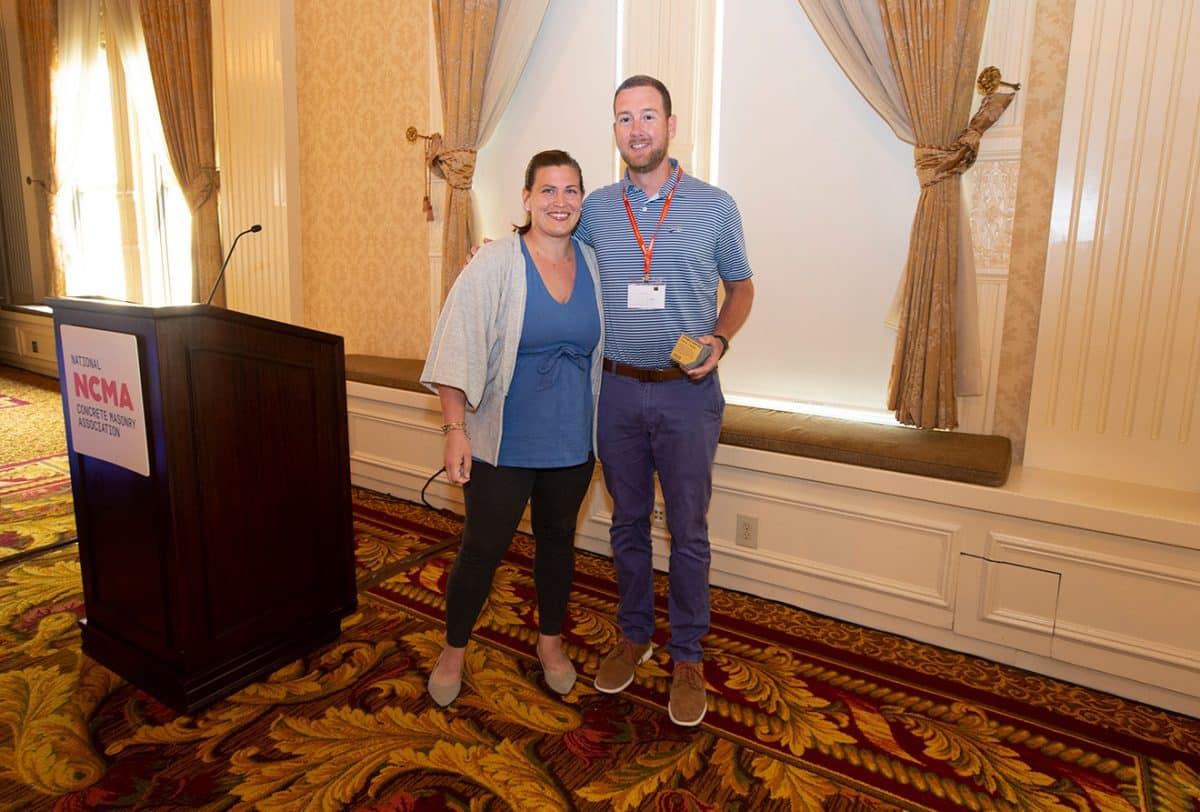
James L. Weber, retiree from Oldcastle Architectural, Inc., was presented with NCMA’s Lifetime Achievement Award on August 5 at the association’s Midyear meeting held at The Pfister Hotel in Milwaukee, WI.
This award is NCMA’s highest recognition for achievement or service by individuals through a member company (or companies). The award recognizes those individuals who have made extraordinary contributions to directly advance the industry and/or the association in a profound and lasting manner.
Weber is known for his sense of humor and sharp wit, traits that are prevalent in all aspects of his life, including business. In addition to his humor, he’s also known as being the consummate devil’s advocate. Weber was exposed to the value of hard work and the concrete block industry early in life when his dad, Wally, who bought Appleton Concrete Products in 1946. His official start date was 1957, the year that he graduated from Appleton High School. In those days, Weber drove the delivery truck, the forklift, the front-end loader, and did every other job to support the family business.
But not for long. He was preparing to see more of the world and gain new experiences and he made full use of those life opportunities. After high school, Weber spent the next four years at St. Norbert College as an ROTC cadet, graduating with a degree in business administration. He was commissioned into the U.S. Army as a Second Lieutenant in June of 1961. It was at St. Norbert he married his wife Janet in 1962. Jim and Janet lived the military life as Jim served his country with distinction over the next six years. He attended armor school at Fort Knox and later became part of the Ordinance Corps, rising to the rank of captain. In 1964, he served at several weapons depots, and his final posting was commanding an ammunition depot in England.
Jim and Janet were busy during this time, and that included building a new family. They were blessed with the births of all three of their children, Debbie, Darcy, and Jim in a span of just two and a half years. Following military service, the family returned to Appleton where Jim resumed work with his father, Wally. Weber considers his father his first and most influential mentor. In 1972, Appleton Concrete Products merged with West Bend Concrete Products and formed Bend Industries. West Bend’s, Fred Yahr, became the president of the expanded company with Weber serving as the vice president of sales and marketing. Fred Yahr, who served as the NCMA chairman of the board in 1981, is the second most influential mentor cited by Weber saying, “He had more confidence in me than I deserved.”
Jim and Janet attended their first NCMA convention in 1968. Weber remarked how those conventions have provided him the opportunity to meet the most interesting and daring people. In 2003 Weber, as president of Bend Industries, negotiated their sale to Oldcastle Architectural Products Group. His more than five decades of involvement with NCMA has included service on dozens of committees. Weber served as Chair of the NCMA Board in 2006 and was inducted into NCMA’s Hall of Fame in 2009.
A few of the accolades and congratulations received for Weber are below.
“What really sets you apart is your committee involvement and what you bring to the table, which with each meeting, you’re always prepared, always challenging, always have the guts to be the contrarian and I think in the end helps NCMA reach its goal of being a member-driven organization.” – Peter B. Hoyt, retiree of Oldcastle Architectural, Inc. and NCMA 1998 Chair.
“Jim has been very supportive of NCMA and he’s also been very supportive of the NCMA Foundation and in both of those I have had the opportunity to work hand and glove together in.” – Bill Holden, CarbonCure Technologies and NCMA 1990 Chair.
These days, life just seems to continue to get even better for Jim and Janet. Their plans for the future include “doing everything we are doing now, only slower.” It sure doesn’t look like they are slowing down yet. And it doesn’t look like the Weber clan, including seven grandchildren, are ready for that either.
NCMA recognizes Jim Weber’s encompassing legacy and it is fitting that he be recognized with NCMA’s highest recognition – the Lifetime Achievement Award.

Kevin Curtis Inducted Into NCMA’s Hall of Fame
Kevin L Curtis, retired CEO of the Besser Company, Alpena, MI, was presented with NCMA’s Hall of Fame award on August 5 at the association’s Midyear meetings held at The Pfister Hotel in Milwaukee, WI.
NCMA’s Hall of Fame award is presented to the industry’s most valued participants whose careers are highlighted by continual accomplishments on the industry’s behalf, and who have demonstrated unquestioned dedication to NCMA’s highest values.
Born on St. Patrick’s Day in the small town of Rogers City, MI, Curtis grew up with his siblings at Grand Lake. It’s here he developed his love for the great outdoors and for small-town living. He’s proud to share that he’s a product of the Posen school system, graduating in 1971 from Posen High School. He spent some time during his summers working alongside his father, Galen at a satellite Besser research and development site where the Dynapac® was being designed and built. Working in the concrete lab and Besser plant housed on the campus of Alpena Community College gave him more exposure to the industry. And if that weren’t enough, he also found time to help Phil Park, then CEO and chairman of Besser with odd jobs, including Mason tending during the construction of the Besser Bell facility. It was Phil Park who influenced Curtis’s decision to attend Olivet College as Phil and his wife, Maxine, both graduated from Olivet.
While attending Olivet, Curtis quickly fell in love with Paula Murray from Newberry, MI. Kevin and Paula were married in 1974 and both graduated in 1975 from Olivet. This began the 47-year journey that continues today. Upon graduation, Curtis managed a hotel and restaurant complex in Flint, MI, and learned about customer service. In 1978, he began his Besser career as a management trainee. Later that year, he was assigned to the Minnesota district as a service engineer and was promoted five years later to a sales representative. His early success can be attributed to his work ethic, willingness to learn, and the strong relationships he forged with customers. Some of Curtis’s best mentors were customers from this district. In 1985, he and his young family returned to Northern Michigan, where he took on the challenging role of national sales manager, a promotion to vice-president of sales and marketing took place in 1993, which was followed by a promotion to company president in 1999. He became CEO in 2004, the same year that Besser became an employee-owned company. His ability to lead and coach has been instrumental to the successful creation of Besser’s current corporate culture, which is now centered around an employee stock ownership plan. Curtis takes great pride in furthering the tradition of supporting the association that supports Besser.
“Jessie Besser got us into NCMA. We’ve been a strong supporter because we do believe it’s the best way to promote the industry, grow the industry, and it’s a great place to network. And so we’re just a strong believer that you will get value if you participate.”
Curtis’s first NCMA meeting was at the Cincinnati machinery show in 1981. His impact has been felt in roles that are numerous and varied, including serving on the membership committee, the associates division board, the board of directors, and the foundation. Likewise, supporting the local community is important to Curtis. As a parent of hockey players, he served as treasurer of the Blue Line Club, served on the ACC Concrete Technology advisory board, and currently serves as a director for the World Center for Concrete Technology. At Besser, his notable achievements are many, but the closest to his heart is the development of the Servopac® Family of Machines while maintaining improved versions of the cam machines, the engineering and production of big board molds, many acquisitions, and the vision to forge partnerships with creative thinkers inside and outside of our industry. Beyond steel and deals, the positive impact he’s had on the people of the industry is what we’ll all remember the most. The drive to get everyone on the same page through effective communication has permeated Besser and the industry. Forever humble, when he announced his retirement, Curtis was surprised by the outpouring of admiration from former employees, retirees, industry friends that have moved on, and those currently active. Many thanked him for his coaching, friendship and guidance, how he shaped them professionally and personally, his impact is sure to shape our industry for years to come. Curtis’s career has taken him across North America and over 40 countries around the globe where he’s taken the opportunity to develop strong relationships with industry members. Likewise, he’s enjoyed welcoming hundreds of guests to Alpena and introducing them to the culture and people that make Besser unique. Although retired, Curtis will remain as an active member on Besser’s Board of Directors.
Above all else, family is his priority. He and Paula are incredibly proud of their sons. Both sons are married, both are attorneys and both have given Kevin and Paula very active grandchildren to keep them young. Much of their retirement will be spent creating memories with Cory, Angie, Olivia, and Jake in the Houston area and with Alan, Chrissy, and Forrest in Alpena, and of course, their dogs will accompany them. Whether in Alpena, Houston, Florida, or spending time with extended family and friends while traveling in their motor home, one thing is for sure, Curtis will always carry a passion for all things concrete.
A few of the accolades and congratulations received for Curtis are below.
“No one’s more deserving than you. What a distinguished career with Besser, what you brought that company and your contributions to our industry.” – Scott Weber, Basalite Concrete Products.
“I remember you breaking a sweat during intense negotiations with my dad, on new plant equipment. Our family truly appreciates and is grateful for the support you gave in establishing the Deborah Hunt scholarship fund at Alpena Community College. And on a personal note, I really appreciate your friendship and support for me and my annual birthday card I look forward to getting every year.” – Steve Hunt, BlockUp.
NCMA thanks Kevin Curtis for everything you have done for the concrete products industry and congratulations on earning this Hall of Fame award.

Daniel Zechmeister Inducted Into NCMA’s Hall of Fame
Daniel Zechmeister, retired Executive Director of the Masonry Institute of Michigan, Southfield, MI, was presented with NCMA’s Hall of Fame award on August 5 at the association’s Midyear meeting held at The Pfister Hotel in Milwaukee, WI.
NCMA’s Hall of Fame award is presented to the industry’s most valued participants whose careers are highlighted by continual accomplishments on the industry’s behalf, and who have demonstrated unquestioned dedication to NCMA’s highest values.
Dan Zechmeister is a natural promoter and educator. His induction into NCMA’s Hall of Fame is based on his skills and passion throughout a tremendously productive career promoting masonry as a superior building material. His 1978 civil engineering degree from Wayne State University provided him with a technical understanding of materials and construction systems that he would ultimately rely upon to craft his messaging. The city of Detroit has a rich history of masonry structures built to their full potential. Shortly after college, he took a job as a structural engineer with a firm founded by Albert Kahn, one of the city’s notable architectural pioneers. He recalls an early assignment to design an addition to a manufacturing plant using 12-inch concrete masonry units. Having no previous experience with masonry, he asked his chief structural engineer for help. His supervisor tossed him copies of the NCMA TEK binder and the BIA technical notes calling them bibles for concrete and brick masonry. In 1986, Zechmeister joined the Masonry Institute of Michigan as a structural engineer. He quickly developed a working relationship with the engineering staff at NCMA. He also had the added benefit of a connection with NCMA’s then president John Heslip. “In the very beginning, I was awestruck by John Heslip and everything he accomplished at MIM.” By 1990, Zechmeister himself would be promoted to executive director of MIM. “I thought I would never measure up to John.”
After that 34 years in the position at MIM, Zechmeister can feel comfortable in his own legacy. He worked hard to develop relationships with architects, engineers, and Mason contractors. He was just as comfortable interacting with building officials and inspectors as he was with masonry suppliers, bricklayers, and block layers. And he didn’t just show up with an educational message. Zechmeister actively participated in their professional organizations. The level of respect and appreciation he garnered is evident by recognition from those organizations. He has been recognized as a life member of the American Society of Civil Engineers. In 2002, was presented with the award of merit, recognizing him for his committee work on masonry units and mortars and grouts. To dispel the impression Zechmeister was simply a buttoned-up engineer, it’s appropriate to highlight the impressive range of creativity and zaniness he brought to his passionate promotion of masonry. He was the driving force in transforming MIM’s black and white newsletter into a full-color magazine and putting the masonry solutions in front of designers and contractors. Zechmeister was regularly in the field, visiting job sites and solving problems. But he focused more on providing solutions to prevent problems and bridging the disconnect between masonry design and masonry installation. He especially enjoyed the grouting workshop that he created for masonry contractors at the request of design professionals.
He builds relationships with various agencies in Michigan associated with construction inspection and safety, such as an Alliance between MIM and the Michigan Occupation and Health Administration, which included an advisory committee on masonry wall bracing. While most of his efforts to gain market share were focused in Michigan, he also traveled throughout the country to support the efforts of his compatriots managing masonry promotion associations in other states.
Zechmeister is certainly drawn to noble causes. His relentless energy and passion for service is rooted in his Christian faith. He and his wife are active members of their local church and are personally involved every week in the preparation and distribution to those in need throughout the Detroit area.
And he is certainly blessed with a wonderful family that has supported him throughout his career. He gives special credit to his wife Deb who he met at age 5. They have been married for 43 years and raised two daughters, Jenna and Michelle. Zechmeister’s family and his peers definitely consider Zechmeister to be a trouble starter, but they might also say that he has been the kind of trouble starter that we need. It is appropriate that we celebrate all he has done for the masonry industry. No one will be surprised by this quote from him: “No other building system can provide enclosure, aesthetics, structure, sustainability, and resiliency. It’s America’s building block.”
Many of those who worked with Zechmeister over his career provided congratulations to him, and this collection was provided to him with his award. Below are just a few.
“Congratulations on your NCMA Hall of Fame award. You’ve been a mentor to me. I learned valuable attributes from you from the way that you did your job. You always acted with integrity and you taught me the value of teamwork. Now you’re retiring, but Dan, I feel this one and I’m going to miss you.” – Todd Dailey, Dailey Engineering, Inc.
“Dan Zechmeister is a man with conviction, passion, loyalty, and compassion.” – Jim Gendron, Fendt Builder’s Supply, Inc.
NCMA congratulates Dan Zechmeister on his induction into the NCMA Hall of Fame.

Pat Sauter Receives Emerging Leadership Award
Patrick J. Sauter, Vice President of King’s Materials, Inc. in Cedar Rapids, IA, was presented with NCMA’s Emerging Leadership Award on August 3 at the association’s Midyear meetings held at The Pfister Hotel in Milwaukee, WI.
The Emerging Leadership Award recognizes professionals within the industry that have demonstrated excellence and great promise through their companies, through regional industry efforts, or through NCMA service.
Pat is a founding member of NCMA’s Young Professionals Group (YPG). His contributions helped to ensure the success of the YPG, and he also quickly became engaged in many NCMA activities and served on numerous committees, notably with the Government Affairs Committee. Pat was elected to the NCMA Board of Directors in 2012, and also began service on the Executive Committee in 2014. He was elected as NCMA’s Chair of the Board in 2016, becoming the first Chair who was also a YPG member and the second youngest Board Chair in NCMA’s history.
He has also been instrumental in efforts to develop the Concrete Masonry Checkoff program, being involved in discussions from the beginning and being a part of the Checkoff Governance Team. He made countless visits to Washington DC to meet with elected representatives throughout the Checkoff process.
In addition to his service to the concrete masonry industry, Pat is also active in his local area, such as serving on the board for the Cedar Rapids Public Library Foundation.
“I’ve always considered myself to be an old soul, but you are an ancient soul. While perhaps not the best delivery, it was a genuine compliment. You are a role model for people like me who work in a family business – you are someone who has the job not because you have the right last name, but because you’re really, really good at what you do,” said Starling Johnson, Johnson Concrete Products and Chair of NCMA’s Young Professionals Group, who presented Pat with the award.
For Pat’s outstanding service to NCMA and the industry and providing leadership and motivation to other young professionals, it is fitting that he was presented with the first ever Emerging Leadership Award.
ICPI Government Affairs Update – August 2021
At this writing, there is a surge on infrastructure bills on both sides of the Hill, in both the authorizing committees in the House and Senate, and in the Appropriations Committee in the House. There are three main infrastructure bills that we highlight in this report, focusing on key provisions affecting permeable pavements and stormwater action.
Authorizations: the House “Invest in America” Act, HR3684 (aka the House infrastructure bill)
We begin by addressing developments in the two authorizing committees, the House Transportation and Infrastructure Committee (House TIA) and the Senate Environment and Public Works Committees (Senate EPA), the two lead Hill committees on infrastructure policy. House TIA goes first.
House TIA introduced, and subsequently passed on the House floor, the Invest in American Act, HR3684. Focusing on permeables, this House bill includes a provision that would expand USDOT’s definition of “protective features” for the purposes of relevant USDOT/FHWA programs to include “permeable pavements for stormwater management.”
This “protective features” provision was added to the Invest in America Act subsequent to ICPI’s overtures to House TIA seeking greater direction for USDOT to conduct work on permeable pavements as part of the Department’s overall stormwater authority. ICPI is hopeful that if permeable pavements are specifically identified in USDOT’s authorization as a protective measure under the Department’s programs, it will elevate the Department’s commitment to involving permeable pavements in USDOT’s plans, programs and grant opportunities.
Next, we point to Section 1604 that would create a (quoting from Invest in America) STORMWATER BEST MANAGEMENT PRACTICES STUDY. Not later than 180 days after enactment, USDOT would be directed to enter into an agreement with the Transportation Research Board of the National Academy of Sciences to under which the TRB would conduct a study to estimate pollutant loads from stormwater runoff from highways and pedestrian facilities eligible for assistance under the U.S. Code, to inform the development of appropriate total maximum daily load requirements; to provide recommendations (including recommended revisions to existing laws and regulations) regarding the evaluation and selection by State departments of transportation of potential stormwater management and total maximum daily load compliance strategies within a watershed, including environmental restoration and pollution abatement carried out under section 328 of title 23, U.S. Code; to examine the potential for the Secretary to assist State departments of transportation in carrying out and communicating stormwater management practices for highways and pedestrian facilities that are eligible for assistance under title 23, U.S. Code, (some elements omitted due to length). The study would include USDOT/FHWA, the Secretary of Agriculture, the Secretary of the Army acting through the Chief of Engineers, State departments of Transportation, with input from stakeholders with experience in implementing stormwater management practices for projects (we would presume ICPI to qualify as such), and educational and technical stormwater management groups. The legislation would further call for a report to be generated to be circulated among the participants as well as the key committees in the House and Senate. Further, the report would be intended to be updated periodically.
ICPI feels this study can provide a solid and impressive platform to link the importance of stormwater management (for which pavers could provide an important contribution) as a core feature of USDOT/FHWA thinking and its mission. ICPI is in an excellent position to participate as a subject matter expert stakeholder educating USDOT/FHWA on the beneficial role of permeable pavements.
Throughout the Invest in America Act, there is a recurrent supportive theme elevating the importance of stormwater management. Some of the provisions explicitly reference the role of innovative pavement materials in helping achieve stormwater management. We expect pavers to satisfy the congressional intent of these provisions. Many of the thirty-some references to stormwater advance not only the importance of stormwater management as a priority in its own right, but also the direct relationship to pavements that can help address stormwater. ICPI is pleased to see that these policy benefits have achieved widespread recognition and acceptance on the Hill.
To be sure, there are other provisions of interest to ICPI in the House’s Invest in America bill, but these are the most directly related to the advocacy put forth by ICPI.
The House passed Invest in America and sent it to the Senate for consideration.
Authorizations: the Senate “bipartisan infrastructure” bill
We now shift to the U.S. Senate, and its version of an infrastructure bill that is generally referred to as “the bipartisan infrastructure bill”. As this report is being prepared on August 9, 2021, that bill is on the Senate floor with amendments under consideration. We expect a vote on final passage early August 10. We expect the bill to pass with substantial bipartisan support.
The Senate bill contains not only its own stormwater management study, but also a (quoting from the bill) PERMEABLE PAVEMENTS STUDY. USDOT would be required to gather existing information on the effects of permeable pavements on flood control in different contexts, including in urban areas, and over the lifetime of the permeable pavement, to perform research to fill gaps in the existing information to develop models for the performance of permeable pavements in flood control; and best practices for designing permeable pavement to meet flood control requirements.
ICPI lauds all efforts by the Hill to direct agency attention to the public policy benefits of permeable pavements.
The Senate bill also contains provisions for detailed stormwater management study quite like what the House requires in its Invest in America.Rather than reprint the Senate language here, we can say the House and Senate provisions are substantively similar.
As we alluded earlier, that there are major other issues (for example, important water resources construction chapters) in both bills with many $billions in funding that may be of interest to ICPI members. But we focus on ICPI’s efforts on permeables and stormwater.
Status: at this time, the Senate bill remains under floor consideration. We expect it to pass on the Senate floor on August 10. The House and Senate will next need to convene a House-Senate conference to resolve all the differences between the House Invest in America Act and the Senate “bipartisan infrastructure” version, and then send the identical compromise “conference report” back to both Houses for up-or-down votes on final passage. The House has already adjourned for the August recess, so only negotiations would occur during the remainder of the August recess. After both Houses reconvene in September, and if a final conference report is achieved, we think it highly likely that it would be passed in both Houses of Congress and then sent to the White House to be signed into law. We think it virtually certain that the President would sign such a bill into law.
This concludes the report on infrastructure authorizations. We now shift to appropriations, specifically House THUD Appropriations for USDOT/FHWA in FY22.
Appropriations: the House FY22 THUD Appropriations bill and committee report
The House has indeed passed its FY22 THUD Appropriations as part of a larger package of funding bills and has sent that package to the Senate for consideration.
The House Committee Report to accompany the FY22 THUD Appropriations bill contains language advocated by ICPI in a joint conversation with subcommittee staff. The report language eventually adopted by the Appropriations Committee is as follows:
Permeable pavements. —The Committee continues to encourage the Secretary to accelerate research, demonstration, and deployment of permeable pavements to achieve flood mitigation, pollutant reduction, stormwater runoff reduction, environmental conservation, and resilience for new road construction and retrofit of existing roads. The Committee encourages the Secretary to conduct structural evaluations of flood-damaged pavements, with emphasis on local roads and highways subject to flooding and extended periods of inundation, to understand the mechanisms of flood damage and how permeable pavements might be used to prevent or reduce damage from future flooding. Furthermore, the Secretary is encouraged to work with the Federal Emergency Management Agency (FEMA) and the Environmental Protection Agency (EPA), as both agencies are also doing work in the area of permeable pavements and a cross-agency collaboration may yield more innovation. As such, the Committee directs the Department to submit a report within 240 days of enactment of this Act to the House and Senate Committees on Appropriations detailing current efforts, utilization, and research within FHWA and efforts made with FEMA and EPA.
ICPI applauds the House interest in a collaboration among USDOT, FEMA and EPA in this regard. ICPI would be happy to offer technical assistance in such a collaboration.
The package of funding bills that includes THUD passed the House and is now in the Senate for consideration after the August recess. New appropriations bills are required to be enacted by September 30. In recent years, appropriations bills have rarely been enacted without considerable eleventh-hour negotiations, but we do not anticipate a government shutdown at this time. The real issue will be whether the new FY22 appropriations bills will be able to pass, or whether a stopgap Continuing Resolution would be required to continue funding under current appropriations. For obvious reasons, ICPI would prefer passage of the FY22 bill, with the report language reprinted above, rather than a CR.
On the horizon: a highly contentious, fully partisan Budget Reconciliation bill
Up to this point in this report, we have focused on infrastructure items, both authorizations and appropriations, that are, for the most part, bipartisan in nature, or at least sufficiently reconcilable to obtain bipartisan Senate support.
That degree of comity will not be continued with respect to the next bill on the Senate agenda, the FY22 Budget Reconciliation (“the BR”) bill.
The White House and Hill Democratic leaders have settled on a two-bill strategy: first, the bipartisan infrastructure bill that can attract the GOP support that the White House wants to demonstrate a commitment, or at least desire for, bipartisanship; and second bill, the BR, that will address all the remaining partisan priorities from all sides of the Democratic Party continuum.
The BR addresses issues such as tax increases, global warming/carbon dioxide emissions reductions, labor issues, immigration issues, social issues and more. This list of partisan issues has been looking for a legislative vehicle since the 117th Congress was seated. They are some of the most election-sensitive issues in American politics.
This second bill will need to be put forward as a BR in order to invoke the Budget Reconciliation rules. If the Democratic leadership can successfully invoke the BR rules, it will eliminate the roadblock of a Senate filibuster. Thus, if all the 50 Senate Democrats can support such a BR, they may have the absolute minimum votes necessary to pass such a bill without any GOP support.
There are too many political and mathematical variables to address in this report as to whether such a parliamentary strategy can be successful. There are other roadblocks involving interpretations of the Budget Reconciliation Act, and whether the privileged voting under BR would apply substantively to some of the key issues the Democrats would like to include. ICPI will pay close attention to the BR.
At this writing, the Senate Democratic leadership are introducing the BR and hope to pass it soon after completing work on the bipartisan infrastructure bill and prior to adjourning for the August recess. It appears the Democrats may have the minimum number of votes for passage at this time, but whether unanimous Democratic can be held throughout the BR process is unknown.
H-2B Worker Visa action: increases in visas, a gauntlet of amendments in opposition
There has been considerable recent action regarding the H-2B worker visa program. H-2B remains a priority for ICPI. ICPI is pleased to work with business advocate allies on H-2B and uses material drafted by H-2B allies in this report.
USCIS recently announced that employers may file H-2B petitions for returning workers under the FY21 H-2B supplemental visa temporary final rule. Employers may take this action if they are likely to suffer irreparable harm without these additional workers. Returning workers are defined as workers who were issued an H-2B visa or otherwise granted H-2B status in FY 2018, 2019, or 2020. USCIS will accept petitions for returning workers until Sept. 15, 2021, or until the remainder of the cap is reached, whichever occurs first. Any petitions that arrive after this cap has been reached will be rejected. USCIS previously announced having received enough petitions for the 16,000 visas initially made available for returning workers under the rule. We refer ICPI members to the USCIS website for more information.
During House FY22 Appropriations consideration for USDOL and USDHS funding, appropriators added language to the H-2B worker visa provisions that would further prompt the Secretary to make additional worker visas available during FY22. ICPI supports this language.
Further during the appropriations process in the House, pro-H-2B Members of Congress successfully resisted several proposals that could have effectively gutted the H-2B program. Proposals would-
-Prohibit industries from using the H-2B program if they experienced unemployment
in any of the previous 12 months over 10%;
-Prohibit construction industries from using the program even in seasonal locations or occupations;
-Increase the baseline for wages to at least 150% of the federal or state minimum wage, whichever is higher;
-Require wage compliance with a collective bargaining agreement for your industry in the area, even if a company is not a party to the agreement;
-Ban participation in the program for labor/workforce related infractions outside of the scope of the H-2B program.
ICPI and other business advocates opposed all these amendments.
The House package of appropriations bills that contains the H-2B provisions has passed the House and awaits Senate action following the August recess.
WOTUS, Waters of the U.S. rule (Clean Water Act): the saga continues
As expected, EPA and the U.S. Corps of Engineers will be commencing efforts soon to replace the Trump Administration version of the Water of the U.S. definition, which defines the waterways subject to the Clean Water Act and related issues such as water quality and stormwater management. Agency listening sessions are expected to begin in August.
During the promulgation of a new version of the rule, the Biden White House has said it intends to temporarily reinstitute the WOTUS rule that existed prior to the Obama Administration changes implemented in 2015.
ICPI will monitor developments.
Labor issues: the PRO Act, NLRB
The Senate HELP Committee held a hearing on the PRO Act (The People’s Right to Organize Act, S420, in July. Quoting from the bill’s abstract, the bill expands various labor protections related to employees’ rights to organize and collectively bargain in the workplace. Among other things, it revises the definitions of employee, supervisor, and employer to broaden the scope of individuals covered by fair labor standards; permits labor organizations to encourage participation of union members in strikes initiated by employees represented by a different labor organization (i.e., secondary strikes); and prohibits employers from bringing claims against unions that conduct such secondary strikes.
The bill also allows collective bargaining agreements to require all employees represented by the bargaining unit to contribute fees to the labor organization for the cost of such representation, notwithstanding a state law to the contrary; and expands unfair labor practices to include prohibitions against replacement of, or discrimination against, workers who participate in strikes.
The bill makes it an unfair labor practice to require or coerce employees to attend employer meetings designed to discourage union membership and prohibits employers from entering into agreements with employees under which employees waive the right to pursue or a join collective or class-action litigation.
Further, the bill addresses the procedures for union representation elections, modifies the protections against unfair labor practices that result in serious economic harm, and establishes penalties and permits injunctive relief against entities that fail to comply with National Labor Relations Board orders.
ICPI and many other business organizations oppose the PRO Act. ICPI signed a joint industry letter opposing the PRO Act. The PRO Act’s future remains uncertain, given that it would be nearly certain to draw a filibuster in the Senate.
In another labor development, the Senate recently approved two Democratic nominees to take seats on the National Labor Relations Board. It is widely expected that when these new members are seated, giving Democrats the majority on the Board, there will be a quite significant shift on the Board. ICPI and other business advocates will monitor NLRB developments closely when the new Board is seated.
Vision Health and Wellness Center – Syracuse, NY
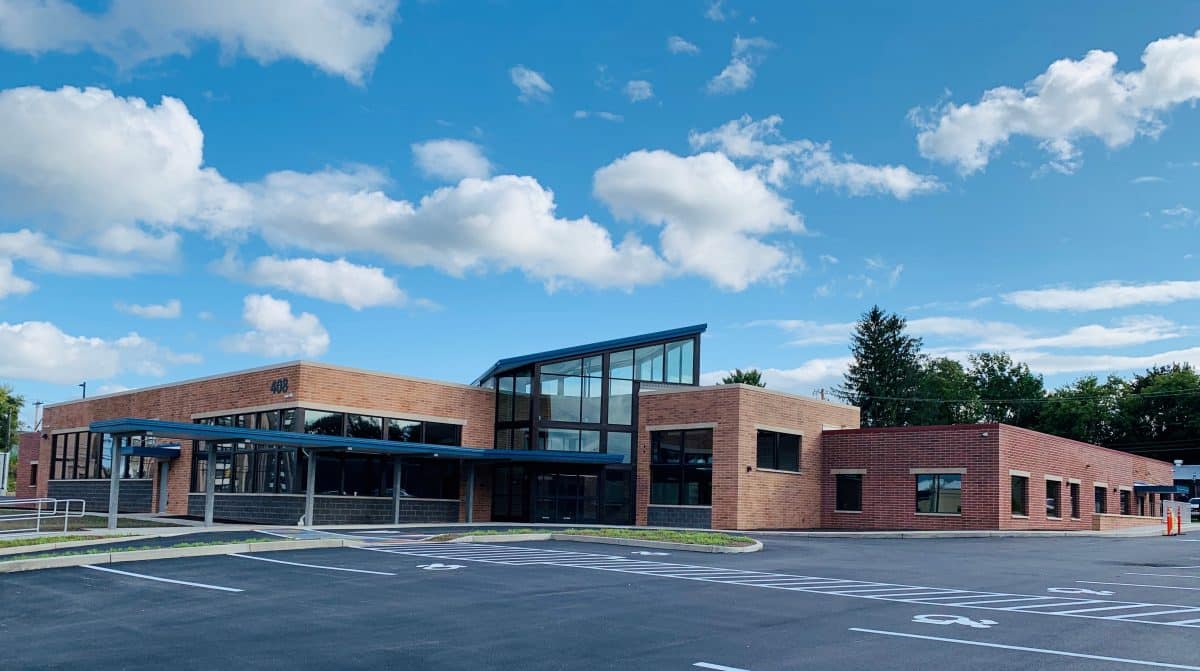
A high-tech, insulated concrete masonry wall system — along with a synergistic effort by the block producer, architect, engineers, contractors, industry experts, and the building’s owner — have created a state-of-the-art Vision Health and Wellness Center for The Central Association for the Blind and Visually Impaired (CABVI) in Syracuse, NY.
The building is a true testament to the power of simple, well-designed concrete masonry construction. It features a single-wythe, structural, integrally-insulated concrete masonry wall system, with exposed surfaces on both interior and exterior faces. The Vision Health and Wellness Center is a CMU success story of collaboration and innovation. The entire team — the building owner, architects, mason contractor, construction manager, and engineer, believed in a structural masonry solution. And that belief, and a lot of interdisciplinary cooperation, paid off handsomely.
CABVI, founded in Utica, NY in 1926, helps the blind and visually impaired achieve their highest levels of independence. The 26,000 sf Vision Health and Wellness Center is a multi-functional facility containing offices, living quarters, educational space, rehabilitation rooms, and a swimming pool. Rudy D’Amico, president and CEO of CABVI during the development and construction of the facility, says “the quality of this building exceeds all of our expectations. We have one of the top facilities in the country.”
And concrete masonry made that happen.
From Nine Layers and Four Trades To One and One
Rick Roach, president of Barnes & Cone, calls the project “a great example of the tremendous versatility of concrete masonry.” According to Roach, the first design concept involved steel frame construction with masonry veneer, exterior insulation board, exterior sheathing, light gauge metal studs, batt insulation within the studs, vapor barrier, gypsum board interior, and paint.
But Bill Ferraldo, principal of Harmony Architectural Associates, wanted a simpler system without the complexity of all the layers and multiple trades. Ferraldo notes that “performance problems always originate within the layers. And with so many trades involved with installing those layers, solutions to problems become difficult.” He wanted structural masonry if it could be brought in for the same budget as the preliminary steel frame design. The new budget, and the actual bid, came in under the original budget
Barnes & Cone is a member of the Concrete Products Group (CPG), a nationwide organization of CMU producers that pool their resources to fund innovation and market development. So, in addition to working with the architect, client, and mason contractor, they were able to work closely with David Biggs, a consultant to the organization and the author of the CPG Spec-Thermal Structural Design Manual. Biggs also consulted with Jeremy Fudo of IPD Engineering on the structural considerations of using the Spec-Brik Hi-R H System. Roach is also quick to praise Jason Thompson, NCMA’s vice president of engineering, who also contributed technical expertise to the project. “These are the times when our membership and involvement in NCMA really pays off for us. It’s one of the best investments we make as a company.”
Challenge – Single-wythe energy efficiency
Solution – Integrally-insulated concrete masonry units
“This building is loaded with CMU innovation,” Roach said. “It really shows how well block can perform on structural, thermal performance, and aesthetic levels. Two new lightweight, high-performance, pre-insulated CMU were invented for the project. We used concrete masonry lintels, reinforced with carbon fiber. We worked with the CABVI to develop special colors for the concrete masonry units that are more easily readable by the visually impaired. We used a computer program to help optimize the layout of the block in terms of the building fenestration. We used single-web block in the foundation, making reinforcing and grouting easier and better. We pushed the envelope on every level.”
To help make it happen, Barnes & Cone turned to Dave Nickerson, inventor of the first pre-insulated concrete masonry unit in 1971. In a collaborative effort, two new pre-insulated units were developed for the project: a 12” x 4” x 16” CMU (trade name “Hi-R H Spec-Brick”), with an R-value of 15.5, and a 12” x 4” x 16“ CMU jamb unit (trade name “Hi-R H Jamb”), with an R-value of 12.1. Dr. Isaac Berger of The California Institute of Electronics and Material Science conducted a second-party review, verifying that thermal calculations complied with ASHRAE Standards. While Nickerson passed away shortly before construction began on CABVI, he lived to see his block produced and renderings of the building.
One Mason Takes The Place of Four to Six Different Trades
Challenge – Simplify control layers and expose masonry
Solution – Innovative CMU system meeting multiple needs
“These systems are innovative,” Roach says. “A mason can install one 11 5/8″-wide wythe of solid-grouted masonry in place of nine different layers of material installed by four to six different trades. One single layer of Hi-R H masonry delivers engineered load-bearing masonry walls, along with thermal mass performance that can exceed R-16 using lightweight mix designs. You also get a solid-grouted moisture barrier wall requiring no in-wall flashing or weeps — a wall that is four-hour fire-rated, has a beautiful Spec-Brik concrete masonry interior finish, and a whole lot more. Bill Ferraldo said it best: It’s ‘one and done.’”
Ferraldo and Dave Colgrove of Harmony Architectural Associates have a long history with mass construction, and they recognized the thermal value of the exposed concrete masonry interior surfaces. The building is heated with geothermal heat pumps, and the mass and the integrally insulated masonry walls reduce temperature swings inside. “It’s classic durable masonry. This integrally insulated CMU system lets us design with masonry in a way we haven’t been able to design in a long time.” Ferraldo said.
Innovation From the Bottom Up
Creative structural design begins from the bottom up, according to Roach. The foundation used 12” x 8” x 16” single-web block — a first in New York State. The open ends of the block made unit placement easier than usual because masons didn’t have to lift the block over the top of vertical reinforcement. Without the typical obstructions found in two-core, three-web block, the open core design also allowed quick grouting of the walls. There was very little grout settlement while the grout was being vibrated.
Challenge – Simplify modular design and coordination
Solution – BIM and MasonryIQ
The many windows in the facility made a modular design critical for efficient labor, and Biggs suggested using Masonry IQ, a computer program that works with Building Information Modeling (BIM) systems that automates masonry layout. The New York State Structural Masonry Coalition provided a grant that made that happen. Mike and Nick Palmer of Remlap Construction, the mason contractor, were brought in to confirm that control joint and vertical bar layout around openings would facilitate the fastest speed of construction possible.
Challenge – Masonry lintels without formwork
Solution – Prefabricated masonry lintels
The project also saw the first New York State installation of Bigg’s pre-fabricated masonry lintels with carbon fiber reinforcing material. Remlap Construction built the lintels in Barnes & Cone’s plant, and they were then delivered to the job site, lifted into place using a forklift, and set on a bed of mortar, ready to receive reinforcing steel, grout, and the masonry courses above
Attention to Quality All the Way Through
Quality installation was essential to the project’s success. The single-wythe system meant the units were exposed on both the interior and exterior of the structure. Many were exposed on three sides — two faces and the end. Remlap Construction took special care to keep mortar joints full, plumb and true and mortar color consistent.
“Really, there were three driving forces that made this project a grand slam — collaboration, innovation, and quality construction. I can’t overemphasize the fact that this was a total team effort. The client, the architect, the engineers, special consultants, and the contractors were all on the same page. We were all working together and looking for ways to innovate and be more efficient for the people at the Vision Health and Wellness Center” said Roach.
Wisconsin Department of Natural Resources Updates Technical Standard 1008 on Permeable Pavement
The Wisconsin Department of Natural Resources (DNR) Technical Standard 1008 Permeable Pavement has been updated and is now available on the DNR’s storm water post-construction technical standards webpage. Changes from the previous version address maintenance and flow path concerns based on new research and technologies. Revisions included input from experts in the field and public review. This technical standard was updated through the Standards Oversight Council (SOC) Modified Process. The updated standard references Interlocking Concrete Masonry & Hardscapes Association for permeable interlocking concrete pavement.
The DNR maintains, implements and develops stormwater construction and post-construction technical standards to assist with the compliance of Chapter NR 151, Wisconsin Administrative Code. The DNR uses the process established by SOC to develop or revise technical standards pursuant to Subchapter V of NR 151. The DNR is a member of SOC with several other federal and state agencies and conservation organizations. They help ensure that technical standards used for soil and water conservation in Wisconsin are science-based and involve collaboration with other stakeholders.
Keeping 2017 Tax Reform in Place is Essential for CMU Producers
Tax provisions enable CMU producers to invest in their companies, creating economic benefits.
Ask Rick Muth, president of ORCO Block and Hardscape, Los Angeles, what he thinks the CMU industry needs from Washington, and he doesn’t hesitate for a second: “Keep the provisions of the Tax Reform Act of 2017 in place — particularly the provision that allows manufacturers to expense equipment in the year it was put in service — rather than requiring depreciation over seven years.”
“Now, more than ever — coming out of COVID — we need to preserve a favorable tax climate for business. We’re feeding the economy. The expensing provisions of the 2017 tax reform bill are helping encourage us to buy equipment. That benefits the equipment manufacturers and all of the companies that build and ship the equipment we need. It benefits our employees. There is a huge multiplier effect to incentivizing the expansion of US manufacturing,” Muth said.
Muth isn’t alone in his assessment of the importance of a favorable tax climate for manufacturers. Both the National Association of Manufacturers and the U.S. Chamber of Commerce have made the preservation of the provisions of the 2017 Tax Reform Act top priorities. In fact, NAM has just published a study indicating that reversal of the current expensing provision or the tax law, increasing the corporate tax rate to 28 percent, increasing the top marginal tax rate, and repealing the 20 percent pass-through deduction would mean that investments in equipment and structures, would drop by $80 billion in 2023 and $83 billion and $66 billion in 2026 and 2031, respectively. It also projects that gross domestic product (GDP) would be down by $117 billion in 2023, by $190 billion in 2026, and by $119 billion in 2031.
“The conclusion of this study is inescapable—follow through with tax hikes that give other countries a clear advantage and we’ll see far fewer jobs created in America… One million jobs would be lost in the first two years, to be exact,” said NAM President and CEO Jay Timmons.
And like NAM, the US Chamber of Commerce lists “preventing rollback of any parts of the pro-growth tax reform bill enacted in 2017 and opposition of anti-growth tax policy proposals” among its top priorities.
Favorable Tax Policy Feeds Growth, Muth Says
For Muth, the idea of spurring the growth of US manufacturing just makes sense. “We make the products that make the buildings and the infrastructure our country relies on. When we buy a new machine, it’s going to be more efficient, and probably safer than the old technology too. New equipment allows us to increase our production and worker productivity. If we invest in new technology, our employees have to learn that technology. They gain new skills. Skills that are transferable. It makes them more marketable.”
A belief in the importance of keeping up with technology and market demand has been driving ORCO since its inception, according to Muth. Rick’s father, Pete Muth — and Pete’s father, brother-in-law, along with an outside business partner — established ORCO 75 years ago by happy accident, really. The Muths were operating a donut business, Muth Donuts when they stumbled upon a fellow whose partner wanted out of a recently established concrete business. “They had to get up a 4 am to make the donuts, which they sold for 30 cents a dozen for plain and 35 cents for fancy. So after the block business took hold, they decided to go that way.”
When ORCO was born in 1946 in Orange County, CA, there were 256 block producers in California. Today, ORCO has seven plants, with has facilities in the Inland Empire and San Diego Counties, and is one of 9 CMU producers. Muth credits the company’s dogged focus on keeping up with modernization and efficiency — both of which require capital investment — on helping ORCO to continue to prosper.
Staying Current With Technology is Essential to Remaining Competitive
“We really work to keep our equipment in top shape, to get the right equipment in here to help us expand and go where the market is.” Over 75 years, that has meant expanding from simple four-inch gray block to architectural block in a wide range of shapes, sizes, and colors, concrete pavers, several kinds of segmental retaining wall units, bagged mortar products, concrete fireplaces, and other hardscaping elements. Rick joined the company in 1975 as assistant office manager. As president, he has led ORCO into the future. A competitive runner from college on, with a three-mile time that still stands in the record books, Muth brought his runner’s grit to the block business.
“We’re survivors, and we at ORCO have very strong capital reserves. We’re doing great. Our company will be all right no matter what the tax policy turns out to be. But ORCO, all CMU producers — and our country as a whole — will be a lot better off with a tax policy that preserves the right to expense equipment in the year it was purchased — and a tax policy that generally encourages business to upgrade equipment and to increase production. Manufacturing employs more than 12.3 million people in this country, contributes $2.32 trillion to the U.S. economy annually. It also has the largest economic multiplier of any major sector. If you want to stimulate the economy. stimulate manufacturing.” he said.
That was certainly the case immediately after the 2017 tax reform act was passed, according to NAM. In 2018, manufacturers added 263,000 new jobs. That was the best year for job creation in manufacturing in 21 years. In 2018, manufacturing wages increased 3 percent and continued going up—by 2.8 percent in 2019 and by 3 percent in 2020. Those were the fastest rates of annual growth since 2003. Manufacturing capital spending grew by 4.5 percent and 5.7 percent in 2018 and 2019, respectively. Overall, manufacturing production grew 2.7 percent in 2018, with December 2018 being the best month for manufacturing output since May 2008.
“What more evidence do you need? We need to preserve the 2017 tax reform changes. It’s the right thing to do — not just for concrete products manufacturers and other manufacturers — but for America,” Muth said.

NCMA/ICPI 2020 Safety Awards Program Winners Announced
160 plants were honored for their commitment to keeping safe manufacturing environments.
[HERNDON, Va. – June 3, 2020] The National Concrete Masonry Association (NCMA) and the Interlocking Concrete Pavement Institute (ICPI), two of the premiere trade associations within the concrete products industry, are pleased to announce the winners of the 2020 NCMA/ICPI Safety Awards.
The prestigious honor is bestowed annually upon plants that demonstrate a commitment to the well-being of their employees and their work environment. An impressive 160 awards were given out to manufacturing locations throughout North America that boast exemplary records. This represents an increase of more than 20% in award winners from the previous year.
To view the list of winners, click here.
“The winners of safety awards are those who consistently promote and implement safe manufacturing practices,” said NCMA President Bob Thomas. “It is encouraging to see members of both ICPI and NCMA demonstrate their commitment to safety. The increase in award winners shows a continued focus on safety and improvement for our industry.”
“This program recognizes the positive safety-conscious work culture of our members,” said ICPI Executive Director Charles McGrath. “Safety Award winners set an example for all manufacturing industries that safety is paramount to a successful business. All winners should be proud of their accomplishments and commitment to their employees.”
Participants were eligible for awards through their OSHA 300A logs or equivalent Canadian injury reports from January 1 to December 31, 2020. Milestone Awards are given to facilities with more than five consecutive years of Safety Award Program entries with zero OSHA/Canadian injury report injuries. Platinum (highest level of single year achievement), Gold and Silver awards are given based on two formulas, one for Incident Rate (IR) and Days Away for Restrictions and Transfer Rate (DART).
For more on the awards, click here.
For a PDF of this announcement, click here.
….
About NCMA: The National Concrete Masonry Association unites, supports, and represents our members who are producers and suppliers of concrete masonry systems – including concrete masonry, manufactured stone veneer, segmental retaining walls, and other hardscape systems. From small family-owned businesses to large corporations, our membership reflects the full spectrum of companies that provide the foundation for resilient building construction. www.ncma.org.
NCMA Contact: Nick Lang, (703) 713-1900, nlang@ncma.org
About ICPI: The Interlocking Concrete Pavement Institute (ICPI), founded in 1993, is the trade association representing the segmental concrete pavement industry in the United States and Canada. ICPI is considered by peer associations around the world as the leader in development and dissemination of technical information for design professionals and contractors. ICPI engages in a broad range of technical, marketing, educational, government relations and communications activities. www.icpi.org.
ICPI Contact: Steven Hawkins, (703) 657-6900, shawkins@icpi.org.
ICPI Government Affairs Update
Infrastructure: possible recent progress after a difficult start; possible positive movement on permeable pavements and stormwater mitigation issues supported by ICPI
The Biden Administration opened its infrastructure initiative by proposing a massive multi-$trillion bill that has failed to achieve bipartisan support in the Senate or the House.
All GOP Members on both sides of the Hill declared the proposal a non-starter that probably would not gain a single GOP vote.
This has rekindled the possibility that the Senate might once again try to use the Budget Reconciliation rules to avoid a Senate filibuster, or even rewrite the Senate rules to neutralize the Senate filibuster, something several key Democrats do not wish to do.
In recent days, it seems that White House and Senate negotiators have moved closer to a possible deal, at least in terms of the funding size. Controversial riders remain an issue, but it seems there is genuine interest among both the President and Senate GOP leaders on infrastructure to continue discussing a consensus package of something akin to one.
Meanwhile, the Senate Environment and Public Works Committee (EPW) has recently released a more limited and bipartisan Transportation bill that contains features that ICPI strongly supports. The size of the bill is attractive to many because it would provide a substantial increase in Transportation funding compared to existing law, but is less costly than the figure associated with the Biden Administration’s initial infrastructure proposal.
From ICPI’s perspective, the Senate draft contains elements that ICPI has been advocating to Members of the House and Senate because they would provide important public policy advancements on stormwater mitigation and permeable pavements.
The Senate EPW Committee marked up its bill in the last week of May. It contains the provisions calling for stormwater best management practices studies and reports in FHWA.
Further, it contains the following provision relating directly to permeable pavements:
SEC. 1518. PERMEABLE PAVEMENTS STUDY.
(a) IN GENERAL.—Not later than 1 year after the date of enactment of this Act, the Secretary shall carry out a study—
(1) to gather existing information on the effects of permeable pavements on flood control in different contexts, including in urban areas, and over the lifetime of the permeable pavement;
(2) to perform research to fill gaps in the existing information gathered under paragraph (1); and
(3) to develop—
(A) models for the performance of permeable pavements in flood control; and
(B) best practices for designing permeable pavement to meet flood control requirements.
(b) DATA SURVEY.—In carrying out the study under subsection (a), the Secretary shall develop—
(1) a summary, based on available literature and models, of localized flood control capabilities of permeable pavement that considers long-term performance and cost information; and
(2) best practices for the design of localized flood control using permeable pavement that considers long-term performance and cost information.
(c) PUBLICATION.—The Secretary shall make a report describing the results of the study under subsection (a) publicly available.
At this writing, the appropriations committees are working on their drafts for markup, so we cannot refer to appropriations language that has been accepted and finalized. But we feel the discussions are going well with respect to permeable pavements and stormwater mitigation and infusing these concepts into the USDOT/FHWA thinking and mission.
If the language we hope for is included in a bill that is enacted, this will be an opportunity for ICPI. In fact, there may be multiple bills and multiple opportunities for ICPI to provide information, technical guidance and the like to agencies that will be tasked with upgrading their knowledge base with respect to stormwater mitigation and interaction with the permeability of pavements. ICPI can help lead as a subject matter expert in providing technical information for use in such studies and fact-gathering.
Meanwhile, ICPI continues the consistent drumbeat to help the Hill build the record in favor of integrating permeable pavements in federal policy. In testimony submitted to the House Subcommittee on Economic Development, Public Buildings, and Emergency Management, ICPI requested consideration for expanding research on and deployment of permeable pavements that can be achieved through integrated transportation infrastructure, environmental, and homeland security legislation. ICPI stated that this would support the following public policy and national objectives:
· Resilient and sustainable pavements programs within DOT/FHWA
· Reduced water pollution from stormwater runoff with increased compliance to NPDES objectives as administered by the US Environmental Protection Agency and States
· Disaster and flood mitigation programs as administered by FEMA
Timing on infrastructure bills: floor action on the Senate EPW Committee bill is unknown. The House Appropriations Committee hopes to issue most of its FY22 appropriations bills by the 4th of July recess.
More action on infrastructure, wastewater: the House Transportation and Infrastructure Committee (T&I) hopes to move a water/wastewater bill this summer. This bipartisan legislation would authorize $50 billion in direct infrastructure investment over the next five years to address wastewater infrastructure and local water quality challenges, including $40 billion for the Clean Water State Revolving Fund (SRF) program. The bill as introduced would address stormwater reuse municipal grants, and add “stormwater” in a section of the Federal Water Pollution Control Act. ICPI supports the legislation.
USDHS and USDOL allow an additional 22,000 H-2B worker visas
(Jointly from the agencies:) USDHS and USDOL have issued a joint temporary final rule making available an additional 22,000 H-2B temporary nonagricultural guest worker visas for fiscal year (FY) 2021 to employers who are likely to suffer irreparable harm without these additional workers. Of the supplemental visas, 6,000 are reserved for nationals of the Northern Triangle countries of Honduras, El Salvador, and Guatemala.
DHS first announced the planned supplemental increase of 22,000 visas for the H-2B Temporary Non-Agricultural Worker program on April 20, 2021. The supplemental H-2B visa allocation consists of 16,000 visas available only to returning H-2B workers from one of the last three fiscal years (FY 2018, 2019, or 2020), and 6,000 visas for Northern Triangle nationals, which are exempt from the returning worker requirement.
“[This] joint rule helps American businesses and addresses the need for robust worker protections,” said Secretary of Homeland Security Alejandro N. Mayorkas. “For the first time, we are setting aside supplemental visas for noncitizens from Northern Triangle countries, in furtherance of President Biden’s and Vice President Harris’ direction to expand legal pathways for protection and opportunity for individuals from those countries.”
“The temporary final rule is designed to prevent permanent and severe financial loss to U.S. employers by supplementing the congressionally mandated H-2B visa cap, takes into account feedback from American businesses, employer organizations, and labor representatives, and is one piece of the administration’s broader comprehensive framework for managing migration throughout North and Central America,” said USCIS Acting Director Tracy L. Renaud. “This rule incorporates several key provisions to ensure adequate safeguards for U.S. workers and H-2B workers. The rule requires that employers take additional steps to recruit U.S. workers, and provides for “portability,” which allows H-2B workers already in the United States to begin employment with a new H-2B employer or agent once USCIS receives a timely filed, non-frivolous H-2B petition, but before the petition is approved. Portability enables H-2B workers to change employers more quickly if they encounter unsafe or abusive working conditions. DHS and DOL will also conduct a significant number of post-adjudication reviews to ensure compliance with the program’s requirements.”
Starting May 25, eligible employers who have already completed a test of the U.S. labor market to verify that there are no U.S. workers who are willing, qualified, and able to perform the seasonal nonagricultural work can file Form I-129, Petition for a Nonimmigrant Worker, to seek additional H-2B workers. They must submit an attestation with their petition to demonstrate their business is likely to suffer irreparable harm without a supplemental workforce. Additional details on eligibility and filing requirements are available in the temporary final rule and the Temporary Increase in H-2B Nonimmigrant Visas for FY2021 webpage.
ICPI has a history of supporting greater numbers of H-2B worker visas and easing procedural roadblocks in using the program. ICPI remains a member of the H-2B Coalition and has already cosigned multiple Coalition letters in 2021 in support of expanded releases of H-2B worker visas.
Brief updates on other issues:
WOTUS: the nomination of U.S. EPA’s new Administrator under the Biden Administration, Michael Regan, has been confirmed by the Senate. We expect that Administrator Regan will undertake a rewrite of the WOTUS rule promulgated in the previous administration, re-expanding its application to smaller waterways. There is no definite timeline on such action.
Corporate tax/corporate tax rate reform: President Biden has recommended an increase in the corporate tax to 28%. The increase has been suggested as one means for helping pay for infrastructure development and perhaps other uses. We think it highly unlikely that legislation containing such a provision could garner any GOP votes in either the House or the Senate, and might not attract the requisite support of all the Democrats in the Senate, with or without using the Budget Reconciliation rules. There has been some indication that the White House might entertain a counter proposal to increase the corporate tax rate to 25% rather than 28%, but it is unclear whether this modification would impact vote dynamics. At any figure, an increase in the corporate tax rate would be a difficult vote for all Republicans and several key Democrats.
Meanwhile, Treasury Secretary Yellen has voice support for an international accord calling for a worldwide minimum corporate tax rate of 15%. There seems to be some favorable reaction from some finance leaders in other countries, but the concept is a trial balloon at this juncture, a work in progress.
Climate change: climate change remains a core value of the current Administration and the progressive wing of the Democratic Party. More moderate elements may not embrace all aspects of climate change but may generally support action to combat climate change. We note this because if policy recommendations can feasibly and accurately make a positive link to mitigating climate change, we think it useful to include such a statement among the list of valid public policy benefits that policymakers should consider.
The PRO Act (Protecting the Right to Organize Act): was reintroduced in the current 117th Congress and has already passed the House. The PRO Act is one of the top legislative priorities of the labor union community, perhaps the top priority. It is an assemblage of union-organizing proposals sought by the labor community.
ICPI opposes the PRO Act.
While the PRO Act has passed the House, its chances in the Senate seem dim at the moment, unless some means emerges to use Budget Reconciliation to avert an otherwise inevitable filibuster. It seems unlikely that the PRO Act would qualify under existing Senate rules to be included in any bill that would qualify for the special Budget Reconciliation treatment.