
The Departments of Labor and Homeland Security Publish Rule Increasing the Number of H-2B Visas Available in the Second Half of Fiscal Year 2021
Announcement from the Office of Foreign Labor Certification (OFLC)
The Departments of Labor and Homeland Security Publish Rule Increasing the Number of H-2B Visas Available in the Second Half of Fiscal Year 2021
The U.S. Departments of Labor and Homeland Security have published a temporary rule increasing the numerical limitation on H-2B nonimmigrant visas to authorize the issuance of no more than 22,000 additional visas through the end of the second half of Fiscal Year (FY) 2021 to employers likely to suffer irreparable harm. The FY 2021 allocation of 22,000 visas consists of up to 16,000 visas for returning workers and up to 6,000 visas for nationals of Guatemala, El Salvador, and Honduras. The rule provides additional protections for U.S. workers, flexibility for foreign workers, and additional recruitment requirements for certain employers.
In support of this rule, the Office of Foreign Labor Certification (OFLC) has posted the new Form ETA-9142-B-CAA-4 and the accompanying instructions. The temporary rule requires an employer to attest, among others, to the fact that it will likely suffer irreparable harm if it cannot employ the requested H-2B workers. This attestation must be submitted to the United States Citizenship and Immigration Services along with Form I-129, in support of an H-2B application subject to the H-2B cap before the end of FY 2021. The attestation is also available on the Forms page of the OFLC website found at: www.dol.gov/agencies/eta/foreign-labor/forms.

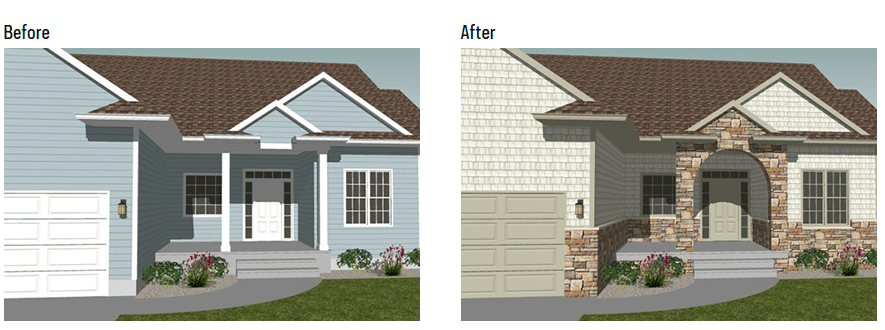
Manufactured Stone Veneer One of Top Projects in 2021 Cost vs. Value Study
In this annual study of return on investment for remodeling projects, MSV again tops 90% return.
The return on investment for installing manufactured stone veneer (MSV) on the exterior of a home is 92.1 percent according to the recently released 2021 Cost vs. Value report from Remodeling Magazine (published by Zonda). This puts MSV as the second highest return on investment of the projects studied, and one of only two to return more than 90 percent of the cost of the project.
Manufactured stone veneer’s 92 percent cost vs. value return is the highest of all cladding projects in the study. Fiber-cement siding replacement was valued at 69.4 percent, while vinyl siding replacement came in at 68.3 percent.

“’Curb appeal’ and ‘first impressions’ are strong concepts in real estate because they have a big impact on how much money prospective home buyers are willing to pay for a home,” the report says.
“As in years past, the national averages for exterior replacements outperformed those of larger discretionary remodeling projects. Manufactured stone veneer this year eclipsed the Garage Door project for the first time as the project with the highest cost recouped,” the report says. It further notes that 11 of the top 12 projects with the highest ROI were exterior improvements.
Long term value with MSV
Manufactured stone veneer has been included in the annual study since 2015. This project has had an average 93.4 percent return over the past seven years.
“Since MSV’s inclusion in the annual study, it has consistently ranked in the top projects, and this year is no exception,” said Chris Hines of Boral, Chair of NCMA’s Manufactured Stone Veneer Committee. “The 2021 report continues to reinforce that MSV is a great investment for homeowners to improve curb appeal and increase home value.”
“NCMA’s MSV Committee has been instrumental in securing MSV’s inclusion in the study, and year-over-year results show the value of this project. While this study is focused on residential remodeling, MSV also provides value also for new construction across all categories – from residential to commercial to institutional,” Hines continued.

Overall remodeling cost trends
Across the projects in the study, the value-over-cost ratio decreased by 3.7 percent from 2020 to 2021. As noted in the report, this is primarily been impacted by rising material costs due to supply-chain disruptions. While the ROI for MSV has decreased by a similar amount in the same period, it remains a sound investment for homeowners to improve the value of their home.

In addition to national averages, the study also looks at cost vs. value across nine geographic regions of the U.S. In two of these regions – South Atlantic (DE, MD, VA, WV, NC, SC, GA, and FL) and West North Central (ND, SD, NB, KS, MN, IA, MO) – MSV is the highest ranking project studied. Similar to the national average, MSV is ranked second in the other geographic regions.
Manufactured stone veneer’s 2021 cost/value return of 92.1 percent was based on an average project cost of $10,386 and a return at the time of sale of $9,571.
Read more about the 2021 Cost/Value report here.
ICPI Holds Two Successful Virtual Regional Events on PICP
ICPI held two successful virtual events on PICP on May 4 and 5, 2021. During the two days of regional events, ICPI was able to reach a total of 61 individuals that worked with government or design firms or Army Corp of Engineers.
The City of Portland PICP Webinar
Tuesday, May 4, 2021, 11:00 am to 12:00 pm PDT
Regarding the webinar attendance:
25 Government or Design Firm Staff
4 sponsors (Curtis Clark, Erica Lange, Matthew Laniohan, Trevor Fearn)
1 panelist (Robert Bowers, P. Eng., ICPI Director of Engineering)
1 host (Bryan Horr, P.E., ICPI Manager of Technical Development & Market Promotion)
The City of Cincinnati PICP Symposium
Thursday, May 6 2021, 1:00 pm to 4:00 pm EST.
Regarding the symposium attendance:
36 Government. Army Corp of Engineers or Design Firm Staff
9 sponsors (Jason Autry, Bob Bridges, Kevin Earley, Charles Taylor, David Pitre, Edward Link, Craig Willike, Greg Cooper, Kevin Piers)
1 ICPI member (Structures)
1 ICPI staff (David Smith, ICPI Technical Director)
4 panelists (Doug Turney, P.E., CFM, Green Infrastructure Project Manager for EMH&T; David Hein, P. Eng.; Robert Bowers, P. Eng., ICPI Director of Engineering; and Jennifer Drake, P. Eng., Associate Professor of Civil Engineering, University of Toronto)
1 host (Bryan Horr, P.E., ICPI Manager or Technical Development & Market Promotion)
NCMA and ICPI Join Precast Show 2022
The National Precast Concrete Association (NPCA) announced today that the National Concrete Masonry Association (NCMA) and the Interlocking Concrete Pavement Institute (ICPI) will join NPCA and the Precast/Prestressed Concrete Institute (PCI) at The Precast Show 2022 on March 3-5 in Kansas City, Mo.
With more than 100,000 square feet of exhibitor space and 5,000 individuals in attendance, The Precast Show is the largest precast-specific trade show in North America and the one place to find the industry’s most important suppliers and foremost equipment experts under one roof.
“We are excited to have NCMA, ICPI and their members officially join us at The Precast Show,” NPCA Chairman of the Board Ron Sparks said. “This decision to renew our relationship underscores our shared interests in the industry and our joint efforts to promote the use of precast concrete, concrete masonry and hardscape products across America.”
“The Precast Show is the premier event within the concrete products industry,” NCMA Chairman of the Board Rocky Jenkins said. “Our members will benefit greatly from the integration of ICON EXPO into this event, as will the companies that supply our members, through increased exposure and the opportunity to come together with so many others across the industry.”
In addition to the trade show floor, The Precast Show includes industry educational sessions and networking events where the latest technology and ideas are shared and discussed. Precast concrete infrastructure products account for approximately $2.4 billion annually, and that figure is expected to increase as the United States looks to repair its aging roads, bridges, highways and rail system.
Along with NCMA’s ICON EXPO and ICON-Xchange tradeshow and events, NCMA and ICPI support an industry that produces and annually sells an estimated 2.5 billion concrete masonry and hardscape products in the United States and Canada with substantial gains from the previous year as a result of increased residential investments in outdoor living spaces.
“NCMA and ICPI members work side by side with NPCA and other organizations participating in The Precast Show on projects every day across the United States and around the world,” NCMA President Bob Thomas said. “We have much in common.”
“Setting the highest standards in product quality, sustainability and safety are at the foundation of all of our groups, making this a natural relationship,” ICPI Board Chair Marshall Brown said.
“With the introduction of the American Jobs Plan, we hopefully are entering a time of national investment in infrastructure that hasn’t been seen since the Interstate Highway System was launched in the 1950s under President Eisenhower,” NPCA President Fred Grubbe said. “It never has been more important for precast concrete associations and their members to work together in order to achieve common goals.”
###
Based in Carmel, Ind., NPCA has represented manufacturers of industrial plant-produced precast concrete products and the suppliers of products and services for the industry since 1965, providing members with the programs and information required to operate a successful precast plant. NPCA operates the industry’s largest and most comprehensive plant certification program, which is accredited by the ANSI National Accreditation Board (ANAB).
Chicago-based PCI develops, maintains and disseminates the knowledge for the design, fabrication and erection of precast and prestressed concrete structures and systems. As a collaborative group of industry stakeholders dedicated to promoting the broader use of precast concrete systems, PCI engages its constituents through standards development, certification, research, marketing and education.
NCMA, based in Herndon, Va., represents the producers and suppliers of the manufactured concrete masonry and hardscape industry in the United States and Canada. NCMA advocates to safeguard the work of its members and promotes its members’ products as the first choice for designers, builders and property owners so communities are improved and made more resilient.
ICPI, based in Chantilly, Va., promotes the value of segmental concrete pavement systems. ICPI delivers education and technical guidance leading to awareness acceptance and use of segmental concrete pavement systems in the United States and Canada.
###
NPCA Contact: To speak with NPCA Chairman Ron Sparks or NPCA President Fred Grubbe, contact Joe Frollo by email or (317) 582-2320.
NCMA Contact: To speak with NCMA Chairman Rocky Jenkins or NCMA President Bob Thomas, contact Brittaney Kamhong Thompson by email or (703) 713-1900.
ICPI Contact: To speak with ICPI Chairman Marshall Brown or ICPI Executive Director Charles McGrath, contact Charles McGrath by email or (703) 657-6900.
Sales Continue to Increase Among Concrete Paver Contractors Despite Significant Workforce Shortage
Gross sales for concrete paver contractors in the United States and Canada increased by 7.8% during 2020, while four of every five contractors reported difficulty in recruiting and hiring quality employees, according to a new survey soon to be released by the Interlocking Concrete Pavement Institute (ICPI).
The 2021 ICPI Contractor Business Report identified business trends from 187 segmental concrete pavement contractors. Respondents included ICPI members and non-members. Industry Insights of Columbus, Ohio conducted the study in January 2020 for ICPI.
“Contractors in the segmental concrete pavement industry are experiencing significant growth in sales,” said Marshall Brown, ICPI Board Chair. “However, this report also confirms a challenge for our industry. There is a large shortage of skilled installers. That is why ICPI has launched a workforce development program to attract more people into the industry and better train the people who are already involved. We have developed a career resource website hardscapingis.com, as well as an online learning center, The Hardscape Institute, where people can better access the industry’s top education programs. We are also working on marketing materials to help member contractors recruit more young people into the craft.”
Other key findings include:
The residential market remains strong representing 72.7% of sales, while commercial/ government projects comprised 27.3% of sales (a decrease of 3.2% from the previous year).
72.7% require crew members to review and participate in a formal, documented, safety program.
A 6.7% average wage/salary increase occurred in 2020, while a similar 5.8% average rise is forecasted for 21
The study also includes data on technologies contractors use to monitor and reduce exposure of crew members to respirable silica, as well as on company promotion and certification trends. Besides reporting overall data, results provide insight into the industry regarding gross sales, ICPI membership level, and number of employees during the construction season. The full report will be available for purchase at https://icpi.org/bookstore.
ICPI and NCMA Boards Approve Continued Collaboration Exploration of a Unified Association
The ICPI Board of Directors met jointly with the NCMA Board of Directors to get an update on recommendations from the ICPI NCMA Collaboration Exploration Committee on March 25, 2021. The committee recommended that both organizations sign a letter of intent to continue discussions and to develop a plan for unification. The unified organization would have two segments one for Masonry (Masonry and Manufactured Stone Veneer) and one for Hardscapes (Pavers and Segmental Retaining Walls). No final decisions have been made. They also recommended to engage consulting support through the process of developing a plan for unification for consideration by the ICPI Board of Directors at the Summer Meeting in August. The plan will include dissolving the NCMA and the ICPI and create a new unified organization. If the plan is approved by the Board, it will go out to all ICPI voting member representatives for a vote this fall. Following the joint Board call, the ICPI Board of Directors met separately and approved these recommendations. If you missed the member webinar on March 9, 2021 on this topic a recording is available online.
ICPI Initiates Research Into the Use of Open-Graded Bases Under Sand Jointed Interlocking Concrete Pavement
The ICPI Foundation for Research and Education has approved funding to investigate the performance and limits of the use of open graded bases and bedding under standard interlocking concrete pavement with sand filled joint.
The Foundation has an agreement with Englobe of Kitchener, ON to complete this multi-phase research.
Phase 1: Initial meeting and literature review of current methods to reduce migration of fine materials from one medium to another. Using the literature determine the available local materials and select 6 materials to use in the lab trials.
Phase 2: Gather samples of each of the six (6) selected materials and test in the lab for gradation. Further testing will include creation of 500 mm (10 inch) by 500 mm (20 inch) plexiglass boxes. Up to nine test sample combinations will be placed in the boxes and tested on a vibration table to determine migration of fines and settlement of pavers placed at the surface, samples will be tested dry and with “rain” cycles. Water outflow will be tested for material loss; GoPro video of samples during testing will be taken for review. Lab trials to be conducted at Englobes facilities in Kitchener, ON.
At the end of phase 2 the results and recommendation from Englobe will be reviewed by the Foundation Program Committee and the task group overseeing this project to determine which assemblies to be constructed in phase 3.
Phase 3: Field Trials will include supervision of construction for up to 2 days as well as evaluation of the Pavement Condition Index at initial construction, one week, 2 weeks, 3 week, 4 weeks, 2 months, 3 months, 6 months, 9 months, 12 months and 2 years after construction. The field trials constructed will include three (3) different material combinations with two (2) different loading conditions. The loading conditions will be pedestrian traffic, light-duty vehicle traffic with sharp turning movements. Costing assumes one onsite field investigation of a failed area to determine root cause of the failure.
Great North Hardscape of Cambridge ON has provided space at their facility in Cambridge ON to conduct the full scale field tests.
ICPI will be looking to members to donate the pavers and other materials that will be used in the construction of the test sections. If you are interested in being considered, please contact Robert Bowers (rbowers@icpi.org) to make sure your name is on the contact list when the call for materials goes out.
Tell Your Project Stories
Project Profiles are often some of the most powerful tools we can use to build interest in our products and services.
These examples tell your story of how CMU, MSV, SRW, or Pavers succeeded in solving problems, enhancing property value, and creating beautiful outdoor living spaces.
To assist members sharing these stories, CMHA staff has developed an easy-to-use Google Form that includes simple questions to learn more about the project and project team.
CMHA staff will happily take it from there – turning your answers into compelling success stories to help build our members’ business.
If you have any questions, please contact our Marketing Team.

ICPI Releases 2020 Annual Report
ICPI has released the 2020 Annual Report. Contents include:
Industry Health Report
Institute Report Card
ICPI 2019-22 Strategic Plan
Workforce Development
Working with Schools
Education Highlights
Course Sponsors
ICPI Website
Concrete Business Update
Virtual HNA
Technical Highlights
ICPI Foundation
Paveshare
Statement of Financial Position
Statement of Activities
Foundation Board of Trustees
Foundation Donors
Board of Directors
ICPI Member Producers
ICPI Member Associates
ICPI Member Voting Contractors
ICPI Contacts
ICPI Government Affairs Update
The Biden Presidency is seated amid pandemic
The 117th Congress is seated with narrow, tenuous Democratic majorities in both Houses
The “political math” of the 117th Congress, and its tactical impact on legislation.
At press time, the last House race (New York 22nd District) has been certified as a Republican victory.
This result gives the Democrats a narrow 9-vote majority control in the House, 222-213, in the 117th Congress. Thus, on any given House vote requiring only a bare majority (which is true for most votes on the House floor), if only 5 Democrats vote with the GOP side rather than with their Democratic colleagues, the GOP side will prevail and the Democratic side will lose.
On the Senate side, the Senate is tied at 50-50, with the tie-breaking vote of Vice President Harris giving the Democrats the narrowest possible majority. This means that if even 1 Democrat chooses to vote with the GOP on any floor issue requiring only a bare majority, the Democratic majority side would lose and the GOP side would prevail.
Several centrist Senators’ votes will be courted quite closely on nearly every major contentious issue.
Unless there are new Senate rules changes that are extremely unlikely at this time, we expect the availability of the Senate filibuster to continue without abandonment. Sufficient Democrats have joined all Republicans to ensure that the filibuster will remain an available tactic. So, in addition to the tenuous bare majority votes in a 50-50 Senate, the need for 60 votes to override filibusters means that the Democrats will need to negotiate to bring at least 10 Republicans on board to defeat a filibuster on most important floor votes.
Whip counting (polling Members how they intend to vote before the vote is scheduled) will be as important as it has ever been.
While we expect the Hill to tilt decisively in the direction of the Democratic agenda, we know that narrow majorities can have a tactical/practical moderating effect on legislation, particularly in filtering out some hot-button issues and blurring some of the more controversial fine points of policy. There will be more on this below with respect to certain key legislative proposals.
With the majorities now settled, the House and Senate are organizing their committees in terms of Chairs and Ranking Members, and finalizing committee memberships. Committees are beginning to schedule hearings. ICPI is monitoring these efforts.
Meanwhile, at the White House, the Biden team is settling in and doing what it can to execute a fast start. At press time, several of the Biden Cabinet nominees have either been confirmed by the Senate or are moving normally through the confirmation process. So far there have been no controversies or delays in confirmations.
The first two orders of business have been to quickly ramp up on COVID-19 legislation, and to issue Presidential Executive Orders (EO) to overturn actions of the Trump Administration. Presidential action by EO is immediate and does not require legislation or negotiation with the Hill.
With respect to the COVID-19 $1.9 trillion package sought by President Biden, the President is relying on the Democratic House and Senate majorities, and the filibuster-proof rules of “Budget Reconciliation,” to move this first package.
President Biden has reached out to Senate GOP centrists. Initial talks between the President and GOP Senators have been cordial, businesslike. We expect polite discourse to continue, a mode which we expect may bear fruit on future legislation where the filibuster is possible and inter-party consensus will be required. But in this first bill, addressing the COVID-19 universe of issues on a massive and urgent basis, the President has accessed the rare procedural opportunity allowed under Budget Reconciliation to move the entire legislation without any GOP votes. (Budget Reconciliation is a privileged matter under the Budget Act, thus a Senate filibuster is not allowed.) At press time no Republican Member has signaled support for the massive $1.9 trillion bill wanted by the President.
The COVID-19 bill does not include issues that might have the most direct impact on ICPI interests, such as infrastructure, taxation, immigration or labor. But it does have many elements intended to improve the economy by both rapidly expanding vaccine deployment to quell the human medical impact of COVID-19 and by providing economic rescue to some of the hardest hit sectors in the U.S. economy.
The issues surrounding economic impacts include, for example, a raise in the federal minimum wage, direct payments to people, increases and extensions in the federal unemployment insurance program. Other examples include funding for FAA and the airlines, other transportation and mass transportation sectors, FEMA programs related to vaccine distribution and virus response. Of course it is a huge bill, substantively and in cost. Some economists say a large bill is needed; others express concerns about the cost, possible inflationary effects and the federal deficit. At press time the various Hill committees tasked to construct the final elements are doing so. Given the urgency of the pandemic and the favorable parliamentary circumstances, we expect a large COVID-19 bill to pass in late February/early March.
With respect to the early Biden Administration Executive Orders which might have relevance to ICPI and its members, the following is a brief selection of EOs and what they would do:
-Reverses Trump-era constraints on rulemakings, overturns many rules, and institutes a regulatory freeze on Trump administrative actions that were under development. A key adjunct is that the new Biden EPA counsel has asked DOJ to suspend work on environmental actions prompted under the Trump Administration to give the Biden Administration time to conduct their own reviews and possibly reverse course.
-Directs each federal agency to develop a plan to increase the resilience of its facilities and operations to the impacts of climate change and directs relevant agencies to report on ways to expand and improve climate forecast capabilities – helping facilitate public access to climate related information and assisting governments, communities, and businesses in preparing for and adapting to the impacts of climate change.
-Directs each federal agency to develop a plan to increase the resilience of its facilities and operations to the impacts of climate change.
-Catalyzes the creation of jobs in construction, manufacturing, engineering and the skilled-trades by directing steps to ensure that every federal infrastructure investment reduces climate pollution.
-Commits the U.S. to rejoining the Paris Climate Accord.
-Makes climate change an essential factor of U.S. foreign policy and national security.
-Re-establishes the President’s Council of Advisors on Science and Technology.
-Makes the Director of the Office of Science and Technology Policy responsible for scientific integrity for the federal agencies, and to ensure that sound science is used.
-Directs OSHA to release clear guidance to employers on COVID-19 (at press time this has already been released by OSHA), possibly establish an Emergency Temporary Standard for employers (currently under consideration by OSHA), and directs OSHA to enforce worker health and safety requirements.
-Directs agencies to apply and strictly enforce the prevailing wage and benefit guidelines of Davis Bacon and other acts and encourage Project Labor Agreements. These actions reaffirm that agencies should work to ensure that any jobs created with funds to address the climate crisis are good jobs with a choice to join a union.
-Strengthens Buy America rules affecting federal purchases of goods.
As we close our discussion of the early Biden EOs, we note the clear effort to include the environment and climate change in nearly every major action taken or contemplated by the new Administration. Of course, PICP is a green technology that fits well with any policy that favors green construction, stormwater mitigation, clean water, reduced flooding, water harvesting and more. We think it prudent to highlight, constantly and comprehensively, the substantial positive environmental benefits of PICP, certainly in discussions with any level of government, and probably to private sector elements influenced by government policies.
Specific issues particularly relevant to ICPI and its members
WOTUS, the “Waters of the U.S.” definition of waterways subject to the Clean Water Act (CWA) and related regulation by EPA and the U.S. Army Corps of Engineers:
The first contemporary movement on WOTUS occurred when the Obama Administration redrafted WOTUS to include many more waterways/types of waterways subject to CWA (and for ICPI’s purposes, stormwater mitigation using permeable pavements). The second movement was the Trump Administration elimination of the Obama WOTUS rule, replacing it with a much narrower definition of waterways subject to CWA.
Now comes the third movement, the effort by the Biden Administration to reverse the Trump action and, presumably, eventually restore much or all of the Obama WOTUS rule.
President Biden included WOTUS in his early regulatory efforts, calling for a review of the Trump rule and a recommendation on how best to proceed.
Environmentalists want Biden to move even further and faster on WOTUS. House Committee on Transportation and Infrastructure (T&I) Chairman Peter DeFazio and Subcommittee on Water Resources and Environment Chairwoman Grace F. Napolitano have called on President Biden to fully repeal the Trump rule now and immediately engage a new rulemaking to replace it.
Such a rulemaking would take considerable time, as was seen in both the Obama and Trump efforts, each of which took years to complete. But it would provide the most complete repudiation and replacement of the Trump rule.
During the Obama rulemaking, ICPI provided WOTUS to EPA comments asserting how permeable pavement technology was readily available to help the country meet increased stormwater mitigation requirements with the economical, proven, readily available “off the shelf” technology to do so. ICPI stands ready to participate in any new rulemaking respecting WOTUS during the Biden Administration. This position comports with ICPI’s effective efforts in branding PICP as a green technology that is fully in synchronization with growing demands for environmentally friendly infrastructure development.
WRDA, the Water Resources Development Act: The WRDA 2020 reauthorization became law late in the immediately preceding 116th Congress. Now comes the time to implement the new law. Infrastructure proponents on the Hill are urging the Biden Administration to do so as soon as possible, in large part because it is the infrastructure bill that has already been passed and is available to boost infrastructure activity in the economy.
An interesting recent twist to WRDA is that it is being hailed for its green construction opportunities as much as for construction jobs. For ICPI, we interpret green construction as opportunities for PICP.
In a recent statement issued by House T&I Chairman DeFazio, he cited key provisions from WRDA 2020 that will help the Biden administration achieve its climate, resiliency, and equity goals:
-Directs final agency procedures for Principles, Requirements, and Guidelines (PR&G). The PR&G ensures that future water resources development projects maximize sustainable development, protect and restore the functions of natural systems, and fully-evaluate environmental, economic, and societal goals (including both monetary and non-monetary effects), in addition to addressing environmental justice concerns and ensuring meaningful participation of locally-affected communities.
-Expands the ability of the Corps of Engineers to provide local governments with direct resiliency planning assistance (at no cost to the local government through the Corps’ Flood Plain Management Services) to avoid repetitive flooding impacts, to prepare and adapt to climate change and extreme weather events, and to quickly recover from flooding events.
-Directs the Corps to prioritize planning assistance to economically disadvantaged communities and communities subject to repetitive flooding events.
-Reaffirms the commitment to greater use of natural and nature-based projects by ensuring natural and nature-based alternatives are fully evaluated in any flood or storm risk-reduction feasibility study carried out by Corps and are provided the same cost-share as structural alternatives.
-Authorizes the Corps to study, design, and construct water resources projects for communities that have been subjected to repetitive flooding events and have received emergency flood assistance, including construction of temporary barriers. This authority is directed at helping repetitive loss communities, especially those in economically disadvantaged communities, obtain critical flood protection.
-Creates additional flexibility for the Corps to address the water resources needs of economically disadvantaged communities, minority communities, and rural communities both through pilot efforts to reduce (or eliminate) the local cost share for partnering with the Corps, or through providing additional resiliency planning or technical assistance, at no cost to the community.
ICPI supports the rapid implementation of WRDA and its growing focus on environmental concerns and combating repetitive flooding.
An “infrastructure package”
While the Biden Administration has not made it a top priority on the same level as COVID-19, an infrastructure package is always mentioned as a priority for action in 2021.
The Biden campaign offered the Build Back Better statement of goals during the 2020 campaign.This was an aspirational campaign document lacking in substantive detail.
President Biden is expected to deliver a speech to Congress on February 23 at which time he is expected to address infrastructure plans in greater detail.
We know that leaders in both parties in House T&I, the Senate Environment and Public Works Committee, and other committees have detailed working drafts ready for consideration. There is strong support for a bill among the business and construction communities.
In days leading up to this writing, President Biden is reported to have said, paraphrasing, he cannot wait to work out an infrastructure package with Chairman DeFazio.
ICPI welcomes those favorable comments and stands ready to offer support and possible permeable pavements language for consideration in such a bill. ICPI will be watching these developments closely as 2021 unfolds.
Immigration, and the H-2B worker visa program
In 2020, President Trump eliminated issuance of new H-2B visas twice, the latter announcement extending his delay on new visas through March of 2021.
President Biden has issued several early EOs addressing various aspects of immigration. He has proposed a study of the political, economic and societal reasons why citizens of other countries emigrate to the U.S. as a precursor to modify U.S. foreign policy to address those dynamics. He has pledged to pursue legislation to reform the immigration system, including enactment of an eight-year pathway to citizenship.
A comprehensive immigration bill remains a primary means to address the H-2B worker visa issue, though not the only means. Unilateral regulatory action by the Administration, DHS and DOL can and do impact H-2B. Further, in recent years, important H-2B action has originated in the House and Senate Appropriations Committees, with directives and conditions attached to DHS and DOL funding legislation.
ICPI is a member of the H-2B Worker Visa Coalition and supports increases in the annual visa caps and the release of additional visas as allowed in recent appropriations bills. In addition, ICPI supports provisions intended to enable expanded use of the H-2B worker visa program, ease the allowances for returning workers and reduce the procedural and paperwork roadblocks to U.S. companies using the program. H-2B is a priority for ICPI.
ICPI signed letters supporting the Senate confirmations of Marty Walsh as Secretary of Labor and Alejandro Mayorkas as Secretary of Homeland Security. These are the two cabinet positions most closely related to immigration issues and the H-2B worker visa program. (At press time, Mayorkas has been confirmed by the full Senate, and Walsh’s nomination has been approved by the Senate HELP Committee by a vote of 18-4). In expressing these views, ICPI re-stated the importance of H-2B to the paver installation industry.
ICPI cosigned a letter to Secretary Mayorkas urging him to use authority granted by Congress to release more H-2B visas.
During the recent Senate confirmation hearings, Senators Susan Collins and Lisa Murkowski voiced support for the H-2B worker visa program.
ICPI greatly appreciates their favorable comments.
Labor issues/agenda
Given the Democratic control of the House, Senate and White House, the likelihood of labor union-supported legislative and regulatory action in 2021 has increased substantially.
At press time, the Biden labor agenda is yet developing in the wake of the more urgent COVID-19 priorities. We anticipate robust action on the labor issue front.
On the Hill, the PRO Act (Protecting the Right to Organize Act), has been reintroduced. The PRO Act is one of the top legislative priorities of the labor union community, perhaps the top priority. It is an assemblage of union-organizing proposals sought by the labor community.
The following is a selection of elements in the PRO Act gleaned from statements from PRO Act proponents (in the interest of space it is not a complete list):
-Authorizes meaningful penalties for companies and executives for violating workers’ rights. The bill also permits the NLRB to impose personal liability on corporate directors and officers who participate in violations of workers’ rights or have knowledge of and fail to prevent such violations.
-Streamlines access to justice for workers who suffer retaliation for exercising their rights.
-Authorizes a private right of action for violations of workers’ rights.
-Gives workers the power to override so-called “right-to-work” laws that prevent unions from collecting dues from the workers they represent. The PRO Act allows employers and unions to enter into a contract that allows unions to collect fair-share fees that cover the costs of collective bargaining and administering the agreement.
-Enhances workers’ right to support boycotts, strikes, or other acts of solidarity.
-Prevents employers from interfering in union elections. The bill prohibits employers from requiring workers to attend meetings designed to persuade them against voting in favor of a union. If a violation takes place or the employer otherwise interferes with a union representation election, the NLRB will be empowered to issue an order that requires the employer to bargain with the union. The bill also prevents employers from interfering in representation cases, which exist to determine workers’ free choice, not corporations’ preference about how their employees should exercise protected rights.
ICPI opposes the PRO Act.
The PRO Act might become the leading labor bill in the 117th Congress. Its chances for enactment are uncertain. The bill appears likely to face a filibuster if it should reach the Senate floor.
It seems plausible that at some point alternative efforts will be made to break the bill into smaller parts, issue by issue. Some elements might have a greater chance for passage than others. ICPI will be monitoring closely.
Tax reform/tax increase proposals
Some Democrats have urged tax proposals to improve tax equity, generate revenues to offset COVID-19 spending, or address deficit issues.
Such proposals include increasing the corporate income tax rate to circa 27%; increasing taxes on individuals earning more than $400,000 per year; increasing the highest individual income tax bracket rate; increasing capital gains taxes on individuals making more than $1 million per year; enacting “mark to market” proposals to tax capital gains annually for gains not yet realized rather than waiting until assets are sold.
There is no single coherent tax package for consideration at this time. Proposals, rates, percentages and mechanisms are being discussed on a conceptual level.
We do not anticipate early action on tax, for multiple reasons that are mutually reinforcing. First, COVID-19 and jobs recovery take precedence. Second, tax increases might be problematic for moderate and red-state Democrats. Third, the prospect of tax increases during a pandemic and high unemployment seems bad timing.
Thus, there will likely be tax debate, the introduction of bills, hearings held and more; there may be calls from Democratic governors to reinstate the federal tax deduction for state and local taxes. But there are solid reasons to question whether a significant tax reform bill is possible at any early point in 2021. It might be, but it would require a superlative effort.