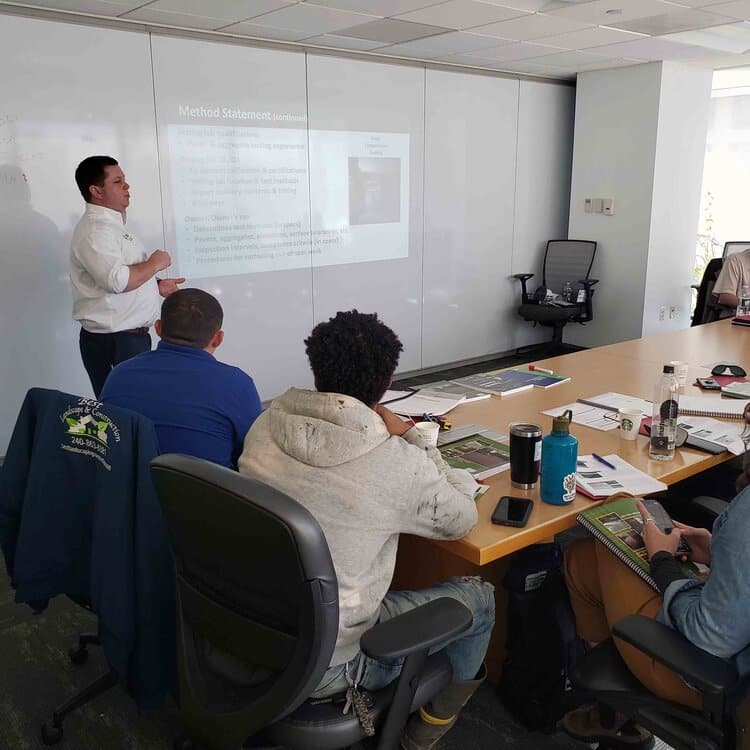

Lynchburg University Westover Hall
Load-bearing concrete block is delivering a cost-effective, fire-safe solution in Lynchburg, VA for the University of Lynchburg’s Westover Hall. Named for the school’s first building and for the Westover Honors College, which it houses, Westover Hall — the university’s largest building — was dedicated in October of 2019.
At nearly 90,000 square feet, the four-story building is constructed with load-bearing concrete block walls and precast concrete plank flooring. Westover features 140 bedrooms, 92 bathrooms, four balconies, a rooftop terrace, classrooms, and faculty offices. It also houses two residential learning communities — one for Westover Honors students and one that allows students to explore spirituality, mindfulness, and wellness together.
Kristen Cooper, associate dean of students, said the design of the building focused on flexibility, collaboration, accessibility, and student needs, including private study space, active learning classrooms, and an outdoor classroom.
Robust, Durable, and Structural
Block was chosen because it is “robust, durable, and structural,” according to architect Jason T. Burger of Dominion Seven Architects, Lynchburg, the firm that designed Westover. “The university wanted a longstanding building — something with a lifespan of 50 years or better. With college students living in the facility, they wanted surfaces that would stand up to the abuse of the residents. Fire containment was of paramount concern. We wanted to use hollow-core precast plank flooring. So it made sense to use concrete masonry because of its structural properties.”
Students provided input on the design. Davion Washington, 21, a Westover Honors student and president of the Student Government Association, said he was invited to sit in on a meeting with the architects to envision the facility. “My peers and I provided suggestions and feedback. Our input was accepted. We felt included.”
The building is clad with a combination of red and gray brick veneer, accented with two different colors of fiber cement siding, allowing it to blend with the older buildings on the campus while projecting a welcoming, modern feel. Many interior walls also feature exposed masonry, some with precast concrete coping. The block for Westover was supplied by NCMA-member Boxley Materials in Lynchburg. The mason contractor was Holman Masonry, Farmville, VA. The general contractor was Jamerson-Lewis Construction of Lynchburg.
A Cost-Effective Solution
William Cook, president of Jamerson-Lewis, was the project manager for the Westover construction. Cook said he wishes more buildings of this type were constructed with load-bearing block and precast plank flooring. “It’s a very cost-effective system for a building of this type. It goes up relatively quickly. It’s a strong, durable system that provides unrivaled fire protection. It’s really simple to deal with.”
“For this type of building — a residence hall — having floor-to-floor fire separation was critical. Almost all of the block is 12-inch, which worked well. The larger units went in almost as quickly as standard units. They allowed for easier grouting and provided greater tolerance in terms of placing the precast flooring,” Cook said.
University of Lynchburg President Dr. Kenneth R. Garren said Westover is “not just a dormitory.” Even ‘residence hall’ fails to fully describe what we hope it will be. It will be home to thousands of students over the coming decades.”
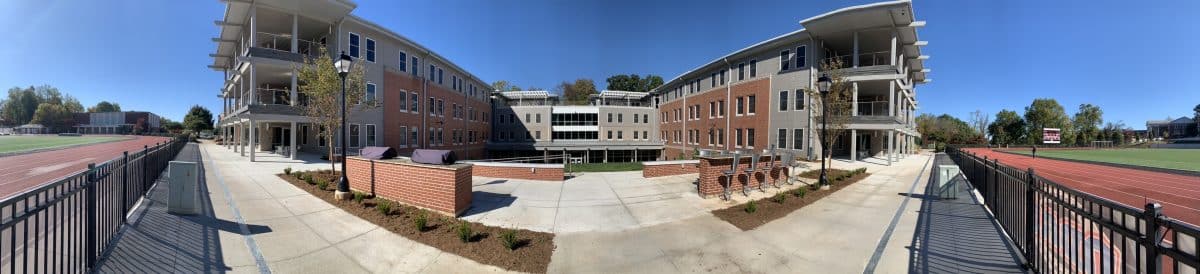
2020 Lawrence Street – Denver, CO
A combination of split face and ground face concrete block, supplied by Basalite Concrete Products, is helping Denver’s 2020 Lawrence stand up to the rigors of its urban environment— providing an upscale aesthetic and setting an example for sustainable residential redevelopment throughout the region and the country.
The carefully chosen colors and textures of the concrete masonry help frame the 12-story urban highrise against its downtown environment and the surrounding Rocky Mountains. Exquisite architecture, mixed with thoughtful, contextual design helped win the community a Mayor’s Design Award in 2013. It’s continued good looks are a testimony to the durability and versatility of concrete masonry.
Block Supplies the Right Aesthetic and Much-Needed Durability
“I was trying to achieve an art deco style in the building,” said architect John Gagnon of JG Architects Inc. The use of stucco was just not going to be an option. We needed a material that was durable and good looking— because the neighborhood was fairly rough at the time we built. Brick was not right because the units were too small. So we went with block. Alternating between split face and ground face allowed us to play with different textures and colors and allowed us to get the look we wanted.”
While the building’s main structural support is provided by pre-stressed concrete, there are also some load-bearing block walls on the interior. Exposed ground face block can be seen on the interior in the complex’s fitness center.
The block went up smoothly, according to Gagnon. “It actually went really, really well because the general contractor stepped up to the plate and selected a good masony contractor, Gallegos Masonry. It went really smoothly and they did a really nice job.”
A Concrete Masonry Envelope for a LEED Gold Project
“Transitioning columns of colored lights beckon young (and young at heart) Denverites to see and be seen on the rooftop deck. This LEED Gold Arapahoe Square space gives off a distinctively urban vibe, and leaves no stone unturned in its mission to be green,” Denver’s Mayor Michael Hancock said when he cited the project for the Mayor’s Design Award.
And this is one green building. The sleek concrete masonry exteriors are just the beginning of smart living at 2020 Lawrence. The interiors boast Energy Star stainless steel appliances with a rooftop photovoltaic solar array that generates power for the building. The building’s developers estimate that the structure’s energy-efficient design saves tenants as much as 50 percent on utility costs. 2020 Lawrence helps prove that green, sustainable design can go hand-in-hand with luxurious residential living—and that concrete masonry fits right in with these ideas.
“This project really has become a model that the city of Denver has used with other developers to show what is possible in terms of beautiful, sustainable downtown redevelopment. I’m very proud of it.” Gagnon said.
ICPI and NALP Provide Resources to Help Address Labor Shortage
Through a partnership with the National Association of Landscape Professionals (NALP), ICPI members have access to additional workforce development resources including a Job Board and an Employee Recruiting Guide.
And don’t forget to follow the @HardscapingIs campaign on Facebook and Instagram, where you can share pictures of your projects to show what Hardscaping Is.
DATE March 25th, 2020

Did You Know? ICPI Has a Presence on Cue Career
ICPI has a presence on Cue Career, a website for career exploration and workforce development for students. Students explore careers on this site by watching video interviews with people in the career and access workforce development opportunities such as internships, apprenticeships, mentorships, micro-credentials, and badges offered by associations.
On ICPI’s page (link is https://www.cuecareer.com/industryassociation/interlocking-concrete-pavement-institute/), students can learn about hardscaping careers, the installation career path, educational opportunities, and events and can watch videos including interviews with Fred Adams and Carlos Gomez as well as the @HardscapingIs social media campaign videos.
DATE March 25th, 2020
Don Beers Receives NCMA Lifetime Achievement Award
SALT LAKE CITY, UT – Don Beers, staff engineer for the Masonry Association of Florida, was presented with NCMA’s Lifetime Achievement Award on February 24, 2020 at the association’s Annual Convention held at The Grand America Hotel in Salt Lake City, Utah.
The Lifetime Achievement Award is NCMA’s highest recognition for achievement or service by individuals through a member company (or companies). The award recognizes those individuals who have made extraordinary contributions to directly advance the industry and/or the association in a profound and lasting manner.
“A review of Don Beers accomplishments over the past 40+ years is overwhelming by any comparison”, said Rocky Jenkins, CEMEX Director – Commercial Development, who presented Don with the award. “More significant however, is that no one individual has influenced a market like Don Beers has done for concrete masonry in Florida.”
Don spent 29 years at Rinker Materials using his structural engineering degree, PE license and general contractor license. For the past 10 years Don has worked as a structural engineer with Adrian Engineering and staff engineer for the Masonry Association of Florida. His accomplishments while in these roles has had a substantial and lasting impact to the Florida masonry market and the masonry industry as a whole.
Don’s contributions are notable and significant in a number of different areas.
- Manufacturing and Plant Design – Don was a key figure in the growth and prosperity of the concrete masonry industry in Florida from the perspective of supporting the introduction of concrete block production capacity to lead and to meet increasing demand. As an employee of Rinker Materials, he led the efforts to construct more than 40 concrete block and ready-mix plants.
- Educator – Following his manufacturing roles with Rinker, Don evolved as a technical support resource for the industry. He has personally performed hundreds of presentations to thousands of architects, engineers, industry personnel, contractors and students. He was instrumental in developing a concrete masonry designer certification program. He is known and respected for his passion and ability to communicate as a speaker. He has also been a prolific writer and has been published in various national and regional industry publications and in trade journals – mostly about concrete masonry solutions.
- Technical Resource and Advocate – Don has been a key player for the concrete masonry industry to identify challenges and provide technical solutions. He has been an advocate of appropriate code provisions at the regional and national level; he has advocated and supported research and development projects to document concrete masonry’s attributes; he has provided technical support for designers and contractors on a regular and ongoing basis.
- NCMA Advocate – Don has always been complimentary of the support and resources that NCMA provides towards the growth of concrete masonry in Florida. He has advocated strongly for collaborative efforts between NCMA and state associations and has encouraged companies in Florida to join and support NCMA.
Don has been supported through his career by his wife, Angela. In his personal life, has had made four mission trips to Haiti, been committee chair for his Parish outreach program, performed prison outreach for the past 13 years, and with his wife hold a Catholic Eucharist Service at three local nursing homes each week.
For a PDF of this story, click here.

2019 SRW Sales Survey Released, 1.1% Increase Reported
Compared to sales in 2017, the overall sales of segmental retaining wall (SRW) units increased 1.3% in the US and decreased by 0.5% in Canada between 2017 and 2018, according to a study released by the National Concrete Masonry Association (NCMA).
The 2019 NCMA SRW Sales Survey is the fourth year of this industry survey. In total, 43 individual companies provided data for the survey, from both SRW producers and SRW licensors. The producers that responded represent 195 plant locations across the United States and Canada in 2018. Data was submitted in four different categories of SRW products: ‘DOT quality products’, ‘8 in. height SRW units’, ‘6 in. height SRW units’, ‘Boundary wall units’ (such as those used for fences or other vertical applications not retaining soil) and ‘other’ (which includes all other SRW products smaller than 6 in. high).
The category with the largest growth in 2018 was ‘SRW units with an 8-inch height’, which experienced a 4.0% increase in sales from 2017. Increases in sales in 2017 were also seen for ‘6 in. height SRW units’ and ‘DOT quality products’.
“This survey continues to be a very valuable tool to understand industry dynamics and impact of efforts to grow SRW markets,” said Wayne Villaluna, Basalite Concrete Products NCMA SRW & Hardscape Products Market Segment Committee Chair. “The survey results continue to show increased growth overall, especially with 8 inch SRW units. The increase seen in sales benefits all the industry and demonstrates continued demand for SRW systems and products.”
From the available data it is estimated that the total sales of SRWs in the US and Canada was 232.4 million sq ft of wall face.
The complete survey is available for purchase for $1,500 to individuals who are not members of NCMA. NCMA members pay only $100. Click here to buy it online, or contact NCMA for more information on other purchase options.

2019 CMU Sales Survey Released, 2.5% Increase Reported
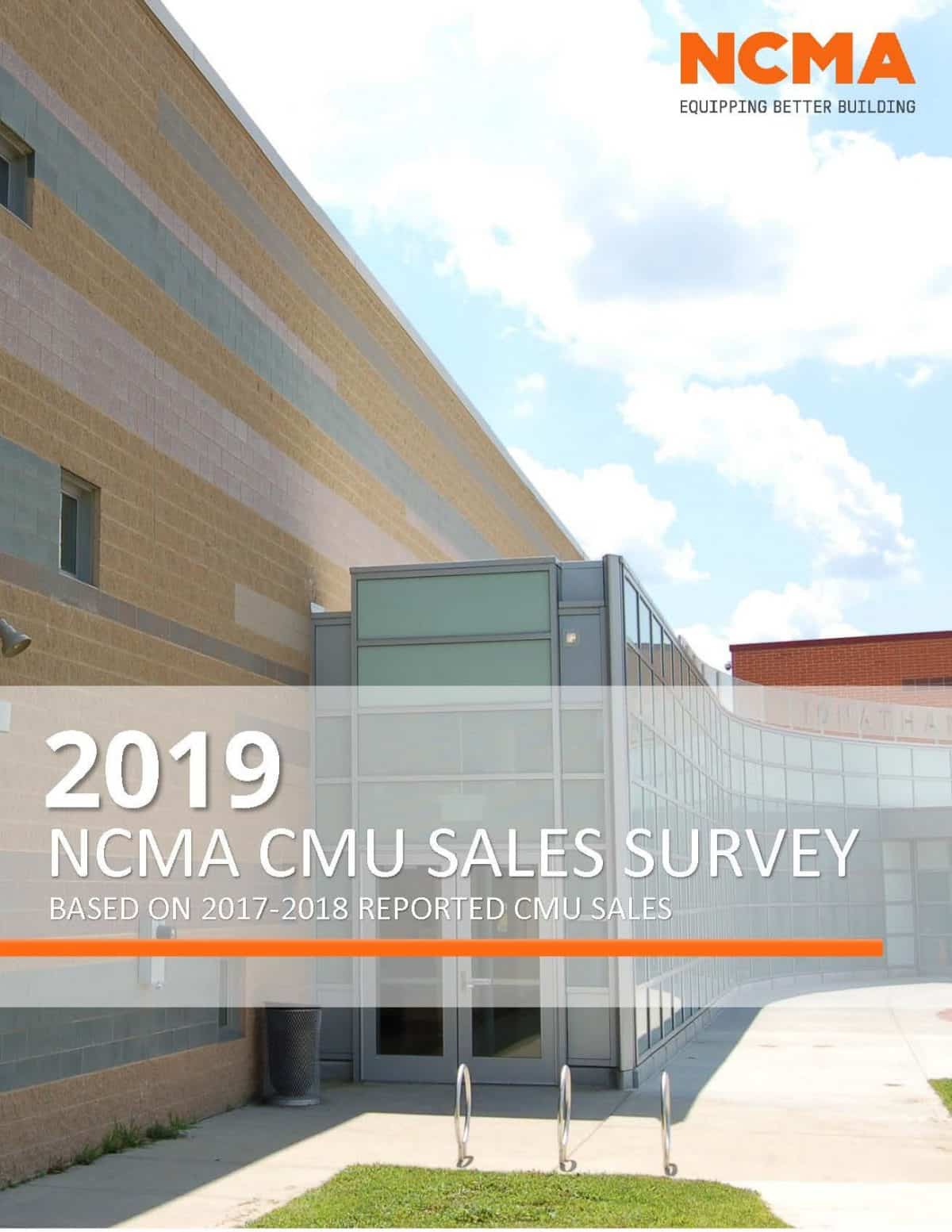
Compared to sales in 2017 and 2018, the overall sales of concrete masonry units (CMU) increased 2.8% in the United States and 1.0% in Canada, according to a study released by the National Concrete Masonry Association (NCMA). For manufacturers, more than 89% of reported production in the United States was gray block as compared to nearly 50% of production in Canada.
The 2019 NCMA CMU Sales Survey is second year for this industry sales survey for concrete masonry units. In total, 47 individual companies provided data for the survey, all of which were manufacturers. The producers that responded represent 206 plant locations across the United States and Canada. Data was submitted in three different categories of CMU products: the aforementioned gray block, architectural block, and concrete masonry veneer.
The category with the largest growth year over year was concrete masonry veneer, which experienced a 4.7% increase in sales in the United States and Canada. Increases in sales from 2017 were also seen for gray block and architectural block as well.
“With the CMU Sales Survey in its second year, it is providing important data to the industry and the association,” said Gary Hensley, Adams an Oldcastle Company and NCMA Masonry Committee chair. “We continue to see increasing sales of concrete masonry products throughout North America, a very encouraging trend for all involved in the industry. The survey provides essential information, through annual updates that demonstrates what we are doing as an industry is working or that we need to make incremental changes to increase wall share.”
It is estimated that total production in the United States was 1.12 billion units in 2017 and 1.15 billion units in 2018. Estimated production in Canada was 100.8 million units in 2017 and 101.8 million units in 2018.
The complete survey is available for purchase through the NCMA Bookstore. Click here to buy it online. NCMA members should contact NCMA at (703) 713-1900 for member discounts and other purchase options.
Load-Bearing Concrete Masonry Gets the Job Done at Villanova
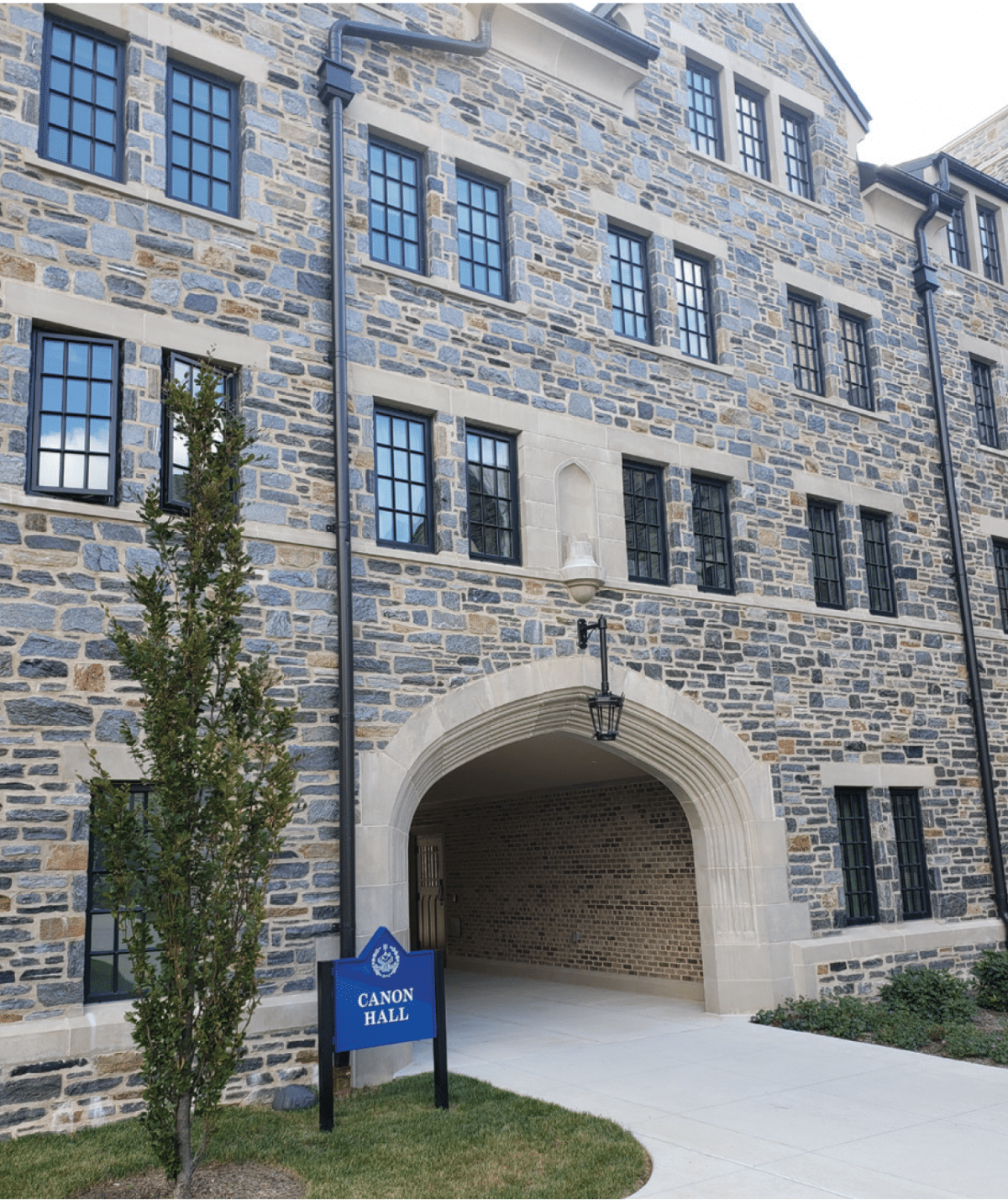
More than 450,000 high-strength and standard concrete block form the backbone of Villanova Commons, a new student housing complex opened in the fall of 2019. The Commons can house 1,135 Villanova University students at the school’s Philadelphia campus.
Designed by Robert A.M. Stern Architects and Voith & Mactavish Architects, the six-building, 425,000-square-foot project began construction in November 2015 and was completed by June 2019. In addition to apartments, the Commons features an on-campus restaurant, a coffee bar, a fitness center, six community rooms, four courtyards, and a 3,800-foot TechZone. The Commons was built to LEED standards and includes a system to capture and reuse stormwater runoff to help cool buildings, along with four rain gardens and a variety of other green building systems.
Built to last
“The floor system is hollow-core precast plank. Precast plank and block is a tried and true system”, said Eric Humes of Macintosh Engineering, the civil engineering firm on the job. “These buildings are dorms, and the university built them to last,” Humes, the project engineer said. The masonry, he said “was a massive undertaking, with a tight schedule, but it went well.”
And that’s saying something, according to Nick Sabia, president of D.M.Sabia Co., the mason contractor on Villanova Commons. “The brick and stone unions have told us Villanova Commons is the largest masonry project to date in the Philadelphia Area.” Rocky Fizzano of block supplier Fizzano Brothers Concrete Products in Philadelphia, echoed Humes’s and Sabia’s comments. “At Villanova, they wanted buildings that will be around a long time. So they chose loadbearing concrete masonry.”
In addition to 450,000 high-strength and standard concrete block, Villanova Commons required 5,000 tons of fieldstone, 28,000 cubic feet of cast stone, 140,000 face brick, 7,000 paving brick, and 113,000 cubic feet of colored and regular mortar.
Old-School Quality and Coordination With Other Trades
“This was a load-bearing masonry project. So once the foundations were completed, the immediate erection of the block walls was critical to the installation of the precast plank floors. At times we had over 150 workers on site laying block, installing rebar, grouting, and installing cast stone and fieldstone,” Sabia said. “We had over 50 stonemasons on this project at its peak. We used five different size cranes, ranging from four-ton to 70-ton capacity, and five 10,000-pound-capacity forklifts. We had 1,300 linear feet of platform scaffold running five stories high. And like the schedule, the site was extremely tight, Deliveries had to be coordinated with other trades, and laydown areas were at a minimum.”
The project demanded “old school quality,” according to Sabia. “We had separate crews for each component (insulation, block, fieldstone, and cast stone) to keep the workmanship consistent. This was a monumental task to complete on schedule and we are extremely proud to have been involved.”
Dale Puskas Inducted Into NCMA Hall of Fame
SALT LAKE CITY, UT – Dale Puskas, special projects advisor and former vice president of Basalite Concrete Products, Dixon, California, was presented with NCMA’s Hall of Fame award February 24 at the association’s Annual Convention held at The Grand America Hotel in Salt Lake City, Utah.
NCMA’s Hall of Fame award is presented to the industry’s most valued participants whose careers are highlighted by continual accomplishments on the industry’s behalf, and who have demonstrated unquestioned dedication to NCMA’s highest values.
“Basalite is very proud that one of our own is being honored by the NCMA with the Hall of Fame award. Dale Puskas has committed his career to the concrete industry and with his leadership Basalite and the NCMA have benefited greatly” said Scott Weber, who was CEO of Basalite for twenty years and now member of the Basalite Board of directors. Scott presented Dale with this award. “We thank Dale and his family for the years of dedication that have helped build Basalite into the company it is today.”
Dale is credited with initiating the effort culminating in approval of changes to the NCMA bylaws in 2017 and a new structure beginning in 2018. He identified the need for a smaller and more efficient Board and actively worked with task groups, the Board and the membership initiatives to enact changes.
He has made multiple trips to Washington, DC to lobby for the CMU Checkoff program and was instrumental in securing bill co-sponsorships from western members of the House and Senate. He has also been active in developing governance structures and models for the Checkoff and been an advocate of the program within the Western states.
Dale has been a leader in our industry’s pursuit of developing digital modeling tools for concrete masonry with a particular emphasis on how such tools can change the nature of how business is done and how we can better present concrete masonry solutions.
Between 2002 and 2018, he chaired and served on numerous NCMA and Foundation committees including Chairman of the Board from 2014 to 2015.
Other accomplishments-
- Actively involved in the development of NCMA’s Plant Certification program and Basalite became the first company with plants to achieve that certification.
- Provided a valuable role as a liaison to the Concrete Masonry Association of California and Nevada
- Instrumental in the integration of the Masonry Veneer Manufacturers Association into NCMA, beginning in 2013.
- Played a leadership role in the recognition of 25 years of NCMA representation of the SRW Industry
- Invested significant energy in improving collaboration with the Mason Contractors Association of America and the Interlocking Concrete Pavement Institute.
Dale has been supported through his career by his wife, René and two sons, Matt and Trent.
For a PDF of this story, click here.

ICPI Continues Training PICP Contractors in Washington, DC
Now in its fifth year of training contractors, RiverSmart Homes engaged ICPI staff to train PICP contractors on installation. RiverSmart Homes provides a rebate to DC residents who install PICP. Contractors must hold a Certification of Completion of the ICPI PICP course to be eligible to bid on projects. Bryan Horr, P.E., ICPI’s Manager of Technical Development and Market Promotion, instructed the one-day course on March 4, 2020 at the District of Columbia Department of Energy and the Environment (DDOEE) attended by thirteen contractors and RiverSmart program staff. Last year, RiverSmart homes provided substantial rebates in support of 40,000 sf of PICP installed in patios, driveways and parking lots with a total approaching 200,000 sf. RiverSmart Homes is operated by the Alliance for the Chesapeake Bay under the auspices of DDOEE. Over the past year months, ICPI and its members have hosted 22 PICP courses for contractors.
Date March 11, 2020