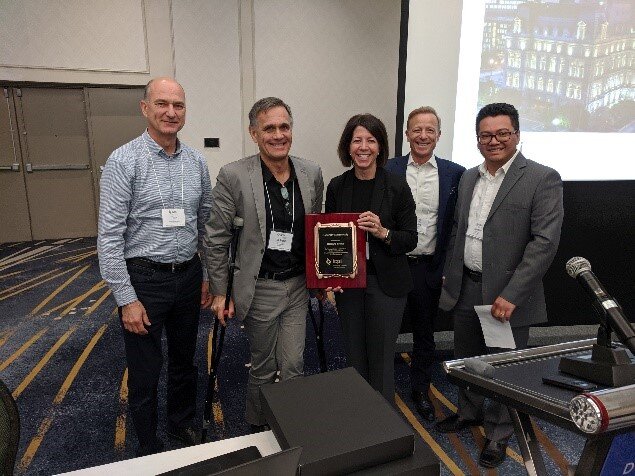

ICPI Recognizes Tony Iacocca With Honorary Membership
Under Tony Iacocca’s leadership, Oaks Concrete Products expanded into the USA by selling products in Michigan, Ohio and Western New York. He managed and executed the start-up of a state-of-the-art paver manufacturing facility in Wixom, Michigan near Detroit in 1991. Oaks quickly became a leading manufacturer of pavers and walls in Canadian and US markets due to quality products and service. Oaks Pavers and Walls became the standard for other producers in their market to meet.
Tony was instrumental in pioneering acceptance of pavers by municipal engineers. The legendary example is supplying the North Bay Streetscape project in 1983. With 37 years enduring harsh winter conditions, over 150,000 sf of street and sidewalk pavers will be refreshed in North Bay next year.
Other project examples include pavers around Toronto’s Skydome in 1989, Tiger Stadium, Cleveland Brown Stadium, CN Tower, and the Air Canada Centre. Besides possessing a high standard for product quality, Tony ran plants that were spotless and had great safety records.
His contribution to the Canadian industry was participating on the CSA Technical Committee for concrete pavers and paving slabs over the past 25 years. He continues to serve on the Committee today.
Tony was an ICPI Charter Member in 1993 representing Oaks Concrete. In the formative years of ICPI, he and Gerry Colquhoun obtained commitments from several paver manufacturers across Canada to join ICPI in exchange for representation on the Board of Directors. This deal led to ICPI expanding dues income, broadening the membership experience base, and becoming an international association.
Because of this leadership skills, he was viewed as a leader by our Canadian members during our formative years and later by the entire membership. His service to our organization includes chairing the first ICPI Dues, Bylaws and Membership Committee from 1996 to 1999 and serving on the Executive Committee as well as on our Board of Directors from 1993 to 2003.
At all times, Tony displayed wisdom, guidance and sensibility with many of the key decisions we made. I ask that our members please join me in recognizing the great contributions Tony made to our association by bestowing him Honorary Membership.
DATE March 11th, 2020

Remembering Billy Wauhop (1943-2020)
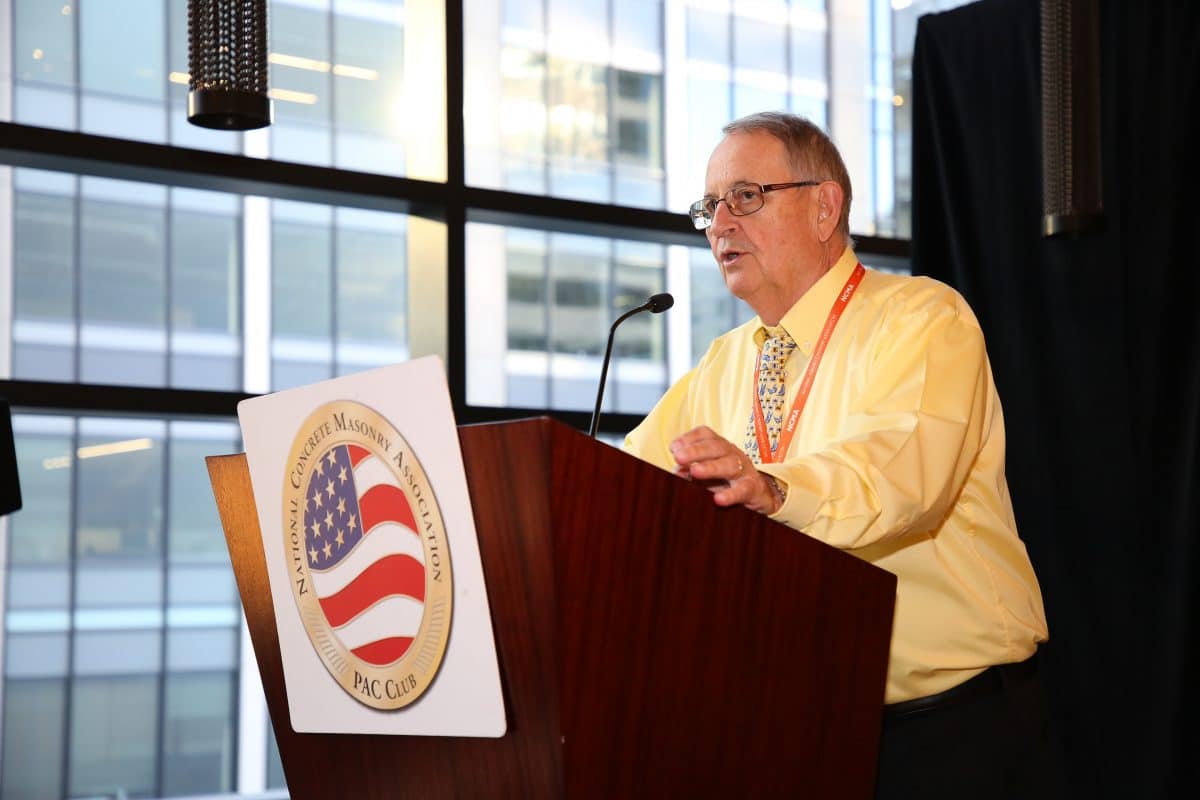
It is with deep regret that NCMA announces the passing of Billy Wauhop, who died peacefully at his home in Clayton, North Carolina this past Sunday, January 5, 2020. Billy, who was very active in promoting the use and advancing the technology of concrete masonry with more than 40 years of involvement in the concrete masonry and hardscape industry, was a proud member of NCMA. Not only did he chair, but he was an active member on numerous NCMA committees — Freeze-Thaw Durability, Production Technology and Operations, Recycled Materials, Codes and Standards, Masonry Technical, SRW Technical, and more. He also helped organize many memorable Midyear Meeting golf outings over the years and may be best remembered for his leadership of NCMA’s Political Action Committee where he and his wife, Adella, together created engaging and memorable fundraising PAC receptions. He most recently chaired the task group that organized NCMA’s 100-Year Anniversary Celebration in 2018, the same Midyear Meeting at which he was inducted into the NCMA Hall of Fame and presented with NCMA’s highest recognition, the Lifetime Achievement Award.
Billy is survived by his wife Adella; children Brian Wauhop (wife Amy), Margie Riedel (husband Fred), and John Wauhop; grandchildren Matthew Riedel, Max Wauhop, and Thomas Riedel; and two brothers, Earnest Mitchell Wauhop and David Wauhop.
A visitation will be held on Friday, January 17, 2020, 6:00-8:00 p.m. at the MacFadden Funeral Home:
325 Hardwick Street
Belvidere, NJ 07823
(908)475-2210
A brief visitation hour will be available from 10:00-11:00 a.m. on Saturday, January 18, at the Belvidere United Methodist Church in Belvidere, New Jersey; followed by a memorial service at 11:00 a.m.
Attendees are invited to a Celebration of Life at: Luigi’s Ranch-O, Rt. 46, from 1:30-3:30 p.m. immediately following the memorial service.
Donations in lieu of flowers may be sent to the Belvidere United Methodist Church or:
The Gary Sinise Foundation
PO Box 368
Woodlawn Hills, CA 91365
ICPI and NCMA Boards Approve Exploration of Additional Collaboration and Possible Unification Into a New Organization
At the ICPI Annual Meeting Board of Directors meeting last week, Charles McGrath, ICPI’s Executive Director announced his planned retirement in August 2022. The ICPI Board of Directors voted to create a joint special committee and hire an outside consultant to pursue a closer relationship with NCMA, including the possibility of unification. The Special Committee will be charged to come back to the ICPI Board of Directors meeting in February 2021 whether to move forward with unification or for ICPI to engage a search consultant to begin a search for a new Executive Director. Special Committee members will provide an update on progress at the 2020 ICPI Summer Meeting in Annapolis, MD.
The Board agreed to pass on the following messages to all members:
Initial exploratory efforts only
No decisions made and no foregone conclusions
Typical unifications (once agreed) take approximately 2 years.
Dues structure and impacts not yet considered
No current staffing changes under consideration
DATE February 26th, 2020
ICPI Reports Results From 2020 Member Needs Assessment
This year’s Member Needs Assessment was sent to all ICPI Standing Committee members (including Board of Directors and Executive Committee members), Commercial Technical Promotion Team and all ICPI member representatives. The overall response rate for this year’s survey was approximately 10%.
The survey contained extra questions regarding the importance and satisfaction of various ICPI programs and services. This line of questioning represents the beginning of a portfolio analysis that was proposed during the strategic planning process that intends to review all ICPI programming and services. It is a top priority of ICPI leadership and staff to make sure the programs and services offered are meeting the need of our members.
Some highlights from this year’s survey were:
ICPI Mission: 96% of survey participants believe that ICPI is achieving its mission.
What is the most important thing ICPI does for your company? The most common answers included education, networking opportunities and technical support.
ICPI Value: 80.9% overall value of ICPI equal to or greater than other trade associations.
Obstacles: Members are still reporting that a labor shortage is still the greatest obstacle facing their companies. Other notable answers were industry consolidation and the economy.
Future Trends: Members note that the labor shortage is still top of mind for future concerns regarding the industry.
DATE February 26th, 2020
ICPI Publishes the 2019 Annual Report
ICPI published and released the 2019 Annual Report this month.
Highlights include information on:
Industry Health Report
Institute Report Card
ICPI 2019-22 Strategic Plan
Workforce Development
Education
Digital Presence
Technical Guidance
Municipal Markets
Hardscape North America
ICPI Foundation
Be sure to check your mailbox or view the digital version of the Annual Report here.
DATE February 26th, 2020

Paver Industry Father Passes
William (Bill) Schneider passed away on January 20, 2020 at Midwest Medical Center in Galena, Illinois. Bill is known for his significant contributions to the segmental concrete pavement industry and to the Interlocking Concrete Pavement Institute (ICPI). Founding LPS Pavement Company in the Chicago area in 1976 after being convinced that concrete pavers were a better pavement solution. He left ready-mix concrete pavement contracting, instead selling many commercial paver projects in the early years of the industry.
With this experience, Bill Schneider became a charter member of ICPI when it formed in 1993 and was first to Chair the ICPI Construction Committee. He developed content for the Concrete Paver Installer Course and the Commercial Paver Specialist Course. He was the first instructor of the Concrete Paver Installer Course with over 30,000 participants since 1995. The program includes over 2,500 ICPI active certified installers today. Additionally, he served on ICPI’s Board of Directors, Executive Committee, and numerous standing and special committees.
Bill Schneider always maintained that educating contractors on industry best practices is paramount to their success. He demonstrated this by developing and instructing ICPI installer courses. He was known for telling engaging stories from his installation experiences to make his points in certification classes. In addition, he helped to found and instructed at the School for Advanced Segmental Paving. He was an inspiration to countless paver installation contractors across the country.
In 2014, Bill received the first ICPI Lifetime Achievement Award which recognizes significant contributions to the industry. The award emphasizes dedication to safety and well-being of employees, demonstrated leadership, and outstanding contribution to the industry via volunteer service.
Besides LPS Pavement Company, Bill’s pioneering included creating a company specializing in permeable interlocking concrete pavement (PICP) design and specification called Advanced Pavement Technology in 2002. He also created a company specializing in PICP installation called Aqua-Paving Construction in 2010. His early PICP installations transformed the Chicago market, making it an early center for PICP sales. This effort was supported by several trademarks and patents on permeable paver shapes as well as design of the Bio-Aquifer Storm System (BASS) using open-graded aggregates for PICP installation that is the accepted method today. He promoted mechanical paver installation to lower project costs and increase efficiency.
Some groundbreaking projects he installed follow:
Morton Arboretum – Built in 2003 for the new visitor’s center, the 173,000 sf PICP parking lot in Lisle, Illinois, proved a viable solution as a best management practice for stormwater management. It was one of the first and largest PICP installations demonstrating that PICP performs in a cold climate.
The Williamsburg Village Project – Built in 1979 in suburban Chicago, this 130,000-sf interlocking concrete pavement project was one of the first street applications in North America. The project was built well before the interlocking concrete pavement industry formed an association, and well before association guide specifications directed designers and contractors on best practices for materials and installation. The 40-year old roadway is still in use and has not had any major maintenance, an impressive performance considering the constant delivery-vehicle traffic, harsh Chicago weather, and regular deicer use in the winter.
Port of Oakland, CA – At five million square feet, this is the largest interlocking concrete pavement project in the western hemisphere. Installed from 2002 to 2004 required over 22 million mechanically installed paving units. Bill’s leadership and participation with other ICPI member contractors resulted in specifications, construction methods, and inspection processes for port paving. The project accelerated use of mechanical paver placement to improve contractor efficiency and reduce installation costs.
Elmhurst College, IL – Another mechanical installation, a campus demonstrated that PICP systems could be used as an alternative to unattractive and space wasting detention ponds as well as decrease flows and volumes to city storm sewers working at capacity. The 2008 project was inspired by the success at Morton Arboretum five years earlier.
Hartz Mountain Industries – As one of the largest private real estate owners in the U.S., Hartz has more than 200 properties with over 38 million square feet of building space in the northern New Jersey/New York area. A New Jersey concrete paver manufacturer proposed using interlocking concrete pavers in 1990 but the developer wanted assurance that the pavement would be installed properly by a knowledgeable contractor. Bill Schneider provided that assurance to the developer which resulted in more than one million square feet of concrete pavers installed in various Hartz Mountain properties. This greatly increased the use of concrete pavers in this New Jersey – New York market.
We are saddened by his loss to the industry and ICPI. Yet, his contribution and inspiration to other contractors and beneficial imprint on ICPI continues. Bill is survived by his wife Ali, sons Derek (Kristina) and David (Denise), daughters Kristi (Scott) and Courtney, and 10 grandchildren.
Per his wishes, there will be no visitation or ceremony at this time. A celebration of his life will be held in the future once the weather warms for anyone who wants to get together to honor him. In lieu of flowers, donations can be made to the ICPI Foundation for Education and Research to the Hospice of Dubuque (https://hospiceofdubuque.org/cms-view-page.php?page=donate) in his memory. If you have any stories, memories, anecdotes, photos, videos, etc. involving Bill you would like to share, please forward them to Derek Schneider (derek@advancedpavement.com) who would love to hear from you, and compile them for use at the celebration.
Date January 29th, 2020

Manufactured Stone Veneer is #1 in Remodeling’s 2020 Cost vs. Value Report
Manufactured stone veneer posted a 96 percent cost/value return in Remodeling magazine’s just-released 2020 Cost vs.Value Report — putting it at the very top of the list of 22 remodeling products/projects covered by the highly regarded benchmarking study.
Manufactured stone veneer’s 96 percent cost vs. value return stands in sharp contrast to the other cladding products in the study. Concrete fiber siding had a 2020 cost vs. value return of 79 percent, while vinyl siding only posted a 75 percent return.

“As in years past, the national averages for exterior replacements outperformed those of larger discretionary remodeling projects. Manufactured stone veneer this year eclipsed the Garage Door project for the first time as the project with the highest cost recouped,” the report says. It notes that the Realtors participating in the study tend to place high value on projects that enhance curb appeal.
Continuing The Value Climb
“This is great news for our industry,” said Bobby Staten of Lee Building Products (Veneerstone and Mountain Stone), Chairman of NCMA’s Manufactured Stone Veneer Committee. “The study confirms what the manufacturers, distributors, and installers of manufactured stone veneer have known all along. MSV adds tremendous value, and the product category is taking off!
“Manufactured stone veneer brings curb appeal, and curb appeal drives value. That’s very clear from Remodeling’s 2020 Cost vs.Value Report. We’re at the top of the list. This study focused on the use of the product in residential remodeling. But MSV adds value in both remodeling and new construction across all categories, from residential to commercial to institutional. NCMA’s MSV Committee is going to use this independent data to help our members continue to grow their sales.”
While the report has been issued by Remodeling since 2008, manufactured stone veneer was only added to the study in 2015, after work by NCMA’s Manufactured Stone Veneer Committee. That year, Remodeling’s report noted that manufactured stone veneer “joined Cost vs. Value with a splash, ranking second among all projects.” It has been number two or three on the list until topping it in 2020.

MSV’s 2020 Increase Bucks The Tide
Manufactured stone veneer’s cost vs. value ratio increased from 94 percent in 2019 to 96 percent in 2020. That year-over-year cost vs. value increase bucks a slight cost vs. value ratio decline across the 22 products/projects studied.
“The 2020 Cost vs. Value report shows a predictable increase in costs for all 22 remodeling projects but a consistent dip in the perceived value of those projects at the time of home sale, as estimated by real estate professionals in more than 100 metro areas across the U.S. This results in a slight downturn on the return on investment for nearly all projects relative to the trends we saw in last year’s report.”
Manufactured stone veneer’s 2020 cost/value return of 96 percent was based on an average project cost of $9357 and a return at the time of sale of $8943.
Read more about the 2020 Cost/Value report here.
Written by Scott Ramminger, The Ramminger Group

A leading Architect on the Best Way to Attract Architects
“For an architect, the composition of the aggregates means a lot. The ratio and how it’s going to look at a distance, how it’s going to look closeup. Once we pick a [concrete masonry] product we try to stick by it, and we try to be an ally.”
Adel A. Nur AIA, LEED AP BD+C is an award-winning architect and principal at Bignell Watkins Hasser, otherwise known as BIGWAHA, a full-service design practice based out of Annapolis, Maryland. In his accomplished career, Nur has created and overseen a wide array of projects, from large-scale mixed use concrete masonry structures and commercial office developments to town centers, retail stores, and car dealerships.
Recently, Mr. Nur was a guest lecturer at one of NCMA’s in-person education courses, Concrete Masonry Level 2 Sales Course, which took place at NCMA Headquarters in Herndon, Virginia.
“Your main ally is going to be the architect because we spend a lot of time picking between one grade versus another. We don’t want to have someone come and change it overnight. Not because of ego or anything, but because we are confident that that’s the right choice and the one that’s going to make the building look good.”

With actual drawings of a project in hand, a commercial project on New York Avenue in Washington DC, Nur, standing at the head of the classroom, walks the concrete products sales professionals — now briefly students again — through the anatomy and paces of a design and development. In addition, he highlights the key phases in which producers can enter and potentially influence what the building solution will ultimately be.
Value engineering, turning a corner, and other familiar variables factored in, of course.
He also points out the best way for a product to be specified.
“Make sure the architect always has a copy of your product in the library,” he explains. “That’s the easiest way to increase the likeliness of your product being utilized.
Nur also makes a clear distinction between using a real sample, versus a picture.
“Photographs don’t do CMU justice.”
Potential LEED points can provide a lesser-known competitive advantage in the process, he explains. And it all has to do with miles. Distance. How far your plant is from the job itself.
Regional materials are rewarded by the United States Green Building Council, according to them, “to increase demand for building materials and products that are extracted and manufactured within the region, thereby supporting the use of indigenous resources and reducing the environmental impacts resulting from transportation.”
Perhaps the biggest tip of all, however, Nur spells out in straightforward terms after wrapping up his detailed account of how a building gets built:
What’s the best way to get the attention of architects?
Front-row seats to a bowl game, he says, in jest.
No, the real answer?
Lunch.
And learning, too, of course.
“The most effective way to get an architect’s attention is by organizing a luncheon,” he says. “As architects, to keep our licenses we have to do continuing education to get AIA credits. So, if your company is certified you can give a presentation — a one-hour presentation. Free food too, of course, that helps. But everyone at the firm is going to go that luncheon as opposed to leaving the building and walking ten minutes to the nearest Subway, for example.
“They’re going to join you and that way, you can see everybody in the office and give the presentation with good attendance, whether their motivation is their stomach or the AIA credit. Which is very important.
“Either way, you’re going to have a big audience. And you can engage, see what they may be working on and see if there’s room for your products.”
For more on Nur and BIGWAHA, click here.
To access NCMA’s AEC Daily page, which offers AIA credits to architects online, click here.

How Masonry Fulfilled the Green Wishes of the Choctaw
If anyone in the South knows about the sanctity of its land, it’s the Choctaw.
Of the 40 million acres that make up Mississippi, they once had dominion over 11 million of them.
And if anyone in the South knows about the the fundamental obligation we have to sustain it, it’s the Choctaw.
For hundreds of years they would name their families after the animals and nature that shared that great big stretch of land along with them. The bear. The deer. The wolf. The holly leaf. The panther. Even the wind.
That’s why recently, when the leaders of their sovereign nation known as the Mississippi Band of Choctaw Indians — currently one of the largest employers in the state thanks to the Golden Moon Casino, the Silver Star Casino and 17 other businesses — wanted a major addition to one of their communities’ elementary schools in Pearl River, sustainability wasn’t an option.
It was a must.
Enter Roger Pryor of PryorMorrow, an architecture firm based in Columbus, Mississippi, and NCMA member Saturn Materials.
“The environmental impact on the project was a priority,” said Roger Pryor, principal architect, AIA, NCARB. “The use of Saturn Materials concrete block as exterior cladding substantially reduced the environmental impact of the project.”
The Saturn Materials proprietary mix design has a nearly 70% reduction in the cradle-to-the-gate carbon footprint and meets the ASTM standards for the concrete industry.
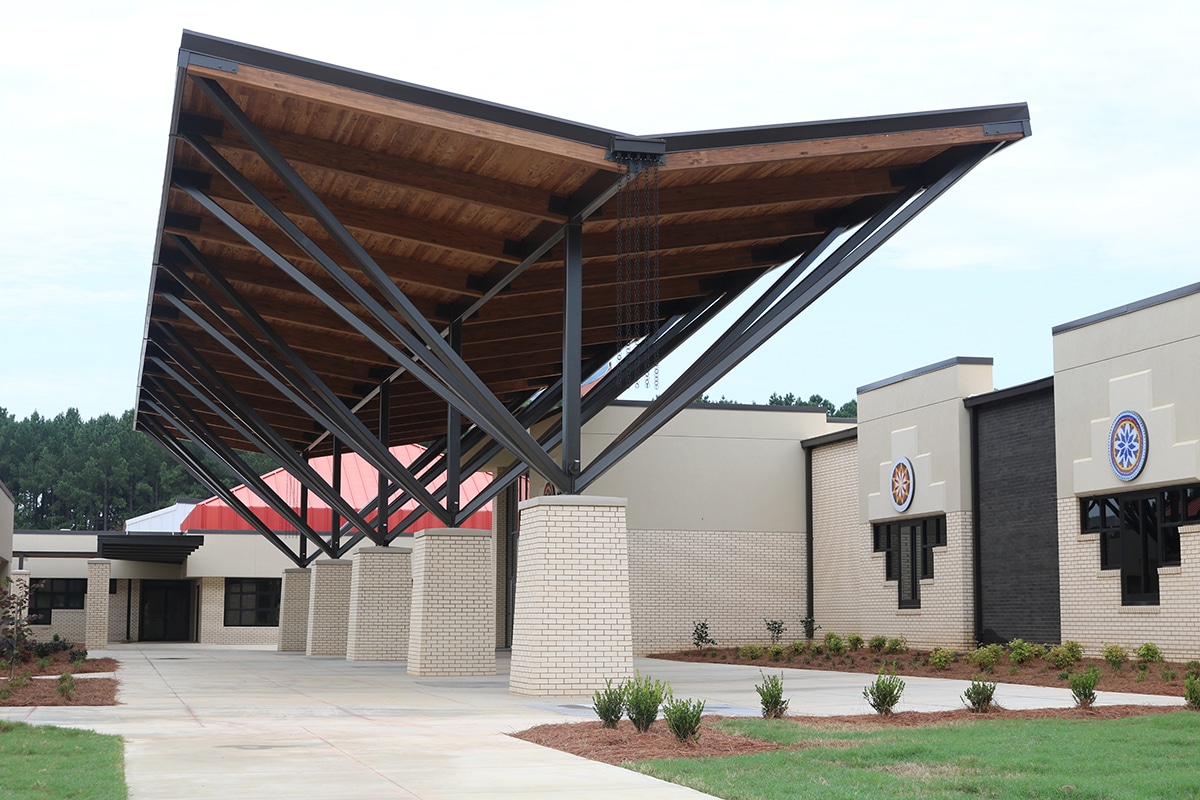
“From the standpoint of operating this facility, and building it, they wanted the project to be fairly green. We were able to succeed in that both in the way we did the building envelope and also with the mechanical and electrical systems,” said Pryor.
“The exterior is all masonry. It’s a good sturdy building on the exterior as far as weather.”
As for an overarching theme to the design, both inside and out, the architects at PryorMorrow were determined to listen and stay genuinely faithful to the traditions of the tribe. Throughout the facility, important symbols and images are carefully displayed and presented in very authentic manner.
“Something that’s important to that tribe and important to the Bureau of Indian Affairs is that there be some cultural influences included in their projects,” said Pryor. “And I think that’s really important in this project because you go to a lot of places on Indian reservations and they tell designers to include cultural elements and it gets kind of Mickey Mouse and Disneyland-like, and the Native Americans are very sensitive about that. And rightfully so, obviously.
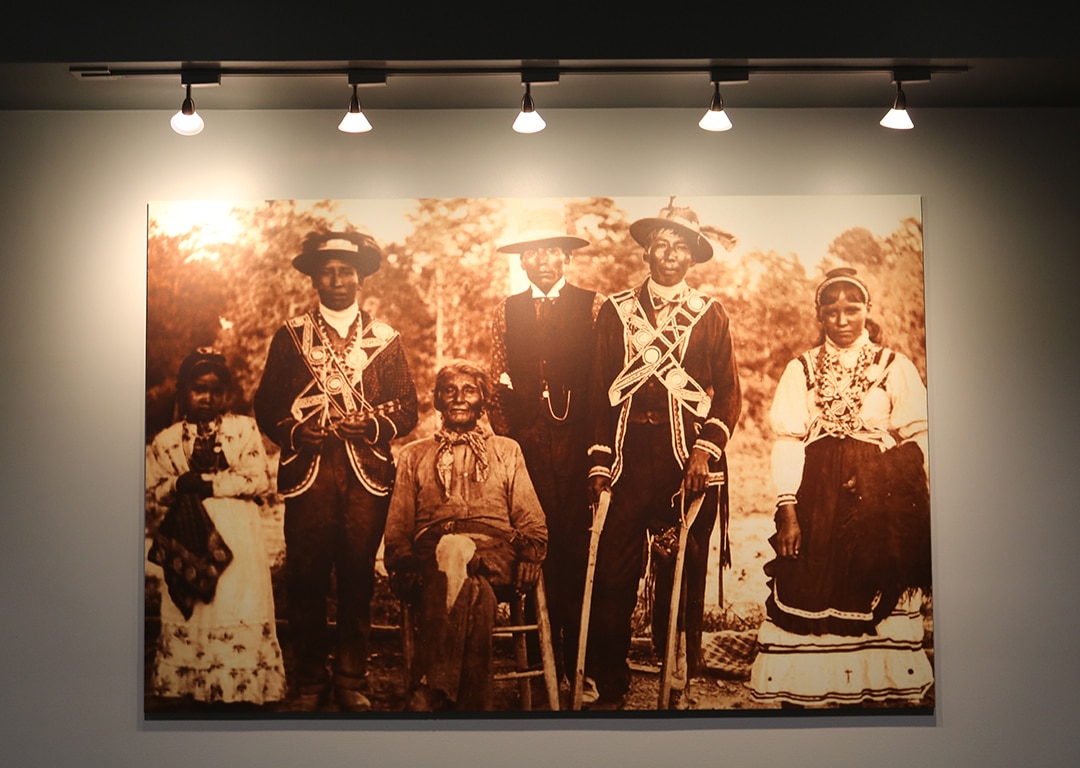
“We actually had a cultural committee that we worked with to make this project happen. And they had quite a bit of influence.”
One of the school’s most impressive and heralded features is an outdoor plaza.
“It’s sheltered and provides a lot of shade and it’s where the students congregate before school and after school as well eat lunch,” said Pryor.
“The canopy of the plaza is very important for a number of different reasons. First off, it’s where the kids can safely hang out. Second, it has a state-of-the-art audio system that amplifies Choctaw language as well as chants.
“The most important game that Choctaws play is a game called ‘stickball.’ The mallets they use in this traditional game served as the inspiration for the structural system that holds up the canopy.”
From the standpoint of security all entrances have electronic access control so you have the ability to lock the school down. And all of the teachers have the access code capability to come and go.
Each classroom has a special latching device at the door to protect kids in the case of an active shooter where it’s a double function locking mechanism.
“It’s a ‘cut above’ of what usually serves as a typical classroom building,” said Pryor.
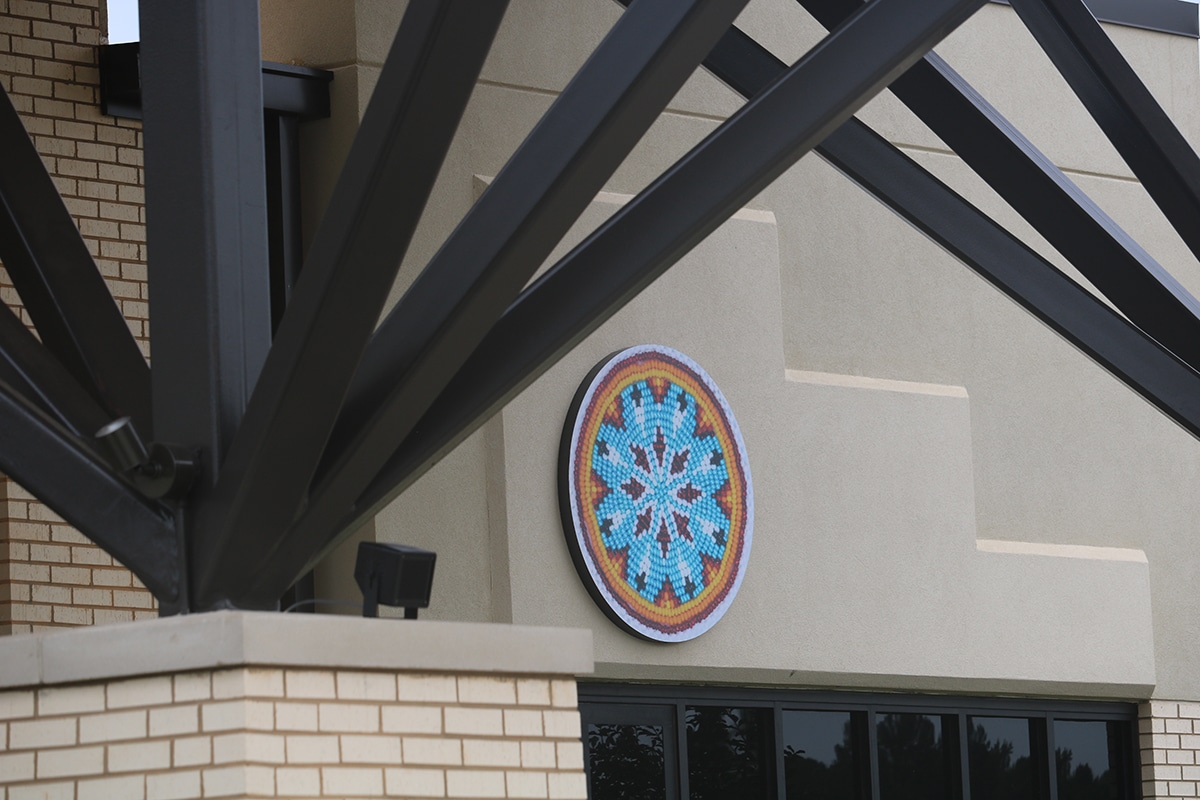
Other key features seen throughout the building include Choctaw language on interior signage, round medallions over each classroom window that are inspired by the Choctaw beadwork and round view windows of each classroom door that mirror the exterior medallions.
The mountain imagery of the classrooms is inspired by Choctaw images. Interior murals at the focal points of corridors include a historic photograph from the Museum of the American Indian (Smithsonian) and contemporary Choctaw photographs of the tribe’s children.
The building also boasts all LED lighting and brand new state-of-the-art polyester carpeting.
“A proper education is one thing we strive to supply for our children. For years, we have struggled with limited space for our students here at Pearl River Elementary. We have long since outgrown the building that was built in 1990,” said Tribal Chief Cyrus Ben.
The school is currently open, operating and educating more than 600 students — exclusively from the Mississippi Band of Choctaw Indian community.
ICPI Recognizes Richard Morin With Honorary Membership
At the 2019 Canadian Activities Meeting, the Interlocking Concrete Pavement Institute recognized Richard Morin, ing, M, Sc. A. for his efforts to support the use of segmental pavements in the City of Montreal by presenting him with an Honorary Membership in the association. Mr. Morin, who is a Technical Advisor for the City of Montreal’s Infrastructure, Roads and Transport Department, Infrastructure Directorate, Division of Expertise and Technical Support, will be retiring from that role in January 2020. Lincoln Paiva, ing., Director – Technical Services, Techo-Bloc briefly introduced Mr. Morin and thanked him for his efforts to help institutionalize segmental pavement systems in the City of Montreal and Canada. Mr. Morin was presented a plaque by ICPI Board Chair Kendall Anderegg and Yvan Bolduc, Bolduc Concrete Products and Charles Ciccarello, Techo-Bloc, who had both submitted letters of support to the ICPI Board of Directors.
At the Canadian Activities Meeting, Mr. Morin presented on the challenges the City has faced related to the use of segmental pavements. He shared project photos installed by the City that had performed poorly and discussed when the City of Montreal was considering banning pavers in the 1990’s due to poor performance of installations completed in the 1980’s. During that time, Mr. Morin researched best installation practices and looked for sound material specifications and designs instead of rejecting the use of pavers in the City. Thanks to Mr. Morin’s research and dedication, the City of Montreal support the use of segmental concrete pavement systems to this day. Additionally, he shared details of the City’s requirements for the use of segmental pavements that he helped developed. Many of these requirements are currently mirrored in ICPI’s best practices.
Mr. Morin was also an active participant in the CSA A231 Technical Committee, responsible for the creation and updating of the National Standard for Concrete Slabs and Pavers, which is now in its third edition. Mr. Morin concluded his presentation with a series of project images around the City of Montreal that are performing well.
Richard, thank you for your sharing your knowledge, your courage, and your dedication with the industry!
Date November 20th, 2019